Credit Union vs Bank Auto Loan in St. Louis: What the Rate Spread Actually Costs You
Revised August 14, 2026

Is it better to get an auto loan from a bank or credit union?
On rate alone, credit unions win by a wide margin. NCUA and S&P data as of December 2025 put the average 60-month new-car loan at 5.44 percent at credit unions against 7.41 percent at banks — roughly a two-point gap that held across all four auto loan products. On a $30,000 loan over 60 months that spread is worth well over $1,500 in interest. The bigger lever is getting preapproved before you shop, because it turns the dealer’s financing into a competing offer rather than the only one. Every figure here is a national average; no source breaks auto rates out by metro.
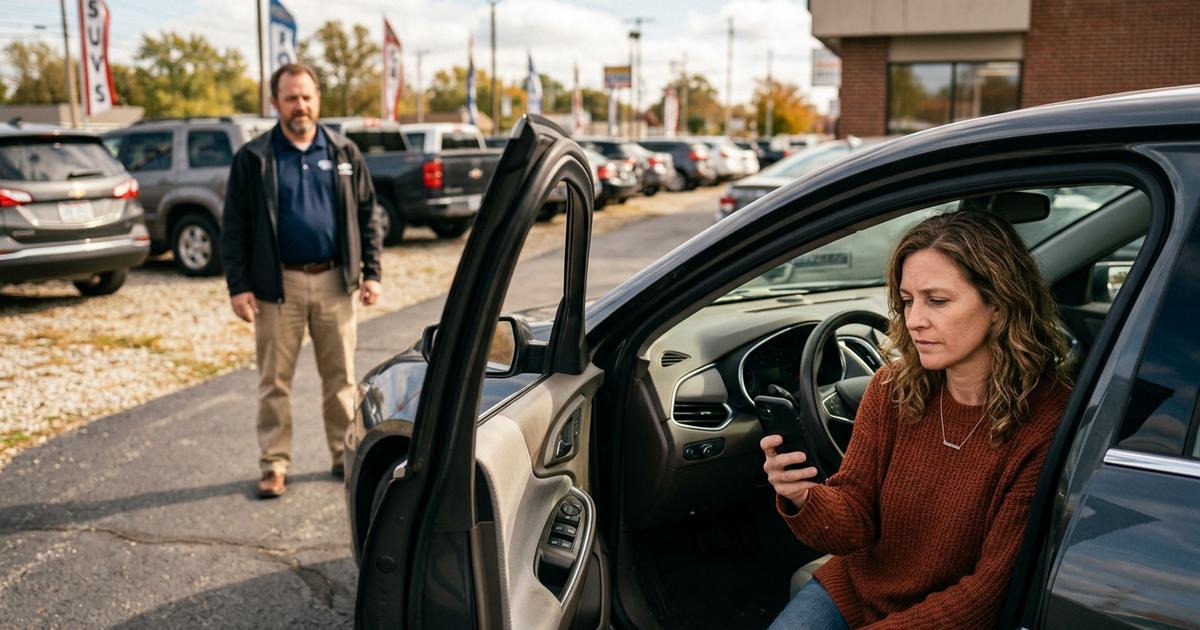
Keep reading ↓Imagine it’s a Saturday afternoon in O’Fallon and you have been at the dealership for four hours. Somebody finally slides a sheet across the desk with exactly one number circled on it: the monthly payment. It fits your budget. Nobody has said the interest rate out loud, and you have not asked, because the number that fits is the number that fits.
Maybe you already know the feeling. Somewhere in Belleville tonight, somebody signs that same sheet. In Kirkwood, somebody else walks into the finance office holding a printout from their own lender, hands it over, and watches the room go quiet for a second while the guy behind the desk re-runs the numbers.
Same car. Same credit file. Different amount of money — and the gap between those two outcomes is usually bigger than anything either buyer got by haggling over the sticker.
This is a plain-English look at what financing a car actually costs around the St. Louis metro: the real spread between credit union and bank auto loan rates, what that spread equals in dollars, how dealer financing gets marked up, and why stretching the term is the most expensive way to lower a payment. It is general consumer education, not advice for your situation — the last section is a list of questions for a licensed lender.
Is it better to get an auto loan from a bank or credit union?
People ask is it better to get an auto loan from a bank or credit union as though it were a matter of taste, and it mostly is not. On average, credit unions price auto loans below banks, and the gap is close to two full percentage points. That is not a marketing claim — it is published quarterly by the federal regulator that supervises credit unions.
The NCUA’s Credit Union and Bank Rates report, using S&P Global Market Intelligence data as of December 26, 2025 (the most recent quarter posted), puts national average auto loan rates at:
- New car, 60 months — credit unions 5.44%, banks 7.41% (a gap of 1.97 points)
- New car, 48 months — credit unions 5.32%, banks 7.33% (2.01 points)
- Used car, 48 months — credit unions 5.53%, banks 7.73% (2.20 points)
- Used car, 36 months — credit unions 5.41%, banks 7.69% (2.28 points)
Two percentage points sounds abstract until you convert it. So here it is in dollars, on a $35,000 loan — a realistic amount financed for a decent used SUV or a mid-trim new sedan around here once tax and fees are in:
- 60 months at 5.44% — about $668 a month, roughly $5,054 in total interest
- 60 months at 7.41% — about $700 a month, roughly $6,990 in total interest
That is a $32 difference in the monthly payment and about $1,936 over the life of the loan. Stretch the same $35,000 to 72 months and the spread widens: about $571 a month versus $604, and total interest of roughly $6,101 versus $8,461 — a difference of about $2,360.
Now use a bigger, very current number. The Federal Reserve’s G.19 consumer credit release (released August 7, 2026, with data through June 2026) shows the average amount financed on a new car loan at auto finance companies was $42,504 in the first quarter of 2026. Run that at the same two rates over 72 months and you get about $693 a month versus $733, with total interest of roughly $7,409 versus $10,275 — a gap of about $2,866. Same car, same driver, same day. Different institution.
One honest caveat: those are national averages reported across thousands of institutions, not a quote you are entitled to. Your rate depends on your credit, the vehicle, the term, your down payment, and the individual lender. Averages tell you which direction to shop. They do not tell you what you will be offered.
The credit tier gap is even bigger than the institution gap
If two points between lender types got your attention, the spread between credit tiers should get more of it. Experian’s first-quarter 2026 data, using VantageScore 4.0 bands, shows average auto loan APRs of:
- Super prime (781+) — 4.55% new, 6.30% used
- Prime (661–780) — 6.23% new, 8.77% used
- Near prime (601–660) — 9.67% new, 14.03% used
- Subprime (501–600) — 13.44% new, 19.42% used
- Deep subprime (300–500) — 16.01% new, 21.77% used
Overall, Experian put the average new car loan at 6.39% and the average used car loan at 11.43% in that quarter. Convert the tiers to dollars on the same $35,000 over 60 months and the picture is stark: about $4,198 in total interest at the super prime rate, about $5,824 at prime, about $9,279 at near prime, and about $13,256 at subprime. The distance between the top tier and the subprime tier is roughly $9,058 of interest on the exact same car.
Nobody publishes credit-union-versus-bank rates broken out by credit tier — the NCUA report does not split by score, and Experian’s tier data does not split by institution type. So read them together: your credit tier decides what neighborhood your rate lives in, and the lender you choose decides where in that neighborhood you land. Both matter. The tier usually matters more.
Which leads somewhere practical. Pull your own credit before you shop, not after a finance manager pulls it for you. If you are sitting a few points under a tier boundary, crossing it can be worth more than anything you were going to win at the negotiating table — and that is a conversation for a lender or a nonprofit credit counselor before you start test-driving, not a decision to make in a showroom on a Saturday.
Totally unrelated — but here’s where to eat in Crystal City.
Get preapproved before you set foot on a lot
A preapproval is a loan quote you get from a lender before you pick a car — it names a rate, a term, and a maximum amount. Getting one is the single cheapest thing you can do to change the shape of the transaction, and the Consumer Financial Protection Bureau says so directly. In its consumer guide Take control of your auto loan, the CFPB writes: “Consider getting one or more loan quotes from a bank, credit union or other lender before going to the dealership. It puts you in a better bargaining position and could save you hundreds or thousands of dollars over the life of your loan.”
What actually changes when you walk in holding one:
- It splits one negotiation into two. The price of the car and the price of the money are separate deals. Bundled together into a single monthly payment, they hide each other. Preapproval pulls them apart, so a good price on the vehicle cannot be quietly funded by a bad rate.
- It sets your ceiling before the pressure starts. The CFPB notes that preapproval “helps you set a budget without the pressure you might feel once you are at the dealership.” Four hours into a Saturday is a bad moment to decide what you can afford.
- It gives the finance office something to beat. You are no longer asking whether the rate is good. You are asking whether it beats a number you already have in writing.
- It does not lock you in. You can still take the dealer’s financing if it wins. The CFPB is explicit that you keep the choice to negotiate a better loan at the dealership and not use your preapproval.
The CFPB even scripts it: show them the lower quote and say you will go with the other lender unless they can match the rate or beat it. That sentence is worth more per second than anything else you will say that day.
How dealer markup on the buy rate actually works
This is the piece most buyers have never had explained, and it is not a secret — the CFPB publishes it plainly. When you apply for financing at a dealership, the dealer sends your application to one or more lenders. A lender that wants the loan quotes the dealer a rate. That quote is called the buy rate — the CFPB defines it as “the interest rate that a financial institution quotes to the dealer when you apply for dealer-arranged financing.”
The rate you are shown can be higher than that. In its auto loan guide, the CFPB states it directly: “Dealers are allowed to charge you more than the buy rate as compensation for helping connect you and the lender. This means that the interest rate the dealer offers may be higher than the original rate given from the lender, so you may be able to negotiate.”
There is nothing illegal about that. It is how dealer-arranged financing is compensated, and arranging the loan is a real service. But the difference is your money, and it compounds. Suppose the buy rate on a $35,000, 72-month loan is 6.39% — Experian’s Q1 2026 new car average — and two points get added. The payment goes from about $587 to about $620 a month, and total interest from roughly $7,229 to roughly $9,665. That is about $2,436 for a markup that never gets said out loud. (Two points is illustrative arithmetic, not a published average — the point is the mechanism.)
Now the fair counterpoint, because dealer financing is not automatically the villain. Manufacturer-owned finance arms — captives — sometimes price below the market to move specific models. The CFPB describes captive lenders as manufacturer-owned finance companies that generally provide below-market interest rate loans. The Fed’s G.19 backs that up: in the first quarter of 2026, auto finance companies averaged 6.1% on new car loans while commercial banks averaged 7.53% on 60-month new car loans. Sometimes the dealer route genuinely wins.
You cannot know which one won unless you are holding a competing offer. And one question costs nothing in the finance office: what is the buy rate on this approval, and what am I being charged? You may not get a straight answer. Asking still changes the room.

Is it smart to do a 72 month car loan?
Ask a room full of car buyers is it smart to do a 72 month car loan and you will get an argument. The arithmetic is not ambiguous, though. A longer term lowers the payment and raises the total cost, and it keeps you underwater on the vehicle for longer. Whether that trade is worth making depends on your budget and your risk of needing to sell before the loan is paid off.
Take $35,000 at 6.39%, the Experian Q1 2026 new car average, and change nothing but the term:
- 48 months — about $828 a month, about $4,756 in total interest
- 60 months — about $683 a month, about $5,981
- 72 months — about $587 a month, about $7,229
- 84 months — about $518 a month, about $8,501
Going from 60 to 72 months drops the payment about $96 and costs about $1,248 more in interest. Going from 60 to 84 drops it about $165 and costs about $2,520 more. The CFPB’s own worked example makes the same point at a lower rate: on a $20,000 loan at 4.75%, a 36-month term costs $1,498 in interest and a 72-month term costs $3,024 — about twice as much.
Long terms are the norm now, not the exception. The Fed’s G.19 has shown the average maturity on new car loans at auto finance companies sitting at 66 months for several straight years, with amount financed climbing to $42,504 by the first quarter of 2026. Nobody is unusual for signing a six-year note. That does not make it cheap.
The trap is structural. The monthly payment is the only number most buyers negotiate, and the term is the easiest lever anyone has for moving it. If your payment target is $500 and the deal comes in at $560, adding twelve months solves it instantly — and quietly adds a year of interest. The CFPB puts the warning in one sentence: “A lower monthly payment doesn’t necessarily mean a lower interest rate; it might just mean that you are paying for a longer time.”
So when the payment drops during a negotiation, check what moved. Write down the price, the trade-in amount, the rate, the term, and the payment every single time a new sheet comes across the desk. If only one of those five changed and it was the term, nothing got better.
Being underwater, rolled-in negative equity, and gap coverage
Negative equity means you owe more on the loan than the vehicle is worth. On a long loan it is not an edge case — it is the ordinary middle of the term, because the balance falls on a schedule and the car’s value falls faster in the early years.
The problem compounds when you trade in a car you still owe on. The dealer offers less than the payoff, and the shortfall gets rolled into the new loan. The CFPB’s guidance is blunt: a dealer or lender “may offer to roll the balance of your existing auto loan into a new auto loan, but this will make your new auto loan more expensive.”
The CFPB’s Negative Equity in Auto Lending report, published June 2024 on loan data from 2018 through 2022, put real numbers on how different those loans look:
- 11.6% of vehicle loans in the dataset included financed negative equity
- The mean negative equity rolled in was $5,073 on new vehicle transactions and $3,284 on used
- Average amount financed was $32,316 with negative equity versus $26,767 with no trade-in
- Average monthly payment was $626 versus $493 with no trade-in — about 27% higher
- Average loan term was 73 months versus 67 months with no trade-in
- Average loan-to-value was 119.3% versus 88.9% for buyers with a positive-equity trade-in
- Those borrowers were more than twice as likely to have the account assigned to repossession within two years than buyers with a positive-equity trade-in
That last line is the one that matters. Rolling negative equity forward does not just cost more — it measurably raises the odds the loan ends badly. If the payoff on your current car exceeds what it is worth, the CFPB’s framing of the choice is worth taking seriously: pay off the old loan now, wait until it is paid before borrowing again, or roll it in knowing what that does.
Which brings up gap coverage. Guaranteed Asset Protection, the CFPB explains, is “an optional product that is intended to cover the difference between the amount you owe on your auto loan and the amount the insurance company pays if your car is stolen or totaled.” When you are upside down, a total loss otherwise leaves you writing a check for a car you no longer have. A few things the CFPB flags:
- It is optional. If you are told you have to buy it to qualify for financing, the CFPB’s advice is to ask where the sales contract says that.
- The price varies enormously. Your own auto insurer and direct lenders may offer it, often for less than the finance office. Compare before you sign.
- Financing it into the loan costs extra. The CFPB notes that rolling a GAP policy into the loan “will add to your total loan amount, which ultimately increases what you’ll pay in total interest over time.”
- You can cancel. You have the right to cancel optional add-on products during the life of the loan and reduce your costs.
Gap coverage and your actual auto policy are two different products doing two different jobs, and both get priced by ZIP code around here. If you have not looked at the other half of that bill lately, our breakdown of what car insurance costs in St. Louis covers why the same driver gets quoted $1,500 apart across the metro.

The rate-shopping window: several applications, one hard inquiry
The fear that keeps people from comparing lenders is that every application dings the credit score. For auto loans, that is mostly not how it works — the scoring models deliberately allow for shopping, as long as you keep it in a tight window.
According to FICO, mortgages, auto loans, and student loans get special rate-shopping treatment. Multiple inquiries inside the model’s window get de-duplicated and counted as a single inquiry: “Older versions of the FICO Score allow a 14-day span for rate shopping,” and “With newer versions of the FICO Score, the rate-shopping window expands to 45-days.” FICO also ignores rate-shopping inquiries that are under 30 days old entirely, so a burst of applications does not hit the score while you are still shopping.
VantageScore handles it similarly but tighter. Experian explains that VantageScore treats multiple auto loan inquiries within a 14-day period as one inquiry. The CFPB sums up both models in one line in its auto loan guide: “Depending on the credit scoring model used, generally any requests or inquiries for your credit scores within about 14 to 45 days counts as a single inquiry.”
Three practical consequences:
- Assume 14 days, not 45. You do not get to pick which scoring model a lender uses, and some still run older FICO versions. Doing every application inside two weeks is safe under all of them.
- It only covers auto, mortgage, and student loans. Multiple credit card applications are not de-duplicated. Do not extend the logic.
- Do not spread it out. Getting a credit union quote in March, a bank quote in May, and a dealer pull in July is three separate inquiries. The same three in one week is one.
For context on the stakes: hard inquiries can stay visible on a credit report for up to two years, but Experian notes that FICO stops factoring them in after twelve months, and the temporary dip from shopping is generally minimal and fades within a few months. The benefit of shopping, as the CFPB puts it, far outweighs the impact on your credit.
Why credit union rates run lower — and where the trade-offs are
The rate gap is not a promotion. It comes out of how the institutions are built. The NCUA’s consumer site describes a credit union as “a not-for-profit financial institution” that is “owned and controlled by their members,” run by a member-elected volunteer board, with earnings returned to members as “reduced fees, higher savings rates, and lower loan rates.” There is no outside shareholder taking a cut, so the margin that would have gone there shows up in pricing instead.
That structure carries requirements. Credit unions serve a defined field of membership — members share a common bond based on an employer, a family relationship, geography (where they live, work, worship, or attend school), or membership in a group such as a church, school, or labor union. In a metro this size, the geographic charters are broad enough that most people qualify somewhere on either side of the river. You still have to join, usually by opening a share account with a small deposit, before you can borrow.
The other trade-offs worth weighing honestly:
- Branch and ATM footprints are smaller than the biggest national banks, though shared branching and surcharge-free ATM networks close a lot of that gap.
- Product menus and technology can be narrower at smaller institutions — fewer specialty accounts, sometimes a thinner app.
- Not every credit union is cheapest on every product. The NCUA averages are averages. An individual institution can be above or below them, which is exactly why you shop rather than assume.
- Approval standards are still standards. Lower average rates are not looser underwriting. Income, debt load, and credit history all still get evaluated.
On safety, deposits at federally insured credit unions are covered by the National Credit Union Share Insurance Fund up to $250,000 per account holder — the same coverage level as FDIC deposit insurance at a bank. That is not a differentiator in either direction; it is just worth knowing before anyone tells you otherwise.

One thing that changes when you cross the river
Financing works the same way in Missouri and Illinois. Paying the sales tax does not, and that difference decides how much cash you need on hand.
In Missouri, you generally settle up yourself at a license office after the sale. The Missouri Department of Revenue charges “state sales tax of 4.225 percent, plus your local sales tax” on the purchase price less trade-in allowance, and states: “You have 30 days from the date of purchase to title and pay sales tax on your newly purchased vehicle.” Miss it and there is a title penalty of $25 on the 31st day, increasing another $25 for every 30 days late, up to a maximum of $200.
In Illinois, the retailer handles it. The Illinois Department of Revenue explains that when a registered Illinois retailer sells you a vehicle, the retailer collects and remits the tax and “generally, the retailer will complete and file this tax return along with the required title forms for you” on Form ST-556, at a rate determined by the dealership’s location. Illinois also capped the trade-in credit on first division motor vehicles at $10,000 for sales made between January 1, 2020 and December 31, 2021 — and for sales on or after January 1, 2022, that $10,000 limit no longer applies.
Why this matters to your loan: a St. Charles or Jefferson County buyer who gets preapproved for the vehicle price alone can be a few thousand dollars short at the license office thirty days later, because Missouri tax was never inside the financed amount. A Belleville or Edwardsville buyer usually sees the tax handled inside the deal. Ask your lender explicitly whether tax, title, and fees are inside the preapproval or outside it. That one question has ruined more month-two budgets around here than the interest rate ever will.
What to ask before you sign anything
Take the identical list to every lender, so the answers line up next to each other:
- What is the APR, not the interest rate, and what is the total finance charge in dollars over the full term
- What is the term in months, and what would the payment and total interest be one term shorter
- Is there a prepayment penalty, and can I pay extra toward principal at any time without a fee
- Does this preapproval include tax, title, and fees, or only the vehicle price
- If this is dealer-arranged financing, what is the buy rate on the approval and what am I being charged
- What is the total amount financed, itemized — vehicle, tax, fees, add-ons, and any rolled-in balance from a trade
- Am I rolling negative equity into this loan, and if so, exactly how much
- What add-ons are on this contract, what does each one cost, and which ones can I remove right now
- If I want gap coverage, what does it cost here versus through my own insurer or my own lender
- How long is this preapproval good for, and what happens to the rate if I use it in three weeks
- What would happen to this approval if I bought a vehicle two model years older
Get every answer in writing, and compare total cost rather than monthly payment. The CFPB says it about as plainly as it can be said: the best way to compare auto loans is by using the total cost of the loan. A payment is a number somebody chose. A total cost is the truth.
None of this is a recommendation about what you should borrow, how long a term suits your household, or whether a given vehicle is a sound purchase. Those depend on your income, your other debts, your savings, and how long you plan to keep the car — and a licensed lender or a reputable nonprofit credit counselor who can see the whole picture is the right person to work them out with. If you run a lending or financial services business in the metro, incidentally, getting listed is how neighbours find you when they start this exact search.
Ready to shop the rate instead of the payment? Browse credit unions across the St. Louis metro on St Louis Near Me Directory, ask two or three of them the same eleven questions inside one two-week window, and take the best written offer with you to the lot.
Want more background first? Start with our roundup of local credit unions in the St. Louis metro, and if the car you are financing is used, read how to find a trustworthy auto repair shop before you need one at month four.
Frequently asked questions
Is it better to get an auto loan from a bank or credit union?
On average, credit unions price lower. NCUA data as of December 26, 2025 shows a 60-month new car loan averaging 5.44% at credit unions against 7.41% at banks, with similar two-point gaps on 48-month new and used car loans. On a $35,000 loan over 60 months, that is roughly $1,936 less in total interest. But averages are not offers — your rate depends on your credit, the vehicle, the term, and the individual lender. The reliable move is to get written quotes from both and compare total cost, not the monthly payment.
Is it smart to do a 72 month car loan?
It lowers the payment and raises the total cost, and it keeps you underwater longer. On $35,000 at 6.39% — Experian’s Q1 2026 new car average — a 72-month term runs about $587 a month with roughly $7,229 in interest, versus about $683 a month and $5,981 at 60 months. You save about $96 monthly and pay about $1,248 more. The CFPB also warns that a longer loan extends your exposure to negative equity. Whether that trade fits your budget is a personal call worth making with a lender, not in a finance office at hour four.
How much would a $30,000 car loan cost a month?
It depends almost entirely on rate and term. At the NCUA’s December 2025 credit union average of 5.44%, $30,000 runs about $572 a month over 60 months or about $489 over 72. At the bank average of 7.41%, it is about $600 over 60 months or about $517 over 72. Total interest ranges from roughly $4,332 in the cheapest of those combinations to roughly $7,253 in the most expensive. Subprime pricing pushes it far higher. Run your own numbers on the actual rate you are quoted before agreeing to a payment.
What is needed to get a car loan from a credit union?
First, membership. Credit unions serve a defined field of membership based on a common bond — employer, family relationship, where you live, work, worship or attend school, or membership in a group like a church or union. You establish it by opening a share account, usually with a small deposit. After that, the application looks like any lender’s: identification, Social Security number or ITIN, address and employment history, income, and your existing debts. The CFPB’s auto loan guide lists the same information set for banks, credit unions, and dealerships alike.
Can I get a 1.9 interest rate on a car loan?
Promotional rates in that range generally come from manufacturer-owned captive finance companies on specific models, not from ordinary bank or credit union pricing — the CFPB describes captives as manufacturer-owned finance companies that generally provide below-market interest rate loans. They typically require top-tier credit and are often offered instead of a cash rebate, so the low rate can cost you the discount. For scale, Experian put the Q1 2026 average new car APR at 6.39% and super prime borrowers at 4.55%. Compare the total cost of the promotional rate against the rebate plus your own preapproval.
What are two disadvantages of a credit union?
The two most common are eligibility and footprint. You must qualify for the field of membership and join before you can borrow, which is an extra step a bank does not require. And branch and ATM networks are usually smaller than a large national bank’s, though shared branching and surcharge-free ATM networks narrow that considerably. Smaller institutions may also offer fewer specialty products or thinner digital tools. What is not a disadvantage is safety: federally insured credit unions carry share insurance up to $250,000, the same coverage level as FDIC insurance at a bank.
The buyer in O’Fallon, the one in Belleville, and the one in Kirkwood are all going to drive home in something. What separates them is not how hard they haggled over the sticker — it is whether anyone ever showed them the rate, the term, and the total cost on the same page. Two of those three numbers are usually negotiable. All three are knowable before Saturday.

Written by a dedicated team of St. Louis locals who live, work, and play right here in the St. Louis metro. Founder Lane Forman and team are committed to building the region’s most trusted directory by verifying listings and connecting local businesses with loyal customers across Missouri and Illinois.