Does Reflexology Work? Missouri’s Hands, Feet and Ears Rule
Revised October 13, 2026
Is reflexology actually effective?
For an hour of calm, many people feel it. As a treatment, no: the federal research center on complementary health says reflexology is claimed to cause relaxation and healing, “but this has not been proven.” Book it for comfort, beside regular medical care, never instead of it.
Keep reading ↓Gravois traffic is still in your shoulders when the sock comes off. A towel, warm from a cabinet you can’t see, slides under your heel. Then a thumb presses into the arch of your foot - slow, firm, a half-second too deep in one spot - and the breath you’ve been holding since Tuesday leaks out in a sigh you’d be embarrassed by anywhere else.
That sigh is the honest half of reflexology. The other half hangs on the wall: a laminated chart swearing the tender spot under your toes is wired to your head, the arch to your gut, the heel to your lower back. Next to it, a certificate in a gold frame.
Here’s the part nobody in St. Louis tells you. To get a Missouri massage license, the therapist down the street on South Grand had to finish at least five hundred hours of supervised instruction. The person pressing your arch may not need that license at all. Missouri’s massage law exempts “persons who restrict their manipulation of the soft tissues of the human body to the hands, feet or ears” - as long as they file written proof with the state board. So the frame on the wall proves less than it looks, and one sentence on the phone, a few sections down, tells you more than any frame can.
Is reflexology actually effective?
For an hour of calm, plenty of people feel it all the way up their legs. As a treatment for disease, no. The federal government’s own research center on complementary health says reflexology “is claimed to cause relaxation and healing in those parts of the body, but this has not been proven.” Not even the relaxation part is settled science - worth knowing before anyone sells you a stack of sessions.
Now the twist you’ll want to repeat at Sunday dinner. In a study funded by the National Cancer Institute, women with advanced breast cancer who got reflexology showed improvement in “a few symptoms, such as shortness of breath, but not others, such as nausea or pain.” Read that again. It didn’t touch the pain it’s usually sold for, it eased a symptom nobody puts on the brochure, and it was safe even for the most fragile patients in that study. A real, modest, strange result - and nothing like a chart that says your arch is your liver.
Why can’t science pin it down? You can hand someone a sugar pill that looks exactly like the real one, but you can’t press on a person’s arch in a way that feels like nothing. Warm hands, a hushed room and an hour of undivided attention tangle up with whatever the technique itself does. That leaves you one job: find the person who sells the calm and stops there.
Missouri’s hands, feet and ears rule
Massage licenses in Missouri go through the Board of Therapeutic Massage, whose office sits in Jefferson City. A practitioner who stays on your feet, hands and ears can skip that license by filing written proof with the board. The certificate in the frame usually means someone finished a private training program. It does not mean Missouri tested them.
So shop like you know the rule. If a place advertises massage alongside reflexology, ask whether the massage therapist holds a Missouri license, and call the board at 573.522.6277 if the answer sounds fuzzy. If a practitioner works only on feet, a blank search can be perfectly ordinary. Ask them plainly, “Did you file your exemption with the massage board?” and “Where did you train, and for how long?” Listen for a straight answer, not a speech. I could not confirm whether the board makes those exemption filings searchable, so don’t let anyone tell you an empty result proves anything either way.
One more Missouri detail with teeth. Missouri’s massage law lets the board file a complaint against a license holder for “use of any advertisement or solicitation which is false, misleading or deceptive to the general public.” So when a licensed therapist’s flyer promises your feet will cure your migraines, that promise has a license riding on it. And if the recliner you’re eyeing sits across the river in Glen Carbon, a Missouri search tells you nothing about it. In a two-state metro, the first question about any credential is which side of the Mississippi it came from.
Say this one sentence before you book
Since no state license vouches for a reflexologist, the phone call is your real vetting. Call two or three practitioners and say this, word for word: “I’m looking for relaxation and stress relief, not treatment for a medical condition. Is that what you offer?” Then stop talking. The little silence after that question does most of the work for you.
The answer you want sounds plain, almost boring. Something like “Yes, it’s a relaxation session, and it’s not a replacement for your doctor,” followed by practical details - how long the session runs, whether there’s a footbath, that you keep your clothes on, what it costs. That’s the voice of someone who knows exactly what they sell. The answer you don’t want has a pitch tucked inside it: talk of detoxing, clearing blockages, fixing your thyroid or your migraines through your feet, or a push to prepay a stack of sessions before you’ve even met. Thank them. Hang up. Dial the next name.
Then ask one more: “If a spot hurts during the session, what does that mean?” A grounded practitioner says it’s tender or tight, that you should tell them, and that they’ll ease off. If you hear “that means your liver is congested,” you’ve learned something important about the next hour of your life. And here’s the line worth repeating to the skeptic in your family: the reflexologist worth booking is the one who tells you what they can’t fix.

Your arch is not your liver
Every reflexology room runs on the same map: the feet as a shrunken mirror of the body, toes tied to the head, the arch to the digestive organs, the heel to the lower back and pelvis. Press the zone, the tradition says, and a signal travels through the nervous system to its matching part. It’s a lovely idea and the backbone of the practice. It’s also the piece science can’t verify, which is why the skeptic at Sunday dinner calls the whole thing a foot rub with a horoscope stapled to it.
The map matters most in one moment. You’re drifting, warm, half-asleep, and the practitioner finds a spot near the ball of your foot that makes you suck air through your teeth. So what does it mean when a reflexology point hurts? Usually that patch of foot is tender, or you’re carrying tension there, or you spent Saturday walking the aisles at Soulard Market in the wrong shoes. A sore point is not a message from an organ, no matter what the chart says.
Sharp or lasting pain is a different thing. Don’t grit your teeth through it on a padded recliner just to be polite. Say so right then, and a good practitioner backs off without making it awkward. You should never walk out limping or bruised. If you do, you have your answer about a second visit.
What happens once the shoes come off?
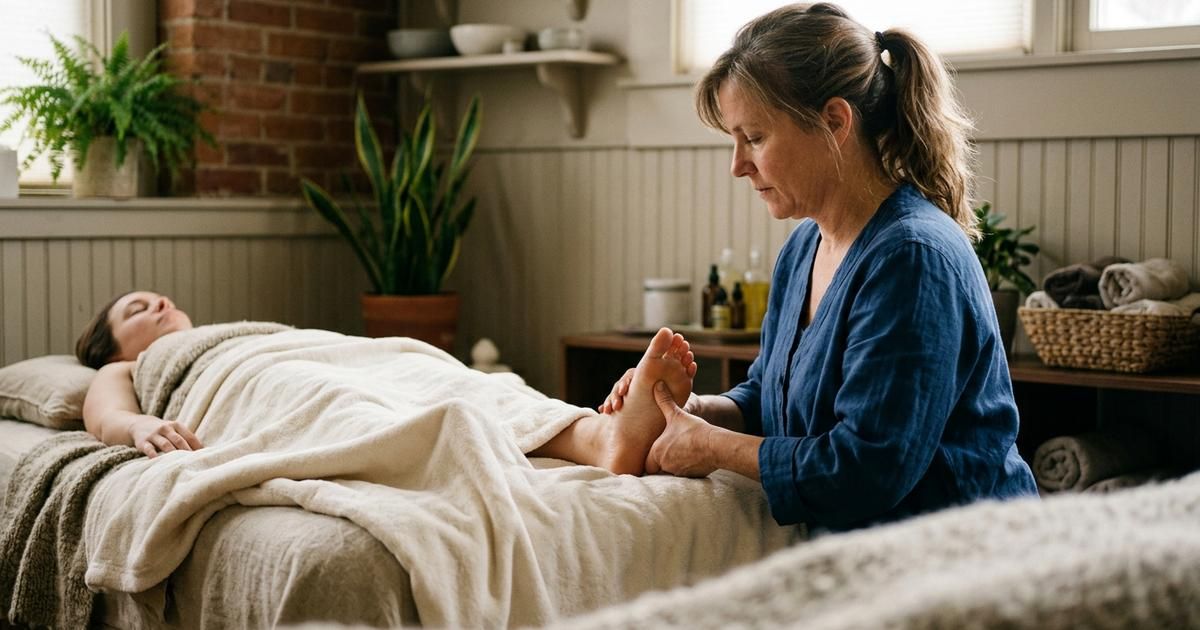
Less than you’d think, and nothing awkward. You keep your clothes on. You sink into a reclining chair or lie on a table under a light blanket. A short chat comes first - how you’re feeling, whether anything hurts, what you hope to get out of the hour. Then the shoes and socks come off, and sometimes there’s a footbath first, warm enough that you feel the heat climb past your ankles while your toes go pink.
A session usually runs 30 to 60 minutes. The practitioner works your feet with thumbs and fingers, and some work the hands or ears too. From across the room it looks like a focused foot massage, but the touch is different: firmer than a rub, more deliberate, moving point to point instead of kneading one area. Expect a dim, warm room and quiet music. Expect to lose track of time somewhere around the second foot.
Afterward your legs feel heavier than when you walked in and your head a little light, pleasantly underwater. Your feet may stay tender for a while. Plan for that. Don’t book the last slot of the workday and then try to merge onto the highway at rush hour in a fog. Drink a glass of water, skip the heavy drinking, and give the calm an hour or two before you dive into anything demanding. You paid to come down. Don’t spend it white-knuckled behind a semi.
Who should skip the table, or ask a doctor first?
Most people can lie back and enjoy it. A few should check with a doctor before they book, because pressure and circulation are exactly what make certain conditions worth a quick call. Ask your doctor or nurse first if you have circulation problems in your feet, inflammation or blood clots in the leg veins, gout, foot ulcers, athlete’s foot or another fungal problem, or a low platelet count that makes you bruise easily. If you’re pregnant or managing any ongoing condition, ask anyway. It costs one question.
That isn’t fearmongering. It’s the same caution you’d bring to any hands-on bodywork. If you’re coming off a double shift with ankles so swollen your laces leave red stripes, the question isn’t whether you deserve an hour off your feet. You do. The question is whether that swelling has a cause your doctor should see first.
The bigger risk isn’t physical at all. It’s mistaking a relaxation practice for medical treatment and putting off care you actually need. Reflexology should stand beside your doctor, never in front of them. If anyone ever tells you to skip a prescription because your feet will handle it, pull your socks back on, feel the cold of the parking lot through your soles, and don’t come back.
Different tension, different pro: what hiring a private investigator costs in Missouri.
Reflexology or a plain foot massage: which is worth your hour?
Which is better, reflexology or foot massage? Neither wins outright, because they overlap so much. A foot massage aims to relax muscles and feels great with no bigger theory attached. Reflexology uses more targeted pressure on specific zones and comes wrapped in the body-map tradition. For pure relaxation, either one gets you to that heavy-limbed, half-asleep place where you forget what you were worried about in the car.
So pick by feel, not by doctrine. Some people love the precise, point-by-point pressure and the little ritual around it - the footbath, the chart, the slow march from heel to toes. Others want broad strokes and warm oil and no talk of zones at all. There’s one practical Missouri difference, though, and you already know it: the hands, feet and ears rule above. Use the phone sentence either way; it sorts massage therapists as cleanly as it sorts reflexologists.
The realistic zone for either one is the same: stress, tension and the wound-up feeling of a hard week. Many people say they feel calmer and lighter afterward, which tracks with any slow, hands-on hour. Where it earns its keep is the same place a slow loop around the Grand Basin in Forest Park does - it pulls you out of fight-or-flight for a while. Some people pair it with a weekly class at one of the yoga studios around St. Louis and treat the two as one stress plan with very different textures.
Comparing the names on your shortlist
Once you’ve made your calls, lay the answers side by side like receipts on the kitchen table. Maybe one practitioner in Frontenac runs a quiet, no-claims room with flexible session lengths. Maybe someone near Festus folds reflexology into broader bodywork, while another in Glen Carbon books only longer sessions. Those are examples, not listings. What matters is the gap between what you asked for and what each one pitched back - and, for anyone who also sells massage, whether the license search matched what they told you.
Then trust the room once you’re in it. The towel should smell like a dryer, not a gym bag. The practitioner should look at you when you talk instead of at the clock. Clean linens, clear words about what happens next and someone who actually listens matter as much as any certificate on the wall. If a practitioner in Dardenne Prairie makes you feel rushed or leans on packages on day one, that’s reason enough to try somewhere else. How often to go back is your call; there’s no fixed rule, so let your body and your budget set the pace.
What will it cost, and who pays?
Nobody honest can quote you one St. Louis number, and anyone who does online is guessing. Price tracks session length and the provider: thirty minutes costs less than a full hour, and someone folding reflexology into broader bodywork prices it differently from a dedicated practice. The only figure that applies to you is the one you hear when you call - so ask for it in the same breath as the relaxation question.
Length is the big lever. Add-ons like aromatherapy or a longer footbath nudge it up. Experience and location play in too. Ask about a first-visit or new-client rate - asking costs nothing. Packages can lower the per-session price once you know you’ll go back, but try one session before you buy a stack. Weighing it against a full-body treatment? Check what therapeutic massage costs in St. Louis and compare hour for hour, so you know what your money actually buys.
Ask your health plan before you assume anything about coverage, and know the answer walking in. A monthly habit works if your budget says so. A once-a-season treat works too. Decide before you book, so the card reader at the front desk never undoes the calm you just paid for.
Do it tonight, while your feet still ache. Open the reflexology practitioners on St Louis Near Me Directory, pick two or three, and skim each About section for one tell - do they promise calm, or promise cures? Then call, say the one sentence, ask the price, and book the person who answers plainly.
If you’re the reflexologist, the massage therapist or the one-room studio with the warm towels, that plain answer is your edge. A Gold listing puts your honest About section in front of the people making these calls and helps you get more customers. Start by seeing who AI names instead of you, or add your practice.
Frequently asked before the first appointment
What are the disadvantages of reflexology?
The biggest one is mistaking it for medical treatment and delaying care you need. Beyond that, some points can feel tender, and results are subjective. It’s a relaxation practice, not a cure, so the real risk is overselling it to yourself and skipping a doctor visit that matters.
How often should you do reflexology on your feet?
There’s no fixed rule. Some people book regularly, some save it for a rough stretch, and gentle self-massage at home is fine whenever it feels good. Let your body and your budget decide - more often isn’t automatically better, and there’s no schedule you have to hit.
What should you not do after reflexology?
Don’t schedule anything demanding right after. You may feel loose, foggy or thirsty, so a tense meeting or a long highway drive while spacey is a bad idea. Drink water, go easy on alcohol, and give yourself an hour or two before diving back in. The calm is the point - don’t spend it in traffic.
What does it mean if a reflexology point hurts?
Usually just that the spot is tender or you’re holding tension there. Some practitioners call it a “congested” zone, but that’s tradition, not a diagnosis, and it says nothing reliable about the organ on the chart. Sharp or lasting pain isn’t normal. Tell your practitioner to ease off right away rather than toughing it out.
Who should not do foot reflexology?
Check with a doctor or nurse first if you have circulation problems in your feet, blood clots or inflamed leg veins, gout, foot ulcers, a fungal foot infection or a low platelet count. If you’re pregnant or managing an ongoing condition, ask too. It’s gentle for most people, but pressure and circulation are exactly why a few conditions deserve a quick medical check.
Which is better, reflexology or foot massage?
Neither wins outright - they overlap heavily. A foot massage relaxes muscles with no bigger theory attached; reflexology uses targeted pressure on specific zones and carries the body-map tradition. For pure relaxation, both deliver. Choose by which touch you enjoy more and by how honestly the practitioner describes what they do.
Do you tip a reflexologist?
Usually, yes, when the visit runs like a spa or massage appointment - something in the range you’d tip a massage therapist is normal. In a clinical or medical-style setting, tipping is less expected. Not sure? Ask when you book, or check whether gratuity is already included in the price. Nobody minds the question.

Written by a dedicated team of St. Louis locals who live, work, and play right here in the St. Louis metro. Founder Lane Forman and team are committed to building the region’s most trusted directory by verifying listings and connecting local businesses with loyal customers across Missouri and Illinois.