How to Plan a Candy Buffet in St. Louis
Revised September 3, 2026
How much candy per person for a candy buffet?
Plan on roughly a quarter-pound to a half-pound of candy per guest. Use the low end when there is cake and a full dessert table, the high end when the buffet doubles as the party favor and guests fill a bag to take home. For thirty guests that is about eight to fifteen pounds total.
Keep reading ↓The open house is in eleven days. Somebody in the family group text typed “we should do a candy table” at 10:40 on a Tuesday night, five people answered with heart emojis, and now it belongs to you. You have two graduation colors, a folding table borrowed from a neighbor in O’Fallon, and absolutely no idea whether that means four pounds of candy or forty.
Here is the part nobody mentions. A candy buffet looks like the easiest job on the party list, and per guest it really is one of the cheaper ones, but it goes wrong in specific and predictable ways. People buy eleven pounds of one thing and half a pound of another. They order two days out and pay full retail. They set open jars of chocolate on a deck in Imperial in the middle of August and come back to a tray of soft gray smears.
So this is the sequence, in the order you actually need it. How much candy per guest, how far out to place the order, what the jars and scoops and bags really run, how buying by the pound at a candy shop compares to the big-box aisle, what survives a Missouri summer, and what to do with the four pounds still sitting there at nine o’clock that night. None of it is complicated. It is just a lot easier when somebody else already made the mistakes.
How much candy per person for a candy buffet?
Plan on roughly a quarter-pound to a half-pound of candy per guest. Use the low end when there is cake and a full dessert table, the high end when the buffet doubles as the party favor and guests fill a bag to take home. For thirty guests that is about eight to fifteen pounds total.
Those are the planning figures this kind of setup generally runs on, not a quote off anybody’s price list, and they hold up well in practice. Four ounces a head is the right number when candy is the supporting act. Eight ounces is the right number when it is the whole dessert and every guest leaves with a filled bag. Most graduation open houses land somewhere in the middle, near six ounces, because people drift in across four hours and graze instead of loading up.
Two things move that number more than anything else. Kids move it up. A room of eleven-year-olds will clear a table that the same number of adults would barely dent, so a birthday party or a First Communion reception should budget closer to the half-pound figure. A cash bar and a dinner move it down, because a guest holding a plate and a drink does not have a free hand for a scoop.
Then split the total across varieties instead of guessing jar by jar. Five to eight kinds is the sweet spot for thirty to a hundred guests, and the math is simple: take your total poundage, divide it by the number of jars, then add a little extra to the two or three crowd-pleasers and take it back off the specialty item nobody but you loves. A jar looks sad when it is one-third full, so buy for the container size as well as for the guest count.
One more adjustment worth making early. If a sheet cake or a dessert bar is coming from a bakery too, cut the candy figure by roughly a quarter, because those two things compete for the same appetite. Deciding that order of operations first saves real money, and how to find a good bakery in St. Louis is worth reading before you lock the dessert plan, since bakery lead times are usually longer than candy lead times.
How does a candy buffet actually work?
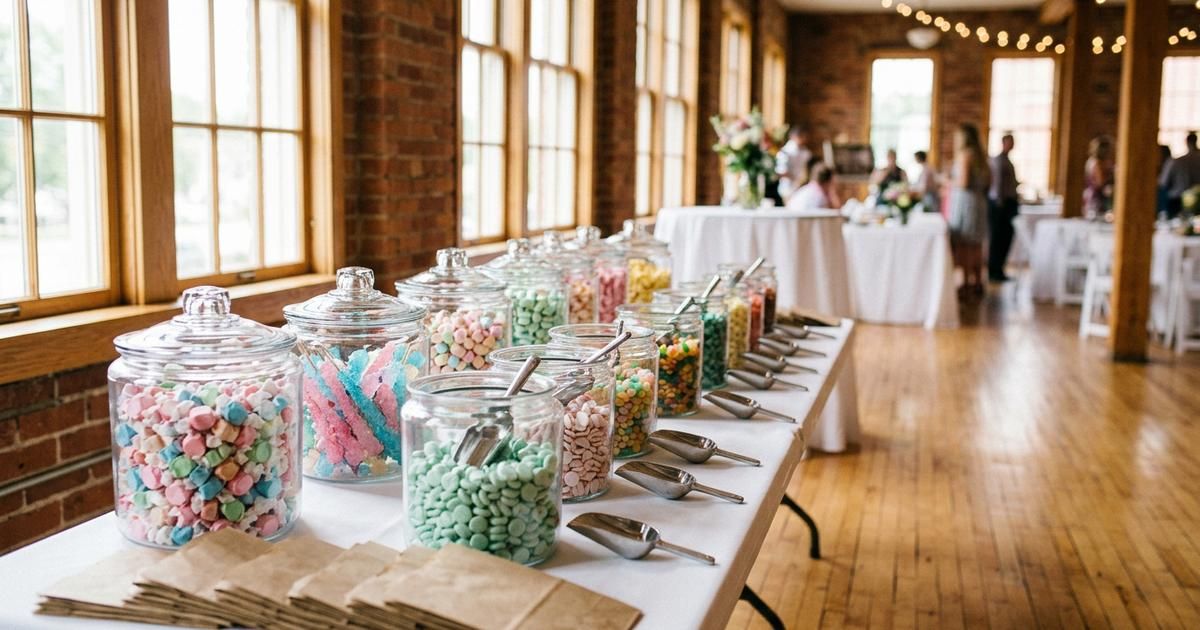
A candy buffet is a table of open containers, a scoop or tongs in each one, and a stack of bags or boxes at the front so guests can serve themselves. It functions as dessert, as decoration, and as the party favor all at once, which is why the format keeps showing up at weddings and graduations.
The flow matters more than the candy does. Put the bags at the entry end of the table, not the middle, so the line moves in one direction and nobody has to reach back across three jars. Set a small sign with the take-home instruction on it, because a surprising number of guests will not touch a candy table until somebody tells them it is theirs to take. Vary the jar heights so the back row is visible, and leave a few inches of bare table between clusters so people can set a drink down.
Color is doing most of the visual work, and it is also where the budget quietly inflates. Two or three colors read as intentional. Six colors read as a bin at a discount store. If school colors are the theme, pick your two, then let white, cream, or clear candy carry the filler weight so you are not paying a premium for an unusual shade in every single jar.
Also think about the table itself before the candy. A six-foot rectangle handles about six to eight jars comfortably. Anything bigger than that and you are into a second table, linens you may not own, and possibly a rental, which has its own timeline. If the party is already renting chairs or a tent, what to ask before booking party rentals in St. Louis covers the questions that decide whether the candy table gets a spot indoors or ends up in the sun.
How far ahead should you order the candy?
Three to four weeks is the comfortable window for a normal-sized buffet, and six to eight weeks if you want specific colors or a large quantity of one item. Two weeks is workable but tight. Anything inside a week means you are buying whatever happens to be in the bins that day.
The reason is stock, not production. A candy shop keeps a working amount of each item on the floor, sized for ordinary walk-in traffic, not for somebody who needs nine pounds of one color of a single item on one specific Saturday. When you give a shop three weeks, your quantity rides along on a regular wholesale order and costs you nothing extra. When you give it three days, the staff is scooping the bins empty and calling around, and you may end up paying more for less of what you wanted.
Season is the other half of it. May and June are the crush in this metro. Every graduation open house, every wedding, every end-of-year banquet and every teacher gift converges on the same six weeks, and pastel colors in particular go thin. October gets busy for a different reason, and the stretch from Thanksgiving through New Year’s is the tightest window of the year for anything chocolate. A May party deserves four weeks of lead time even if a November party would have been fine with two.
Then work backward from the date rather than forward from today. Candy needs to be in your hands two or three days early, not the morning of, because that is your buffer for the item that came up short. Filling jars is a one-hour job the night before, and it is much better done in a kitchen in Waterloo at eight in the evening than in a rented hall forty minutes before guests arrive.
How much do the jars, scoops, and bags actually cost?
Containers are usually the surprise line item. Apothecary jars and glass canisters commonly run a few dollars each for small sizes up to around twenty or more for the tall statement pieces, scoops and tongs typically run a few dollars apiece, and favor bags or small boxes generally land somewhere between ten and forty cents each in bulk quantities.
Those are typical ranges rather than quoted prices, and they add up faster than people expect. Eight jars, eight scoops, a hundred bags and a roll of ribbon can quietly cost as much as the candy inside them. The fix is not to buy cheaper glass. It is to buy less glass. Mix in what you already own: trifle bowls, cake stands with the dome off, wide mason jars, a wooden crate turned on its side, a clean galvanized bucket for the bulk item.
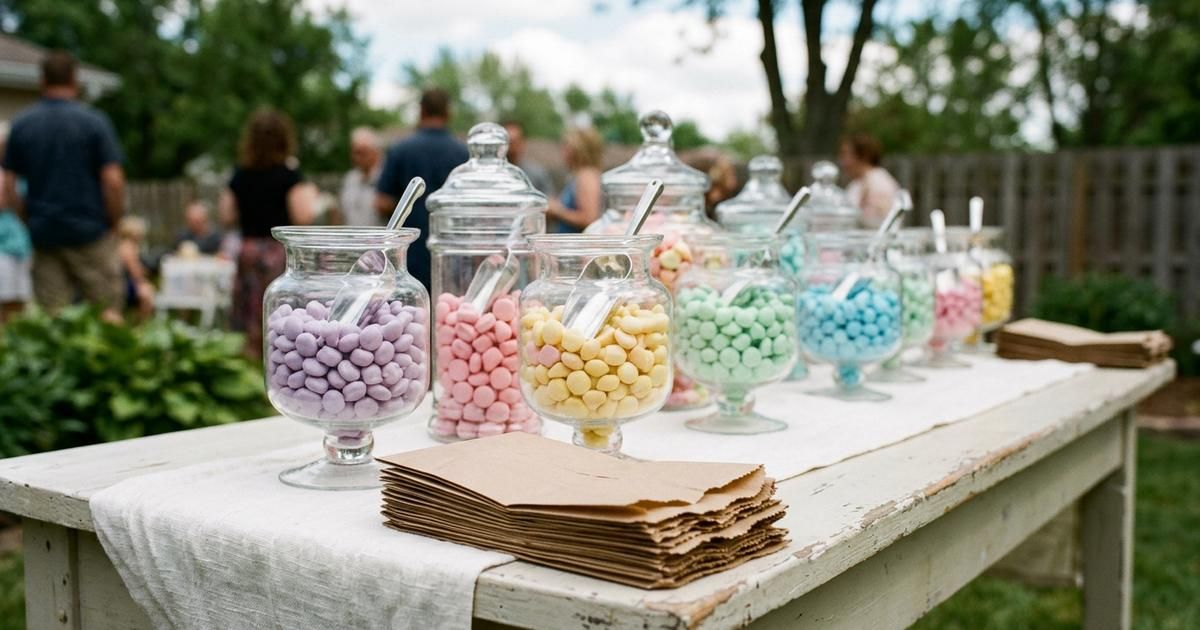
Borrowing is genuinely the move here, and almost nobody does it. Ask the two or three people in your circle who hosted a shower or a wedding in the last two years. Jars from a candy buffet do not get thrown away, they get put in a basement in Maryland Heights, and their owner will be delighted to hand you a box of them. You will spend an evening washing glass instead of a hundred dollars buying it.
Two small things that punch above their cost. First, buy one scoop or set of tongs per jar and do not plan to share, because a shared scoop is how the chocolate ends up in the sour candy and how the line stalls. Second, buy the slightly better bag. A flimsy cellophane bag that splits in a car in the parking lot undoes the whole effect, and the upgrade is usually pennies per guest.
Is bulk candy cheaper at a candy shop or a big-box store?
It depends on which part of the table you are buying. Big-box and warehouse stores usually win on plain, common, high-volume items sold in large sealed bags. A candy shop selling by the pound usually wins on color selection, on unusual items, and on any situation where buying exactly nine pounds beats buying twelve.
Buying by the pound out of a bin is a different transaction than buying a sealed bag, and the difference is waste. A warehouse club sells you a five-pound bag of a mixed color assortment, and if your colors are navy and gold you have just paid for three pounds of red, green and orange that will sit in a cabinet until Halloween. The shop scoops navy and gold only. Even at a higher price per pound, buying only what goes on the table often costs less in total, and it always looks better.
The other thing a shop sells you is a person who has done this before. Somebody who fills party orders every May knows which items clump in humidity, which ones bleed color onto a white linen, and how many pounds a jar that size actually holds. That is worth something on a first attempt. Ask directly whether there is a price break at a certain poundage, because there often is, and the threshold is frequently lower than people assume.
Where the two approaches meet is a split order, and that is what most experienced hosts end up doing. Buy the bulk filler item and the individually wrapped basics wherever they are cheapest. Buy the color-critical items, the chocolate, and anything anybody will comment on from a shop. If part of the table is meant to impress, artisan chocolate in St. Louis and what makes it different explains what you are paying for when the price per pound jumps.
What candy survives a Missouri August?
Hard candy, gummies, foil-wrapped pieces and anything individually sealed hold up. Bare chocolate does not, and neither does unwrapped hard candy in real humidity. Missouri summer air is genuinely hard on a candy table, and the two failure modes are chocolate softening and blooming, and hard candy going tacky and fusing into one lump.
Chocolate starts losing structure well before it looks melted. Once it warms past the mid-eighties it goes soft on the fingers, and when it cools again the cocoa butter or the sugar can migrate to the surface and leave that dull gray film. It is harmless and it tastes fine, but it looks like the candy is old. Keep chocolate indoors, out of direct sun and away from a window, and if it must go outside, use foil-wrapped or shell-coated pieces and put out small amounts you refill from a cooler.
Hard candy has the opposite problem, and it is the one that catches people off guard. Sugar pulls moisture out of humid air, so an open jar of unwrapped hard candy on a July afternoon here will get sticky on the surface and then weld itself together. Individually wrapped is the whole answer. If a piece you love only comes unwrapped, put it out late, put out less of it, and keep the reserve sealed with the bag clipped shut.
A few practical rules that cover most outdoor parties. Set the table on the shaded side of the house or under a tent, never where the afternoon sun will find it by four o’clock. Skip open bowls of anything with a soft center. Keep the backup stock in a cooler with the ice sealed in bags so nothing gets damp. And if the reception is outdoors in August, be honest with yourself and build the whole buffet out of gummies, sours, taffy and wrapped items, then serve the chocolate as a plated dessert indoors.
How do you keep a candy buffet cheap without it looking cheap?
Cut the number of varieties, not the amount of candy. Five well-filled jars look abundant. Nine half-empty ones look picked over, and they cost more. Volume is what the eye reads as generous, so buy fewer kinds in bigger quantities and let one inexpensive bulk item carry most of the weight.
The rest of the savings come from the container side. Borrow glass instead of buying it. Use a mirror or a runner from your own linen closet instead of buying a backdrop. Put risers under the back row, and a cake stand or an upside-down bowl under a cloth works exactly as well as anything sold for the purpose. Print the labels at home on cardstock. Nobody at the party will ever know, and honestly, nobody is looking at the labels.
One trick worth knowing: pick one hero item and let it be the expensive one. A single jar of something genuinely good, sitting at eye level in the middle of the table, sets the tone for everything around it. The other six jars can be ordinary bulk candy and the whole table still reads as thoughtful. Spreading the same budget evenly across seven jars gets you seven ordinary jars.
What do you do with the leftovers?
Plan for leftovers before the party, because you will have them. Guests take less than hosts expect, and the usual result is two to four pounds still on the table at the end of the night. The single best move is to hand out filled bags on the way out rather than hoping people serve themselves twice.
Station somebody near the door for the last half hour with pre-filled bags. That one change clears more candy than every sign you could print, because guests who felt awkward scooping in front of people will happily accept a bag that is handed to them. Send extra home with the families who drove the farthest and with anybody who brought a dish.
What is left after that stores better than people think, with one rule per type. Wrapped hard candy keeps for months in an airtight container at room temperature, away from heat and light. Gummies dry out, so seal them tightly and use them within a few weeks. Chocolate should stay cool and dry but not cold, since a refrigerator introduces condensation and the sugar bloom that comes with it. Never store chocolate next to anything strongly scented, because it absorbs odors readily.
Then find the leftovers a job. Teacher lounges, break rooms, coaches, scout troops and volunteer nights all absorb candy instantly. Leftover jars refilled and tied with ribbon make perfectly good thank-you gifts for the people who helped set up, and if you want that gift to feel like it came from here rather than from a shelf, St. Louis gifts that are actually from here has better ideas than a generic gift card.
Candy is a one-day budget. How Missouri taxes retirement income is a lifelong one.
How should you choose which candy shop to talk to?
Shortlist two or three shops worth interviewing, then walk in with the real numbers. Guest count, date, colors, indoor or outdoor, and the total you have to spend. Let each one tell you what it would put on that table. You are comparing what you want against what each shop is prepared to deliver.
The gap is the signal, not the price. One shop hears “sixty guests, navy and gold, outdoors on the twentieth of June” and immediately steers you away from bare chocolate and toward wrapped items. Another says it can do whatever you want and leaves it there. A third tells you straight out that your color is hard to get in that item and here are two alternatives that are not. That third answer is worth more than a slightly lower price per pound, because it is the only one that has been checked against reality.
Pay attention to what gets asked first. A shop that asks where the table will be standing before it asks your budget is telling you something good. Indoors and outdoors are two different orders, and anybody who fills party orders regularly knows that before you do. Ask how many pounds that shop would put on a table your size, then compare the answer to your own math. If the two numbers are far apart, ask why, and listen to the reasoning rather than the number.
Serving drinks alongside the candy table? Here is what it takes to hire a bartender for a party in St. Louis.
Bring one photo. A picture of the table you have in your head does ten seconds of work that ten minutes of description cannot. Bring a swatch too, or the actual invitation, because “navy” covers a wide range and candy colors do not blend. And ask what the shop has run before for a party like yours, since a place that fills a dozen graduation orders every May has already solved problems you have not thought of yet.
Where do you find a candy shop near you?
Start with your date and your guest count, not your color scheme. You can browse candy stores across the metro on St Louis Near Me Directory, then talk to two or three with your real numbers in hand and see what each one would build. Give them three or four weeks and the whole job gets easier & cheaper at the same time.
If you run a business in this trade, put your business on the map.
Frequently asked questions
How many bags of candy for 30 people?
Think in pounds first, then convert. Thirty guests need roughly eight to fifteen pounds total, so at a common bag size of about a pound to a pound and a half, that is somewhere around eight to twelve bags. Spread across five or six varieties, that works out to one or two bags of each, with a little extra of the two items you know will disappear first.
How much candy should I get for a candy bar?
Use a quarter-pound to a half-pound per guest. Four ounces a head is right when there is also cake and a dessert table, and eight ounces is right when the candy is the dessert and guests take a filled bag home. Kids push it toward the high end, a sit-down dinner pushes it toward the low end, and most open houses land near six ounces a person.
How to make a candy buffet cheap?
Cut varieties, not volume. Five well-filled jars look generous where nine half-empty ones look picked over, and they cost less. Borrow glass from friends who have hosted showers or weddings recently, use risers and linens you already own, and print labels at home. Let one inexpensive bulk item carry most of the weight, then spend the difference on a single hero jar at eye level.
What are some examples of candy buffet ideas?
Two-color school themes for graduations, all-white or blush for weddings and showers, a nostalgic table of the candy the guest of honor grew up with, or a texture mix pairing sours, gummies, chocolate and taffy. Seasonal palettes work well too. Whatever the theme, keep it to two or three colors with white or clear as filler, vary the jar heights, and put the bags at one end so the line flows in a single direction.
How does a candy buffet work?
Guests serve themselves from open containers using a scoop or tongs in each jar, filling a bag or box to take home. It works as dessert, decoration and party favor at once. Put the bags at the entry end of the table, give every jar its own scoop, and add a small sign saying the candy is theirs to take, because many guests will not touch the table until somebody tells them so.
What is the best candy to use in a candy buffet?
The best candy is whatever holds its shape in your room and your season. Wrapped hard candy, gummies, taffy, malt balls and foil-wrapped pieces all travel and sit well. Bare chocolate is the riskiest choice outdoors in a Missouri summer, and unwrapped hard candy goes tacky in humidity. Mix textures and sizes so the table has visual variety, and keep at least half the jars filled with items nearly everyone likes.
Which famous candy was invented in St. Louis?
Several nationally known confections trace back to St. Louis-area confectioners, and the 1904 World’s Fair generated a great many origin claims that are still argued over today. Rather than repeat internet lore, ask the shops themselves, since long-running confectioners usually know their own history well, or check with the Missouri Historical Society and your local county historical society. Their records settle these questions better than a listicle can.
What candy is Missouri known for?
Missouri has a real confectionery history and the St. Louis area still supports both large manufacturers and small hand-made candy makers, so there is no single answer everybody agrees on. The more useful approach is to walk into a shop and ask what it makes in house and what it has made the longest. That is also how you find something worth putting on a gift table rather than just a candy table.

Written by a dedicated team of St. Louis locals who live, work, and play right here in the St. Louis metro. Founder Lane Forman and team are committed to building the region’s most trusted directory by verifying listings and connecting local businesses with loyal customers across Missouri and Illinois.