The Missouri River Used to Run Here. Now Only Electric Motors Do.
Revised November 9, 2026
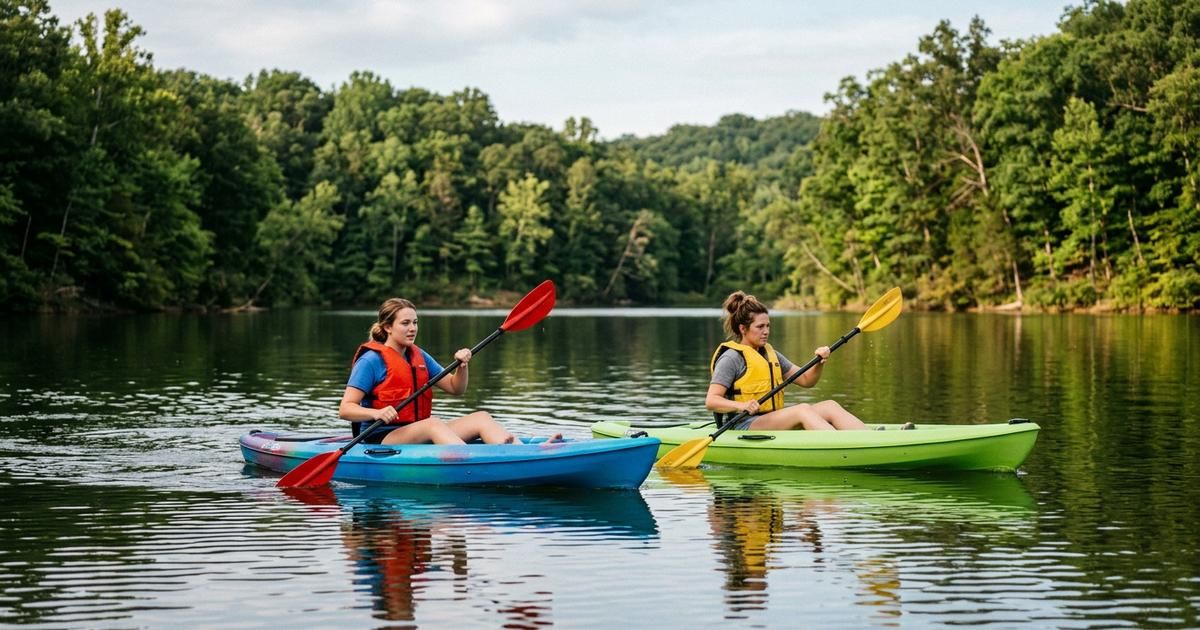
Can you kayak with no experience?
Yes. Most people can paddle a recreational kayak on calm, sheltered water their first time out, with a few minutes of basics on the bank. The catch is the water you choose. Flat lakes forgive mistakes. Big rivers with current, barges and cold water do not, so beginners should start small and stay close to shore.
Keep reading ↓The Missouri River used to bend right here. Now it holds still. Push off from the bank and the bow noses out across flat water, the life jacket snug against your ribs, the blade dripping cold on your knuckles every time it comes up. No gas engine anywhere on the lake to drown that sound out. Just the drip, your breathing, and the hull hissing forward a little more with every pull.
Your first kayak trip in St. Louis can be on the Missouri River, and it can still be the calmest water you’ll ever paddle. There’s a lake in the St. Louis County park system, out in the river bottoms west of the city, that the Missouri Department of Conservation describes as an oxbow lake, formed when a tight curve of the Missouri River was cut off and separated from the main channel. The river moved on. The bend stayed behind and went still.
MDC’s page for the lake lists it at 320 acres, and its rule for the water is short: only electric motors may be used. No gas outboards roaring past. No ski-boat wake slapping your hull sideways while you’re still figuring out which way the paddle faces. For a beginner, that one rule matters more than any stroke technique.
Can you kayak with no experience?
Yes. Most people can paddle a recreational kayak on calm, sheltered water their first time out, with a few minutes of basics on the bank. The catch is the water you choose. Flat lakes forgive mistakes. Big rivers with current, barges and cold water do not, so beginners should start small and stay close to shore.
On that lake you don’t even need your own boat. Big Muddy Adventures rents kayaks, canoes and stand-up paddleboards from 13171 Dripping Springs Road, phone (314) 430-1319, and its lake rental page is blunt about the one thing beginners like to skip: life jackets are included with all boat rentals and must be worn while paddling. Kids under 16 have to come with an adult. Bring a state or government-issued ID, since one is required for all rentals. Rentals run first come, first served, so check their site for the season before you drive out.
Recreational kayaks are built wide and stable on purpose. Forward is easy. Turning takes a little longer to click. Stopping takes the longest, which is one good reason to practice in open water instead of right next to a dock. The real gap for a beginner isn’t technique, though. It’s judgment. Noticing the wind come up across the open middle of the lake. Realizing you’ve drifted farther than you meant to. Feeling your forearms burn while the launch is still a long pull away.
Getting in is the wobbliest moment of the whole day, and the stillest water in the county won’t save you from it. Set the kayak parallel to shore in shallow water, lay the paddle across the boat behind the seat as a brace, and lower yourself in rear-first before swinging your legs over. Plenty of people take their first swim right here, in six inches of water, with cold mud squishing between their toes. Laugh it off. Everybody on the bank has done it.
The temperature math that fools people
You’ll hear about the 120 rule: add the air and water temperatures, and if the total is 120 degrees or below, wear a wetsuit. Virginia’s Department of Wildlife Resources passes it along as a general guide for paddlers. Here’s the turn. The National Center for Cold Water Safety calls formulas like it dangerously misleading, and runs the numbers to prove it: a 75F day over 53F water adds up past 120, yet immersion in 53F water is immediately life-threatening without thermal protection.
Their rule is simpler. The only thing that matters when you’re in the water is the water temperature. So on a warm afternoon early in the year, when the sun feels like summer on your arms, put your hand in the lake before you decide what to wear. That cold shock up your wrist is the number that counts.
Should a beginner pick a sit-on-top or sit-inside kayak?
For warm-weather first trips, a sit-on-top is usually the easier pick. It’s stable, simple to climb back onto after a fall, and it won’t fill with water. You sit on a molded seat with your legs in the open, and small drain holes called scuppers let splashed water run straight through. The trade-off is that you will get wet. Your seat will get wet. On a breezy day you’ll feel every gust on damp skin. Bringing the dog? At the lake rental, dogs are allowed on canoes or paddleboards, but not in kayaks, so pick the boat around the passenger.
A sit-inside kayak tucks your legs under a deck, and your knees brace against the sides. That contact gives you more control and a drier, warmer ride. Recreational sit-insides have big open cockpits, so you won’t feel trapped. If one flips, though, it takes on water, and you’ll probably swim it to shore to drain it.
Whichever you’re in, adjust the foot pegs on land. Knees slightly bent, feet pressing firmly. Five seconds on the bank beats fiddling with them while you drift sideways into the reeds.
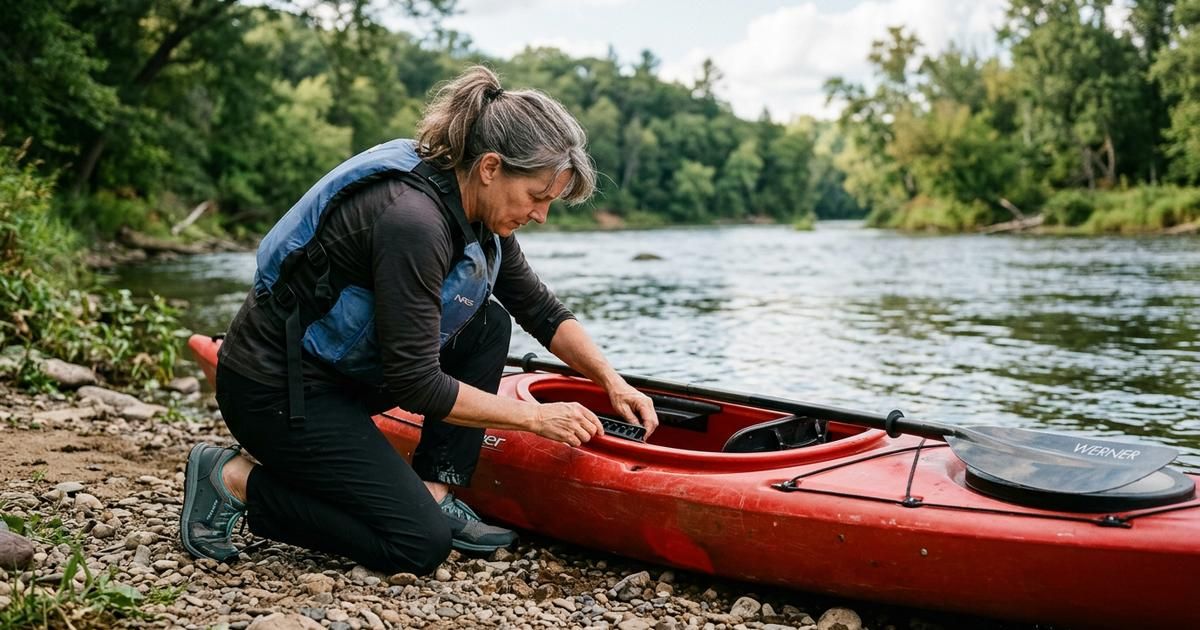
A few basics before you push off
Grip the paddle with your hands a bit wider than your shoulders and your knuckles lined up with the blade edge. The cupped face of each blade pulls toward you. Press your feet into the pegs so your torso does the work instead of your arms. Sit up tall. Slouching wrecks your stroke and your lower back by the end of the first hour.
Shorter and wider means stable and easy to turn. Longer and narrower means faster and straighter, but tippier. If you’re renting, ask what they’d put a nervous beginner in and take the answer seriously.
Where should a first-timer paddle around St. Louis?
Start on calm, enclosed water: a small lake, a pond, or a quiet cove without gas-motor traffic. Slow, shallow creeks come next, once you can steer. The open Missouri and Mississippi come last, not first. Their current, barge traffic, wing dikes and floating debris make them water for experienced paddlers, ideally with a guide.
Calm lakes and ponds
This is where day one belongs. With no current, you mostly stop moving when you stop paddling. Wind is the main thing to watch. Launch into the breeze if you can, so the trip home is the easy half, and stay within a comfortable swim of shore.
Slow creeks
A creek float feels different from a lake. A gentle current does some of the work, but you’ll also meet gravel bars, low branches and riffles where water speeds up over rocks. Downed trees that let water through but not people, called strainers, are the real hazard. Steer wide. Always. Water levels swing after rain, too, so check recent conditions and ask someone local before you commit.
The open Missouri and Mississippi
Beautiful, historic, and not for your first day. Both rivers carry commercial barge traffic, and a tow can’t stop or swerve for a kayak. Wing dikes, the rock structures that jut from the banks to steer the channel, churn up eddies around them. Our guide to barges on the Mississippi explains the traffic you’d be sharing the water with.
Want big-river paddling someday? Get there through a guided trip after real hours on flatter water. A drive along the bluffs is a good way to take in the scale first, and our list of best stops along the Great River Road lets you study the river long before you’re floating on it.
What should you bring on a first paddle?
A properly fitted life jacket comes first, worn and buckled, not stashed behind the seat. After that: quick-dry clothes, water shoes, sun protection, drinking water and a dry bag for your phone and keys. Skip cotton, especially jeans. Wet cotton stays wet, gets heavy, and pulls heat from your body fast.
Footwear matters more than people think. Flip-flops float away. Bare feet meet sharp rocks and hot pavement at the launch. Water shoes or sandals with a heel strap stay put in the mud. Add sunglasses with a strap, a hat, a whistle clipped to your life jacket, and dry clothes plus a towel waiting in the car.
Rather see the water from way up? Try hot air balloon rides
Curious how much of the fancier stuff you’ll really use? Our breakdown of what outdoor gear you actually need in St. Louis sorts the essentials from the impulse buys.
Your first trip, in order
Pick flat water. Check the wind and put a hand in the water. Rent or borrow a stable boat. Text a friend where you’re launching and when you’ll be off the water. Spend five minutes close to the bank practicing forward strokes, a wide sweep turn each way, and a few reverse strokes to stop. Then head upwind for a short leg, turn around, and let the breeze help carry you home.
Bring a snack and a full water bottle even for a short loop; sun off flat water dries you out faster than you’d guess. Quit before you’re tired. Your shoulders and grip will ache tomorrow in ways that surprise you, and fatigue is exactly when paddles get dropped. An hour out and back is a great first day.
One last thing, if it’s warm and the water is shallow: tip over on purpose with a friend watching. Slide out, flip the boat, climb back on. It’s awkward and a little ridiculous, and it drains the fear out of the thing you were most worried about. Do it once and the whole sport feels different the next time you push off from the bank, water sliding cold down the back of your neck, laughing.
Ready to get on the water? Browse kayaking rentals and outfitters across the St. Louis metro on St Louis Near Me Directory, ask what they’d put a beginner in, and pick calm water for day one.
If you’re the outfitter, the instructor or the river guide, the nervous first-timer is searching for you right now from a phone in a parking lot. A listing that answers their questions is how you get more customers from that search, so list your kayak rental.
Frequently asked questions
What is the 120 rule in kayaking?
It’s a quick cold-water check: if the air and water temperatures together are 120 degrees or below, wear a wetsuit. The National Center for Cold Water Safety warns it can mislead you, because the only thing that matters when you’re in the water is the water temperature. Dress for the water, not the air.
Do you need a life jacket in a kayak in Missouri?
Missouri law requires boaters to have a U.S. Coast Guard-approved life jacket on board for each occupant, and children under the age of seven are required to wear a life jacket whenever they are on a boat. At the oxbow lake rental, everyone wears one while paddling.
What not to wear when kayaking?
Skip cotton. Jeans, sweatshirts, cotton tees and cotton socks soak up water and stay cold. Leave flip-flops, heavy boots and dangling jewelry at home, too. Wear quick-dry synthetics or wool, a hat, and water shoes or sandals with a heel strap.
How likely is a kayak to flip?
In a wide recreational kayak on flat water, not very. Most beginner swims happen while getting in or out, leaning too far to grab something, or sitting sideways to a wake. Current, wind and narrow boats raise the odds. Keep your weight low and centered.
What are the disadvantages of sit-on-top kayaks?
You’ll almost certainly get wet, since you’re sitting out in the open on the deck. That makes them chilly in wind and cool weather. They’re often heavier and a bit slower than sit-inside kayaks of similar length, and they give you less contact with the boat for control.
Is it safe to kayak on the Missouri River?
Not for beginners. Build skills on calm water first, like the cut-off Missouri River bend in the county park system, and go with a guide when you’re ready for the main channel.
How long does it take to learn to kayak?
You can learn enough to enjoy calm water in one outing. Getting comfortable with steering, wind and longer trips takes several more times out. Moving water and self-rescue take real instruction and practice.
Do you need a permit to kayak in Missouri?
It depends on the water. Check with whoever manages the lake or park you plan to paddle before the trip. On the county’s oxbow lake, MDC says boats may be used and only electric motors may be used.

Written by a dedicated team of St. Louis locals who live, work, and play right here in the St. Louis metro. Founder Lane Forman and team are committed to building the region’s most trusted directory by verifying listings and connecting local businesses with loyal customers across Missouri and Illinois.