Near Me Search Optimization for St. Louis: The Guide to Getting Found
Revised August 10, 2026

How do I get my St. Louis business to show up in ‘near me’ searches?
To rank in ‘near me’ searches, Google weighs three things: relevance (does your profile match the search), distance (how close you are to the searcher), and prominence (how established and reviewed you look). Optimize all three — a complete, accurate Google Business Profile, consistent name-address-phone across the web, and a steady stream of genuine reviews — and you’ll surface for the nearby customers who are ready to act.
Keep reading ↓It’s a weekday afternoon. Someone in Florissant pulls out their phone and types “plumber near me.” A family in Belleville searches “tacos near me open now.” A stressed parent in Wentzville asks out loud, “urgent care near me.” In the three seconds it takes those results to load, a handful of local businesses win the customer — and everyone else may as well not exist.
That’s the whole game of “near me” search. People aren’t browsing; they’re ready to act, right now, close to home. The only question is whether your business is one of the few they see. This is the complete playbook for making sure it is — across Google, Maps, and the AI assistants people increasingly ask.
“Near me” search optimization means making your business the one Google — and now AI assistants — surface when someone nearby searches for what you offer. It comes down to three things Google weighs (relevance, distance, and prominence), powered by a complete Google Business Profile, consistent listings, and recent reviews. Nail those and you show up in the map pack, in “open now” results, and in the AI answers 45% of consumers now rely on.
What “Near Me” Search Really Is
A “near me” search is any search with local intent — whether the person types the words “near me” or not. When someone searches “coffee shop,” “emergency electrician,” or “tacos open now,” Google assumes they mean near them and serves local results built around their location. That behavior isn’t new, and it isn’t slowing down. When the trend first exploded, Google reported that mobile searches for “___ near me now” grew more than 150%, and “open now near me” searches more than 200%, between 2015 and 2017 (Think with Google). By 2018, 82% of smartphone shoppers had done a “near me” search (Uberall, 2018), and Google has said roughly 46% of all searches carry local intent (Google, 2018).
Those numbers are years old — and that’s exactly the point. “Near me” searching stopped being a trend and became the default long ago. What’s changed since is where people do it, and how ruthlessly the top results get rewarded. The businesses in the top three map results capture the overwhelming majority of clicks and calls; everyone below the fold splits the scraps.
The 2026 Shift: People Ask AI “Near Me” Too
Here’s the update most St. Louis businesses haven’t caught. 45% of consumers now use AI tools like ChatGPT to find local businesses — up from just 6% a year earlier (BrightLocal, 2026), making AI the third most popular way people get local recommendations, behind only search engines and maps. When someone asks an assistant “who’s the best [your service] near me,” you’re either in that short answer or you don’t exist to them.
The good news: AI doesn’t invent its picks. It reads the same signals Google does — complete profiles, consistent listings, real reviews, and presence on trusted local sources. So “near me” optimization in 2026 isn’t two separate jobs. It’s one job that pays off in two places at once. Do the fundamentals well and you win the map pack and the AI answer with the same effort.
How “Near Me” Ranking Actually Works
Google is unusually clear about how it ranks local results. Per Google’s own Business Profile documentation, three factors decide who shows up — and understanding what each one rewards tells you exactly what to do.
Relevance — do you match the search?
Relevance is how well your profile matches what someone typed. You raise it by choosing the single most accurate primary category (a “taqueria” should not be filed under “restaurant” if taqueria is an option), adding every relevant secondary category, listing your real services in plain language, and writing a description that uses the words customers actually search. Most businesses lose here simply by leaving their profile half-filled.
Distance — how close are you?
Distance is how far you are from the person searching. You can’t move your building, but you can make sure Google knows precisely where you are and how far you travel: a verified, exact address, or — for service-area businesses like plumbers and cleaners — a properly configured service area listing the suburbs you cover. A vague or wrong location quietly caps how often you appear.
Prominence — how established do you look?
Prominence is how well-known and trusted your business appears across the web, and it’s the biggest lever most owners ignore. It’s built from the volume and recency of your reviews, the consistency of your listings everywhere they appear, links and mentions from other reputable sites, and your overall reputation. Two businesses the same distance from a searcher will rank very differently based on prominence — and prominence is almost entirely earnable.
Distance is largely fixed. Relevance and prominence are entirely in your control — which is where every win in this guide comes from.
Near-Me Search, by the Numbers
| The reality | Figure | Source |
|---|---|---|
| Smartphone shoppers who’ve done a “near me” search | 82% | Uberall, 2018 |
| Google searches with local intent | ~46% | Google, 2018 |
| Consumers now using AI for local recommendations | 45% (up from 6%) | BrightLocal, 2026 |
| Consumers who read reviews before choosing | 97% | BrightLocal, 2026 |
The Near-Me Optimization Playbook
Do these in order — each one feeds the next, and together they cover relevance, prominence, and the AI layer at once.
1. Complete and verify your Google Business Profile
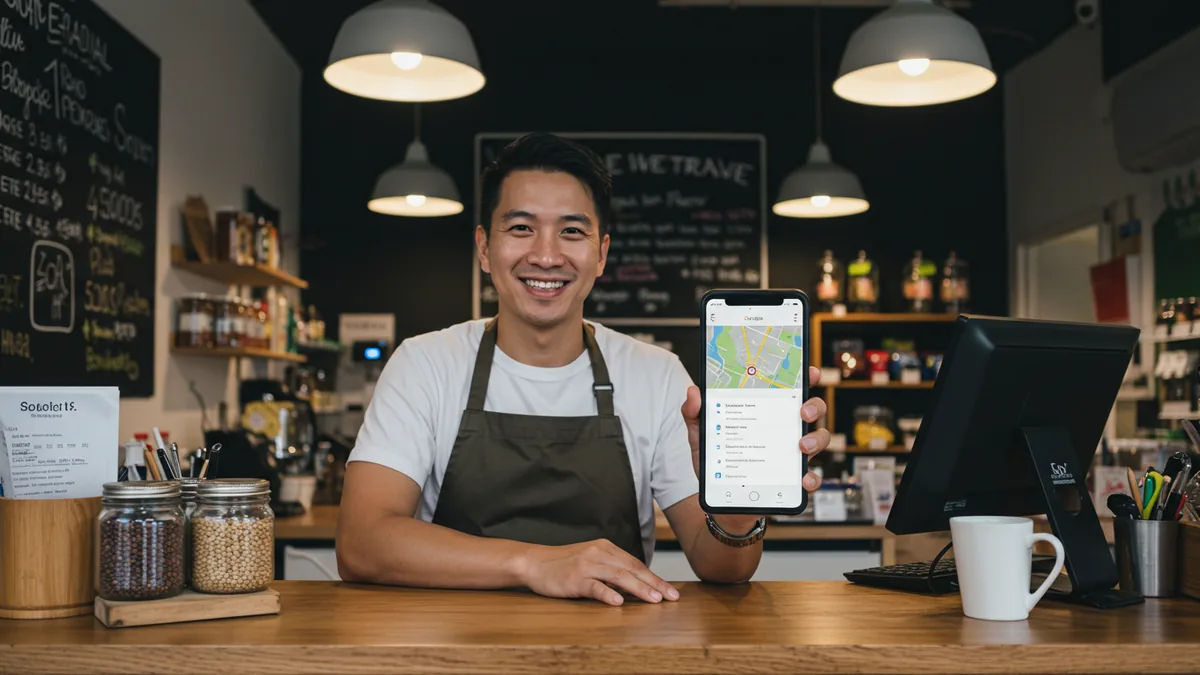
Non-negotiable, and free. Claim your profile, verify it, then actually finish it: exact hours (including holidays), the most accurate primary category, relevant secondary categories, your full service list, real photos of your work and space, attributes, and answered questions. A complete profile is the single biggest driver of whether you appear in the map pack — and “complete” beats “merely claimed” every time.
2. Build a steady stream of recent reviews
Reviews are pure prominence, and 97% of consumers read them before choosing (BrightLocal, 2026). Recency matters as much as volume — a wall of five-star reviews from two years ago reads as stale. Build a simple, repeatable habit of asking every happy customer, make it one tap easy, and reply to every review, good or bad. A business earning a few fresh reviews a month will steadily out-rank a quiet competitor with more old ones.
3. Make your listings identical everywhere
Your name, address, and phone must match exactly across Google, your website, the major maps and review sites, and a strong local directory. Google trusts a business whose details line up everywhere and discounts one that contradicts itself — an old suite number here, a disconnected phone there. You don’t need 100 listings; you need the handful customers actually use, kept perfectly consistent. That same consistency is what feeds the AI answers.
4. Add local signals to your own website
Your site reinforces relevance. Name the neighborhoods and suburbs you serve, build a real page for each core service, publish genuinely useful local content, and mark up your pages with local-business schema so search engines and AI can read your details cleanly. A generic site with no location signals leaves relevance on the table.
5. Show up where AI looks
The 45% asking AI get answers pulled from your profile, your reviews, and reputable directories. There’s no separate “AI strategy” — steps 1 through 4 done well are what get you cited. The businesses investing now are getting a head start their competitors haven’t noticed yet.
Hard left turn: your stomach will thank you for Troy’s dinner list.
Near-Me Search Looks Different for Every Business Type
The fundamentals are universal, but how “near me” plays out — and where you should focus — depends on what you do.
- Restaurants & cafes: “Open now” and photos rule. Keep hours flawless (including holidays), post fresh food photos, and stay on top of reviews — a hungry searcher in Maplewood decides in seconds, and stale hours or dark photos lose them.
- Home & trades services (HVAC, plumbing, roofing): These are service-area businesses. Nail your service-area setup across the metro, lean hard on reviews (trust is everything for someone letting you into their home in Kirkwood or O’Fallon), and win the “emergency ___ near me” and “open now” searches with accurate 24/7 hours if you offer them.
- Retail & shops: Product-level relevance and in-store photos matter. Someone searching “bike shop near me” in Webster Groves wants to see you have what they need before they drive over.
- Professional services (legal, accounting, agencies): Prominence and reputation carry the most weight. Reviews, consistent citations, and authoritative local content build the trust these higher-consideration searches demand.
- Healthcare & wellness: Accurate categories, insurance/attribute details, and recent reviews decide who a patient in Chesterfield or Belleville books.
The Mobile Reality (and the Voice Question)
“Near me” is a mobile behavior first and foremost — these searches happen on phones, on the move, with intent to act immediately. That means the experience after the click matters: a mobile-friendly site, a tap-to-call button, and directions that actually work. If your site is slow or clunky on a phone, you lose the customer even after winning the search.
Voice search — “Hey Google, find a bakery near me” — layers on top of this, and it pulls from the exact same local signals. You’ll see a lot of eye-popping voice statistics online; be skeptical, because most trace back to circular citations with no primary source. What’s reliably true is simpler: voice results lean heavily on your Google Business Profile and structured data, so the work you’re already doing covers it. Don’t chase voice as a separate project — just keep your profile and site clean.
What to Actually Publish: Near-Me Content That Works
Content is how you compound relevance over time. The pages that earn near-me visibility aren’t clever — they’re useful and specific:
- Service-plus-location pages: a real page for each core service, naming the areas you serve, written for humans (not stuffed with “plumber St. Louis plumber Kirkwood plumber”).
- Neighborhood and suburb guides: genuinely helpful local content that signals you know and serve the area.
- Answer-style FAQs: the real questions customers ask, answered plainly — the format both Google’s features and AI assistants love to quote.
Quality beats quantity every time. One thorough, honest, genuinely local page outperforms ten thin ones — and it’s the kind of page an AI assistant will happily cite.
Why You’re Not Showing Up
If you’re invisible for “near me” searches, it’s almost always one of a handful of fixable reasons: an unclaimed or half-finished Google profile; a name, address, or phone that differs across your listings; a vague or wrong primary category; too few recent reviews; or a thin website with no local signals. None of these cost money to fix — they cost an afternoon and then consistent upkeep. The businesses beating you usually aren’t spending more; they’re just more complete and more consistent.
What It Costs — and How Long It Takes
Two fair questions. On cost: every fundamental above is free if you do it yourself — your time, not your money. Done for you, local SEO runs roughly $300 to $2,000 a month across the industry (WebFX). On time: it’s not overnight. Plan on three to six months for meaningful movement — Google itself says SEO changes can take four months to a year to fully register. Anyone promising the top of the map next week is selling something.
Near-Me Optimization in a Metro Like St. Louis
St. Louis makes this both harder and more winnable. It’s a crowded market — 99.4% of Missouri businesses are small businesses (SBA, 2025) — and customers cross municipal lines without a second thought. Someone in Ballwin will drive to Chesterfield or Maryland Heights for the right business; someone in Belleville searches the same way someone in Kirkwood does. That means you’re competing across the whole metro, not just your block — and a business that’s genuinely findable, from Ferguson to Wentzville to the Illinois Metro East, can pull customers a bigger, sloppier competitor never sees.
Watch: The Secret to Dominating Near-Me Search
Go Deeper
Near-me optimization touches every part of your local presence. These companion guides drill in:
- Google Business Profile management — the #1 near-me lever, step by step.
- Where to list your business — the consistency that builds prominence.
- The full small-business marketing playbook — the bigger picture.
Show Up Where Your Customers Are Searching
Every “near me” search is a customer with their wallet already out, looking for someone close. Make sure that someone is you. See exactly where your business stands today — on Google and across the AI engines — with a free AI audit, or list your business so neighbors find you first.
Ready to get found by more St. Louis customers? The fastest way to show up in local and AI search is a complete, consistent online presence. List your business on St Louis Near Me Directory and get a free 6-engine AI visibility audit that shows exactly where you’re being found today.
Frequently Asked Questions
What is a “near me” search?
Any search with local intent — whether or not the person types “near me.” When someone searches “coffee shop” or “electrician open now,” Google assumes they mean nearby and serves local results based on their location. About 46% of all searches carry this local intent (Google, 2018).
How do I rank for “near me” searches?
Optimize the three factors Google uses: relevance (complete profile, accurate category, real services), distance (accurate address and service area), and prominence (recent reviews, consistent listings, reputation). A complete Google Business Profile plus consistent listings and steady reviews is the core of it.
Does “near me” optimization cost money?
Not the fundamentals. Claiming and completing your Google profile, asking for reviews, and fixing your listings cost time, not money. Done-for-you local SEO runs about $300 to $2,000 a month industry-wide (WebFX) — worth it once the free basics are solid, not before.
How long until I start showing up?
A complete profile can appear in local results within days, but ranking well for competitive “near me” searches usually takes three to six months of consistent effort. Google itself says SEO changes can take four months to a year to fully register.
Do I need to optimize for AI search too?
Yes — 45% of consumers now use AI tools like ChatGPT for local recommendations, up from 6% a year earlier (BrightLocal, 2026). The good news is the same fundamentals feed it: a complete profile, consistent listings, and real reviews get you into both Google and the AI answer.
Does near-me optimization work differently for a service-area business?
Yes. If you travel to customers (like a plumber or cleaner) rather than serving them at a storefront, set up a service area listing the suburbs you cover instead of relying on a single pin. That tells Google where you operate so you appear across the metro, not just your home ZIP.
Why does my competitor show up when I don’t?
Usually a more complete and active Google profile, more recent reviews, and more consistent listings across the web — not luck or a bigger budget. Those are all gaps you can close with steady upkeep.
Do I need to worry about voice search?
Not as a separate project. Voice results (“find a bakery near me”) pull from the same Google Business Profile and structured data as regular near-me search, so keeping your profile and site clean already covers it. Be skeptical of dramatic voice statistics online — most lack a credible primary source.
What’s the single most important thing for near-me search?
A complete, active Google Business Profile. It’s the top driver of the local map pack and it feeds the AI answers customers increasingly rely on, so it’s the one move that pays off across every channel at once.

Written by a dedicated team of St. Louis locals who live, work, and play right here in the St. Louis metro. Founder Lane Forman and team are committed to building the region’s most trusted directory by verifying listings and connecting local businesses with loyal customers across Missouri and Illinois.