What Does a Photographer Cost in St. Louis? 2026 Prices and Permits
Revised August 16, 2026

What is a reasonable price for a photographer?
Portrait and headshot work prices at $150 to $350 an hour here; real estate runs $110 to $500 a listing. Weddings are the outlier. The Wedding Report’s 2026 St. Louis estimate puts the photographer line at $3,174 to $3,880 for a 75-guest wedding, and The Knot’s 2026 Real Weddings Study puts the national average at $3,000. Real quotes here span roughly $1,800 to $8,000 depending on hours, second shooter and date. Under $1,000 usually means fewer hours.
Keep reading ↓Imagine it’s a Thursday night in Affton. Your daughter starts her senior year in three weeks, you sit down to book the photos, and the first four quotes are $99, $350, $650 and $1,200. Same city. Same September light.
Or you got engaged on the Katy Trail outside St. Charles and three photographers have already sent numbers from $1,400 to $7,200. Or you’re an agent in Belleville with a listing going live Monday, staring at a $175 bid and a $450 one.
The spread is real, and nearly all of it is explainable. Here’s how much you should expect to pay for a photographer around St. Louis in 2026, what pushes the number up, and what you can skip.
What is a reasonable price for a photographer in the St. Louis metro?
Plan on $150 to $350 an hour for portrait work, roughly $2,700 to $8,600 for full-day wedding coverage, $110 to $500 per listing for real estate, and about $150 to $350 for a headshot session. The Wedding Report’s 2026 St. Louis estimate puts the photographer line for a 75-guest wedding at $3,174 to $3,880.
The Knot’s 2026 Real Weddings Study, built from 10,474 US couples who married during 2025, puts the national average wedding photographer at $3,000 inside an average wedding of $34,200. Regionally it runs $3,800 in the Mid-Atlantic down to $2,600 in the Southwest. St. Louis sits near the middle.
Why does one wedding quote say $1,400 and the next says $7,000?
Four things move it: hours of coverage, whether a second shooter is included, how much editing labor is priced in, and the date. Coverage is the biggest lever — four hours and ten hours are different jobs, and most of the gap is simply time on the clock.
The second shooter. Roughly a third of wedding photographers build one into the base package; the rest charge separately, and adding one typically runs $300 to $700, with some quoting $500 to $1,500. You’re buying simultaneous coverage — two getting-ready rooms, two ceremony angles — which matters as the guest list passes 100.
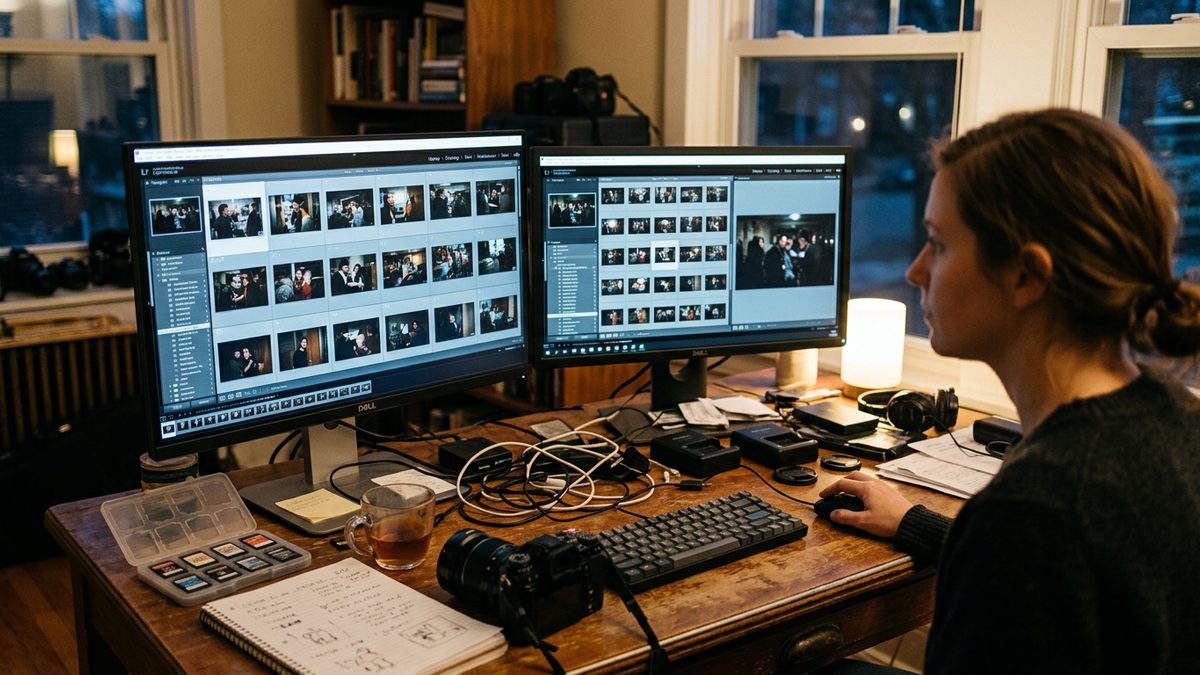
The editing. A full wedding day generates 3,000 to 6,000 raw frames and yields 500 to 800 finished images. Culling takes 3 to 5 hours; editing another 8 to 14. Post-production eats more than half of a working wedding photographer’s business hours. When a quote comes in cheap, that labor is what got cut.
The date. Fall is peak season. The Knot reports 35% of couples marry between September and November, and October alone accounted for 17% of US weddings in 2024. An October Saturday in Kirkwood is the hardest date in the metro to book and the least likely to be discounted.
What do senior portraits, headshots and listing photos run here?
Family and senior sessions price at roughly $150 to $300 per hour of shoot time. St. Louis studio pricing pages in 2026 show session fees from under $100 up to about $650, with full collections landing between $650 and $1,200 once prints or an album are added.
Headshots average about $250 nationally, and most individual sessions fall between $150 and $350. Team shoots get priced per head at volume, roughly $30 to $80 a person on top of a day rate. Watch the add-ons: extra retouching, commercial usage rights and hair and makeup can push $250 past $400.
Real estate photography runs $110 to $500 per listing for a standard package in 2026, with premium HDR at the $300 to $500 end. Drone work prices separately — $75 to $200 as an add-on, $100 to $350 standalone. Anyone flying for a paid listing needs an FAA Part 107 certificate.
Are you buying the copyright or just a print release?
A print release, almost always. Under US law the photographer owns the copyright the moment the shutter fires, and 17 U.S.C. §204(a) says a transfer of copyright ownership isn’t valid unless it is in writing and signed by the owner. Paying the invoice does not move the copyright.
The US Copyright Office states that a work is protected the moment it is created and fixed in tangible form. Handing over a file or an album transfers the object, not the rights. A full transfer leaves the photographer nothing — no portfolio use, no reprints — which is why it costs thousands more when it’s offered at all.
The practical questions are narrower. How many finished images, at what resolution? Does the release cover commercial use, which matters enormously for headshots and listing photos? How long does the gallery stay live? Put those answers in the contract, not a text thread.
Is a photography retainer refundable if your date falls through?
Usually not, and the word in your contract is the reason. A retainer holds a specific date and is normally non-refundable. A deposit is an advance payment toward the work, and if the shoot never happens, it is far likelier to come back. Check which word appears before you sign.
The reasoning is opportunity cost: blocking your October Saturday means declining every other October Saturday, and that date can’t be resold in March. The flip side matters too. If the photographer breaches the contract, they generally owe back everything you paid, retainer included.
Ask what changes if you reschedule instead of cancel, whether there’s an illness clause, who shoots if your photographer goes down, and what happens if files are lost. Those four answers beat a discount.
Wildly off-topic — St. Louis-style pizza is its own argument entirely.
Do St. Louis parks and gardens charge a photography permit fee?
It depends on who owns the ground, so check before you drive. Tower Grove Park states that photography permits are not needed in the park. The Missouri Botanical Garden requires a permit for formal photography — weddings, family sessions, prom, quinceañera — reserved 24 hours ahead.
The Garden’s conditions go past the permit: outdoor public areas only, no buildings, conservatories or Japanese Garden islands; no lighting or reflectors; props limited to one per person, no larger than two feet by two feet. Reservations aren’t accepted during Signature Events.
Gateway Arch National Park. Under the EXPLORE Act changes effective January 2025, still photography involving eight or fewer people needs no National Park Service permit, provided you stay in public areas, use hand-carried equipment, don’t require exclusive use of a spot, and don’t create added costs for the park.
Missouri conservation areas. The Missouri Department of Conservation dropped its paid commercial photography permit on July 1, 2023. A no-cost special use permit is still required if more than 10 people participate in a day, if you fly a drone, if props exceed what one person can carry, or for access outside open hours.
County and city ground. St. Charles County Parks requires professional photographers shooting portraits or group photos for profit to apply for authorization; the parks office is 636-949-7535. In Forest Park, flying a drone requires a City of St. Louis Board of Public Service permit plus a $1,000,000 certificate of insurance. The city Parks line is 314-289-5300.
The Illinois side. Metro East rules are published less uniformly, so call the site. At Cahokia Mounds State Historic Site, every activity requires an Activity Permit approved by the Illinois Department of Natural Resources, and photo sessions are arranged with staff in advance at 618-346-5160.
Which line items are worth paying for, and which are padding?
Pay for the second shooter above 100 guests, pay for the engagement session, pay for the album only if you’ll print it. Skip the rush-delivery upgrade until you know the standard timeline. The Wedding Report’s 2026 St. Louis estimate prices an engagement session at $326 to $398 — cheap rehearsal for a day you can’t redo.
Turnaround. Four to eight weeks is the most commonly cited standard for a full wedding gallery, and some studios quote eight to twelve. A 2026 ShootProof report found 31% of clients expect the full gallery within 14 days. That gap is where the friction lives. Get the number in the contract.
Sales tax, which differs across the river. In Missouri, a separately stated sitting fee or hourly wedding rate isn’t subject to sales tax, finished prints and albums are, and electronic downloads aren’t — the framework set out in Missouri Department of Revenue Letter Ruling LR3714, issued April 4, 2007. Illinois runs it through its photoprocessing rule, 86 Ill. Admin. Code 130.2000, taxing 10% of a separately stated photoprocessing charge. Missouri’s state rate is 4.225%; Illinois’ is 6.25%. How the invoice is itemized changes what you owe.
What questions separate a professional from someone with a good camera?
Five, and they take ten minutes. Are you insured, and can you send my venue a certificate? Do you shoot to two memory cards at once? Who actually shows up on the day? How many weeks until the full gallery? What happens if you’re sick? A vague answer is the answer.
Venues and corporate clients commonly require $1 million per occurrence and $2 million aggregate in general liability coverage, with the venue named on the certificate for your date. A working photographer carries that year-round and can produce it in a day or two. Someone shopping for a policy after you ask has told you something.
Credentials are optional here but checkable. The Professional Photographers of America Certified Professional Photographer credential requires PPA membership, a $200 candidacy application good for two years, six exam modules and a Technical Image Evaluation. Plenty of excellent photographers skip it entirely.
What the price looks like from behind the camera
If you shoot for a living here, the wedding itself is the small part. Eight hours on your feet becomes 3,000 to 6,000 raw frames, 3 to 5 hours of culling and 8 to 14 hours of editing — which is why post-production consumes over half the working hours, and why 44% of photographers report high burnout in peak season. Then the invisible costs: general liability at $1M/$2M because venues demand a certificate before you’re through the door, a second body because one can fail mid-ceremony, redundant storage, and a second shooter paid $200 to $600 a day out of your own fee. The retainer isn’t greed either — holding one October Saturday means declining every other one, in a month that was 17% of US weddings in 2024.
None of it fits in a quote, and none of it helps if the search that starts in Florissant at 10pm never reaches you — the whole argument for keeping a complete, current listing on St Louis Near Me Directory.
Related reading: what visitors take home and photographing an old brick house well.
Tired of comparing quotes that don’t match? Browse photographers across the St. Louis metro on St Louis Near Me Directory, then send three the same short brief — date, hours, second shooter, print release — so the numbers come back comparable.
Frequently asked questions
What is a reasonable price for a photographer?
Portrait and headshot work prices at $150 to $350 an hour here; real estate runs $110 to $500 a listing. Weddings are the outlier. The Wedding Report’s 2026 St. Louis estimate puts the photographer line at $3,174 to $3,880 for a 75-guest wedding, and The Knot’s 2026 Real Weddings Study puts the national average at $3,000. Real quotes here span roughly $1,800 to $8,000 depending on hours, second shooter and date. Under $1,000 usually means fewer hours.
Is $100 an hour good for a photographer?
Below the local market for portrait work, which prices at $150 to $350 an hour here. Session fees under $100 do appear on St. Louis studio pages, but a session fee is not an hourly rate. Culling and editing eat over half a working photographer’s hours.
How much does a 2 hour photo shoot cost?
At the metro rate of $150 to $350 an hour for family and portrait work, two hours lands roughly $300 to $700 before add-ons. Retouching, usage rights and hair and makeup move it; prints or an album put a full collection between $650 and $1,200.
How much should a 20 minute photoshoot cost?
Short sessions are priced as a session fee, not by the minute. St. Louis studio pages in 2026 show fees from under $100 to about $650, and the editing behind those twenty minutes is most of what you pay for.
Do I own the photos I paid a photographer to take?
You own a license to use them, not the copyright. The photographer holds copyright from the moment the shutter fires, and 17 U.S.C. §204(a) requires any transfer of ownership to be in writing and signed. Most contracts grant a print release — permission to print and post personally. Commercial use is separate, so ask if you need it.
Is a photography deposit refundable if I cancel?
Check whether the contract says deposit or retainer. A retainer holds a date and is normally non-refundable. A deposit is an advance payment toward the work and is likelier to be returned if the session never happens. If the photographer cancels, they generally owe everything back.
Do I need a permit to take photos at the Missouri Botanical Garden?
Yes, for formal photography. The Garden requires a permit for weddings, family sessions, prom and quinceañera photos, reserved at least 24 hours ahead and unavailable during Signature Events. Sessions stay in outdoor public areas, lighting equipment and reflectors aren’t allowed, and props are capped at one per person at two feet square. Casual snapshots need no permit.
Do I need a permit to shoot photos at the Gateway Arch?
Usually not. Under EXPLORE Act changes effective January 2025, still photography with eight or fewer people needs no National Park Service permit if you stay in public areas, use hand-carried equipment, don’t need exclusive use of a spot, and don’t create extra costs for the park. Bigger groups or mounted equipment still require one.
How long does it take to get wedding photos back?
Four to eight weeks is the most commonly cited industry standard, and some studios quote eight to twelve. Many photographers send a preview within 24 to 48 hours. Expectations have outrun delivery: a 2026 ShootProof report found 31% of clients expect the full gallery within 14 days. Get the number in writing.
Do photographers charge sales tax in Missouri and Illinois?
Both states tax the physical goods rather than the service, but the mechanics differ. Missouri exempts separately stated sitting fees and hourly rates, taxes finished prints and albums, and leaves electronic downloads untaxed. Illinois applies its photoprocessing rule, taxing 10% of a separately stated photoprocessing charge. Missouri’s state rate is 4.225%; Illinois’ is 6.25%.

Written by a dedicated team of St. Louis locals who live, work, and play right here in the St. Louis metro. Founder Lane Forman and team are committed to building the region’s most trusted directory by verifying listings and connecting local businesses with loyal customers across Missouri and Illinois.