St. Louis Food Traditions: The Dishes This City Actually Invented
Revised August 16, 2026
What food is only found in St. Louis?
The St. Paul sandwich comes closest. It is an egg foo young patty on white bread with mayo, lettuce, tomato and pickle, sold at small Chinese carryouts across this metro and almost nowhere else, including St. Paul, Minnesota. The slinger is nearly as local: order one in another city and you get a blank look.
Keep reading ↓Imagine it’s a Saturday in September and a college friend has flown in for the weekend. She wants the real thing — not the airport version, not whatever a travel list told her to eat. So you stand in your Affton kitchen with your keys in hand and realize you can’t answer a simple question: what does St. Louis eat that nowhere else does?
Maybe you start listing. Toasted ravioli, obviously. The slinger, if she’s willing to still be awake at 2 a.m. Gooey butter cake from a bakery counter in Florissant that has made it the same way since before you were born. A pork steak, because half of Kirkwood still has a grill going. Then you stall out, because you don’t know where any of it came from. You just know somebody’s grandmother made it.
Here is what most of us never learned. Some of these dishes have a paper trail. Some are folklore repeated until it hardened into fact. This is the honest answer to what foods originated in St. Louis — what this city invented, what two families are still arguing over, and why it all tastes the way it does from Belleville to St. Charles.
What food is St. Louis famous for?
St. Louis is known for toasted ravioli, the slinger, gooey butter cake, grilled pork steaks, the St. Paul sandwich, frozen custard concretes, crispy pig snoots and Red Hot Riplets potato chips — plus its own square-cut pizza. Nearly all of it was invented in the 20th century, in working kitchens, by people trying to sell something cheap.
Two threads run through the list. One is thrift: the pork shoulder, the pig snout, the ravioli already sitting there. The other is accident. At least four of these dishes come with a story about somebody dropping the wrong thing in the wrong pot, and those stories are charming and mostly unprovable.
Pizza already has its own long argument, so it stays there: the Provel, the cracker crust and the square cut are covered in our piece on St. Louis-style pizza. Everything below is the rest of the menu.
Who invented toasted ravioli?
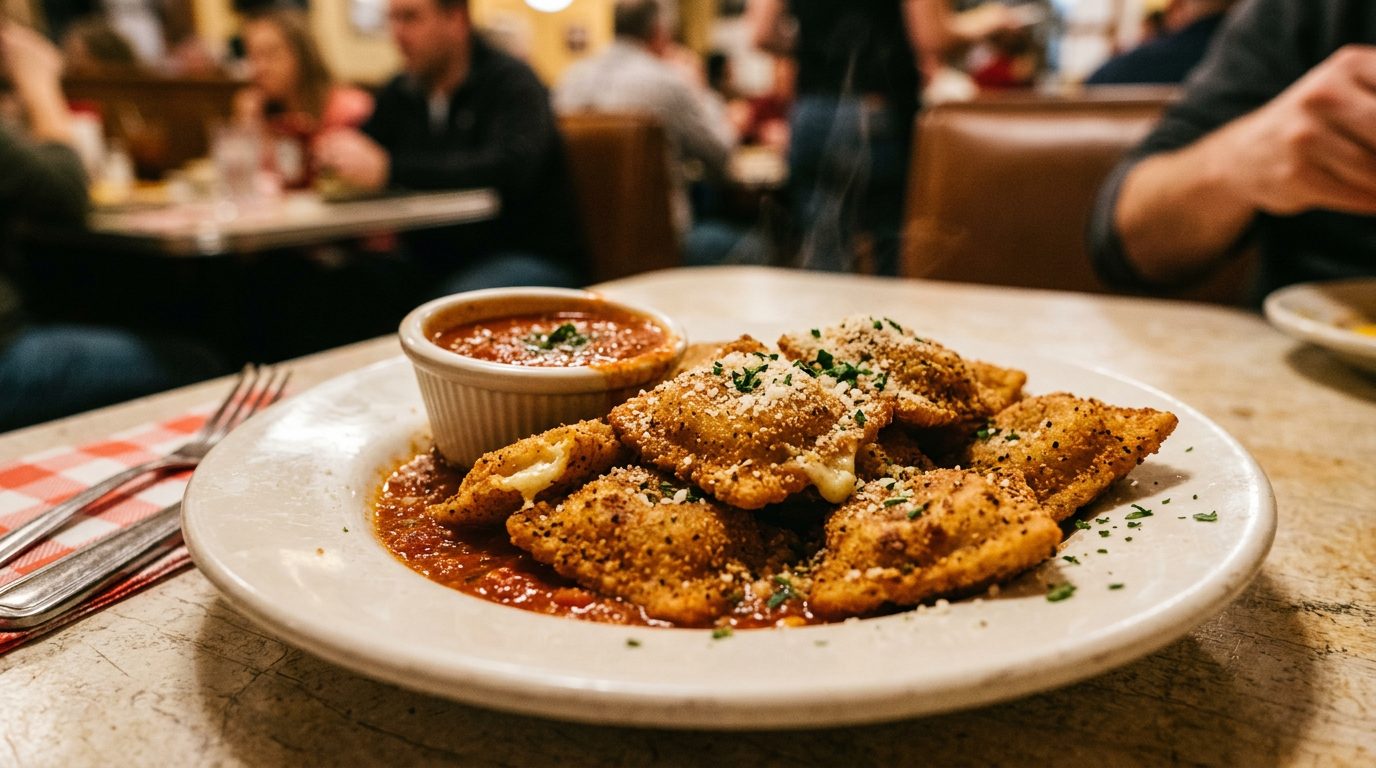
Nobody can prove it, and anyone who tells you otherwise is repeating a family story. Toasted ravioli — breaded, deep-fried, dusted with Parmesan, served with red sauce for dipping — is claimed by at least three long-running restaurants on the Hill. The dispute has never been settled and the reporting on it consistently calls the origin disputed.
The competing accounts are suspiciously alike, which is part of the trouble. Two involve a cook dropping ravioli into hot oil instead of boiling water in the early 1940s. A third family says the dish came from Sicily and points to menus from the 1930s. The oldest hard evidence usually cited is a 1943 advertisement in the St. Louis Star and Times, in which one Hill restaurant offered toasted ravioli and claimed in print to have originated it.
An ad proves the dish was on sale in 1943. It does not prove who fried the first one, and nearly everyone involved died decades ago. Treat the fryer-accident tale as folklore.

What exactly is a slinger?
A slinger is two eggs, hash browns and a hamburger patty on one plate, buried under chili and shredded cheese, usually finished with raw onion. It is a diner dish, it is enormous, and it barely exists outside this metro. Order one in another city and you will get a blank look.
The origin here is lore rather than record. The family behind a Gravois Avenue diner has long said the plate was assembled there in the 1970s, and that the name came from a cook being told to just sling it together. Other diners copied it fast, which is why there is no fixed recipe: some add a tamale, some swap in sausage, some build it on a pork steak.
The slinger is closing-time food. It turns up on late-night menus in south city, out in Maryland Heights, across in Belleville, because it does one job: it absorbs a night out. Nothing about it is delicate. That is the design.
Is gooey butter cake really a St. Louis mistake?
Probably, but no version of the story has ever been documented. Gooey butter cake is a yeast-raised bottom crust under a dense, barely set butter-and-egg topping, and it traces to south St. Louis German-American bakeries in the 1930s. Several origin stories circulate and none has been historically verified.
Two families have gone on the record in local press. One account, from the son of a south city bakery owner, credits a different baker entirely — John Hoffman — with a mix-up between gooey butter, a sticky smear bakers used like glue, and deep butter, the batter for a coffee cake. The other comes from the daughter of a baker at California and Arsenal, and puts it in the early 1940s. Both are family memory written down decades later. Neither carries documentation.
One quieter fact is worth knowing: the cake most people bake at home is not the original. The bakery formula is yeast-raised and stabilized with corn syrup or glycerin. The cream-cheese-and-cake-mix version that spread through cookbooks is a later shortcut, and it has largely buried the real thing.
Why do St. Louisans grill pork steaks instead of beef?
A pork steak is a half-inch slice cut across the pork shoulder — the same cut sold whole as a Boston butt. It runs with fat and connective tissue, so it needs a slow grill and a long finish: sear it, then braise it covered in beer and barbecue sauce until it goes tender.
The reason it is a St. Louis thing is actually documented, and it is a grocery story, not a restaurant one. Feast Magazine credits Schnucks Markets with popularizing the cut here in the late 1950s, when second-generation owners Don and Ed Schnuck began selling shoulder steaks as an inexpensive piece of meat that grilled well and fed a crowd. That timing lands squarely on the rise of backyard charcoal grilling, in a city already built around meatpacking.
Changing subjects completely — the Mexican food here deserves its own trip.
What is a St. Paul sandwich?
A St. Paul sandwich is an egg foo young patty — egg with bean sprouts and onion, fried flat — served on plain white bread with mayonnaise, lettuce, tomato and dill pickle. It is a fixture of small carryout Chinese kitchens all over the St. Louis metro and almost unknown elsewhere, including in St. Paul, Minnesota.
The usual story credits a Lafayette Square chop suey parlor in the early 1940s and says the owner named the sandwich for his Minnesota hometown. That account gets repeated everywhere and it has a hole in it: the phrase St. Paul sandwich appears in American print as far back as 1904, long before the local version existed.
Food historians offer a wider frame. James Beard and Evan Jones argued that the Denver or Western sandwich came from Chinese cooks feeding railroad crews and logging camps in the 19th century, and was itself derived from egg foo young. By that reading the St. Paul is a local branch of much older Chinese-American road food. It was a metro staple by the 1970s.
What makes frozen custard different from ice cream?
Egg yolk, and the federal government put a number on it. Under FDA rules at 21 CFR 135.110, a frozen dessert must contain at least 1.4 percent egg yolk solids by weight to be labeled frozen custard or French ice cream. Below that threshold it is legally ice cream. The yolk is why custard eats denser and smoother and melts slower.
The concrete is the St. Louis addition. It is custard blended with mix-ins until it is stiff enough to hand over the counter upside down without losing any, and it was introduced at a St. Louis custard stand in 1959 — by the shop’s own account, after a teenage regular kept asking for a thicker malt until the milk got left out. The upside-down handoff became the local test of whether it was made right.
What are snoots, and where do they fit in St. Louis barbecue?
Snoots are pig snouts — shaved, cut away from the nasal cavity with the skin on, then smoked or fried until they shatter like a pork rind. They come sauced, sometimes on white bread, often next to rib tips. Texture is the appeal: crisp at the edge, chewy behind it, closer to bacon than rib meat.
Snoots are the clearest link between St. Louis barbecue and St. Louis history. The city ran an enormous hog-processing trade, and the parts nobody wanted were cheap and abundant. Black pitmasters in north St. Louis and across the river in East St. Louis built a tradition on those cuts from roughly 1930 on, the same decade snoot sandwiches sold in Memphis, Atlanta and Harlem.
The sauce belongs to that tradition too. St. Louis-style barbecue sauce is tomato-based, sweeter and thinner than Kansas City sauce, which is why it goes on late and why it runs down your wrist.
Red Hot Riplets, the Hill, and the rest of the pantry
Red Hot Riplets are a ridged potato chip in a sweet-hot barbecue seasoning, made by Old Vienna, a St. Louis chip company founded in 1936. The flavor arrived in the late 1970s and now accounts for roughly 80 percent of the company’s sales, according to Feast Magazine. The seasoning was bottled on its own in 2017 and a sauce followed in 2018 — a chip that became a condiment.
The Hill is the other engine. Italians from Lombardy and Sicily started arriving in the 1880s to work the clay mines and brick works on that ridge, and by 1910 the neighborhood was roughly 90 percent Italian. It stayed dense and self-contained, with its own groceries, bakeries and butchers — which is why so much of what this metro treats as ordinary, from the salsiccia to the toasted ravioli argument itself, came out of about forty square blocks.
What a regional specialty costs the kitchen that makes it
Here is the side diners never see. Food cost at a full-service independent typically runs 28 to 35 percent of revenue, and smaller operators under $2 million in sales sit closer to 34 percent. Labor for full-service reached a median near 36.5 percent of sales in 2025. Missouri’s minimum wage went to $15.00 an hour on January 1, 2026, with tipped staff owed at least $7.50 plus enough to reach $15.00; Illinois is at $15.00 statewide as well. What is left is a net margin around 3 to 8 percent. Regional specialties squeeze that further — toasted ravioli is labor before it is food cost, snoots take hours of smoke for a low ticket price, and a third-party delivery order can take 15 to 30 percent off the top. Which is why good operators guard their own channel: the phone, the pickup counter, and being findable when somebody searches the category.
Related reading: the pizza argument in full and how to ship it.
Ready to eat your way through the argument? Browse American food across the St. Louis metro on St Louis Near Me Directory, then pick one dish off this list and go settle it for yourself this week.
Frequently asked questions
Who really invented gooey butter cake?
No one knows. Two St. Louis baking families have each claimed it in local press — one crediting a baker named John Hoffman, the other a baker at California and Arsenal. Both were recorded decades after the fact and neither has documentation. The safe statement is that it came from a south city German-American bakery in the 1930s.
Is toasted ravioli actually from Italy?
Not in the form St. Louis serves. Fried filled pasta exists in Italian regional cooking, and one Hill family says their version came from Sicily. But breaded, deep-fried ravioli with marinara for dipping is an American dish that spread from this city. Three Hill restaurants claim it and none can prove it; the earliest print evidence is a 1943 newspaper ad.
What goes on a slinger?
Two eggs, hash browns and a hamburger patty on one plate, covered in chili and shredded cheese, with raw onion on top. There is no official recipe — diners across the metro swap the patty for sausage or a pork steak, add a tamale, or change the chili. The constant is the layering: starch, egg, meat, chili, cheese, onion.
Why are pork steaks so popular in St. Louis?
Because a local grocer made them a habit. Feast Magazine credits Schnucks Markets with popularizing the cut in the late 1950s, selling half-inch steaks off the pork shoulder as cheap meat that grilled well and fed a family. That coincided with the backyard charcoal boom in a meatpacking town. The cut is still uncommon outside the Midwest.
What food is only found in St. Louis?
The St. Paul sandwich comes closest. It is an egg foo young patty on white bread with mayo, lettuce, tomato and pickle, sold at small Chinese carryouts across this metro and almost nowhere else, including St. Paul, Minnesota. The slinger is nearly as local: order one in another city and you get a blank look.
What foods originated in St. Louis?
Toasted ravioli, the slinger, gooey butter cake, the frozen custard concrete and Red Hot Riplets all started here in the 20th century, and the St. Paul sandwich took its current form here. The pork steak is the odd one out: popularized here, not invented here.
What is St. Louis food famous for?
Thrift and accident. Toasted ravioli, the slinger, pork steaks, snoots, gooey butter cake, concretes and Red Hot Riplets came out of working kitchens selling cheap cuts, and several carry an origin story about somebody dropping the wrong thing in the wrong pot.
What is a must eat in St. Louis?
It depends on the hour. Toasted ravioli is the standard table starter on the Hill, a pork steak is the summer backyard answer, gooey butter cake belongs to a bakery counter rather than a restaurant, and after midnight it is a slinger.
What is the difference between a concrete and a milkshake?
A concrete is made with frozen custard rather than ice cream, and it is blended thick enough to hold when the cup is turned upside down. Federally, frozen custard needs at least 1.4 percent egg yolk solids under 21 CFR 135.110; ice cream has less. That yolk gives custard its density. A milkshake is thinner and made to drink through a straw.

Written by a dedicated team of St. Louis locals who live, work, and play right here in the St. Louis metro. Founder Lane Forman and team are committed to building the region’s most trusted directory by verifying listings and connecting local businesses with loyal customers across Missouri and Illinois.