A Missouri Mastodon Stands in London: Things to Do in Imperial, MO
Revised November 10, 2026
Is there a mastodon bone found in Missouri?
Yes. The best-known site is the Kimmswick Bone Bed, preserved at Mastodon State Historic Site in Imperial, where Albert Koch dug in 1839. In 1979, a stone Clovis spear point turned up with mastodon bones there, the first site in eastern North America to conclusively show people and mastodons together.
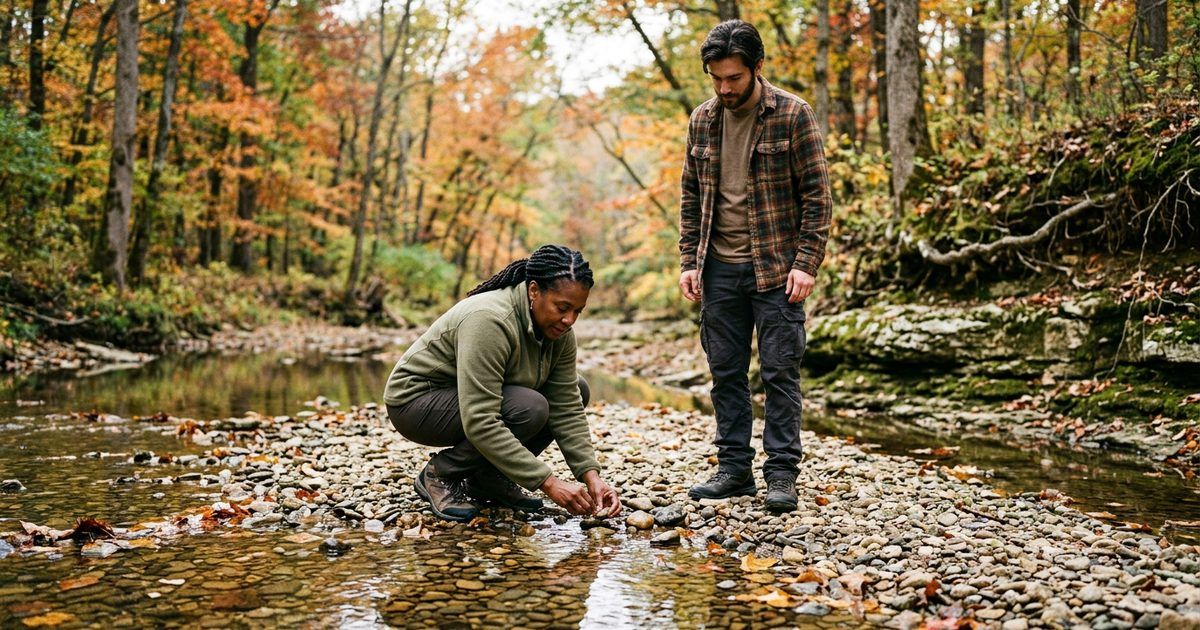
Keep reading ↓Hold the rope. Behind the museum at Mastodon State Historic Site in Imperial, the paved path down the hill turns very steep, then gives way to flagstone and gravel with a rope railing to steady your hand. At the bluff, railed steps and stretches of fine gravel take you to the bottom, and the trail runs right through the bone beds. This is the ground where, in 1979, a stone spear point turned up with mastodon bones. There’s no pit to peer into. What’s left of the bone bed is “safely buried,” the state says. You’re standing on it.
Now the part that sounds made up. In 1839 a St. Louis museum owner named Albert Koch came here after hearing about bones weathering out of the banks of Rock Creek, according to Missouri State Parks, dug them up and named his find the Missouri Leviathan. The skeleton he showed off was about twice the size of a real mastodon, padded with extra vertebrae and ribs, wood wedged between the bones and the tusks set so they swept out sideways, London’s Natural History Museum says. “His goal was to impress people,” says the museum’s extinct megafauna expert, Adrian Lister.
It worked. Koch toured the monster to an exhibition hall in Piccadilly, where Richard Owen of the British Museum convinced him it was just an American mastodon and bought the fossils in 1844 for $2,000 down and $1,000 a year for the rest of Koch’s life. Koch lived 22 more years. The museum says the deal cost around $24,000. Owen took the monster apart and rebuilt it in its true shape, and it stands on the ground floor of Hintze Hall today, “the first accurate mount of a mastodon, anywhere, ever.” (The London museum dates Koch’s big find to 1840, from a farmer’s land, and Koch dug at more than one Missouri site, so nobody can point at one bone in London and swear it came out of Rock Creek.)
Rock Creek kept giving up bones. Around the turn of the 20th century an amateur St. Louis paleontologist, C.W. Beehler, dug skulls, jaws, teeth and tusk out of the same ground and kept them in a wood shack museum near the bone bed, and railroad tours from St. Louis brought visitors down to see it, especially during the 1904 World’s Fair. A quarry worked the site from the 1870s through the 1930s and destroyed many of the Ice Age remains. Then Interstate 55 came through in the 1970s, and the Mastodon Park Committee, local legislators, private citizens, companies and local schoolchildren pushed until the state bought the 418 acres holding the bone bed in 1976. Of all the small towns outside St. Louis, Imperial might be the one people know only as an exit sign.
Is there a mastodon bone found in Missouri?
Yes. The best-known site is the Kimmswick Bone Bed, preserved at Mastodon State Historic Site in Imperial, where Albert Koch dug in 1839. In 1979, a stone Clovis spear point turned up with mastodon bones there, the first site in eastern North America to conclusively show people and mastodons together.
The site is at 1050 Charles J. Becker Drive, just off I-55. The grounds and trails are open every day of the year from 8 a.m. to a half-hour after sunset, and walking them costs nothing. Only the museum charges: $4 for anyone 13 and up, free for kids 12 and under. Museum hours change with the season. From March 16 through Nov. 15 it’s open 9 a.m. to 4:30 p.m. Wednesday through Saturday and noon to 4:30 p.m. Sunday. From Nov. 16 through March 15 it’s open 11 a.m. to 4 p.m. Thursday through Saturday and noon to 4 p.m. Sunday. Call the site office at 636-464-2976 before a winter trip.
Wildflower Trail starts near the museum and loops back up the slope past a historic quarry. It’s about half a mile, steep in places and laid in gravel fines at the bottom. Inside the museum, the state lists hands-on specimens next to the glass cases, a 15-minute video and a mastodon skeleton replica it calls “a sight that is not easily forgotten.”
The spear point came out of a 1979 dig the state sponsored, and paleontologist Russell W. Graham of the Illinois State Museum is credited with that first solid evidence. For its archaeological and paleontological significance, the bone bed went on the National Register of Historic Places on April 14, 1987, and the state calls it one of the oldest known archaeological sites in Missouri, more than 10,000 years old.
For the rest of a visit here and next door, our Arnold guide covers visiting Mastodon State Historic Site too.
Which trail should you hike at Mastodon?
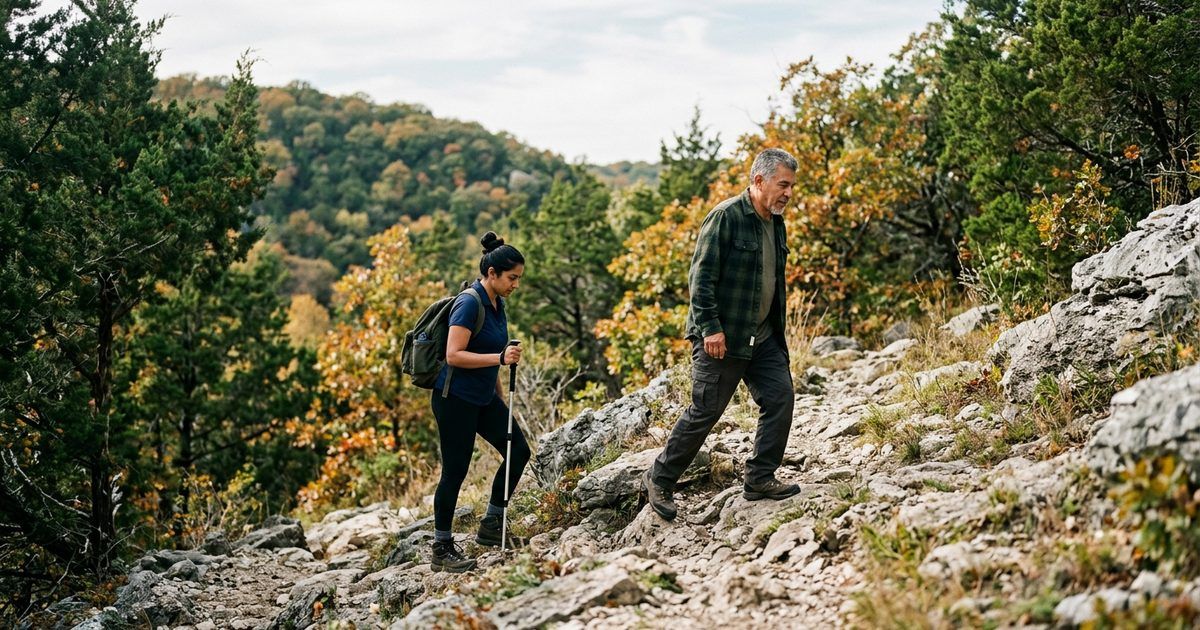
There are three trails. Wildflower is the short one, the half-mile walk to the bone bed. Limestone Hill is the one with some grit: the state describes it as natural, rugged surfaces through the woods, so wear real shoes. Spring Branch is the third. Pick by who’s with you, then check the state’s trail maps before you go.
One St. Louis secret about Limestone Hill: the site sometimes leads it after dark. Its Hunter’s Moon Hike was planned as a guided walk of up to 1.5 miles on Limestone Hill by the light of the full moon, a rare chance to be in the park after hours, with registration required and room for just 25 people. Then the state canceled it for lack of registration. Not enough people signed up. If the site puts another night hike on its calendar, call 636-464-2976 and grab a spot before you talk yourself out of it.
The state’s explanation of the name is worth knowing anyway. The hunter’s moon is the first full moon after the harvest moon, and it got its name, the state says, from Native Americans using its light to hunt animals feeding on the last of the harvest.
For toddlers. The site runs free Toddler Thursdays at 10 a.m., up to an hour of story time and a craft for toddlers and their grown-ups, right outside the museum, or in the auditorium if the weather turns. No registration. Bring a water bottle and a lawn chair or blanket. The next two are Nov. 19 (Indigenous Americans) and Dec. 17 (animals in winter).
For a group campout. There’s no regular campground, but a special-use area is set aside for group camping, with nonprofits and youth groups getting priority. It has vault toilets, water, picnic tables and fire rings, and it costs $2 per person, per night. Call 636-464-2976 to reserve it.
What did Koch think the Missouri Leviathan was?
A sea monster, more or less. The name pointed to the biblical one, and Koch believed the animal lived underwater, using those sideways tusks as hooks to hang onto branches below the surface, the Natural History Museum says. He toured it all over North America and then shipped it across the Atlantic to Europe, a very costly trip at the time, before it landed in an exhibition hall in Piccadilly, where Owen saw it.
The museum is gentler on Koch than you might expect. Nobody really knew how these animals lived back then, the museum points out, and it was common to try to fit discoveries into stories from the Bible. The real animal was strange enough. American mastodons lived in pine forests and boggy ground, ate twigs, leaves and water plants, and had broad feet with wide-splayed toes for walking on soft, waterlogged ground beside ponds and lakes. That fits what paleontologists think the Imperial site once was: swampy, with mineral springs, where animals coming to drink could get trapped in the mud.
How do you tell a mastodon from a mammoth? The museum’s short version: the mammoth has very high shoulders, a sloping back and twisted tusks, while mastodon tusks are shorter and gently curved. Look for that in the replica skeleton at the museum here.
Where did the rest of the bones go?
Mostly, away. Missouri State Parks says many of the remains from the Kimmswick Bone Bed disappeared or were destroyed over the years. Besides the quarry, there were plenty of non-scientific digs where people gave away or sold bones and tusks. Beehler’s excavations weren’t well documented either, so when he found stone artifacts in the deposit, scientists didn’t accept them as proof that people had lived alongside the animals.
The serious digging came later. From 1940 to 1942, archaeologist Robert McCormick Adams of the St. Louis Academy of Science led excavations sponsored by the Works Progress Administration, recovering more fossils but few artifacts. After the state bought the land, Missouri State Parks sponsored digs in 1979, 1980 and 1984, and the first of those produced the spear point that put the site in the textbooks.
Where do you bowl in Imperial?
Imperial Bowl, at 6045 W. Outer Road, right off the highway. It’s open 11 a.m. to 11 p.m. Sunday through Thursday, 11 a.m. to midnight Friday and 9 a.m. to midnight Saturday, and the number is 636-464-2695.
Two things to know before you walk in. Smoke-free times are Saturdays and Sundays from open until 5 p.m., so if smoke bothers anyone in your group, that’s your window. And from mid-April through September, kids 15 and under get two free games every day when you sign them up. The center runs senior, men’s, women’s and mixed leagues, and posts tournament results on its site.

Mastodons ate twigs and water plants. You can do better: where to eat in Imperial, MO
What’s near Imperial for a longer day?
Imperial sits in a stretch of Jefferson County where the next good stop is a few minutes away:
- Things to do in Kimmswick, the river village next door
- Crites Park in Festus
- Things to do in Ste. Genevieve, farther south
- Our guide to the buildings left from the 1904 World’s Fair, for the city end of Beehler’s story
- The best arcades in St. Louis, for a rainy day
Hungry after the walk down to the bone bed? Our guide to where to eat in Imperial, MO covers the kitchens a few minutes from the museum lot.
If you’re the diner, the pizza place or the bait shop on the Outer Road that hikers and league bowlers drive past, those are customers already hungry and already in town. Get your name in front of them.
Next time somebody calls Imperial an exit sign, you’re the one who knows a Missouri mastodon stands in London, the man who sold it got paid for 22 years, and the bone bed is still under your feet at the end of a half-mile trail. Go on a weekday. Walk down. Look at the creek.
Frequently asked questions
Did mastodons ever live in Missouri?
Yes. During the last Ice Age, mastodons roamed the Midwest alongside giant ground sloths and peccaries, according to Missouri State Parks. Paleontologists think the Imperial site was once swampy, with mineral springs, and that animals coming to the springs got trapped in the mud, which helped preserve their bones. People had reached what’s now Missouri by at least 12,000 years ago, and for a short stretch at the end of the Ice Age, the two overlapped.
How much is a mastodon tooth worth today?
We couldn’t find a reliable price, and we won’t guess at one. What matters locally is that you can’t take one home from Mastodon State Historic Site. Missouri State Parks rules say removal of rocks, artifacts or relics is prohibited without written permission from the state park director. The museum’s fossil displays are the way to see one up close, for $4 or free for kids 12 and under.
What are some hidden places to visit in Missouri?
Start with one off I-55 in Jefferson County. In Imperial, the half-mile Wildflower Trail at Mastodon State Historic Site drops to the spot where a Clovis spear point turned up among mastodon bones, and the grounds are open from 8 a.m. to a half-hour after sunset every day. Pair it with the river village next door in Kimmswick and you’ve filled a Saturday.
Is there a bowling tournament in St. Louis?
Plenty, and one place to watch for them south of the city is Imperial Bowl, which posts tournament results on its site and runs senior, men’s, women’s and mixed leagues. Call 636-464-2695 to ask what’s coming up.
Can you camp at Mastodon State Historic Site?
Only as a group. There’s no regular campground for individual campers. The special-use area is set aside for group camping, with nonprofits and youth groups getting priority, and it has vault toilets, water, picnic tables and fire rings. The fee is $2 per person, per night. Call the site office at 636-464-2976 to reserve. When no group has it booked, the area is open for general use.

Written by a dedicated team of St. Louis locals who live, work, and play right here in the St. Louis metro. Founder Lane Forman and team are committed to building the region’s most trusted directory by verifying listings and connecting local businesses with loyal customers across Missouri and Illinois.