Things to Do in New Haven, MO: Public Telescope Nights, $5 Movies at the Walt, John Colter's Lost Grave
Revised October 7, 2026
Is there anything to do in New Haven MO?
Yes, and the best of it happens after the tasting rooms close. New Haven, MO has a 1940 Art Deco movie house where tickets are still $5, a 30-inch telescope a club opens to the public on scheduled Friday nights, a levee river walk past John Colter’s memorial, and a Pumpkin Glow and Christmas by Moonlight downtown.
Keep reading ↓Forget the wineries. Every recycled New Haven list leads with a tasting room that closes by 5, and a widely circulated one still sends readers to a winery that retired in 2023. The New Haven worth the drive starts after dark. On scheduled Friday nights from March through November, a volunteer astronomy club opens a 30-inch telescope in a field two miles west of town to anyone who walks down the rock road at dusk. Downtown, an Art Deco movie house that opened in 1940 still projects onto its original screen, and a ticket still costs $5, cash or check.
New Haven sits on the south bank of the Missouri River in Franklin County, 11 miles west of Washington on Highway 100 and about 64 miles from downtown St. Louis. It has 2,414 people, a short downtown on Front Street, a levee you can walk on, and a reputation as a wine-and-gin stop that empties out once the tasting bars close. Of all the small towns outside St. Louis, it’s the one most people leave an hour too early.
Everything below was checked against the astronomy club’s, the theater’s, the Missouri Department of Conservation’s, the chamber’s and the organizers’ own pages on Oct. 6, 2026. Small-town schedules move. Check before you drive.
Is there anything to do in New Haven MO?
Yes, and the best of it happens after the tasting rooms close. New Haven, MO has a 1940 Art Deco movie house where tickets are still $5, a 30-inch telescope a club opens to the public on scheduled Friday nights, a levee river walk past John Colter’s memorial, and a Pumpkin Glow and Christmas by Moonlight downtown.
Besides Röbller Vineyard and Pinckney Bend Distillery, which lead every list and which our guide to where to eat in New Haven, MO already covers, the town runs a second shift. For everything else, here’s New Haven sorted by when you’d go:
Friday nights, March through November: Big Blue, the 30-inch telescope, on the club’s scheduled dates. Friday, Saturday and Sunday, most weeks: a first-run movie at the Walt for $5. Any daylight hour: the levee walk and the cluster of historical markers at John Colter Memorial Park. Rainy afternoons: theater seats facing a glass furnace at Astral Glass, and two free museums in an 1883 schoolhouse. October: the Scarecrow Festival and Pumpkin Glow downtown, plus a U-pick pumpkin patch out on Highway E. December: two free Fridays of Christmas by Moonlight.
A lot of that is free. The movie is five dollars.

How much is a movie at the Walt Theatre in New Haven?
Five dollars. That’s the ticket price at the Walt Theatre, 111 Front St., and children 2 and under get in free. The box office takes cash or check only, so bring cash. Shows run Friday and Saturday at 7 p.m. and Sunday at 5 p.m., and the box office opens 30 minutes before each one. The Walt plays first-run movies, meaning current releases, plus the occasional special screening.
Here’s why it’s worth the trip. The Walt opened on Nov. 14, 1940, with three showings of the western “Wyoming,” starring Wallace Beery. Kids paid 10 cents. Adults paid 25. More than 85 years later the theater still has the same marquee out front, and it still projects onto the same white screen that first movie played on. The one big change came in the summer of 2014, when it switched from 35mm film to digital; the first digital show was Friday, Aug. 29, 2014. It’s a fully restored Art Deco house, and it’s locally owned and operated.
Do the date-night math. Two tickets cost $10. The Sunday 5 p.m. show has you back in St. Louis at a reasonable hour before the work week starts.
One 2026 date: on Saturday, Oct. 17, from 7 to 9 p.m., the Walt is set to screen “The Trail State,” a documentary about how Missouri turned a flooded rail line into the Katy Trail, America’s longest rail-trail. Gov. Mike Kehoe proclaimed Sept. 22 Trail State Day, the day the film premiered at the Missouri History Museum. Seeing it in a 1940 theater, in a river town that sits across the water from the trail, beats watching it at home. Its 2026 schedule also had the Walt closed Oct. 9 to 11 and on Oct. 18, so check the Now Showing panel on its homepage before you drive.
For cheaper seats closer to home, our guide to cheap movie tickets in St. Louis covers discount days and the independent single screens around the city. The Walt is the long-drive version of the same idea, with a better marquee.
Dinner before the 7 p.m. show? Where to eat in New Haven, MO
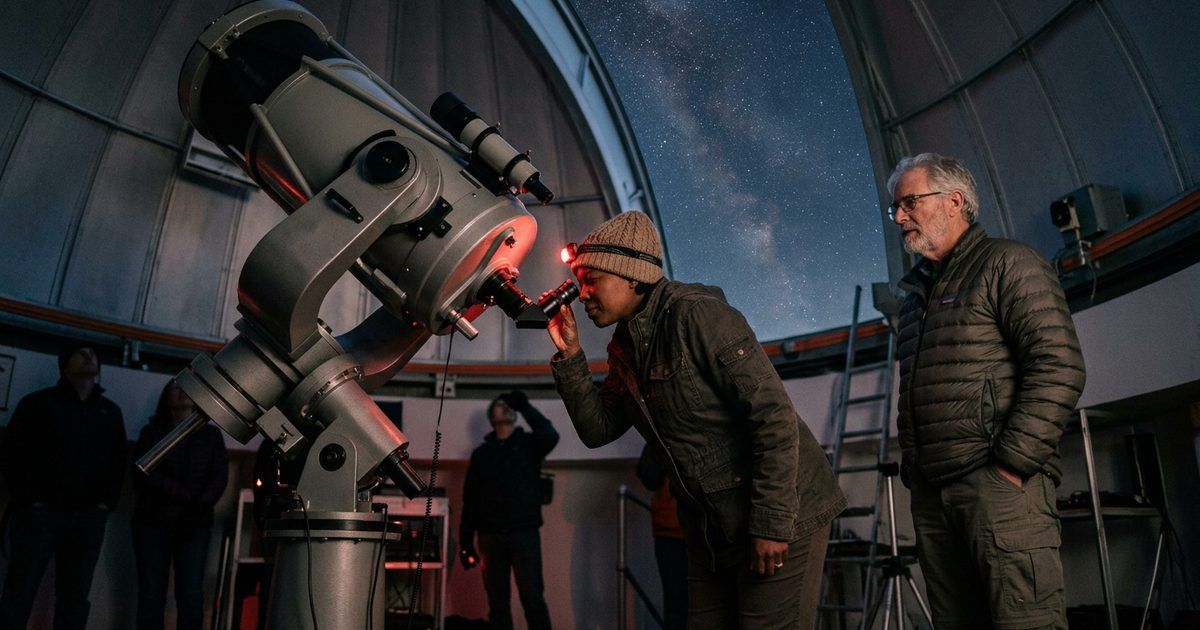
Where can you look through a 30-inch telescope near St. Louis?
At Big Blue Observatory, two miles west of New Haven, on the public nights the Eastern Missouri Dark Sky Observers schedule from March through November. The club dates to 1991, and Big Blue is its 30-inch telescope, housed in an observatory on the grounds of Cedar Creek Conference Center, 1401 Olive Road. Nights start at dusk. The club’s site lists no admission charge, and there’s no ticket to buy. You park, walk down a rock road and wait your turn at the eyepiece.
Why 30 inches matters. What a telescope can show you depends mostly on the width of its main mirror. A 30-inch mirror gathers roughly 12,000 times the light of a fully dark-adapted human eye, and about 14 times what a common 8-inch backyard scope collects. Faint galaxies and nebulas that look like gray smudges in a small scope start to show structure. That’s the difference you drive out for.
2026 public nights. Friday, Oct. 9; Friday, Nov. 6; and Friday, Nov. 13. Those three close out the 2026 season. There are no public nights in December, January or February, and the club warns that November weather often cancels. The 2026 season opened March 13, so look for the 2027 list to start around mid-March; it wasn’t posted as of early October 2026. Clouds or bad weather cancel a night, and the club’s Big Blue page lists a phone number to call if you’re not sure. Check the club’s schedule at emdso.org the day you go.
How to find it in the dark. Take Highway 100 two miles west of New Haven and watch for three blue tourism signs and a covered wagon. Turn right at the covered wagon onto Olive Road. In about half a mile, turn left at the third covered wagon into Cedar Creek’s parking lot, park at the south end, and walk about 300 feet down the rock access road to the observatory. Wear shoes you don’t mind getting dusty.
What to bring, and what to leave home. The club’s list is short: flashlights, bug spray, lawn chairs, a jacket when it’s cool, and an insulated reusable cup, because they provide the water. The site rules are shorter: no alcohol, no dogs, no firearms. The observatory is handicap accessible, and a video eyepiece lets someone observe from a seat. A club post in late August mentioned a second instrument, a 12-inch computerized GoTo scope, so there may be two lines.
Stack it with a movie. In 2026 the Walt is set to close Oct. 9 to 11, meaning no movie after that year’s October sky night. November is the better double. Once the clocks fall back, dusk lands around 5:30 p.m., which leaves time for a turn or two at the eyepiece before the Walt’s 7 p.m. Friday show two miles away. If the sky clouds over, you still have the movie.
Two closer options keep the habit going between Big Blue nights. Every Friday night, weather permitting, another club sets up telescopes at Broemmelsiek Park, and our guide to things to do in Wentzville has the details. The Big Blue club also runs public Saturday nights at East Central College, covered in our guide to things to do in Union, MO. Big Blue is the upgrade: a 30-inch mirror, farther from the city’s glow.
Where is John Colter buried?
Nobody knows, and the granite marker in New Haven says so. The Daughters of the American Revolution set it in 2006 at the front of John Colter Memorial Park, at Main and Miller streets, and it states plainly that “his gravesite has never been located.” The same stone says he’s believed to lie several miles east of town on a bluff top overlooking the Missouri River. The National Park Service lists his burial place as unknown.
Who he was explains why people keep asking. Colter was a private on the Lewis and Clark Expedition, the only member allowed to leave early, so he could go back to the mountains and trap. The Park Service credits him as the first American to see what became Yellowstone. In 1810 he came home and settled near the mouth of Boeuf Creek, about three miles east of here, where he married and had a son named Hiram. Military records show he died May 7, 1812, while serving with the U.S. Mounted Rangers under Nathan Boone, Daniel Boone’s son.
When we searched for his grave in October, the first memorial listing that came up belonged to a different John Colter, one born in 1833, 21 years after this one died. The local version comes with a legend: in 1926, a railroad cut through a ridge east of town known as Tunnel Hill turned up old coffins, and accounts still disagree on whether Colter was among them. Treat that as a story, not a location.
What you can actually visit. The memorial park is the town’s front porch. A log shelter and visitor center went up in 2003 for the Lewis and Clark bicentennial, with interpretive signs and a monument to Colter. From there a river walk runs about a quarter mile along the top of the flood-control levee, with signs on the expedition and on local history, and the Missouri sliding by below. About eight historical markers stand in or beside the park, out of 18 that marker databases count in New Haven. Three are worth the stop.
Colter’s Escape from the Blackfeet, on the kiosk in the middle of the park, tells the naked footrace that made him famous (the short version is in the FAQ below). Miller’s Landing marks where Philip Miller bought the riverbank on June 23, 1836, to sell firewood to passing steamboats, which is how the town began. The Iron Horse Arrives covers 1855, the year the Pacific Railroad reached the landing.
The whole loop takes about 30 minutes and costs nothing. Then drive up to 225 Selma St. and look at the Anna Bell Chapel from the street. It’s a small white AME church on a hill, on the National Register since 1992, and in February 2025 it was one of 30 historically Black churches in the country picked for a $200,000 grant from the Preserving Black Churches program of the National Trust for Historic Preservation’s African American Cultural Heritage Action Fund. Restoration started in fall 2025, so it’s an outside-only stop for now.

Can you get on the Missouri River at New Haven?
Yes, at New Haven Access, a public ramp at river mile 82 at the very end of Front Street. Take Miller Street north from Highway 100, cross the railroad tracks and turn right on Front Street. It’s a single-lane concrete boat ramp on a one-acre site, and you can fish from the bank on the riverfront next to it. The Missouri Department of Conservation (MDC) lists catfish for anglers and eBird for birders. MDC doesn’t own the site; it regulates it under a cooperative agreement with the owner, and the info line it lists is (636) 441-4554. Anglers 16 through 64 need a Missouri fishing permit. Before you launch, check the river stage on the USGS gauge at Washington, the one MDC points to for this ramp.
The full-moon float. Paddle Stop, the river outfitter at 204 Front St., built its flagship trip around this riverfront: a 16-mile paddle that shuttles you upstream to the next river town’s ramp and brings you back down to New Haven. You’re fitted for a paddle and life jacket at the shop first. Guides stop on a sandbar and cook dinner while the sun sets and the moon comes up, then you paddle the rest of the way by moonlight. Plan on five to six hours. The listed price is $80. As of early October 2026 the booking page says the trip isn’t available, so treat it as next season’s plan and contact the outfitter for dates.
The ferry that ran on horses. Before there was a bridge anywhere close, there was a ferry, and its marker stands near the Colter memorial. Ferryboats docked below the bank here for nearly a century, starting in 1831 at a spot a mile west. By the late 1800s they made hourly trips across to Warren County, and high school students from the north side rode the ferry to class in New Haven. The strangest of them was the Tilda-Clara, around 1900, whose paddlewheel was turned by a team of horses walking a treadmill. The marker ties the end of ferry service to the opening of the bridge at Washington in 1936.
The Katy Trail question. The trail runs along the north bank, across the water from town, and there’s no bridge at New Haven. The nearest crossing is the Highway 47 bridge at Washington, 11 miles east. Our guide to things to do in Washington, MO covers that bridge’s walking path, the Katy shuttles that leave from Washington, and MDC’s numbers on the river’s blue catfish, so we kept all three off this page.
What can you do in New Haven on a rainy day?
Watch glass get made from a theater seat. At Astral Glass Studio, 133 Front St., two rows of theater-style seats sit behind a thin sheet of glass, facing a furnace that The Missourian reported in 2024 often burns hotter than 1,500 degrees. On the other side of the glass, the studio’s artists shape molten glass on blowpipes while you watch. Gary and Judy Rice run it with their granddaughter, Katelynn Escobar, and Lance Stroheker, who started with them as an apprentice. The business began in California in 1974 and marked 15 years in New Haven in 2024. Demos usually happen on Saturdays, but the furnace schedule changes, so call (573) 237-5159 before you count on one.
Two museums, free. The New Haven Preservation Society keeps two of them, “Springgate” and “The Journey Begins,” inside the Old Grade School, 810 Maupin Ave., built in 1883. The society bought the building in 1989 and later put back its steeple, which had been gone since about the 1930s. On the lower level, in what used to be the cafeteria and locker rooms, the Steamboat Room has an interactive pilot-house model that lets kids play steamboat pilot, and a 22-foot cityscape lays out the downtown businesses of the 1800s and 1900s. There are Civil War and World War II exhibits and a gallery of photos called “Fires, Floods, and Train Wrecks.” Admission is free and donations are welcome. Tours are by appointment, through the number on the society’s museum page.
A tasting you take standing up. Pinckney Bend’s tasting bar is indoors, standing-only and set right in front of the still, and it runs every half hour, Monday through Saturday, with no reservation. That’s all we’ll say here; the where-to-eat guide has the rest.
End with the Sunday show. The Walt’s Sunday movie starts at 5 p.m. So here’s a wet-weekend plan: book the museum for late morning, catch a glass demo after lunch, and finish in a 1940 theater seat while it rains on Front Street.
What events are happening in New Haven, MO?
Fall is the busy season. Here’s what’s on the 2026 calendar from mid-October on, then what to watch for next year.
Scarecrow Festival and Pumpkin Glow: Friday, Oct. 16, 2026, 5 to 9 p.m. Downtown New Haven Inc. fills the streets with lighted pumpkins, costume contests, live music and food. In 2024 the organizers counted over 400 carved pumpkins and ran hayrides; the 2026 lineup may differ. The Walt’s homepage flagged the 2026 festival for that Friday, so check there before you assume there’s a 7 p.m. movie. Reading this after Oct. 16? Check with Downtown New Haven Inc. for the next festival date.
“The Trail State” at the Walt: Saturday, Oct. 17, 2026, 7 to 9 p.m. The Katy Trail documentary, covered above. Pumpkins Friday, the film Saturday, and you’ve made a weekend of it.
Pin Oak Farms pumpkin patch: in 2026, Fridays through Mondays, 10 a.m. to 5:30 p.m., through Sunday, Nov. 1. The farm, at 2317 Highway E, counts 2026 as its 26th annual fall festival. General admission is $15, kids 2 and under are free, and parking is free. Tractor-pulled wagons carry you out to the U-pick patch, and there’s a corn maze, a petting zoo and a Kiddie Koral for the small ones. Leashed, well-behaved dogs are welcome. The Pumpkin Smash is the last weekend of October.
Big Blue: Fridays, Nov. 6 and Nov. 13, 2026, at dusk. The last two public telescope nights of the 2026 season, weather permitting.
Next year, dates to be announced. Miller’s Landing Day takes over downtown in May (the 2026 edition was May 9), running from 3 p.m. until fireworks at sundown, with live music, re-enactors, a nickel scramble and craft vendors, all free. The hot air balloon glow on a Friday and the balloon race the next afternoon, 3 to 5 p.m., fill City Park in late September. Both are free, and there’s no rain date if the weather turns. The 2026 pair ran Sept. 25 and 26.
For anything else, the New Haven Chamber of Commerce site and the Downtown New Haven Inc. Facebook page are where the town posts its events.
What does New Haven do for Christmas?
It lights up the whole town, and most of it is free.
Christmas by Moonlight: the first two Fridays of December (Dec. 4 and Dec. 11 in 2026, 5 to 8:30 p.m.). Downtown New Haven Inc. holds it downtown, and there’s no charge. Check the chamber’s events page in late November for the program.
The Candlelight Christmas House Tour: the first Sunday of December. The New Haven Preservation Society has run it since 1988, opening homes decorated for the season. The chamber lists it at $15 a person. The 2024 tour was Dec. 1 from 3 to 7 p.m. By the first-Sunday rule, 2026 should land on Dec. 6, but confirm the date and hours with the society before you plan a day around it.
The lights. The New Haven Lions Club works with the city to put up the Holy Family display at the Highway 100 water tower, plus the Christmas lights that line streets all over town. You’ll pass the water tower display on Highway 100 coming into town.
Stack it. On either Christmas by Moonlight Friday, walk downtown from 5, then slip into the Walt for the 7 p.m. show if it’s running that week. A December night in a river town, for five dollars a head.
For bigger displays closer to home, our guide to Christmas events in St. Louis covers the rest of the metro’s December calendar.
Nearby, back toward St. Louis
Washington is 11 miles east on Highway 100, and it’s covered above. Union, the Franklin County seat, is a short drive south of Washington on Highway 47, and the I-44 side of the county runs east from there. If you head home that way, Jensen’s Point Overlook in Pacific is a 1939 stone lookout on old Route 66 and a good last stop before the city.
So the next time somebody says there’s nothing in New Haven once the tasting rooms lock up, you’re the one who knows better. The movie is $5 and the screen is from 1940. The telescope is 30 inches across, and the club lets you look through it. And the first American to see Yellowstone is still out there somewhere on the bluffs east of town. Pick a Friday. Bring cash and a lawn chair. Go.
Before a Friday at Big Blue or the 7 p.m. show at the Walt, our guide to where to eat in New Haven, MO covers the riverfront brewery, the distillery patio and the deli on Front Street.
If you run a shop or a kitchen on Front Street that the movie and telescope crowds walk past after dark, list it with us so they find you before they head home.
Frequently asked questions
What is New Haven, Missouri known for?
Its riverfront and its history. New Haven began in 1836 as Miller’s Landing, a woodyard where Missouri River steamboats stopped for fuel, and it was platted as a town in 1856. John Colter of the Lewis and Clark Expedition settled about three miles east in 1810. Today it’s known for Röbller Vineyard and Pinckney Bend Distillery, the 1940 Walt Theatre and its $5 tickets, the furnace-side seats at Astral Glass Studio, and the levee walk at John Colter Memorial Park.
How far is New Haven, MO from St. Louis?
About 64 miles by road from downtown, or roughly an hour and 15 minutes, depending on your route and traffic. Whichever way you come, the last stretch is usually Highway 100 west out of Washington, which is 11 miles east of New Haven.
How many people live in New Haven, MO?
2,414 at the 2020 Census, up from 2,089 in 2010. Some regional tourism sites still show the older number.
What’s happening in New Haven this weekend?
Start with the regulars. The Walt Theatre shows a movie Friday and Saturday at 7 p.m. and Sunday at 5 p.m., unless its homepage says it’s closed that weekend. Pinckney Bend’s tasting bar runs Monday through Saturday. On scheduled Friday nights from March through November, the astronomy club opens Big Blue at dusk. For one-off events, check the New Haven Chamber of Commerce site and the Downtown New Haven Inc. Facebook page.
How did John Colter survive?
He ran. The National Park Service marker in New Haven’s Colter Memorial Park tells it this way: in the fall of 1808, a Blackfeet war party caught Colter and his partner, John Potts, trapping beaver on the Jefferson River. Potts was killed. Colter was stripped naked and made to run for his life across a prairie covered in prickly pear cactus, with the river about six miles ahead. He outran all but one pursuer, turned, took the man’s spear and killed him, then dove into the river and hid in a pile of driftwood until the search gave up after dark. From there he walked about 300 miles, living on roots, back to Manuel Lisa’s fort.
How accurate are John Colter’s stories?
Hard to say, because Colter left nothing in writing beyond his signature. His stories reach us through other people: the English botanist John Bradbury, who met him in St. Louis and published the escape in 1817, and the trapper Thomas James, whose memoir tells a somewhat different version of the fight. Even the basics drift. The New Haven marker puts the run in the fall of 1808, some histories say 1809, and his death date shows up as both May 7, 1812, and Nov. 22, 1813. His reports of geysers and bubbling mud were laughed off at the time, and the area earned the joking name “Colter’s Hell.” The thermal country he described turned out to be real.
What is the best month to go stargazing?
Around here, September and October are the sweet spot for Big Blue. Dark comes early enough to make a Friday work, the bugs ease off, and you’re ahead of the November cold that the club warns often cancels its nights. Its public nights run March through November and sit close to the new moon, when the sky is darkest. December through February has no public observing at all. Whatever the month, a clear, moonless night beats everything else, so check the forecast before you leave St. Louis.
Do you need tickets for the Big Blue telescope nights?
No. Public nights are walk-up: there’s no ticket, and the club’s site lists no admission charge. Show up at dusk on a scheduled Friday, park at the south end of Cedar Creek’s lot and walk the 300 feet to the observatory. Groups that want their own night can send a reservation request through the Eastern Missouri Dark Sky Observers’ website, and the Big Blue page lists a number to call if you think clouds have canceled it.

Written by a dedicated team of St. Louis locals who live, work, and play right here in the St. Louis metro. Founder Lane Forman and team are committed to building the region’s most trusted directory by verifying listings and connecting local businesses with loyal customers across Missouri and Illinois.