What Actually Makes a Good Burger, and What Ruins One
Revised September 1, 2026
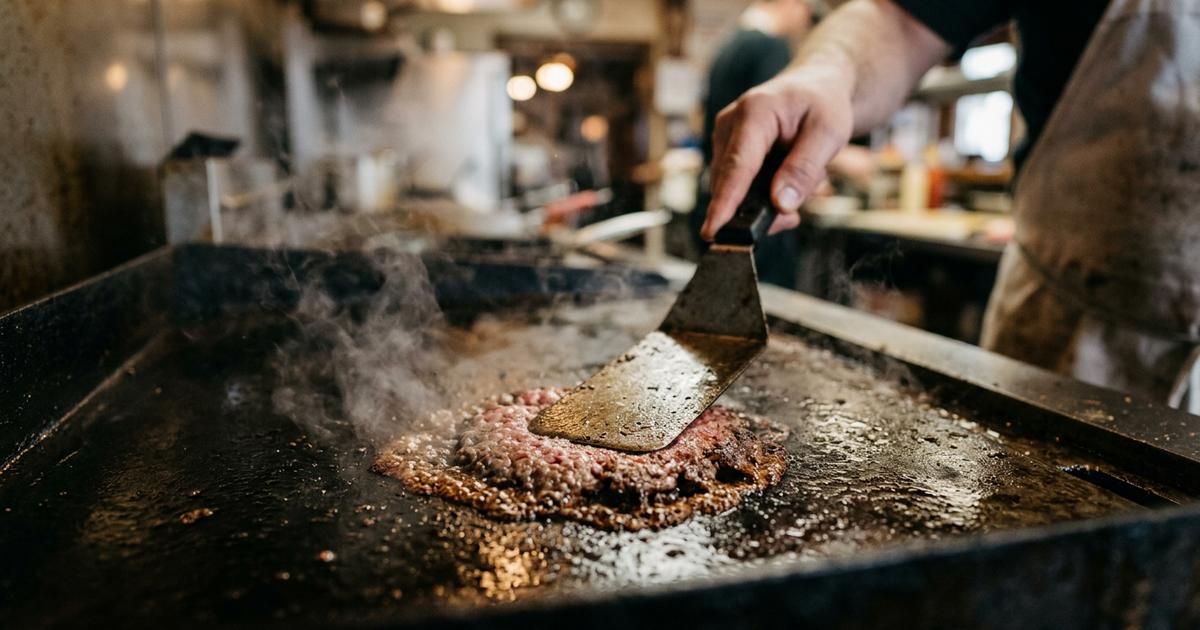
What’s the secret to a good smash burger?
Heat, contact, and speed. Drop a loose ball of 80/20 chuck onto a screaming hot surface, then flatten it hard within the first thirty seconds while the meat is still soft. Season after the smash, flip once, scrape up every bit of crust, and never press it again.
Keep reading ↓Imagine it’s a Saturday in Webster Groves, the charcoal has finally gone gray, and six people are showing up at four o’clock. You have three pounds of ground beef and a bag of soft white buns. You’ve done this a hundred times. Maybe half of those burgers were genuinely good, and you couldn’t tell anyone why.
Imagine the same afternoon happening all over the metro. Somebody in Maplewood has a cast iron skillet on high with the windows open and the smoke alarm quietly unplugged. Somebody in Florissant is standing in the grocery aisle deciding whether the pre-formed patties are good enough this time. Somebody in O’Fallon is cooking nine at once and mashing every single one flat with a spatula, because that is how their dad did it.
Same ingredients, wildly different burgers. The gap between one you forget by Sunday and one you’re still thinking about on Tuesday isn’t a secret sauce. It’s four or five small mechanical decisions: what the beef is, how hot the metal is, when the salt lands, whether you press, and when you stop. Here they are, in order.
What actually makes a good burger?
Fat, heat, and restraint, in that order. A good burger is mostly decided before a single topping shows up: coarse ground chuck at roughly 80 percent lean and 20 percent fat, a surface hot enough to brown the outside quickly, and hands that barely touch the meat. Everything else is trim.
The grind and the fat ratio
Fat is flavor, and it’s also insurance. An 80/20 blend, meaning 80 percent lean beef to 20 percent fat, is the default for burgers because that fat melts as the patty cooks, carries flavor, and keeps things edible when somebody inevitably overcooks it. Lean 90/10 sirloin sounds like an upgrade. It cooks dry, and no amount of sauce fixes dry.
Ground chuck is the workhorse cut here. It lands close to 80/20 naturally, it tastes deeply beefy, and every meat counter in the area carries it. If you have a butcher who grinds to order, ask for chuck ground coarse, and ask for it the same day you’re cooking. A coarse grind gives you a patty with texture instead of paste, and beef ground that morning tastes noticeably better than something that has been sitting compressed in a foam tray since Tuesday.
Blends do add something if you want to get fancy. Chuck for the base, brisket for richness, short rib for a deeper, almost roasted flavor. Honestly though, fresh chuck at 80/20 beats a clever blend that’s been handled too much. Fix the fundamentals first, then play.
How much you handle the meat
Every time you squeeze ground beef, you make it a little worse. Working the meat smears the fat and links up proteins, and the result is a patty with the springy, dense bite of meatloaf. Keep the beef cold, portion it with your fingertips, and form the loosest patty that will survive the trip to the heat.
Cold matters more than most people expect. Warm fat smears into the lean; cold fat stays in distinct pieces and melts during cooking, leaving little pockets of juice behind. Portion your patties, then put them back in the refrigerator until the pan or the grill is genuinely ready.
Shape and size
A thick grilled patty needs a dimple. Press your thumb into the center to leave a shallow well, because the edges tighten as they cook and shove the middle up into a dome. The dimple relaxes flat instead. Make the patty a little wider than the bun, too, since it shrinks in both directions.
For a smash burger the math is different: 2 to 3 ounces per ball, and two thin patties on one bun beat a single thick one every time. Two patties means twice the browned surface, twice the crust, and a burger you can still fit in your mouth.
What’s the secret to a good smash burger?
Heat, contact, and speed. Drop a loose ball of 80/20 chuck onto a screaming hot surface, then flatten it hard within the first thirty seconds while the meat is still soft. Season after the smash, flip once, scrape up every bit of crust, and never press it again.
That early window is the part almost everyone gets wrong. You’re forcing soft, raw beef into total contact with hot metal, and once the outside begins to set, the patty stops spreading and starts tearing. Ball goes down, spatula goes on immediately, lean your weight into it, and hold for about ten seconds.
Your tools matter here as much as your technique. A flimsy spatula flexes and hands you a thick middle with thin, scorched edges. Use a stiff metal spatula or a dedicated burger press, and slip a square of parchment paper between the tool and the beef so nothing sticks and tears when you lift. A second spatula stacked on the first gives you more force with less wobble.
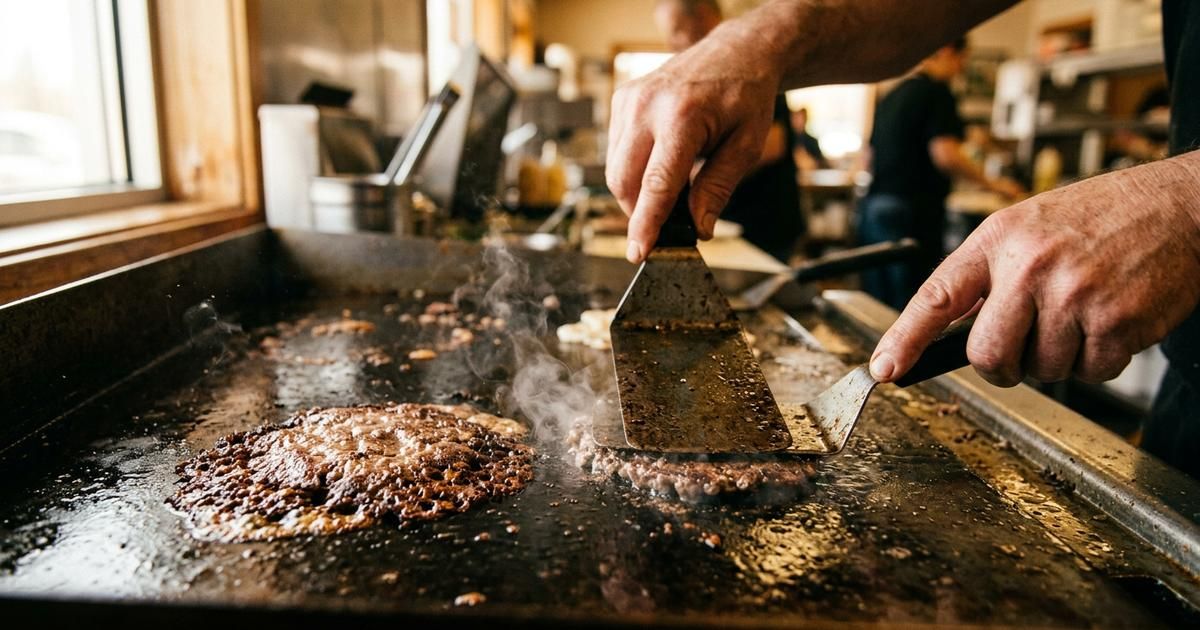
Then leave it alone. That crust is the entire point of a smash burger: browned, lacy, faintly crunchy edges that a thick grilled patty simply cannot produce. It forms because the beef is pinned flat against dry, hot metal with nowhere to steam. Every time you slide the patty around, you interrupt the browning and start over.
Flip once, with the thinnest, sharpest spatula you own, and scrape rather than lift. All the flavor you just built is stuck to the griddle. Lift it gently and you leave the crust behind and eat a plain gray patty. Get under it aggressively and bring everything with you.
Cheese goes on the instant the patty flips, while the second side cooks. A thin smash patty is finished in about a minute per side, which is not much time for cheese to melt, so cover it briefly or add a splash of water to the pan and trap the steam for a few seconds.
How hot should the pan or griddle be?
Hotter than you think, and for a smash burger, as hot as your equipment safely allows. A flat surface holding somewhere around 400°F to 450°F browns the beef in seconds instead of minutes. Medium heat steams the patty in its own juices and leaves you with something gray and disappointing.
Cast iron and carbon steel are the right tools because they hold heat. Cold beef hitting the surface drops the temperature hard, and a thin nonstick pan never recovers. Nonstick also isn’t built for this kind of heat, and the coating suffers for it. Preheat a solid five minutes, longer than feels necessary, then test with a drop of water. It should skitter and vanish, not sit there and bubble.
Grilled burgers want a different setup: two zones. Build a hot side and a cooler side. Thick patties get browned over direct heat, then moved to the cooler side to finish cooking through without the outside turning to carbon. That cooler zone is also your escape route when fat drips and a flare-up starts.
Ventilation is the real limit in most kitchens. A proper smash burger makes smoke, and there’s no version of this where it doesn’t. Open a window, run the hood on high, and if the alarm in your hallway is sensitive, take the whole operation outside onto a flat griddle plate over the grill burners.
When should you season a burger?
Right at the heat, and on the outside only. Salt mixed into ground beef dissolves proteins and turns the texture springy and sausage-like, so keep it on the surface and apply it seconds before, or just after, the patty hits the pan. Season generously, because most of it never reaches the middle.
Coarse kosher salt and coarse black pepper, more than looks reasonable, on both faces. The patty is thick and the seasoning only sits on the outside, which makes under-salting far more common than over-salting. If you’ve ever wondered why a restaurant burger tastes better than yours with the same beef, this is usually a big part of it.
On a smash burger, salt the top face right after you flatten it, then hit the other side after the flip. Doing it in that order keeps salt from pulling moisture to the surface while you’re trying to build a dry, browned crust.
Save the rest of your ideas for the sauce. Garlic powder, chopped onion, Worcestershire and egg belong in meatloaf, not in a burger patty. Mixing anything into the beef means working the beef, and working the beef is exactly what you were trying to avoid.
Why is pressing a grilled burger wrong when a smash burger is all about pressing?
Timing is the whole difference. A smash burger gets pressed in the first seconds, while the beef is raw and soft and the rendering fat pools in a hot pan and fries it. A grilled burger gets pressed halfway through, when that same press squeezes cooked juices out and straight into the fire.
Think about where the fat goes. On a flat griddle, rendered fat has nowhere to run, so the patty essentially fries in it, and that is a large part of why smash burgers taste the way they do. On a grill, the fat falls through the grate, and pressing only speeds up the loss. You get flare-ups, a scorched exterior, and a drier burger for your trouble.
So the rule isn’t “never press.” The rule is press once, at the very beginning, or not at all. Once the crust has formed on a smash patty, the pressing job is finished and any more of it just pushes juice out. On a thick grilled burger, the spatula is for flipping and nothing else.
Does a burger really need to rest?
A thick one does, briefly. Give a grilled patty three to five minutes off the heat and the juices redistribute instead of running onto the plate at first bite. A thin smash patty is a different case: it cooks so fast, and gets eaten so fast, that resting mostly just makes it cold.
Resting also buys time for everything else. Cheese finishes melting on residual heat, buns come off the griddle, and the internal temperature keeps climbing a few degrees after the patty leaves the pan. Plan for that carryover instead of being surprised by it.
Tent loosely with foil if the kitchen is cold, but don’t wrap tightly. Trapped steam softens the crust you just spent all that effort building. And if you salt a thick patty and leave it uncovered in the refrigerator for a while before cooking, the surface dries slightly and browns better. Small thing, real difference.
A great burger is wasted on a sore tooth. Find a St. Louis dentist.
How do you know when a burger is done?
Use a thermometer, not the color. The USDA’s safe minimum internal temperature for ground beef is 160°F, and ground beef can turn brown in the middle before it gets there, or stay a little pink after it passes it. Slide an instant-read probe in through the side, into the center.
Color is genuinely unreliable, which is why federal guidance points at temperature instead. Grinding mixes surface bacteria all the way through the patty, unlike a whole steak where the inside stays sealed, and that is the reason the recommendation for burgers is stricter than for a roast.
Insert the probe horizontally through the edge so the tip sits in the middle of the patty and not out the far side. On a thin smash patty a thermometer is close to useless, though it’s also close to unnecessary. Beef that thin, on metal that hot, is cooked through in roughly a minute a side.
If you’re cooking for kids, older adults, anyone pregnant, or anyone with a weakened immune system, treat 160°F as a rule rather than a suggestion. This is general information and not food safety advice for your specific kitchen, so check current USDA guidance when it matters.
Does the bun matter as much as the patty?
Not quite, but it’s the second biggest variable and by far the easiest to fix. A bun’s job is structural: hold everything together for the length of a meal without falling apart. Toast the cut faces in butter or in the beef fat left in the pan, which adds flavor and a moisture barrier at once.
Match the bun to the burger. A soft potato roll compresses around a smash burger and is close to perfect. A big grilled patty carrying a lot of toppings needs something sturdier, like a brioche or a seeded bun with more structure. Anything crusty and chewy fights back when you bite, and the whole build squirts out the far side.
Order matters in the build, too. Sauce on both toasted faces, lettuce on the bottom as a barrier against the juices, then the patty and cheese, then tomato, onion and pickle on top. Salt the tomato slices on a paper towel first if you want them to taste like anything.
Cheese should be a melter above all else. American takes a lot of criticism and still wins on the one thing that counts here, which is melting into the patty instead of sitting on top in a stiff square. Sharp cheddar, Provel, provolone and pepper jack all work; just give them heat and cover the pan for a few seconds.
Where do you find a great burger near you?
Once you know what to look for, you can spot a good one before the first bite. Ragged, dark brown edges instead of a perfect circle. Cheese that has run down the sides and pooled a little. A bun with griddle marks on the cut face. Those are all signs that somebody back there is paying attention.
Ask what the grind is if the counter seems friendly. Kitchens that grind chuck in house usually volunteer it, because it costs them more and they know it shows. And if you run a burger spot yourself, getting it listed in a local directory is how neighbors actually find you when they go searching on a Saturday afternoon.
Hungry now, or planning Friday? Browse burger spots across the metro on St Louis Near Me Directory, then order the double and look at the edges before you eat. You already know what a good one is supposed to look like.
Frequently asked questions
Are smashburgers better than regular burgers?
They’re different, not better. A smash burger trades thickness for crust: more browned surface, more flavor in every bite, and a much faster cook. A thick grilled patty gives you a juicier center and smoke from the fire. If you want crust, smash it. If you want a pink middle, don’t.
What is the best type of burger for smash burgers?
Coarse ground chuck at 80/20 is the standard, and some cooks push to 70/30 for extra fat. Skip lean sirloin blends and skip frozen pre-formed patties, which are pressed too tightly to spread properly. Portion loose balls of 2 to 3 ounces and keep them cold until they hit the pan.
What are common smash burger mistakes?
Pressing too late is the big one, since the patty stops spreading once its surface sets. After that: a pan that isn’t hot enough, balls too large to flatten evenly, a flimsy spatula that bends, lifting instead of scraping so the crust stays behind on the griddle, and crowding the pan until everything steams.
Is Five Guys a smashburger?
Not in the classic sense. Five Guys cooks fresh, never frozen beef on a flat-top griddle, serves its burgers well done, and its standard hamburger comes with two patties. A true smash burger, though, is a loose ball flattened hard in the first seconds on the griddle to build those thin, lacy, browned edges.
Do I cook burgers on medium or high heat?
High, for almost every burger. Smash burgers want a griddle around 400°F to 450°F so the crust forms in seconds. Thick grilled patties get seared over high direct heat, then moved to a cooler zone to finish. Medium heat the whole way through mostly steams the beef gray.
What does a 160 degree burger look like?
Usually brown throughout with clear juices, but appearance is not a reliable test. Ground beef can look brown before it reaches 160°F and can stay slightly pink after it gets there. The USDA points people to a thermometer for exactly that reason. Probe through the side into the center and read the number.
Should you let burgers sit after cooking?
Yes for thick patties, for roughly three to five minutes. That pause lets the juices redistribute and lets carryover heat finish the job, so the burger doesn’t empty itself onto the plate. Thin smash patties are the exception, since they cook in about a minute a side and are best eaten immediately.
Should you put oil in the pan when frying burgers?
A very thin film, on a dry preheated surface. An 80/20 patty renders plenty of its own fat within seconds, so you only need enough high smoke point oil to guarantee full contact with the metal. Too much and the patty floats and browns unevenly. On well seasoned cast iron, wipe the pan and use almost none.

Written by a dedicated team of St. Louis locals who live, work, and play right here in the St. Louis metro. Founder Lane Forman and team are committed to building the region’s most trusted directory by verifying listings and connecting local businesses with loyal customers across Missouri and Illinois.