What to Know About Cannabis Dispensaries in St. Louis
Revised August 21, 2026

What are the current cannabis regulations in Missouri?
Adults 21 and older may buy and possess up to three ounces of dried, unprocessed marijuana or the equivalent, from a state-licensed dispensary, with a valid government-issued photo ID. That comes from Article XIV, Section 2 of the Missouri Constitution, added when voters passed Amendment 3 on November 8, 2022. The Division of Cannabis Regulation inside the Missouri Department of Health and Senior Services runs the program.
Keep reading ↓Imagine it’s a Wednesday in October and your brother-in-law is in from out of state for a wedding in Manchester. On the drive in he passed a plain gray storefront with a security camera over the door and no windows, and now he wants to know whether that was really a legal weed store. It was. There is probably one within fifteen minutes of wherever you are standing in this metro.
Then he starts asking the questions you can’t actually answer. Does his out-of-state license work? How much can he buy? Can he ride back across the Poplar Street Bridge to the hotel in Fairview Heights with it in the console? Why did the receipt in Berkeley look nothing like the receipt his friend got in Belleville? And somebody at the table swears the federal government legalized the whole thing this spring, which is not quite what happened.
So here is the reference-desk version, as the rules stand on August 21, 2026, with the source named for every legal claim. No product talk, no recommendations, no opinions about whether any of this is a good idea. Just what the two states on either side of the Mississippi actually require, where they differ, and where federal law still runs straight through the middle of St. Louis.
What are the current cannabis regulations in Missouri?
Adults 21 and older may buy and possess up to three ounces of dried, unprocessed marijuana or the equivalent, from a state-licensed dispensary, with a valid government-issued photo ID. That comes from Article XIV, Section 2 of the Missouri Constitution, added when voters passed Amendment 3 on November 8, 2022. The Division of Cannabis Regulation inside the Missouri Department of Health and Senior Services runs the program.
The transaction cap and the possession cap are the same number. Missouri’s own consumer guidance states that up to three ounces may be purchased in a single transaction and that consumers may be in possession of up to three ounces at any time (Missouri DHSS, Division of Cannabis Regulation). There is no separate, smaller limit for visitors from other states — Missouri writes the rule around age, not residency.
Two prohibitions in the constitutional text catch people out. Smoking in a public place, outside an area specifically licensed for it, carries a civil penalty of up to one hundred dollars. And consuming marijuana while operating — or being in physical control of — a motor vehicle, train, aircraft or motorboat is prohibited outright, as is smoking in one while it is being operated (Missouri Constitution, Article XIV, Section 2). Impaired driving law applies on top of that.
Home cultivation is legal in Missouri but not casual. The constitution allows up to six flowering plants, six nonflowering plants over fourteen inches, and six clones under fourteen inches, and only for a person registered with the department for cultivation. That registration is a real card you apply for, not a formality you assume.
What are the regulations for dispensaries in Illinois?
Illinois legalized adult use through the Cannabis Regulation and Tax Act (410 ILCS 705), effective January 1, 2020, and licenses retail stores as “dispensing organizations” through the Illinois Department of Financial and Professional Regulation. Buyers must be 21 with a government-issued ID, and Illinois — unlike Missouri — sets two different possession limits depending on whether you live there.
Those limits just doubled. Governor Pritzker signed Public Act 104-0463 (SB 3222) on June 12, 2026, and IDFPR’s own fact sheet dated June 23, 2026 spells out the change: for Illinois residents, cannabis flower went from 30 grams to 60 grams, infused products from 500 milligrams of THC to 1,000 milligrams, and concentrate from 5 grams to 10 grams. For out-of-state visitors, the caps went from 15 grams to 30 grams of flower, 250 to 500 milligrams of THC in infused products, and 2.5 to 5 grams of concentrate.
Several other operating rules changed the same day, which is why an Illinois store may look different than it did last year. Dispensaries may now offer curbside pickup and drive-through service after IDFPR reviews their plans, may hire their own security guards instead of contracting a third-party firm, may store 60 days of camera footage rather than 90, and may stay open until 2 a.m. with local municipal approval (IDFPR SB 3222 fact sheet, June 23, 2026).
Home growing is where the two states split hardest. In Illinois, only registered qualifying medical cannabis patients may grow, and the limit is five plants (Illinois cannabis program FAQ). A non-patient adult in Belleville cannot legally grow a plant that a registered adult in Affton can grow six of. Same river, opposite answer.
Why does the same purchase cost more on one side of the river?
Because the two states stack taxes in completely different ways. Missouri charges a 6% state tax on adult-use retail sales, and local governments may add a sales tax of up to 3% (Missouri Constitution, Article XIV, Section 2). Illinois runs a tiered excise tax instead: 10% of the purchase price for cannabis with an adjusted THC level at or below 35%, 25% for anything above 35%, and 20% for cannabis-infused products, and that sits on top of the general merchandise sales tax rate in that jurisdiction (Illinois Department of Revenue).
Illinois then lets local governments layer on more. Municipalities may impose a cannabis retailers’ occupation tax up to 3%, and counties may impose up to 3% inside municipalities and up to 3.75% in unincorporated areas, all in quarter-percent increments (Illinois Department of Revenue, Informational Bulletin FY 2026-06). In other words, an Illinois county tax and a city tax can both apply to the same sale.
Missouri used to work that way too, and then it didn’t. On July 22, 2025, the Missouri Supreme Court ruled 6-1 in a case brought by a Florissant dispensary against St. Louis County that a county may impose its 3% marijuana tax only in unincorporated areas — not inside an incorporated city, town or village that levies its own. Judge Russell wrote that in an incorporated area the “local government” is the city, and in an unincorporated area it is the county (Missouri Supreme Court, July 22, 2025; reported by St. Louis Public Radio). Three percentage points came off the receipt in places like Florissant. The county 3% still applies where there is no municipality to charge it.
What happens when you walk into a dispensary?
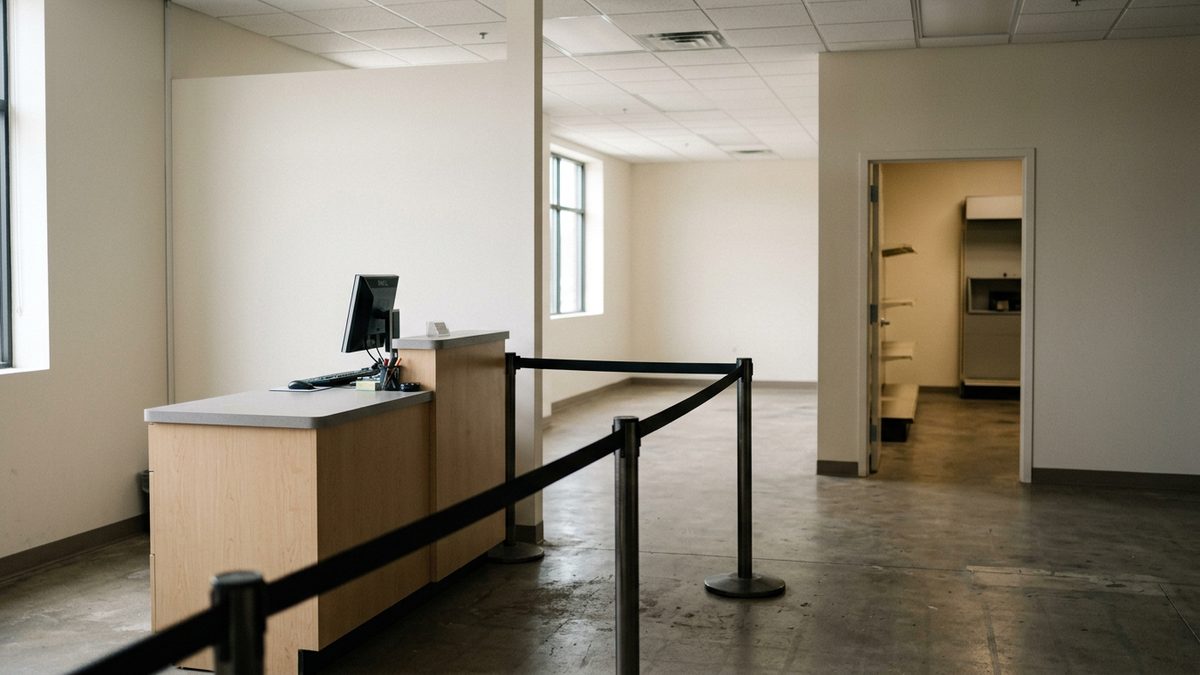
You show a valid government-issued photo ID at the door, every single visit, before you get past the lobby. Staff check age first and everything else second. Then you order at a counter or a kiosk, the sale is recorded in the state’s seed-to-sale tracking system against your legal limit, you pay, and you leave with a sealed, labeled package.
The ID check is not theater and it is not negotiable at the clerk’s discretion — the store’s license depends on it. Expect a security guard. Illinois now requires that guards be present at all times the store is open, whether they are contracted or employed directly (IDFPR, June 2026). Expect cameras. Expect the lobby to be a separate room from the sales floor.
Consumption is not part of the visit at a typical store. Illinois does allow individual municipalities to authorize on-premises consumption at a licensed dispensary, so it genuinely varies town to town on that side of the river; assume no unless the store says otherwise. And on the Missouri side, Article XIV’s public-place restriction means the parking lot is not a solution.
Why is it cash or debit at almost every dispensary?
Because federal banking rules have not caught up with state law, and the card networks wrote their own prohibitions on top. Visa, Mastercard and American Express each bar cannabis transactions under their own operating rules, which is why the terminal at the register runs PIN debit or an on-site ATM rather than a normal credit swipe. Federally insured banks that do serve the industry take on Bank Secrecy Act and anti-money-laundering obligations to do it.
Congress has repeatedly tried and repeatedly not finished. The SAFE Banking Act — the bill that would shield banks serving state-legal cannabis businesses — was reintroduced in both chambers in 2026 after clearing the Senate Banking Committee back in 2023, and it has still not become law. Nothing about the April 2026 rescheduling order changes that on its own; it did not create a banking safe harbor.
The practical consequence for a shopper is small and annoying: bring cash or a PIN debit card, expect an ATM fee, and expect the register to round the transaction. The consequence for the business is much larger, because a cash-heavy retailer has to pay for armored pickups, a vault and counting procedure that a coffee shop never thinks about.
Wildly off topic — your yard still needs a landscaping crew.
Is marijuana still illegal under federal law?
Mostly, yes — and the part that changed is narrower than the headlines suggested. On April 28, 2026, a final order published at 91 Fed. Reg. 22714 moved two specific categories from Schedule I to Schedule III of the Controlled Substances Act: marijuana contained in an FDA-approved drug product, and marijuana subject to a state medical marijuana license. Everything else, including adult-use product sold in a state-legal dispensary, stayed in Schedule I.
A separate and much broader proceeding is still open. The DEA held a formal administrative hearing beginning June 29, 2026 on whether marijuana generally should move to Schedule III, and post-hearing briefs were due August 17, 2026. No final order on that broader question had issued as of this writing. Even if it does, Schedule III is not legalization — it is a controlled substance with a prescription requirement.
Three consequences are worth stating plainly, because they surprise people in a two-state metro. Carrying cannabis across a state line is a federal offense, and that includes every bridge over the Mississippi between here and Illinois; a legal Missouri purchase does not become a legal Illinois possession by driving it there, and neither state’s limits travel with you. Federal property is federal jurisdiction regardless of what the state says, and downtown St. Louis contains Gateway Arch National Park, a unit of the National Park Service, plus federal courthouses and VA facilities. And safety-sensitive transportation workers are still covered by federal drug testing rules — the U.S. Department of Transportation posted on February 25, 2026 that it is “still unacceptable for people who work in safety-sensitive transportation positions to use marijuana,” and 49 CFR Part 40 has not changed. There is no medical-card exception for a CDL holder. If that describes your work, our post on what to know before buying a commercial truck in St. Louis covers the rest of that world.
One area is genuinely unsettled and we are not going to pretend otherwise. Federal law bars an “unlawful user” of a controlled substance from possessing a firearm under 18 U.S.C. 922(g)(3), and ATF’s firearms transaction form has long asked buyers to certify on that point. After the April 2026 order, ATF circulated a draft revision to that form, and the Justice Department has said the rescheduling order does not by itself rewrite the criminal statute. If you own firearms, treat this as an open legal question and ask an attorney rather than a website. Employment protections are similarly state-specific and still being litigated in both states.
Where is cannabis still off limits around St. Louis?
Public places, vehicles, federal land, and any property whose owner says no. Missouri’s constitution attaches a civil penalty of up to one hundred dollars to smoking in a public place outside a licensed area, and prohibits consuming or smoking in a motor vehicle, train, aircraft or motorboat while it is being operated (Article XIV, Section 2). Illinois prohibits use in public places, in vehicles, on school grounds, in state and local government buildings, and near anyone under 21 who is not a registered medical patient (Illinois cannabis program FAQ).
Landlords, employers and hotels are their own jurisdictions. Neither state’s law obligates a private property owner to permit smoking, and lease language routinely bans it the same way it bans tobacco. A hotel in Maryland Heights or St. Charles can and often does charge a cleaning fee. Nothing in either state’s legalization changed a property owner’s right to set that rule.
Local government still shapes where stores exist at all. In Missouri, a city or county can only prohibit non-medical dispensary facilities by putting it to voters, and it takes at least 60% approval at a general election in a presidential election year (Missouri Constitution, Article XIV, Section 2) — a deliberately high bar. In Illinois, units of local government have broader zoning and time, place and manner authority over cannabis businesses (410 ILCS 705/55-25), which is why dispensaries cluster in some Metro East municipalities and are absent from their neighbors.
Does a Missouri medical marijuana card still get you anything?
Yes, three things, and they are real. Tax: medical purchases are taxed at 4% rather than the 6% adult-use rate. Quantity: an approved patient ID cardholder has a standard allotment of six ounces in a 30-day period, or more with a physician recommendation, against three ounces per transaction for adult use. Age: the medical program serves patients under 21, who cannot legally buy adult-use product at all (Missouri DHSS).
Illinois draws the same distinction with different math. Registered medical patients there are excluded from the Cannabis Purchaser Excise Tax entirely and their purchases are taxed at the qualifying food and drug sales tax rate rather than the general merchandise rate (Illinois Department of Revenue). That is a meaningful gap when the adult-use excise alone can be 25%. Illinois medical patients are also the only people in that state who may grow at home.
Illinois is expanding medical access on the retail side, too. Under Public Act 104-0463, beginning September 10, 2026, any adult-use dispensary holding an active license in good standing may opt in for a medical dispensary license, which lets it sell to patients at the medical tax rate up to the patient’s allotment (IDFPR, June 23, 2026). Practically, more Illinois stores should be able to serve card holders than could a year ago.
One note that has nothing to do with taxes: a card is a medical record, and medical teams ask. Pre-surgical screening questionnaires include cannabis use, and the honest answer matters more than the comfortable one — our guide to what to ask about anesthesia before surgery in St. Louis covers how that conversation usually goes.
What this trade looks like from behind the counter
The margin on the shelf is not the margin in the bank. Internal Revenue Code section 280E bars businesses trafficking in Schedule I or II substances from deducting ordinary expenses like payroll and rent, so a dispensary can be profitable on paper and still owe federal tax computed on gross profit; the April 2026 order is expected to lift that only for qualifying medical activity, which is why operators moved fast on medical licensing. Add armored cash pickups, vault procedure, mandatory guards, seed-to-sale reconciliation, and a Missouri annual dispensary fee of $11,568.13 for the year beginning July 1, 2026 (Missouri DHSS fee schedule). Missouri statewide sales grew roughly 3% in 2025 to about $1.52 billion (Division of Cannabis Regulation data reported January 2026), so growth now comes from being the store someone chooses, not from a market that is still doubling. Owners who want to be found in local search can list a business on St Louis Near Me Directory.
Want to know what is actually near you? Browse cannabis stores across the St. Louis metro on St Louis Near Me Directory, then check that store’s own hours and ID rules before you drive out there.
Frequently asked questions
Is a cannabis store the same as a dispensary?
In Missouri and Illinois, yes — both words describe the same state-licensed retail store. Missouri’s constitution calls the license a dispensary facility and Illinois licenses a dispensing organization. Neither state uses “cannabis store” as a legal term. What is not the same is a shop selling hemp-derived products without a state cannabis license; that is a different business under different rules.
What is the difference between a cannabis store and a dispensary?
Legally there is no difference in this metro — both are casual names for a licensed retailer. The distinction that matters is licensed versus unlicensed. A Missouri dispensary facility answers to the Division of Cannabis Regulation and an Illinois dispensing organization answers to IDFPR, including seed-to-sale tracking, lab testing and badged staff. An unlicensed storefront selling hemp products carries none of those obligations.
What is a cannabis store called?
Officially, a “dispensary facility” in Missouri under Article XIV of the Missouri Constitution, and a “dispensing organization” in Illinois under the Cannabis Regulation and Tax Act, 410 ILCS 705. In everyday speech, everyone says dispensary. Missouri also issues separate microbusiness licenses, including for dispensaries, through the Department of Health and Senior Services.
What do people do at a dispensary?
You present a valid government-issued photo ID showing you are 21 or older before you get past the lobby — every visit. Staff take your order at a counter or kiosk, the sale is logged in the state tracking system against your legal limit, and you pay, usually with cash or PIN debit. You do not consume on site at a typical store, though Illinois lets individual municipalities authorize on-premises consumption.
How much does 3.5 grams of bud cost?
Neither Missouri nor Illinois sets or publishes a retail price for an eighth of an ounce — stores price it themselves and it moves with supply. What is fixed is the tax added on top. Missouri applies a 6% state cannabis tax plus up to 3% local, over ordinary sales tax. Illinois applies an excise tax of 10%, 20% or 25% depending on the product, plus sales tax (Illinois Department of Revenue).
How much to open a dispensary in Missouri?
The state fees are published: $3,083.40 for a new comprehensive dispensary license application and $11,568.13 for the annual fee, for July 1, 2026 through June 30, 2027 (Missouri DHSS fee schedule, adjusted annually by CPI). Those are only the state charges — real estate, build-out, vault and camera systems, staffing and inventory are separate. Missouri is not currently accepting general dispensary applications.
How much is a budtending license?
In Missouri, a facility agent identification card costs $75, for a new application or a renewal (Missouri DHSS fee schedule). That badge is what allows someone to work on a licensed dispensary floor, and the employer sponsors it. Illinois badges dispensary agents through IDFPR, and under Public Act 104-0463, signed June 12, 2026, those badges are no longer tied to one specific dispensary.
How much is it to own a franchise in a dispensary?
Cannabis retail does not work like a sandwich franchise. Both states license specific companies at specific addresses, and ownership changes run through the regulator. Illinois raised its principal officer disclosure threshold from 1% to 5% for privately held companies in Public Act 104-0463 (IDFPR, June 23, 2026), which shows how closely ownership is tracked. Start with the state regulator, not a franchise broker.
What to buy at dispensary for beginners?
This article does not recommend products, and neither state publishes a beginner list. What both states do require is that licensed cannabis be lab tested and sold in labeled packaging, so the label is the reliable information, not the counter conversation. Dispensary staff are retail employees, not clinicians — health questions belong with a physician. Missouri caps a single adult-use transaction at three ounces.

Written by a dedicated team of St. Louis locals who live, work, and play right here in the St. Louis metro. Founder Lane Forman and team are committed to building the region’s most trusted directory by verifying listings and connecting local businesses with loyal customers across Missouri and Illinois.