What Replaced the Yellow Pages? Free Business Listing Sites
Revised August 29, 2026
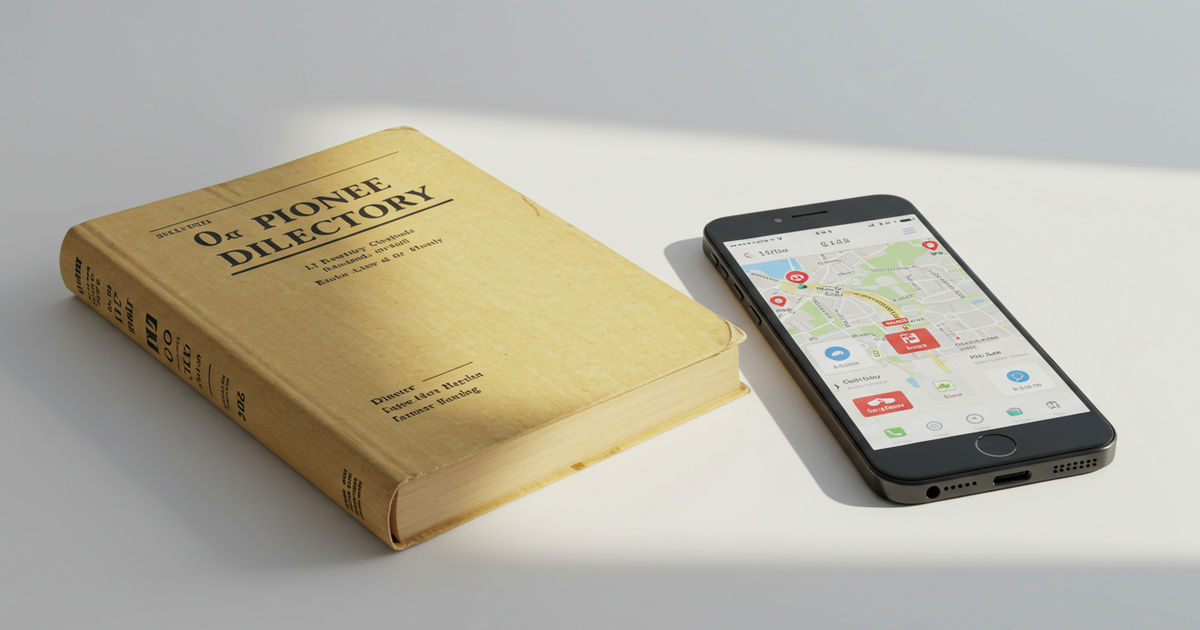
What has replaced the Yellow Pages?
The Yellow Pages was replaced by the whole ecosystem of online local search: Google (especially the free Google Business Profile and map pack), review platforms, online directories, and now AI assistants like ChatGPT and Google’s AI Overviews. Your Google Business Profile is the modern equivalent — free, and the single most important listing a local business can have. The print book is a legacy channel, not a growth strategy.
Keep reading ↓There was a time when getting your business “in the book” was the whole marketing plan. A listing in the Yellow Pages — maybe a bold-print upgrade if you were feeling ambitious — was how customers found a plumber, a florist, or a lawyer. For a St. Louis business owner who remembers that era, a fair question lingers: does any of that still matter, and if the phone book is gone, what took its place?
The short version is that the Yellow Pages didn’t so much disappear as scatter and digitize — the function it served is bigger than ever, just spread across new platforms. This is a straight answer to what replaced the Yellow Pages, whether the physical book still exists, and — most usefully — the free business listing sites a St. Louis business should actually claim in 2026 to get found.
What Has Replaced the Yellow Pages?
The Yellow Pages was replaced not by a single thing but by the whole ecosystem of online local search: Google (especially the Google Business Profile and the map pack), review platforms, online directories, and now AI assistants like ChatGPT and Google’s AI Overviews. Where you once flipped to a category in a paper book, customers now type a service and “near me” into Google or simply ask an AI for a recommendation. The job the Yellow Pages did — connecting a local customer who’s ready to buy with a nearby business that does the thing — is exactly what these tools do, at far greater scale and with much better targeting.
The most important single replacement is your Google Business Profile. It’s free, it’s what surfaces in the map pack for local searches, and it is, in effect, the modern Yellow Pages listing — except it also carries your reviews, photos, hours, and a direct line to call or get directions. If the old goal was to be “in the book,” the new goal is to be complete and consistent across this handful of digital platforms.
Do Physical Yellow Pages Still Exist?
Technically, yes — but their role has collapsed. Printed directories are still produced and distributed in some areas, and a small segment of the population, skewing older, still occasionally reaches for one. But for the overwhelming majority of customers, the search has moved to their phone and their browser, and paying for a prominent print Yellow Pages ad is, for most businesses, no longer money well spent. YP.com, the digital descendant, still exists as an online directory, and a free, accurate listing there is a minor consistency signal worth claiming — but the print book is a legacy channel, not a growth strategy. If your marketing budget is going into a big print directory ad out of habit, that money almost certainly works harder on the free and low-cost digital foundations below.
Where Can I List My Business for Free Online?
This is the practical heart of it, and the encouraging news is that the most valuable listings cost nothing. For a St. Louis business, the free listings worth claiming, in rough order of importance, are: your Google Business Profile (non-negotiable, the single most important one); the major review platforms customers check; Apple Maps and Bing Places, which increasingly feed Apple’s and Microsoft’s AI-powered results; Facebook, which still functions as a de facto directory for many; a strong local directory built for the St. Louis metro; and the two or three niche directories that specifically matter in your industry. Claim each of those, fill them in completely, and keep the details identical, and you’ve covered where the vast majority of local customers — and the AI tools they increasingly ask — actually look.
What Is the Best Free Business Listing Site?
If there’s a single winner, it’s your Google Business Profile, hands down. Nothing else comes close for local visibility: it powers the map pack, shows your reviews and photos, and is the first thing most people see when they search for a business like yours. It’s free, and a complete, active profile routinely outperforms a half-finished one from a bigger competitor. After that, “best” depends on your business — a restaurant leans on review platforms, a contractor on the listing sites built for their industry, and every local business benefits from a strong metro directory. The honest answer to “what’s the best free listing site?” is: start with Google Business Profile, then add the specific handful that fit your industry and your area. Don’t chase a long list; win the important few.
Quality and Consistency Beat a Long List
Here’s the mistake that wastes the most effort: believing more listings automatically means more visibility. It doesn’t. What matters is that your business name, address, and phone number are identical everywhere they appear, across a focused set of quality platforms. Search engines and AI assistants cross-reference these citations to decide whether your business is real and trustworthy; when they match, you earn trust and visibility, and when they conflict — an old address on one site, a wrong number on another — you can actually suppress your own rankings. This is why the old “get listed on 500 sites” pitch backfires: it multiplies inconsistency across junk directories. A tight, perfectly consistent set of listings is far more powerful than a sprawling, sloppy one. Before you add a new listing, make sure the ones you already have all agree.
A St. Louis Business Listing Starter Set
If you want a concrete place to begin, here’s a sensible starter set for a St. Louis-area business, all free. Lock in your Google Business Profile first — claim it, verify it, and complete every field. Add Bing Places and Apple Maps next, since they’re quick and increasingly feed AI and phone-based map results. Set up or update your Facebook business page, which many locals still use to check hours and legitimacy. Claim your spot in a strong St. Louis metro directory to anchor your local relevance. Then add the major review site and the one or two industry directories that matter most in your field. That’s six to eight high-quality listings — not a hundred — and together they cover the platforms where nearly all of your local customers, and the AI tools they ask, actually search. Do those well before you even think about anything else.
Should You Ever Pay for the Print Yellow Pages?
For the vast majority of St. Louis businesses in 2026, the honest answer is no. The audience still reaching for a printed phone book is small and shrinking, and a prominent print ad is expensive relative to the handful of calls it’s likely to generate. There are narrow exceptions — a business whose customer base skews significantly older, in a specific area where the book still circulates, might see modest returns — but even then, it should come after the free digital foundation, never instead of it. If you’re currently spending real money on a print directory ad out of long habit, it’s worth honestly asking how many customers actually mention it, and redirecting that budget toward the digital pieces that reach far more people for far less.
Unrelated, and we know it — where to book a St. Louis spa day.
How Do You Actually Claim a Listing?
The process is more approachable than it looks. For most platforms, you search for your business to see if a listing already exists (many are auto-generated), then click to “claim” or “manage” it and verify that you’re the owner — usually by phone, email, or a postcard code. Once verified, you fill in every field completely and consistently: the same business name, address, phone, hours, categories, description, and photos across all of them. Set aside an afternoon, work through your starter set one platform at a time, and keep a simple document with your exact business details so every listing matches. It’s a few hours of focused, mostly clerical work — and it’s some of the highest-value, lowest-cost marketing a local business will ever do.
Why This Matters More in the AI Era
The reason to get this right in 2026 isn’t nostalgia for the Yellow Pages — it’s AI. Customers increasingly skip searching entirely and ask an assistant: BrightLocal’s 2026 research found about 45% of consumers now use AI tools like ChatGPT for local recommendations, up from just 6% a year earlier. When an AI answers “who’s a good option near me?”, it builds that answer from the consistent, trustworthy local data it can find — exactly the data your listings provide. So the humble business listing has quietly become one of the most important marketing assets you have: it’s how you stay visible not just in Google, but in the AI answers that a growing share of your customers now trust. The Yellow Pages is gone, but being findable has never mattered more.
Looking for the strong local directory to add to your free listings? The St Louis Near Me Directory is a focused, hyper-local directory built to connect nearby customers — and the AI tools they now ask — with businesses across the whole St. Louis metro, Missouri and Illinois alike.
Claim your spot. Listing your business adds a consistent, trusted citation that feeds both local search and AI discovery — one of the highest-return, lowest-cost moves you can make.
More for St. Louis Businesses
- How to list your business online in St. Louis
- The 2026 St. Louis small-business marketing playbook
- Are business directories still worth it?
Frequently Asked Questions
Do physical Yellow Pages still exist?
Technically yes — printed directories are still produced in some areas, and a small, older-skewing segment occasionally uses them — but their role has collapsed. Nearly all customers now search on their phones. YP.com survives as an online directory, and a free accurate listing there is a minor consistency signal, but paying for a big print ad is, for most businesses, no longer money well spent.
Where can I list my business for free online?
The most valuable listings are free: your Google Business Profile (the most important), the major review platforms, Apple Maps, Bing Places, Facebook, a strong local directory for your metro, and the two or three niche directories that matter in your industry. Claim each, fill it in completely, and keep every detail identical — that covers where local customers and AI tools actually look.
What is the best free business listing site?
Your Google Business Profile, without question — it’s free, powers the local map pack, carries your reviews and photos, and is the first thing most people see when searching for a business like yours. After that, the “best” depends on your industry: restaurants lean on review sites, contractors on trade directories, and every local business benefits from a strong metro directory. Start with Google, then add the few that fit you.
How many free listing sites should my business use?
The right handful, not hundreds. Cover your Google Business Profile, the major review sites, Apple Maps and Bing Places, Facebook, a strong local directory, and the couple of niche sites in your industry — keeping every detail identical. Consistency across a focused set beats volume every time; anyone selling “500 free submissions” is offering noise that can hurt you by scattering inconsistent information.
Are free business listings actually worth it?
Yes — they’re among the highest-return, lowest-cost moves a local business can make. Consistent listings help you rank in Google’s map pack, bring referral traffic, and feed the trustworthy data AI assistants use to recommend businesses. With about 45% of consumers now using AI for local recommendations, complete and matching free listings are how you stay visible in both search results and AI answers.
What sites can I list my business for free?
Google Business Profile, Apple Business Connect, Bing Places, Facebook, Yelp and your local Chamber — all free. A St. Louis directory on top of those is about local relevance, not volume. The one principle that matters more than the list: identical name, address and phone everywhere.
What are some alternatives to Yellow Pages?
The maps platforms took the demand, so the practical alternatives are Google, Apple and Bing, plus a category directory where your industry genuinely has one. What is not an alternative is a service submitting you to hundreds of junk sites — that multiplies inconsistency rather than reach.
Why are there no Yellow Pages anymore?
Search moved the demand, and the advertising revenue followed it. Print directories still exist in some markets, but nobody reaches for one to find a plumber at nine at night. The behavior changed first and the book simply caught up.
Do they still make phone books in 2026?
A few are still printed in some markets, and you can generally opt out of delivery. Circulation and use have fallen far enough that no St. Louis business should count on one for calls. If you inherited a listing, leave it be — just do not pay to renew it.

Written by a dedicated team of St. Louis locals who live, work, and play right here in the St. Louis metro. Founder Lane Forman and team are committed to building the region’s most trusted directory by verifying listings and connecting local businesses with loyal customers across Missouri and Illinois.