Aerial Silks Classes: How Hard Is It?
Revised September 25, 2026
How hard is it to learn aerial silks in St. Louis?
Hard in an unglamorous way, and easier to start than it looks. A beginner class is mostly conditioning plus two or three foundation skills. Grip strength and skin tolerance limit you first, not upper-body power. Progress arrives in months rather than weeks, and twice-a-week attendance beats occasional long sessions.
Keep reading ↓Dana went to the show for somebody else’s birthday. Folding chairs, a low stage, a converted warehouse space with exposed beams, and she spent the whole second act with her head tilted back. Two performers climbed a pair of red silks to the ceiling, wrapped themselves in the fabric, and dropped. She got a ride back to Tower Grove and could not stop thinking about it. The next morning she looked up classes and talked herself out of it before lunch. She had not done a pull-up since middle school. She was thirty-four. Everyone in the videos looked like they had been doing this since they were nine, and none of them looked like her.
The same week, a mom in Kirkwood was working on a different version of the question. Her daughter had spent one week of summer camp on a low trapeze and a fabric hammock and had talked about almost nothing else since. The mom wanted the boring answers. How young is too young. Whether anyone stands underneath the kid. What happens the first time she is eight feet up and gets scared. She had signed this family up for enough activities to know that a five-minute phone call would tell her more than the website did.
Here is what this covers. What a beginner aerial silks class actually asks of your body, and why grip and skin, not upper-body strength, are what stop most people in the first month. What happens in a first class, including the two or three foundation skills nearly every studio teaches first. What to wear and what to leave in the car. How recreational circus programs are structured, and what lyra, aerial sling, static trapeze and floor acrobatics feel like next to silks. The honest answer to the weight question, which is a rigging question rather than a body question. The real risks, and the health conditions a studio will ask about before you climb. How pricing tends to be structured. How to shortlist two or three studios worth visiting. And at the end, a note to studios around the metro about the beginner page most of them have not written yet.
How hard is it to learn aerial silks in St. Louis?
Hard in an unglamorous way, and easier to start than it looks. A beginner class is mostly conditioning plus two or three foundation skills. Grip strength and skin tolerance limit you first, not upper-body power. Progress arrives in months rather than weeks, and twice-a-week attendance beats occasional long sessions.
That is the part the videos hide. What looks like a strength sport from the audience is, for the first few months, mostly a patience sport. Nobody walks into a beginner class and gets asked to muscle their bodyweight up a rope. They get asked to hold on, to squeeze fabric between their feet, and to stop gripping so hard with their hands that their forearms quit before the drill does.
Grip and skin, not biceps
Ask anyone in their first month what hurts and you will hear the same two answers. Forearms, and skin. Grip endurance is the true early limiter, because everything on silks starts with holding fabric that wants to slide. Your hands give out well before your back or shoulders do, and that feels like failure when it is really just a very trainable weakness.
Skin tolerance is the second one, and it surprises people more. Fabric under load rubs, and the classic beginner marks show up on the insides of the upper arms, the backs of the knees, and the tops of the feet where a footlock sits. Bruises and raw patches are normal. They fade, and the same spots stop complaining as tolerance builds, which is a real physical adaptation and not just toughness. In our experience the people who quit in week three quit because nobody told them this was expected.
What progress actually looks like
Measure it in months. A reasonable arc for an adult beginner attending consistently looks something like this: the first few weeks are conditioning and learning to trust the fabric, the next stretch is a climb that finally works without a fight, and somewhere after that come clean inverts and the first wrapped shapes that look like something. Two shorter sessions a week beat one long weekend session almost every time, because grip and skin adapt to frequency rather than duration.
One honest note about plateaus. Almost everybody hits a wall right where the climb should be getting easy, and almost everybody thinks it is a strength problem. Usually it is technique: feet in the wrong place, hands too high, or a body trying to pull when it should be standing up. Good instructors spot that in about four seconds. That is most of what you are paying for.
What happens in your first aerial silks class?
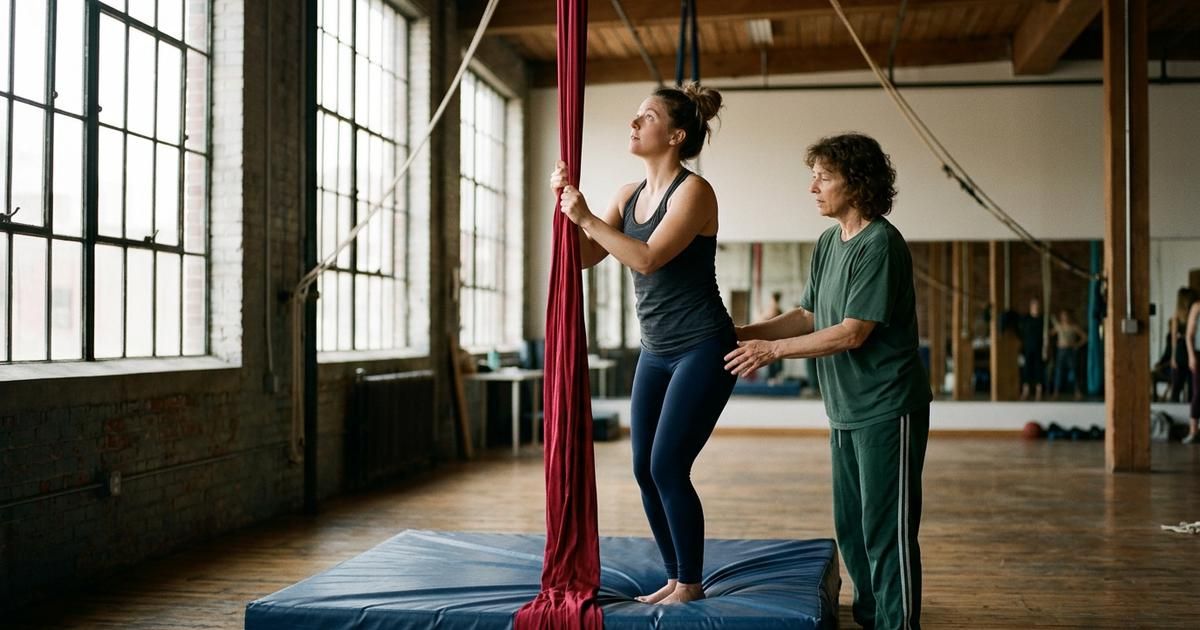
Less flying than you expect and more floor work. A typical beginner session opens with a warm-up and conditioning, then teaches two or three foundation skills that everything else is built from: a climb, a basic footlock, and an invert. You stay low. You repeat things. You leave sore in places you did not plan for.
The climbs have names, and you will hear them on day one. A French climb uses the fabric wrapped around the body and is often taught first because it is forgiving. A Russian climb, sometimes taught alongside it, uses a foot lock created by the fabric and moves faster once it clicks. A footlock is exactly what it sounds like: a wrap that secures one foot so you can hang and shape without holding your whole weight in your hands. Inverting is turning upside down from a hang, and it is a core skill dressed up as a trick.
What to wear, and what to leave in the car
Leggings and a fitted top with sleeves. That is the standard answer everywhere, and it is not a dress code, it is friction. Bare skin slips against fabric and then burns when it stops slipping, so covering the backs of the knees and the insides of the arms makes a real difference on day one. Fitted matters too, because loose fabric gets caught in wraps.
Leave the rest in the car. No jewelry, especially rings and dangling earrings, and no watches. No zippers, buttons or hardware that can snag or tear silk. No lotion, oil or heavy moisturizer that day, because slick skin is genuinely dangerous on fabric. Long hair tied back and off the neck. Nails short enough that you can grip without them digging in. Most studios go barefoot, so no socks unless the studio says otherwise.

Mats, spotting and how crowded the class is
Crash mats under the apparatus and a spotter nearby are standard practice for beginners, and their absence is worth asking about rather than assuming. Beginner classes are usually capped, because one instructor cannot spot six people at once and everyone needs their own fabric. If a beginner class is large, ask how many instructors are on the floor. That single number tells you a lot about how much correction you will actually receive.
How does circus school work?
Recreational circus runs on levels, not seasons. You start in a beginner or intro class, learn a fixed set of foundation skills, and move up when an instructor says you are ready rather than when a calendar says so. Most adults never audition for anything. They take class the way other people take yoga.
There is usually a split worth understanding. Recreational tracks are open enrollment, ability-mixed and built around fitness and fun. Pre-professional or performance tracks add training hours, technique requirements, sometimes an audition, and a student showcase at the end of a term. A studio may run both under the same roof, and the beginner door is the same door. Youth programs run on their own ladder with age minimums, and if you are also weighing a tumbling class for a kid, the same evaluation habits apply as when you are signing a kid up for gymnastics.
The rest of the apparatus family
Silks are one member of a family, and trying the others early is smart. Aerial sling, also called hammock, is a loop of the same fabric rather than two tails, and it is often the gentlest entry point because it supports more of you and asks less of your grip. Lyra, the aerial hoop, is a steel ring that gives you something rigid to hold, which many beginners find far less intimidating than fabric that moves.
Static trapeze is a bar and two ropes, and it is deceptively demanding on the shoulders and the hands. It is a different animal from flying trapeze, which needs a rig, a net and a catcher and is far less common as a weekly drop-in. Floor acrobatics, handstands and partner acro round out the family, and they are the least glamorous and most useful thing you can add, because almost every aerial problem is a core and shoulder problem in disguise. Plenty of people end up loving an apparatus they only tried because silks class was full.
Is there a weight limit for aerial silks?
This is a rigging question, not a body question. Aerial equipment is engineered and rated, and the rated capacity belongs to the rigging point, the hardware and the apparatus, not to a rule of thumb someone repeats online. Some studios publish a policy, many have none, and the only reliable answer comes from asking the studio.
Say it plainly, because people are anxious to ask and often just quietly do not sign up. Properly installed aerial rigging is rated well above what a person weighs, with a substantial safety factor built in, because equipment has to handle dynamic load, which is the force of a drop, not just the static weight of a body hanging still. That engineering margin is why the honest answer is about hardware.
So ask it as a hardware question when you call. What is your rigging rated for, who installed it, and do you have a stated policy? A studio that answers clearly and without weirdness is telling you exactly what kind of room it is. And if a studio has a published limit, that is not a judgment, it is a specification that comes from their building and their gear. Aerial classes around the metro are full of adults of every build who could not do a single climb in January.
What are the risks of aerial silks?
Real but manageable, and mostly ordinary. The everyday stuff is skin abrasion, bruising, and sore forearms and shoulders. The overuse injuries that show up later cluster in the shoulders, wrists and elbows. The serious risk is a fall, which is exactly why crash mats, spotting and a coached progression from low heights are standard for beginners.
The everyday risks resolve themselves. Fabric burns and bruises are the cost of admission and they fade, though it helps to know that a hot shower over a fresh fabric burn is its own small education. Nobody warns you about that one twice.
Overuse is the one that quietly ends people’s first year, and it comes from doing too much too soon. Shoulders take a lot of load in a hang, and wrists take it in inverts and acro. Adding a third or fourth class a week the moment things start clicking is the classic mistake. Build slowly, rest, and tell an instructor when something aches rather than working around it silently.
The health conditions a studio will ask about
Studios commonly ask new students to disclose a short list, and inversion is the reason for most of it. Typical categories include recent surgery, pregnancy, uncontrolled high blood pressure, glaucoma or other eye conditions affected by being upside down, heart conditions, vertigo, osteoporosis, a recent concussion, and existing shoulder or wrist injuries.
None of that is a list of disqualifications, and none of it is something you should decide from an article. These are conversations to have with the studio and with your physician, in that order or the reverse, and a good instructor will often have a modification ready that keeps you upright while everyone else inverts. What matters is that you say it out loud on the intake form instead of hoping it will not come up.
How much do aerial silks classes cost?
Pricing follows a predictable shape even though the numbers move. An intro or trial class is usually priced below a regular drop-in. Class packs and monthly memberships cost less per class than drop-ins. Small-group and private lessons cost more. Apparatus rental or open-gym time is often sold separately. Confirm current pricing with the studio.
Anybody quoting you a firm number for this category is quoting one studio they saw once. What is stable is the structure, and once you know the structure you can read any price sheet in about a minute. The intro class exists to get you in the door and is the right first purchase for almost everyone. A pack makes sense only once you know you will use it before it expires, so ask about expiration dates before you buy one.
Two costs people forget. Open-gym or practice time, where you work on your own without instruction, is frequently a separate line and is often the single best value once you have skills worth drilling. And gear is minimal, which is a genuine relief: leggings, a fitted top, maybe grip aids later. There is no equipment purchase standing between you and a first class.
Chasing a stage life, not a hobby? See how St. Louis performers get signed.
How do you pick a studio worth a first month?
Shortlist two or three worth visiting, then go interview them. Say plainly what you want and where you are starting from: your goal, your current fitness, any injury history, and the nights you can realistically show up. Then compare that against what each studio is actually set up to provide. The gap is the signal.
You are not asking anyone for three written estimates. Nobody in this world works that way and asking for it tells the room you have never taken a class. What you are doing is much simpler. You describe your situation the same way to each place, and you notice which one asks a follow-up question, which one recommends the sling class instead because you mentioned a cranky wrist, and which one just sends you a link to the schedule.
The four questions worth asking
Ask who rigs and inspects the equipment, and how often. Ask what the instructor’s training and certification path was, since aerial has several recognized instructor pathways and the answer should come easily. Ask how many students per instructor in a beginner class. Ask whether crash mats and spotting are standard for beginners, or only sometimes. Four questions, five minutes, and the difference in how the answers arrive is worth more than any price comparison.
Then go stand in the space. Ceiling height, floor surface, how the mats look, whether the room is hot in August, and whether the class before yours looked like people having a good time. Aerial studios sit in the same category as the metro’s independent gyms and studios in one important way: the room’s culture decides whether you come back in week four.
Ready to find an intro class near you? You can browse circus and acrobatics studios on St Louis Near Me Directory, shortlist two or three worth a visit, and bring the same four questions to each one: who rigs and inspects the equipment, what training the instructors have, how many students are in a beginner class, and whether mats and spotting are standard. How readily those answers come back tells you most of what you need.
If you run a business in this space, get on the directory.
For St. Louis aerial and circus studios
Think about Dana at eight in the morning, phone in hand, three tabs open, talking herself out of the thing she wanted to do. She was not shopping on price. She was looking for one page that told her she would not be the only beginner in the room, and nobody had written it.
So write it. Describe an actual beginner class minute by minute: the warm-up, the conditioning, the two or three skills you teach first, how low the fabric stays. Say what to wear in plain words, and say the leave-it-at-home list too, because no jewelry, no zippers and no lotion is exactly the kind of detail that removes anxiety before it starts. Name the path from intro class to level one, and say who decides when someone moves up.
Then publish the operational facts that people are too polite to ask. Which apparatus you offer and which are open to beginners. Age minimums by program, stated as numbers. Who rigs your equipment, who inspects it, and on what schedule. Your beginner class cap and your instructor-to-student ratio. Whether mats and spotting are standard. If you have a rigging capacity policy, publish it as a specification with the reason attached, because how you word that sentence decides whether a whole group of people ever emails you.
And write one honest paragraph about what the first month feels like. Sore forearms. Bruises on the insides of the arms and the tops of the feet. A climb that does not work for three weeks and then suddenly does. Studios worry that honesty scares people off. It does the opposite: it is the paragraph a nervous adult in Maplewood or Florissant screenshots and sends to a friend with the words “ok, doing this.”
Frequently asked questions
Where can I take trapeze classes in St. Louis?
Look for studios with a rigged ceiling that list trapeze on their schedule, and check which kind they mean. Static trapeze, a fixed bar on two ropes, is the common recreational class and often shares a class slot with lyra or silks. Flying trapeze needs a dedicated rig, a net and a catcher, so it is far rarer and usually offered as a session or a special event rather than a weekly class. Ask before you book.
Where can I find aerial classes in St. Louis?
Start with the circus and acrobatics category in the directory, then filter by what your week can hold: distance, evening availability, and whether the studio runs a true intro class rather than dropping newcomers into a mixed level. Aerial spaces need high ceilings, so they are often tucked into converted industrial buildings and gyms rather than storefronts, which means map searching alone tends to miss several of them.
What is the best age to start aerial classes?
There is no single right age, and studios set their own minimums by program, commonly starting somewhere in the elementary years for youth classes and around the teen years for adult-track classes. What matters more than age is whether a child can follow safety instructions reliably and listen when an instructor says stop. Adults start at every age, including in their fifties and sixties. Ask each studio for its stated minimum.
Is aerial silks a good hobby?
For a lot of people, yes, and for reasons beyond fitness. It builds real strength and body awareness, it has a visible skill ladder that keeps motivation high, and the social side is unusually warm because everyone in the room remembers being terrible at it. The honest counterweights are the time it takes to progress, the bruising, and the fact that you cannot practice at home without proper rigging.
What are people who do aerial silks called?
An aerialist. That covers anyone working on hanging apparatus, so silks, lyra, sling and trapeze performers are all aerialists, and someone may specify further by naming the apparatus. The silks themselves go by several names: aerial silks, tissu, and simply fabric. You will hear all three in the same class, sometimes in the same sentence, and none of them is more correct than the others.
Who should not do aerial yoga?
Because aerial yoga involves inversions, studios commonly ask about recent surgery, pregnancy, uncontrolled high blood pressure, glaucoma or other eye conditions affected by being upside down, heart conditions, vertigo, osteoporosis, recent concussion, and shoulder or wrist injuries. None of these is automatically disqualifying. They are conversations to have with the studio and your physician, and instructors can often offer an upright modification rather than turning someone away.
Is aerial silk harder than pole dancing?
They are hard in different places, so most people find one clicks faster than the other. Pole gives you a rigid surface and lets you build from standing, and skin contact and grip strength are still central. Silks give you a moving surface, more height early, and more work in the hands and shoulders before anything looks graceful. Try one class of each if you can before committing to a pack.
Do I need to be flexible to start aerial silks?
No. Flexibility makes shapes look prettier later, but it stops nobody at the beginning, and beginner classes are built for average range of motion. What helps far more on day one is being willing to hang on when your forearms complain, and being fine with looking clumsy in front of strangers. Flexibility improves as a side effect of showing up, which is the easiest kind of progress to get.
More St. Louis guides
- What to Know Before Signing Your Kid Up for Gymnastics
- The Best Independent Gyms and Studios in St. Louis
- Is Pilates Three Times a Week Enough?

Written by a dedicated team of St. Louis locals who live, work, and play right here in the St. Louis metro. Founder Lane Forman and team are committed to building the region’s most trusted directory by verifying listings and connecting local businesses with loyal customers across Missouri and Illinois.