How to Start Playing Disc Golf in St. Louis
Revised November 5, 2026
Is disc golf hard to learn?
Not hard to start — hard to master. Most people get a disc down a fairway on their first try. Scoring is simply golf’s scoring, and the throwing is the part that takes months. A beginner who starts with a putter instead of a driver skips most of the early frustration.
Keep reading ↓The first throw goes sideways. Hard right, about chest height, into a stand of oaks that swallows it whole, and you’re left standing on the concrete pad listening for the sound of plastic hitting a trunk. That happens to everybody. It happened to the guy who just birdied the hole in front of you and walked off like it was nothing.
People describe disc golf as easy, and they’re half right. Walking onto a course costs you almost nothing, and nobody is going to stop you or ask what your handicap is. What takes real work is getting a disc to go where you pointed it, which is a coordination problem your arm has never been asked to solve before. Throwing a beach frisbee is not the same motion. Not even close.
So here’s the honest version of starting out: three discs, one hole explained properly, and the handful of unwritten rules that keep the group behind you from resenting you.
Is disc golf hard to learn?
Not hard to start — hard to master. Most people get a disc down a fairway on their first try. Scoring is simply golf’s scoring, and the throwing is the part that takes months. A beginner who starts with a putter instead of a driver skips most of the early frustration.
Split it into two skills and it makes sense immediately. Scoring is almost insultingly simple: throw from the pad, keep throwing from wherever the disc lands, count every throw, lowest number wins. A seven-year-old understands that in a minute flat. Accuracy is the other skill, and accuracy stays hard forever, which is why people who have played for fifteen years still lose discs in creeks.
What trips up new players is almost never fitness. It’s the grip and the angle of the disc at release. Plastic leaves your hand at some tilt, and that tilt decides far more than arm strength does whether the flight ends in the fairway or in the brush well off to one side. Tiny correction. Enormous difference in where you end up walking.
Expect round one to be ugly and slow. Expect round two to be noticeably less ugly. That gap, improvement you can actually feel inside two outings, is why people get hooked, and it’s a much friendlier curve than ball golf hands a beginner.
What does a disc golf course actually look like?
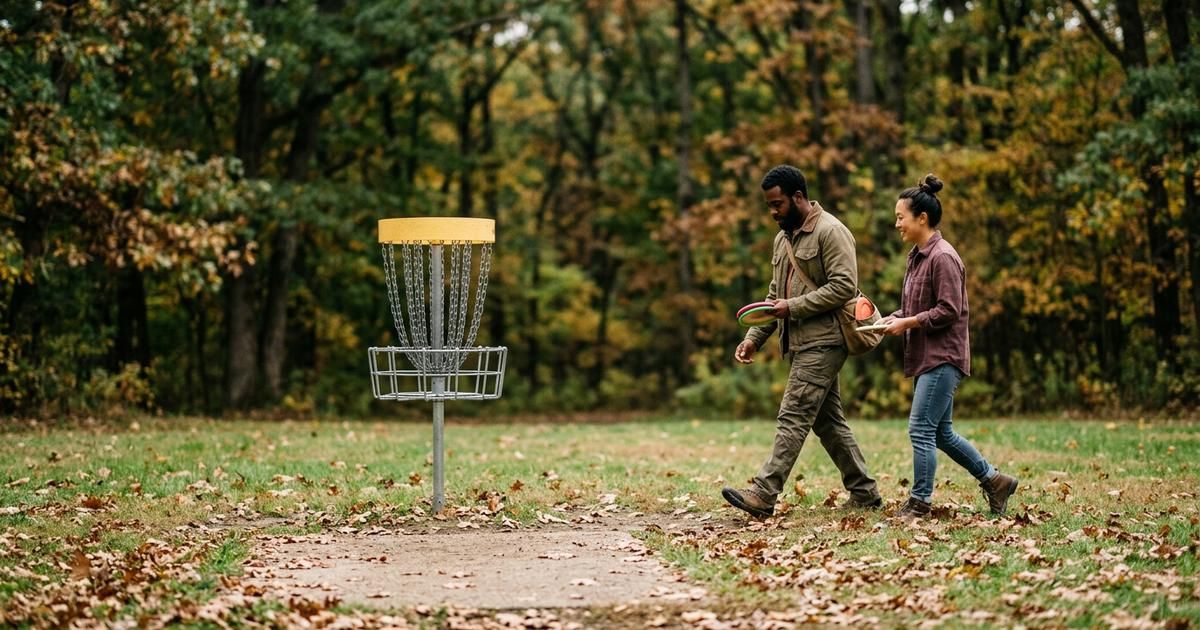
Three things per hole: a tee pad, a fairway, and a metal basket with chains hanging inside it. The pad is usually concrete or packed gravel, the fairway is whatever terrain the park already had, and the basket is your target. Find the basket, throw toward it, repeat until the disc is in the chains.
Most tee pads have a sign or a post showing the hole number, the par and a rough sketch of the layout. Read it. Courses hide baskets behind hills and tree lines constantly, and walking a little way up the fairway to look before you throw is completely normal. Mildly embarrassing the first time. Standard practice after that.
Fairways look nothing like the manicured version. Some cut through woods so tight you’re throwing down a narrow corridor with trunks on both sides. Others run wide open across mowed grass with one lonely tree planted exactly where your disc wants to travel. Wooded holes punish bad angles. Open holes punish weak arms. Pick your poison, then learn to beat both.
Now the basket. It’s a metal cage on a pole with a ring of chains suspended above it, and your hole ends the moment the disc comes to rest in that cage or wedged in those chains. Clank off the pole and bounce out? Keep throwing. Land on top of the basket? Also doesn’t count, and it’s the most irritating way in the sport to give away a stroke.
Courses usually live inside public parks alongside everything else the park does, so you’ll share space with dog walkers, birthday picnics and kids on bikes. Building a list of cheap things to do outside? Disc golf sits comfortably beside the other outdoor activities around St. Louis that ask almost nothing of your wallet on a Saturday morning.
Which three discs does a beginner actually need?
A putter, a mid-range and one slower fairway driver. Three discs, bought once, and you can play any course competently for a year. The sport sells plastic the way fishing sells lures, hundreds of molds in dozens of blends, and almost none of that matters until your throw repeats itself.
The putter
Blunt, thick-rimmed, slow. A putter feels like a heavy frisbee and flies straight at modest distances, which makes it the most useful disc a beginner owns and the one that should be in your hand for roughly half the round. Use it inside putting range. Use it in the woods. Use it any time the shot matters more than the yardage. Everything a putter teaches you transfers upward to faster discs later.
The mid-range
Your workhorse. A mid-range has a slightly sharper edge than a putter, travels meaningfully farther, and still flies more or less where you aimed it, which is a combination no driver offers a new player. A clean mid-range throw covers a surprising share of holes in one shot. If you could only buy two discs, this and the putter would be the two, and you’d hardly notice the third was missing.
The fairway driver
Read the adjective carefully: a fairway driver, not a distance driver, and ideally an understable one in a light weight. Understable means the disc wants to drift away from the curve your backhand naturally produces, which quietly cancels out a beginner’s biggest flaw. It’ll feel slippery and unpredictable for a week or two. Then one afternoon it starts going somewhere, and you’ll grin like an idiot.
Buying those three at a shop rather than online is worth doing once, because somebody will put discs in your hand, watch your arm, and swap one out for lighter plastic. Shortlist two or three places and say plainly what you want: a starter set for someone who has never thrown, light weights, nothing fast. Then compare what each one hands back. One will ask how far you throw and which way your shots curve. Another points at a bin. The gap between those two answers is the signal.
Why shouldn’t a beginner start with a distance driver?
Because a fast driver needs arm speed you haven’t built yet, and without that speed the disc drops out of the air early and hooks hard to one side. High-speed plastic is shaped for a throw far harder than a beginner’s. Thrown slowly, it becomes a dependable way to hit trees you weren’t aiming at.
The physics aren’t mysterious. Disc flight depends on how quickly that wide, sharp rim is cutting through the air, and below a certain speed the disc simply never generates the lift its shape was designed around. You throw your absolute hardest, it lands shorter than your mid-range would have, and you conclude you’re bad at this. You’re not bad at this. You bought the wrong disc.
There’s a second cost and it’s worse than the lost distance. Fast drivers hide your form from you. A putter tells the truth about your release angle instantly, because the flight is slow enough to watch and diagnose. A driver flattens every different mistake into the same ugly result, a hard dive off to one side, so you never learn which mistake you actually made. Cheap feedback beats expensive gear.
Good shops already know this and will talk you out of the disc on the poster. Already own a distance driver because a friend handed you a bag of them? Keep it. Put it away. Dig it out in a year and see what your arm has learned.

How is a single hole played, start to finish?
Stand on the tee pad, throw toward the basket, then throw again from wherever the disc landed, repeating until it settles into the chains. Count every throw, including the ones that travel two feet. That total is your score for the hole, and par is most often three.
Your lie is the spot where the disc came to rest, and your next throw starts from there. Mark it by leaving the disc where it lies or by setting a mini marker disc directly in front of it, then plant your supporting foot behind that point as you release. No running start after the tee shot. That foot rule is the one new players break constantly without ever realizing it.
Order of play matters a little. Everyone throws from the tee, usually in the order set by the previous hole’s scores, and after that the player farthest from the basket throws next. Sounds fussy for a casual round with friends. It exists so nobody is standing downrange of a disc that’s about to be launched at them.
Holing out finishes the hole. Send a disc into water, past a marked boundary, or into a thicket you genuinely cannot find, and you typically take a penalty throw and play from the last spot that was in bounds. Casual groups are loose about all of this and nobody will scold you. Just choose an interpretation and apply it the same way for all eighteen.
Then you walk to the next tee and do it again, and that hole will be different in some way you won’t see coming until you’re standing on the pad looking at it.
What etiquette should you know before your first round?
Never throw when a person is within range, and that includes the group ahead of you, dog walkers, and kids cutting across on the path. That single habit covers most of disc golf etiquette. The rest is staying quiet while somebody throws, packing out whatever you brought in, and letting faster groups pass.
Range is farther than beginners assume. A disc that gets away from you can travel a long way sideways at head height, and it hurts a great deal more than a tennis ball. Wait until the group in front has cleared the basket and moved on to the next tee. Someone wanders into the fairway mid-round? Hold your throw and wave them through.
Yell “fore” and yell it loud. If your throw is heading anywhere near a person, that word goes out immediately, not after the disc has already landed. Nobody thinks less of you for shouting. Everybody thinks less of you for the silent throw that nearly clipped a stroller.
Two more habits that make you easy to play with. Wave a faster group through if they’re clearly moving quicker or if you’re five minutes into hunting a disc in waist-high brush. And leave the course exactly as you found it: no snapping branches for a better line, no carving fresh paths through undergrowth, no can left behind the basket. Parks have pulled courses over litter before.
Write your name and phone number on the underside of every disc you own. Most players will happily return a disc they find in a ditch, and the honest ones can’t call you without a number to call.
Bigger decisions deserve bigger homework, like board certification when choosing a cosmetic surgeon
Is disc golf hard to get into?
No, and that’s most of the appeal. Your barrier to entry is three discs and shoes you don’t mind getting wet. Most public courses are free to walk onto, nobody books a tee time, and you can show up alone on a Tuesday evening and play nine holes without speaking to a single human being.
Compare that against the sport it borrowed its scorecard from. Ball golf wants a bag of clubs, a booked time, a green fee, and at some places a collar on your shirt. Anyone who has priced out starting golf in St. Louis and winced at the setup cost is looking at roughly the same game here with a fraction of the overhead.
Getting social is easier than it looks, too. Leagues run weekly at a lot of courses, doubles formats deliberately pair a new player with an experienced one, and the culture is unusually tolerant of people who are visibly terrible. Somebody will offer you a disc to try mid-round. Take it. Ask what it does.
What’s genuinely hard is patience. You’ll spend a chunk of your first month walking through tall grass looking for plastic, and there is no purchase that fixes that. Throw shorter. Throw straighter. Lose fewer discs.
How to disc golf for beginners?
Throw a putter off the tee, play the short tees where a course offers them, and count your throws honestly. That’s the entire method. A beginner who throws a putter all round scores better and improves faster than one reaching for a driver on every hole, which sounds backwards and is the advice experienced players give most consistently.
Pick your timing deliberately. Weekday mornings and early evenings are quiet, weekend mid-mornings are the crush, and a packed course with a beginner in front of it is stressful for everybody involved. Go when the pad is empty and take as long as you like. Wherever you end up, an hour alone on a course is the best practice you’re going to get all week.
Bring water, bug spray in summer, and footwear you don’t care about. Fairways drop through low ground and creek beds, and plenty of discs finish in both. Long pants for wooded layouts. Sunscreen for open ones. No special shoes, no special clothes, nothing anybody will look at twice.
Learn a backhand before anything else. Set your feet sideways to the target, reach the disc across your body, pull it back along a straight line toward your chest, and release flat with your wrist snapping at the very end. Flat is the word that matters most in that sentence. Tilt the disc as it leaves your hand and physics takes the decision out of yours.
Then throw at a tree in a park, twenty feet away, over and over again. Five minutes of that a few times a week does more for your score than any disc you could buy.
How do you find a course near you?
Start with the parks department for the municipality you’re in, then cross-check one of the disc golf course-finder apps, which map layouts, list par for each hole, and note whether a course is free. Park websites are the place that tells you honestly if a permit or daily entrance fee applies.
Apps beat search engines here, and it isn’t close. The course-finder apps carry user-submitted maps, photographs of individual tee signs, and reviews that tell you the thing no park website ever will: whether a given hole is unplayable after two days of rain, and whether the course is forgiving for a first-timer or a wooded gauntlet that will cost you discs.
Ask a shop, too. Disc golf retailers know which nearby course suits a beginner, which one eats plastic, and exactly when the local leagues meet. That conversation beats an hour of scrolling, and it costs nothing but the time it takes to walk in.
Drive time shapes this more than anything else. A household in Imperial and a household in Rock Hill aren’t working from the same shortlist at all, and families over in Glen Carbon, Highland or Grafton should check the Illinois side as carefully as they check across the river, because the nearest basket isn’t always in the same state. Same logic as planning a morning at the St. Louis skate parks: the closest option and the right option are two different questions.
Check before you drive. Some courses share ground with ball fields and close for tournaments, some sit inside a park that charges at the gate, and a few are on private property with their own posted hours. One phone call to the park saves a wasted trip and a carload of disappointed kids.
Ready to go throw something? Browse disc golf courses and shops around St. Louis on St Louis Near Me Directory, pick two or three, and call before you load the car.
- If you’re the shop fitting that starter set, the course people drive to, or the organizer running the league, being the one players and AI tools name first is the game now, so list your course or shop.
Frequently asked questions
What are the five basic rules of disc golf?
Tee off from behind the front of the tee pad. Play your next throw from wherever the disc came to rest, with your supporting foot behind that mark. The player farthest from the basket throws next. Count every throw, penalties included. The hole ends when the disc rests in the basket or its chains. Safety sits above all five: never throw toward a person.
How much does a round of disc golf cost?
Most public courses are free to play, which is the honest headline. Some charge a small fee, and a few sit inside parks that require a permit or an entrance payment at the gate. Your real expense is the discs themselves, bought once and used for years. Call the park or ask a local shop before you drive out, because policies differ course to course.
How far should a beginner disc golfer throw?
Shorter than you think, and that’s fine. New players consistently overestimate their distance and underestimate how much straightness is worth. A mid-range thrown flat and clean will finish farther down the fairway than a driver thrown badly, every single time. Chase a repeatable release angle first. Distance arrives on its own once the form stops fighting you.
What is the golden rule of disc golf?
Never throw when anybody could be hit. That’s the rule that outranks everything else in the rulebook, because a disc is heavy, fast and edged. Some players quote a second one alongside it: leave the course better than you found it, meaning no broken branches, no litter, no new trails. Both come down to respecting the people and the park sharing the space with you.
Is disc golf basically frisbee?
Same family, different equipment and a different motion. A recreational frisbee is large, light and blunt, built to float gently between two people. Golf discs are smaller, denser and beveled at the rim so they cut through air and carry. The throw is a pull across your body rather than a flick, and the game is scored hole by hole like golf.
What’s the 2 m rule in disc golf?
A disc stuck in a tree or other object more than two meters above the ground costs you a penalty throw, and you play from the ground directly beneath it. Here’s the catch: that rule is optional and usually switched off, applied only when a tournament director specifically puts it in play. Casual rounds almost never use it. Play from underneath and move on.
Do you need special shoes or clothes for disc golf?
No. Sneakers or trail shoes you don’t mind soaking will do the job, since fairways cross wet ground and creek beds. Long pants help in wooded layouts where thorns live, and sunscreen matters more on open courses than any gear choice. There’s no dress code at a public course, and nobody is going to look at your outfit twice.
How many discs should a beginner carry?
Three, plus a small marker disc for your lie. A putter, a mid-range and one slower fairway driver cover everything a new player will face for a full season. Carrying eight discs before your throw repeats itself just adds decisions you aren’t equipped to make yet. Add the fourth disc when you can name the specific shot it’s meant to solve.

Written by a dedicated team of St. Louis locals who live, work, and play right here in the St. Louis metro. Founder Lane Forman and team are committed to building the region’s most trusted directory by verifying listings and connecting local businesses with loyal customers across Missouri and Illinois.