Getting a Business Sign Made and Permitted in St. Louis
Revised August 16, 2026
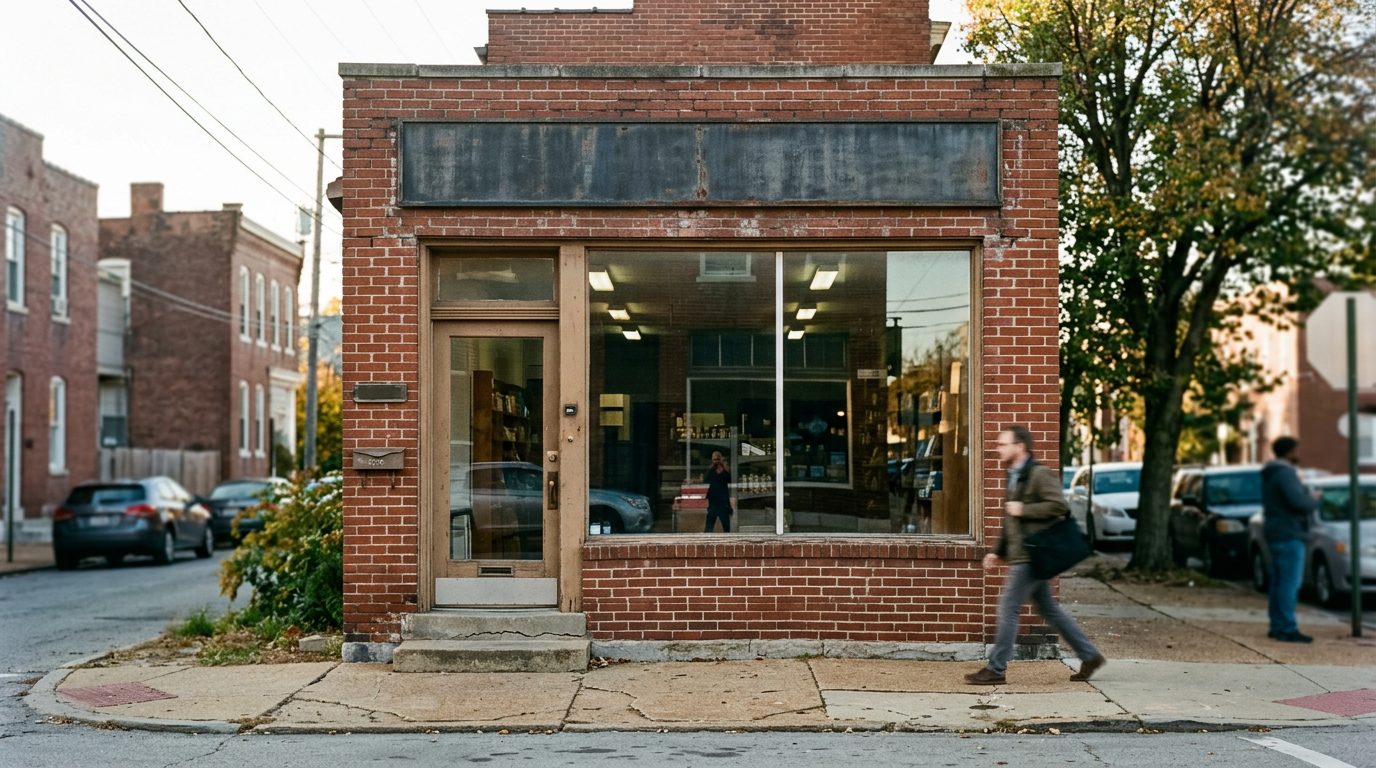
Where is it legal to place business signs?
On your own building or lot, within what your zoning district allows — and never in the public right-of-way, where Missouri sign codes routinely treat a sign as unlawful and remove it without compensation. Freestanding signs also have to clear setback and sight-distance limits near driveways and intersections.
Keep reading ↓Imagine you signed the lease in June on an end-cap suite in a strip center, and the buildout is finally close. Floors are in. Equipment lands Thursday. Above the door sits a blank panel where the last tenant’s sign used to be, and a sign shop’s proof is in your inbox with a number on it.
Maybe the space is in Affton. Maybe it’s a brick storefront in Maplewood, a freestanding building in Florissant, or a suite in a newer center out in St. Charles. Somebody has told you the sign is the easy part — pick a font, hang it, open. Somebody else has a story about a sign that sat in a warehouse for two months.
Both are describing the same job. What separates them is whether anyone handled the permit before the aluminum got cut. Here is the order that keeps your sign off a shelf.
Do you need a permit for a business sign in St. Louis?
Almost always, yes. The City of St. Louis Building Division handles signs and awnings as a commercial building permit category: installing or modifying a sign on your building requires a permit so the work clears local safety and zoning rules. Nearly every municipality in this metro has some version of that requirement, on both sides of the river.
Exemptions exist, but they are narrow and locally written — small window lettering, address numerals, temporary real estate signs, government signage. Those lists are not identical in Kirkwood, Belleville and unincorporated St. Louis County. Assume a permit is required and get any exemption in writing. One note for City addresses: a sign permit is not a Banner Permit, which the Board of Public Service issues only for banners on City light poles.
Why do sign rules change from one street to the next?
Because this metro is split into an unusual number of separate governments. St. Louis County contains 88 municipalities, and the City of St. Louis sits outside it as an independent city. Add St. Charles and Jefferson counties, then St. Clair, Madison and Monroe on the Illinois side, and a fifteen-minute drive can cross four or five different sign codes.
Where it is legal to place business signs is set address by address; the sign your competitor put up two miles away tells you nothing about what you can build. Unincorporated St. Louis County works from Section 1003.168 of its zoning ordinance; the moment your address falls inside a city limit, that city’s code governs instead. Call whoever handles zoning for your exact address — Chesterfield planning at (636) 537-4733, Belleville’s planning and zoning office at (618) 233-6810, the City of St. Louis permit section at (314) 622-3313.

What does a sign permit application require?
Plan on a scaled drawing of the sign, a site plan or elevation showing exactly where it mounts, and full specs: dimensions, materials, colors, mounting method, and whether it is illuminated. Chesterfield requires a completed application for each sign plus scaled drawings showing size, color and material.
Most jurisdictions want three more things. Written authorization from the property owner if you are a tenant. A licensed, bonded and insured installer — Missouri has no statewide contractor license, so those rules are set city by city. And a separate electrical permit for anything lit. In O’Fallon, Illinois, permanent signs go through Planning and Zoning as a Certificate of Zoning Compliance, and the permit is triggered by expanding, altering, relocating or reconstructing a sign, not just by a new one. Re-facing an old cabinet often counts.
What does a sign permit cost?
In the City of St. Louis, permit fees run off estimated construction cost. There is a $25 application fee per application, then $44 total for work valued at $1,000 or less, $48 from $1,001 to $2,000, $55 from $2,001 to $3,000, and above $3,000 it becomes the $25 application fee plus $10 per thousand dollars of estimated construction cost. All of it is non-refundable.
Put a real number through that: a $9,000 illuminated storefront sign in the City lands around $115 in permit fees. Not the expensive part of the project. Other municipalities price differently — flat fees, per-square-foot fees, fees by sign type, plus electrical and plan review charges. Edwardsville, Illinois keeps sign rules in Chapter 94 and fees in a separate schedule. Ask for your number in writing.
Wildly off-topic — good marketing help is easier to find locally than you think.
How are size, height and setback limits calculated?
Most codes here do not hand you a flat square-footage number. They tie your allowance to your storefront, commonly one to two square feet of sign area per linear foot of building frontage — though the exact ratio is local. That is why the 40-foot bay next door gets a bigger sign than your 22-foot bay in the same building.
Freestanding signs pick up a second layer: maximum height measured from grade, a minimum setback from the property line and right-of-way, and sight-distance rules capping height inside the visibility triangle near driveways and intersections. St. Louis County also ties setback obligations to sign height, so taller means farther back. Illumination carries its own limits — internal versus external, brightness, hours, and light spill onto residential property behind you.
What does a historic district add?
A review step, and it happens before the building permit. In the City of St. Louis, the Cultural Resources Office reviews permit applications for exterior work on City Landmarks and buildings in City Historic Districts, applying the adopted Rehabilitation or New Construction Standards. No permit issues without CRO or Preservation Board approval.
What gets scrutinized is materials, mounting, and how the sign meets the building. Drilling into original masonry, internally lit plastic cabinets on a nineteenth-century storefront, and covering transom glass are the recurring friction points; mortar-joint anchoring, painted wood or metal, and halo-lit letters clear more easily. CRO offers a free preliminary review from photos and schematic plans, at 314-657-3865. Municipalities across the metro run their own review boards.
Can you put up a digital or LED message board?
Sometimes, and usually with tight strings attached. Electronic message centers are the most restricted sign type in this metro. Lake Saint Louis shows the typical shape: under Section 425.550(C)(4) of its sign code, a message must hold for a minimum of thirty seconds, animation effects such as scroll, flash, twinkle, travel and melt are prohibited, and video or moving video imagery is not permitted.
Other municipalities go further — banning them outright in some districts, capping the digital portion as a share of total sign area, requiring night dimming, or allowing them only on freestanding signs. Guess wrong and it hurts, because the display is the priciest component in the sign. Get your local rule in writing before anyone orders hardware.
Monument, pylon, wall or window — which one do you need?
Zoning and your lease usually decide this, not taste. A wall sign mounts flat to the building and is what most in-line tenants get; channel letters are individually fabricated letters, typically lit, mounted to the wall or a raceway. A window sign is vinyl or lettering on the glass, often capped at a percentage of the window area.
Freestanding signs come in two shapes. A monument sign sits low on a solid base, the form many newer commercial districts specifically require. A pylon or pole sign lifts a cabinet on poles for highway visibility, and it is the type most likely to be capped or disallowed under a modern code. In a multi-tenant center you probably are not getting your own freestanding sign at all — you get a panel on the center’s existing pylon, in a format the landlord controls.
How much does a sign for a business cost?
Cost tracks fabrication method more than size. National sign-industry pricing guides put channel letters at roughly $75 to $150 per letter depending on size and font complexity, with complete illuminated storefront sets commonly landing between $3,000 and $8,000 installed. Installation is its own line: those guides put crane rental for a sign install at about $600 to $1,200 for the day, and high-mount channel letter work at $1,000 to $2,500.
A printed vinyl banner lives in a different universe — roughly $3 to $8 per square foot, so a 3-by-8 banner often comes in under $200. That is the right tool for a grand opening or a seasonal push, not a substitute for permanent signage, and many local codes cap how many days a year a temporary banner may stay up. Treat these as market shape, not a St. Louis price list.
What does your lease say about signage?
Read the signage clause before you read the sign quote. Most commercial leases here require written landlord approval of design, size, materials and mounting, and many centers operate under a recorded sign criteria document dictating letter height, color, font and whether the sign may be lit at all.
Pin down three things in writing: whether the landlord approves your specific proof, who owns the sign when you leave, and who patches and repaints the facade at removal. Landlord authorization is often a permit submittal item too, so a slow landlord delays the municipal review rather than running alongside it.
What happens if you skip the permit?
You can be ordered to take the sign down, and you pay for the removal. Missouri municipal sign codes routinely carry that language. Independence, Missouri’s ordinance shows the standard form: if the permit holder or property owner fails to comply within ten days after notice, the city may remove or alter the sign at the owner’s expense, and signs in the public right-of-way are treated as unlawful and abandoned, subject to removal without compensation.
The quieter costs land harder. An unpermitted sign can hold up an occupancy permit, surface during a sale or refinance, and hand an insurer an argument if it ever comes down. Fixing it later means paying for removal, paying for the permit anyway, and often redesigning a sign you already bought.
What sign shops wish buyers understood
From the shop’s side, the quote you compare against an online price is not the same product. A storefront job carries hours of unbilled design time before anyone approves a proof. Then substrate and hardware — aluminum, acrylic faces, trim cap, LED modules, a raceway — priced off metal and plastic markets the shop does not control. Then installation: a bucket truck, a crew, general liability and workers’ compensation coverage, and a licensed electrician for anything lit.
And the line nobody quotes out loud — somebody drives the permit. That is a person reading a code section, redrawing a layout to fit an area allowance, and standing at a counter, often twice. An online price for a printed panel includes none of it. Whether sign making is profitable depends almost entirely on which of those costs a shop actually recovers — the ones competing head-on with an online panel price are usually giving away the install. Ask a shop to itemize permit work rather than assume it. Shops get called for these jobs by being findable, which is what a complete local listing is for.
Related reading: buying the stock behind the window and landlord approval on the lease.
Want a shop that pulls the permit, not just prints the panel? Browse sign dealers across the St. Louis metro on St Louis Near Me Directory, then call two or three with your street address in hand — the address decides the code, and the shop that asks for it first is worth a second call.
Frequently asked questions
Do I need a permit to put a sign on a building I own?
Owning the building does not exempt you. A sign permit is a zoning and safety approval attached to the property and the sign, not the tenancy. In the City of St. Louis, installing or modifying a sign requires a Building Division permit regardless of who holds the deed.
Where is it legal to place business signs?
On your own building or lot, within what your zoning district allows — and never in the public right-of-way, where Missouri sign codes routinely treat a sign as unlawful and remove it without compensation. Freestanding signs also have to clear setback and sight-distance limits near driveways and intersections.
How long does a sign permit take in the St. Louis area?
There is no single metro-wide answer, because 88 municipalities in St. Louis County plus the independent City, St. Charles County and the Illinois side each run their own review. Ask for a target date when you submit, and build in extra weeks if the building sits in a historic district or the sign needs a variance.
How much does a sign permit cost in the City of St. Louis?
Fees follow estimated construction cost: a $25 application fee, then $44 total for work valued at $1,000 or less, $48 from $1,001 to $2,000, $55 from $2,001 to $3,000, and above $3,000 the $25 fee plus $10 per thousand dollars of estimated cost. Fees are non-refundable.
How much should a shop sign cost?
Price a storefront sign by its parts: channel letters at roughly $75 to $150 each, complete illuminated sets commonly $3,000 to $8,000 installed, high-mount installation at $1,000 to $2,500, and crane rental around $600 to $1,200 a day. A quote far under that usually leaves something out.
How much does it cost to get a sign?
Budget three lines, not one: fabrication, installation and permits. The permit is usually the small one — a $9,000 illuminated sign in the City of St. Louis runs about $115 in permit fees — but anything lit also needs a separate electrical permit, and landlord approval costs time.
Can I hang a banner while I wait on my permanent sign?
Often yes, with limits. Many local codes treat temporary banners as their own category, with a maximum size, a maximum number of display days per calendar year, and sometimes a separate temporary sign permit. Ask your municipality for the day limit first.
Are digital LED message signs allowed around St. Louis?
It depends on your municipality and zoning district. Restrictions are common: minimum message hold times, bans on animation and video, night-dimming rules, and caps on how much of a sign may be digital. Lake Saint Louis requires a thirty-second minimum hold and prohibits animation and video under Section 425.550(C)(4). Check your own code before ordering a display.
Is sign making profitable?
It depends on what the shop recovers beyond materials. A storefront job absorbs unbilled design hours, substrate and hardware priced off metal and plastic markets, a bucket truck and crew, general liability and workers’ compensation coverage, a licensed electrician for anything lit, and somebody’s time driving the permit through a counter. Shops that itemize that work price it sustainably. Shops matching an online panel price generally are not.
Does my landlord have to approve my sign?
In nearly every commercial lease in this metro, yes, and in writing before fabrication. Many multi-tenant centers also enforce a sign criteria document controlling letter height, color, font and illumination. Landlord authorization is often part of the permit application too, so chase it early or it becomes the thing holding up the project.

Written by a dedicated team of St. Louis locals who live, work, and play right here in the St. Louis metro. Founder Lane Forman and team are committed to building the region’s most trusted directory by verifying listings and connecting local businesses with loyal customers across Missouri and Illinois.