Buying Building Supplies in St. Louis: Lumberyard, Big Box, or Salvage
Revised August 16, 2026
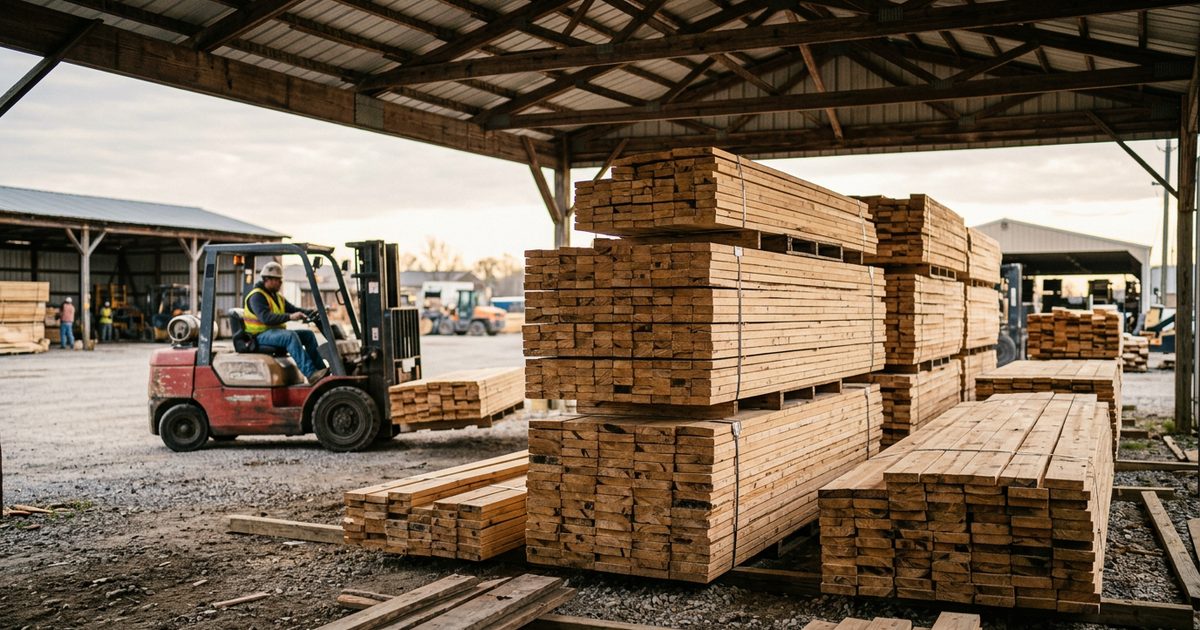
Do lumber yards have better lumber than Home Depot?
Better selection and better sorting, more than better boards. A yard carries more species, more grades, longer lengths and treated lumber rated for your actual exposure, and will-call has the order banded when you pull up. At a home center you cull the pile yourself.
Keep reading ↓Imagine it’s a Saturday morning in Kirkwood and the back deck has finally lost the argument. A board flexed under your heel last October and you let it go. Now there are two soft spots, a railing that moves, and a list on the back of an envelope.
Maybe your version is different. A basement in Florissant that needs framing before Thursday’s drywall crew. A garage in Belleville with a header gone soft under a leaky gutter. A fence in St. Charles that a June storm took down. A wall in Maryland Heights where the mortar falls out when you poke it.
The list is the easy part. Where you buy it decides what the job costs, how long you spend digging for boards that aren’t twisted, and whether anybody catches your math before you pay.
Do lumber yards have better lumber than Home Depot?
Match the store to the job, not to habit. A big-box home center wins on hours, on small quantities, and on taking back the four boards you didn’t need. A lumberyard wins on grade selection, on stock somebody already pulled and stacked, on delivery that reaches a job site, and on a counter person who catches the wrong joist span before you pay.
You also do not need a contractor license or an account to buy from a yard. Most building supply houses in the St. Louis metro sell to the public.
The real gap is depth. A home center stocks a narrow band of fast-turning framing. A yard selling to builders carries more species, more grades, longer lengths, and treated lumber rated for the exposure you actually have. Ground contact is a different product from above ground, and grabbing the wrong one is the most common expensive mistake on a deck.
The second gap is who sorts. At a home center you cull the pile yourself, sighting down each edge for crown and twist. At a yard the will-call counter has your order banded and waiting when you pull up.
What does the stamp on a piece of framing lumber tell you?
The stamp is the only objective quality information on a board, and it carries five things: the grading agency, the mill number, the grade, the species group, and the moisture content when the board was surfaced.
- Grade — Select Structural, No. 1, No. 2, No. 3 and Stud, strongest to weakest. Most framing sold over the counter is No. 2 or better.
- Species — SPF, southern yellow pine, Doug Fir-Larch and Hem-Fir span differently and are not interchangeable in a span table.
- Moisture — S-GRN is surfaced green. S-DRY and KD-19 both mean 19 percent moisture or less. KD-15 or MC-15 means 15 percent or less.
- Mill number and agency logo — what a building inspector looks for on a permitted job.
Drier lumber shrinks and twists less once nailed up, and grade drives span: a No. 1 joist reaches farther than a No. 2 of the same depth.

What does a contractor account actually get you?
Trade credit and a person. A real account means net 30 terms instead of a credit card, purchases coded to a job address, quoted pricing held for a stated window, will-call staging, job-site delivery, a material takeoff run from your plans, and returns handled by someone who knows the account.
Net 30 matters most to anyone running crews — the yard is financing thirty days of material while you wait on a draw. Charges coded to an address also stop you guessing which project ate the margin. Homeowners can ask for a cash account and the same takeoff.
One thing to know in Missouri: a supplier who delivered material to your house can lien it even if you paid your contractor in full. Suppliers must give the owner ten days’ written notice before filing under RSMo 429.100, and liens run six months from the last material furnished. RSMo 429.012 makes the original contractor give owner-occupants a written disclosure saying exactly that. Ask for lien waivers from the supplier, not only the contractor.
Nothing to do with lumber — you will need a plumber eventually.
What does building material delivery cost across the St. Louis metro?
Delivery is priced by the truck, not by the board. Expect a flat charge per drop inside a yard’s zone, a higher one when a boom truck or piggyback forklift has to place the load on a roof or behind a fence, and a hard edge where the zone stops. Ask the fee, the zone line, and what day they run your area.
Geography is the whole story. The St. Louis metropolitan area is 15 counties across roughly 8,458 square miles in two states. A yard in Maryland Heights and a yard in Belleville are both local to somebody and nowhere near each other, so most run set days per zone.
Know curbside from placed. Curbside means the load lands wherever the truck can reach, and a pallet of block at the end of the driveway is a long afternoon. Many yards also cut the fee above an order threshold, so folding three trips into one pays for itself.
Where do you buy brick and mortar for an old St. Louis house?
A masonry supply yard, and the spec that matters most is the mortar, not the brick. National Park Service Preservation Brief 2 is explicit that masonry originally laid in lime mortar should not be repointed with Portland cement mortar. Hard mortar in a soft wall pushes stress into the brick face, and the faces spall off.
Clay from the Cheltenham deposit south of Forest Park fed dozens of brickyards from the 1840s on, and after the Great Fire of 1849 burned fifteen blocks of riverfront the city required new construction east of Jefferson Avenue to be brick. Fired cooler than modern brick, those units are soft and porous.
Under ASTM C270, mortar is graded by 28-day compressive strength: Type M at 2,500 psi, Type S at 1,800, Type N at 750, Type O at 350. On a soft historic wall you want the weakest mortar that will do the job, and a masonry supplier can mix a lime-rich Type O.
Used brick carries its own rule. The City of St. Louis licenses brick dealers under Ordinance 67392: a permitted dealer must photograph every seller, keep a register of purchases and sales, and see a demolition permit before taking used brick. Violations carry fines up to $500 plus at least fifty cents per brick.
Is reclaimed and salvaged material worth the hassle?
For brick, solid doors, old-growth dimensional lumber, mantels, hardware and trim profiles nobody mills anymore, yes — salvage is often the only way to match what is already in the house. For anything with a code or safety function you cannot verify by looking at it, no.
What salvage costs you is certainty. No warranty, usually no return, and the quantity on the floor is the entire quantity that exists. If you find 900 bricks that match, buy 10 to 15 percent past your takeoff that day, because there is no reorder.
Dimensions surprise people: older framing runs closer to its nominal size, and old brick will not line up with new coursing. Assume painted material from a pre-1978 building may carry lead paint. The supply exists because crews here take buildings apart instead of knocking them flat, to save the brick and the lumber.
How do you price a materials list without getting upgraded?
Write the spec, not the product, and hand every yard the identical list: species, grade, dimension, length, quantity, treatment rating. Ask each to quote line by line and flag substitutions in writing. Three comparable quotes is the whole defense against a cheerful upgrade.
Some upgrades are real. Ground-contact lumber where the code calls for ground contact is the job, not an upsell, and No. 1 across a long span may be structurally required. A “premium” stud on a garage partition usually is not.
Ask when the quote expires. The Random Lengths framing lumber composite that the National Association of Home Builders tracks sat at $558.19 per thousand board feet on August 7, 2026; it peaked near $1,515 in May 2021. Policy drives part of that swing: duties on most Canadian softwood ran 35.16 percent, and although Commerce preliminarily cut them to 24.83 percent in April 2026, a separate 10 percent Section 232 tariff from October 2025 sits on top.
Lumber is not automatically cheaper at a lumber yard. Compare delivered-and-taxed totals, not shelf prices. Missouri’s state sales tax is 4.225 percent and Illinois’s is 6.25 percent, before local add-ons. On a $9,000 order that is not rounding.
What can you legally install yourself in Missouri and Illinois?
Missouri has no statewide general contractor, plumbing or HVAC license — those rules are set county by county and city by city. Illinois licenses plumbing and roofing at the state level. That difference decides who may install the material you just bought.
In St. Louis County, electrical and plumbing work must be done by a licensed contractor or by a pre-authorized homeowner who has passed an open-book test given by county inspections. The property has to be a single-family residence you occupy and hold the occupancy permit for, and the test may be taken only once every twelve months.
In the City of St. Louis, a permit is required for an entire new roof or any job replacing more than 25 percent of the roof sheathing, plus decks, porches, retaining walls, accessory buildings over 50 square feet and new fences. Tuckpointing, painting, and swapping windows and doors into existing openings do not.
The Illinois Plumbing License Law (225 ILCS 320) requires licensed plumbers, with a carve-out letting the owner-occupant of a single-family residence do their own — if the work meets the Illinois State Plumbing Code, stays open to inspection, and no unlicensed helper assists. The Illinois Roofing Industry Licensing Act (225 ILCS 335) requires a state license unless you are working on your own property. You can buy the shingles in Belleville; you cannot hand the install to an unlicensed handyman.
What a supply yard sees from the other side of the counter
Ask an owner where the money is and it is not the lumber. Trade benchmarks put a typical dealer near a 23 percent gross margin and low single-digit pretax profit, with commodity dimensional lumber the thinnest line on the sheet — millwork, doors and windows run closer to 30 percent. That is what the pro desk is for: a package deal moves the mix, not just studs. Meanwhile the yard carries inventory whose replacement cost shifts weekly, extends net 30 to contractors, and runs a delivery fleet across 8,458 square miles. National building-material dealer sales came in at $33.7 billion in January 2026 against $42.3 billion the previous October. What owners tell each other is simpler: bring a list, not a sketch. Yards get found by neighborhood searches, which is why a complete listing is worth ten minutes — claim or add yours.
Related reading: what makes furniture last and when the job needs an architect.
Not sure which yard stocks what your project needs? Browse building supplies across the St. Louis metro on St Louis Near Me Directory, then send the same written material list to two of them and compare the quotes line by line.
Frequently asked questions
Do I need a contractor license to buy from a lumberyard in St. Louis?
No. Building supply yards across the metro sell to the public, and most will open a cash account for a homeowner and run a material takeoff from your drawings. What a contractor account adds is trade credit: net 30 terms, purchases coded to a job address, and quoted pricing held for a stated window.
Do lumber yards have better lumber than Home Depot?
Better selection and better sorting, more than better boards. A yard carries more species, more grades, longer lengths and treated lumber rated for your actual exposure, and will-call has the order banded when you pull up. At a home center you cull the pile yourself.
Is lumber cheaper at a lumber yard?
Not automatically. Dimensional lumber is the thinnest line on a dealer’s sheet, and the commodity moves weekly — the Random Lengths framing composite sat at $558.19 per thousand board feet on August 7, 2026 against a $1,515 peak in May 2021. Compare delivered-and-taxed totals on an identical list.
Where’s the cheapest place to get lumber?
For old-growth dimensional lumber, salvage — no warranty, no return, no reorder. For new material, whichever of two or three yards comes back lowest on the identical written spec, delivered and taxed.
What does KD-19 mean on a 2x6?
KD-19 means the board was kiln dried to 19 percent moisture content or less when it was surfaced. S-DRY signals that same ceiling reached by air or kiln drying, S-GRN means surfaced green, and KD-15 or MC-15 means 15 percent or less. Drier lumber shrinks and twists less after you nail it up.
How much does building material delivery cost in the St. Louis area?
Delivery is priced per truckload rather than per item, so one flat charge usually covers a single drop inside a yard’s zone, with a higher rate when a boom truck places the load on a roof or behind a fence. Fee schedules and zone lines vary by yard, so get the charge printed on your quote.
What mortar should I use on a 100-year-old St. Louis brick house?
Generally the weakest mortar that will do the job. National Park Service Preservation Brief 2 warns against repointing lime-mortar masonry with Portland cement mortar, because hard mortar drives stress into softer brick and pops the faces off. Under ASTM C270, Type O runs 350 psi and Type N 750, against 1,800 for Type S. Bring a piece of the original mortar to a masonry supplier.
Can I do my own plumbing or electrical work in St. Louis County?
Within limits. St. Louis County lets a pre-authorized homeowner do their own electrical and plumbing work after passing an open-book test administered by county inspections. The property must be a single-family residence you occupy and hold the occupancy permit for, and the test may be taken only once every twelve months.
Where can I legally buy used brick in St. Louis?
From a dealer holding a City of St. Louis brick dealer permit. Ordinance 67392 requires permitted dealers to photograph every person selling them bricks, keep a register of purchases and sales, and see a demolition permit and a valid city business license before accepting used brick. Permits expire October 15 each year, so ask to see the paperwork.

Written by a dedicated team of St. Louis locals who live, work, and play right here in the St. Louis metro. Founder Lane Forman and team are committed to building the region’s most trusted directory by verifying listings and connecting local businesses with loyal customers across Missouri and Illinois.