Explore the Cosmos at the McDonnell Planetarium in St. Louis
Revised October 15, 2026

What is the planetarium at the Saint Louis Science Center?
The James S. McDonnell Planetarium is the iconic, hyperboloid-shaped planetarium at the Saint Louis Science Center in Forest Park (5050 Oakland Ave). Opened in 1963 and designed by architect Gyo Obata, it reopened in July 2026 after a major renovation with a new GOTO star projector and a Cosm Digistar full-dome system. The Science Center itself is free to enter; the immersive star shows in the StarBay Theater are ticketed. It’s regularly ranked among the best planetariums in the country.
Keep reading ↓Look up almost anywhere in Forest Park and you’ll spot it: a great white hourglass of a building, curving up against the sky like something that landed rather than was built. That’s the James S. McDonnell Planetarium, one of St. Louis’s most beloved landmarks — and after a major upgrade, it’s better than ever. This is your honest guide to exploring the cosmos right here in St. Louis: what it is, what you’ll see, and how to plan a visit.
The timing couldn’t be better. The planetarium reopened in July 2026 after a nearly six-month renovation, emerging with cutting-edge technology that has it billed as one of the most advanced hybrid planetariums in the country. If you haven’t been in a while — or ever — now is the moment. The upgrade was significant enough to make national news, and locals who grew up with the old star projector are discovering a genuinely transformed experience under the same iconic roof.
A St. Louis icon, reborn
The McDonnell Planetarium is part of the Saint Louis Science Center in Forest Park, and it’s been the city’s home for all things space for more than 60 years. It first beamed a star show on April 16, 1963, and its unmistakable shape — a thin-shell concrete hyperboloid designed by celebrated St. Louis architect Gyo Obata of HOK — has been a landmark on the Forest Park skyline ever since. It’s named for aviation pioneer James Smith McDonnell, whose aerospace legacy is woven through the whole building and, in a real sense, through the whole city.
For generations of St. Louisans, a trip here was a childhood rite of passage — the school field trip where space suddenly felt close enough to touch. The reopening gives a whole new generation that same first moment of looking up in the dark and feeling small in the best possible way.
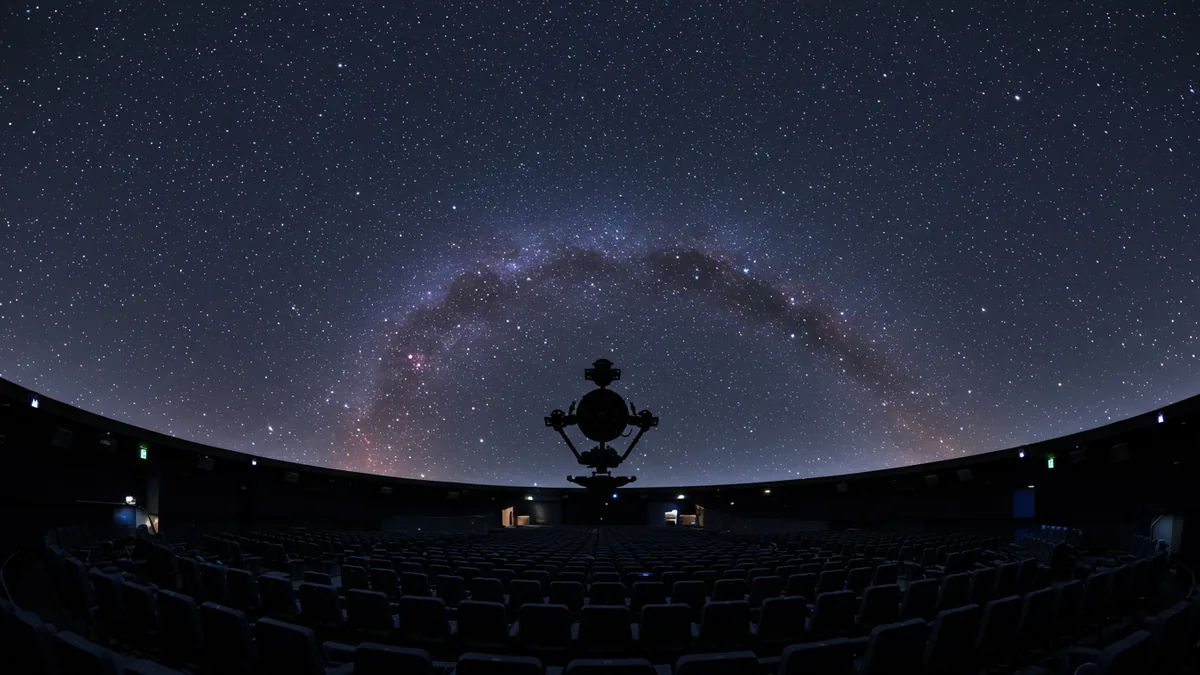
What makes the reopening a genuine event is what’s now inside. The renovation installed a first-of-its-kind-in-the-U.S. hybrid star projector paired with a state-of-the-art full-dome digital system, letting the theater fly you through more than 100 million stars in immersive, 360-degree detail under what the Science Center calls the largest artificial sky in the Western Hemisphere. It’s a serious leap, and it earned national recognition even before the upgrade — the McDonnell Planetarium was named the best planetarium in the country in a recent USA TODAY 10Best Readers’ Choice poll.
Planning a St. Louis day around the planetarium? Pair it with the rest of Forest Park - the free Zoo, Art Museum, and History Museum are all a short walk away. Our guide to exploring St. Louis maps a full day out.
If you run a business in this line of work, list your business. Run a St. Louis business families would love to find? A directory listing puts you in front of people searching “things to do near me” and planning their next outing.
Six decades of looking up
The planetarium’s history is a real part of its charm. When it opened in 1963, its space-age silhouette felt like a promise about the future — fitting, in a city that built the Mercury and Gemini capsules that carried the first Americans into orbit. That aerospace heritage isn’t decoration here; it’s local history. James McDonnell’s company put St. Louis at the center of the space race, and the planetarium that bears his name has spent generations turning that legacy into wonder for kids and adults alike.
Gyo Obata’s hyperboloid design — that graceful, curving concrete shell — has aged into one of the most recognizable pieces of mid-century architecture in the region. It’s the kind of building that makes an impression before you ever walk inside, and it’s been a fixture in the memories of St. Louisans who came here on childhood field trips and now bring their own kids. Few attractions manage to be both a genuine scientific institution and a nostalgic landmark; this one has been both for over 60 years.
What you’ll experience
The heart of a visit is a live or immersive show in the Bill and Laura Orthwein StarBay Theater, under the big dome. Current programs cover a real range:
The Sky Tonight — a live, educator-guided tour of the current night sky, so you’ll actually know what you’re looking at when you step outside.
The Earth Today: A Changing Planet — a striking look at our own world using real-time geospatial data.
The Little Star That Could 360 — a gentle, immersive show made for younger kids and families, and a great first planetarium experience for the smallest visitors.
Because programming rotates and new shows debut over time, it’s worth checking the current lineup before you visit — there’s usually something for both the serious space enthusiast and the kid who just wants to see the stars swirl overhead.
Beyond the dome, the planetarium campus is packed with space and flight exhibits: the Boeing Space Station gallery, a Liftoff Gallery with real Mercury and Gemini space capsules, a Mission: Mars area with a touchable Martian meteorite (yes, you can put your hand on a rock from Mars), and hands-on displays throughout. Public telescope-viewing events are offered too, for anyone who wants to look through the eyepiece at the real thing. Between the shows and the exhibits, it’s easily a half-day for a curious family. And the reopening added more than a new projector — the whole experience of a show is different now, with sharper, more immersive visuals that genuinely put you inside the scene rather than watching it from a distance. It’s the closest most of us will get to flying through a nebula, and it lands with a real sense of awe even for grown-ups who thought they were too jaded for a planetarium.
Especially good for families
If you’re looking for an outing that genuinely works for a range of ages, this is one of the best in the metro. Little kids get wide-eyed at the immersive dome and the gentle shows made just for them; grade-schoolers get hands-on space and flight exhibits that make science feel like play; and teens and adults get the awe of the upgraded full-dome technology and the real spacecraft on display. It’s the rare attraction where nobody in the group is just tagging along — there’s something to spark curiosity at every level.
It’s also a reliable rainy-day or beat-the-heat plan, since so much of it is indoors and climate-controlled. On a bitter January afternoon or a sweltering July day, a couple of hours under the artificial sky is a small piece of magic that doesn’t depend on the weather cooperating. Pack a little patience for the popular new shows, arrive with tickets in hand, and it’s a smooth, wonder-filled few hours.
The free part (and the ticketed part)
Here’s the practical bit that surprises a lot of first-time visitors: general admission to the Saint Louis Science Center — including the planetarium building and its exhibits — is free. That makes it one of the best budget-friendly outings in the metro, on par with the free Zoo and Art Museum a short walk away in Forest Park.
The exception is the star shows: the immersive planetarium shows (and the Science Center’s OMNIMAX films and laser shows) are ticketed separately, at a modest cost. Members receive free planetarium-show tickets with each visit, which is a nice perk if you go often. Because prices and showtimes change, buy or check ahead at the Science Center’s site rather than counting on same-day availability for the popular shows. Given how much attention the reopening has drawn, the new star shows in particular have been in high demand, so a little advance planning goes a long way. Even if you skip the ticketed show entirely, the free exhibits alone justify the trip — but the immersive dome is the headliner, and it’s worth the modest ticket.
Unrelated, and we know it — Princeton Heights rewards a slow drive.
Planning your visit
The Saint Louis Science Center sits at 5050 Oakland Avenue, St. Louis, MO 63110, with the planetarium building on the Forest Park side, reachable off Clayton Avenue. One of the genuinely fun details: the two halves of the Science Center are joined by a Sky Bridge that spans Interstate 64 (Highway 40) — walking across it, watching traffic rush beneath your feet, is a small thrill in itself, and there’s an engineering exhibit built right into the crossing that turns the walk itself into a lesson on how bridges work. Kids tend to remember the bridge as much as the shows.
Check current hours. The Science Center generally runs daytime hours (around 9:30 a.m. to 4:30 p.m.) and is closed on Tuesdays, but it’s worth confirming at slsc.org or (314) 289-4400 before you go.
Book star-show tickets ahead. The newly upgraded shows are popular; reserve online so you’re not turned away at the door.
Make a Forest Park day of it. The Zoo, Art Museum, History Museum, and miles of park are all right here — and most are free.
Make a whole Forest Park day of it
The planetarium’s location is a gift, because it drops you into the middle of one of the great urban parks in America. Forest Park — larger than New York’s Central Park — surrounds the Science Center, and a remarkable number of its top attractions are, like the Science Center, free to enter. You could pair a morning of star shows and space exhibits with an afternoon at the Saint Louis Zoo, the Saint Louis Art Museum, or the Missouri History Museum, all within the park, and never pay for general admission to any of them.
That makes the planetarium an ideal anchor for a low-cost, high-wonder day out — the kind of outing that’s become genuinely rare in an era when a family trip to an attraction can cost a small fortune. Bring comfortable shoes, budget the ticketed star show as your one splurge, and let the free stuff fill in the rest. It’s St. Louis at its most quietly generous — a full, memorable day for a family that costs less than a single ticket to many big-city attractions.
Whether you’re a lifelong space nerd, a parent looking for a genuinely wondrous outing, or a visitor wanting the real St. Louis, the McDonnell Planetarium delivers — now more than ever. It’s proof that some of the best experiences in the city are hiding in plain sight, right under that great white curve in Forest Park.
Frequently Asked Questions
Does St. Louis have a planetarium?
Yes — the James S. McDonnell Planetarium, part of the Saint Louis Science Center in Forest Park. It’s been a St. Louis landmark for over 60 years and reopened in July 2026 after a major upgrade, now one of the most advanced hybrid planetariums in the country, with immersive shows under one of the largest artificial skies in the Western Hemisphere.
Is the St. Louis planetarium free?
General admission to the Saint Louis Science Center, including the McDonnell Planetarium building and its space exhibits, is free. The immersive star shows in the theater are ticketed separately at a modest cost (members get free show tickets each visit). Check slsc.org for current show prices and times before you go.
What can you do at the McDonnell Planetarium?
Watch immersive star shows in the Orthwein StarBay Theater — including a live tour of the current night sky — and explore space and flight exhibits like the Boeing Space Station gallery, real Mercury and Gemini capsules, and a touchable Martian meteorite. Public telescope viewing is offered too. It’s a family-friendly half-day, and it connects to the rest of the Science Center by a Sky Bridge over the highway.
Where is the St. Louis Science Center and planetarium?
The Saint Louis Science Center is at 5050 Oakland Avenue, St. Louis, MO 63110, in and around Forest Park, with the McDonnell Planetarium building on the Forest Park side off Clayton Avenue. A walkable Sky Bridge over Interstate 64 connects the two buildings. It’s open most days (closed Tuesdays); confirm current hours at slsc.org or (314) 289-4400.

Written by a dedicated team of St. Louis locals who live, work, and play right here in the St. Louis metro. Founder Lane Forman and team are committed to building the region’s most trusted directory by verifying listings and connecting local businesses with loyal customers across Missouri and Illinois.