Hardwood, Laminate or Vinyl? Start by Looking Under Your Carpet
Revised October 21, 2026
Hardwood or laminate — which should you actually put down?
The room decides it more than taste does. Hardwood for main living areas above grade, especially in an older home. Laminate or luxury vinyl for basements, heavy traffic, rentals and big dogs. Engineered wood for real wood over a concrete slab. ⚠️ Solid hardwood does not belong below grade — that is moisture physics, not preference. 💡 Before pricing anything, pull up a corner of carpet in a closet: a lot of houses here have original hardwood underneath, and refinishing usually costs less than replacing.
Keep reading ↓The carpet in the back bedroom has to go. That much is settled.
What replaces it is less settled, and an hour of reading turns up confident people telling you hardwood is the only real answer, laminate is a scam, vinyl plank has solved everything, and engineered wood is either the smart compromise or a marketing exercise.
Hardwood or laminate — which should you actually put down?
It depends far less on taste than the comparison articles suggest, and far more on three questions:
- What room is it, and is it below grade? Solid hardwood does not belong in a basement. That is not a preference, it is moisture physics.
- What is already under the carpet? In a lot of houses around here, the answer is original hardwood — and refinishing beats buying.
- Who lives there? Large dogs, small children and heavy traffic push the answer toward wear resistance over authenticity.
The short version: hardwood for main living areas above grade, especially in an older home. Laminate or luxury vinyl for basements, high-traffic rooms, rentals, and houses with big dogs. Engineered wood when you want real wood over a concrete slab or in a room with some humidity swing.
Look under the carpet first
Before you price a single square foot, pull up a corner in a closet.
This metro is full of houses built long before wall-to-wall carpet existed, and a great many of them have original hardwood underneath — oak, usually, installed when the house was built and covered over sometime in the second half of the last century. If your house predates the carpet by decades, there is a genuine chance the floor you want is already in the room.
Refinishing existing hardwood is usually cheaper than buying and installing new flooring, and the material is frequently better than what you would buy today: old-growth, tighter grain, and thick enough to sand more than once. It also keeps the house consistent with itself, which matters in a period home more than people expect.
What to check when you look: whether the boards are actually wood rather than a thin veneer; how much thickness is left above the tongue, since that determines whether it can be sanded at all; whether there is water staining, cupping or crowning; and how much damage the carpet tack strips and staples did around the perimeter. A flooring contractor will tell you in one visit whether it is refinishable, and that visit is worth more than any amount of online comparison.
If you have recently worked out that your house is older than the listing claimed, this is the practical payoff — that age makes it much more likely there is something worth uncovering.
The basement rule
This is the one place where the choice is not really a choice.
Basements are below grade, which means the slab passes moisture upward continuously, humidity swings hard by season, and the risk of standing water is never zero. Solid hardwood in that environment cups, gaps and eventually fails — not because it is poor quality, but because wood moves with moisture and a basement never stops supplying it.
What works below grade is waterproof by construction rather than by finish: luxury vinyl plank, tile, or sealed concrete. Laminate is a middle case — better than hardwood, but its core is wood-based, and a genuine water event will swell it permanently unless it is a specifically waterproof product.
And the sequencing point that saves people the most money: fix the water before you buy the floor. A finished basement floor installed over an unresolved moisture problem is a floor you will pay for twice. If the space has ever taken water, deal with that first.
What each material is actually good at
Solid hardwood. Real wood, sandable several times over a lifetime, and the only option that genuinely adds to a period home rather than sitting inside it. Weaknesses: moisture, scratching, and cost. It should stay above grade.
Engineered wood. A real wood veneer over a dimensionally stable core. It handles humidity swings better than solid, can go over concrete, and looks identical because the surface is wood. The catch is the veneer thickness — a thick wear layer can be refinished once or twice, a thin one never can. Ask for that number before buying anything.
Laminate. A photographic layer under a hard wear surface. Modern laminate is genuinely scratch-resistant — often more so than real wood — and inexpensive. Weaknesses: it cannot be refinished, ever, and water at the seams is its failure mode. It also sounds different underfoot, which some people never stop noticing.
Luxury vinyl plank. Fully waterproof, quiet, comfortable underfoot, and the most forgiving of everything the household throws at it. Weaknesses: it can dent under heavy point loads, quality varies enormously between cheap and good, and it does not add the character an older home wants.
If you have dogs
This deserves its own answer because it is asked constantly and answered badly.
Two different problems get conflated: scratching and liquid. Dog nails scratch, and accidents, water bowls and wet paws soak. A material can be excellent at one and poor at the other.
Solid hardwood loses on both counts — it scratches visibly and standing liquid stains it if it sits. Laminate resists scratching very well and handles liquid poorly at the seams. Luxury vinyl plank handles both, which is why it wins most dog-household recommendations honestly rather than as a sales pitch.
Two practical notes worth more than the material choice: matte and textured finishes hide scratches dramatically better than glossy ones, and lighter or heavily grained looks hide them better than dark uniform ones. And whatever you install, keeping nails trimmed does more for the floor than any product feature.
Nothing to do with flooring — here’s where to eat in Byrnes Mill.
Where each one belongs
- Living room, dining room, bedrooms, above grade: hardwood if the house suits it, engineered if there is a slab.
- Kitchen: tile or luxury vinyl. Wood in a kitchen is a decision about looks, made knowing the dishwasher will eventually leak.
- Bathrooms and laundry: tile or vinyl. Nothing wood-based.
- Basement: vinyl, tile or sealed concrete. Never solid hardwood.
- Rentals and high-traffic: laminate or vinyl. Durability and replaceability beat authenticity when you are not the one living on it.
- Stairs: wood or carpet. Vinyl and laminate on stairs is a specialist installation and frequently done badly.
- Entryways and mudrooms: tile or vinyl. This is where road salt, slush and grit arrive every winter, and grit is what actually destroys a finish — it works like sandpaper underfoot. A mat inside and out does more for whatever you install here than the material choice does.
Pick one of each up and look at the edge
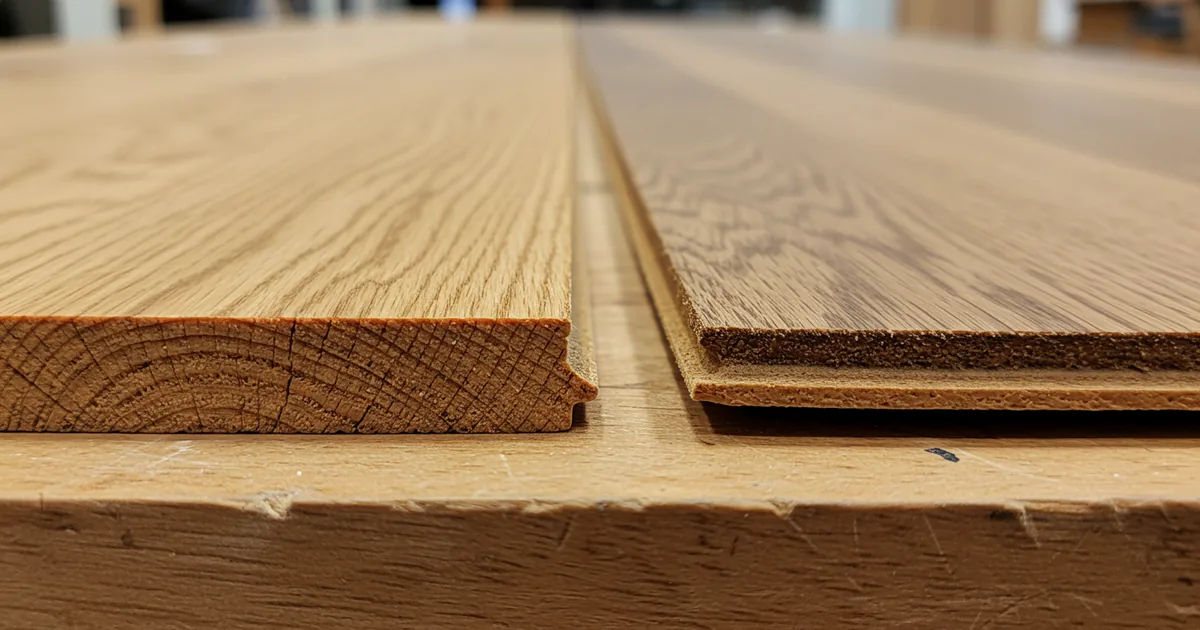
If you take one thing into the showroom, take this: hold a solid oak plank next to a laminate plank and look at them edge on.
The oak will be around three quarters of an inch thick, and it is wood the whole way through. The laminate will be somewhere near three sixteenths — roughly a quarter of the thickness — with a thin decorative layer over a dense core.
That difference is the entire argument, and it explains everything else. Three quarters of an inch of real wood can be sanded down and refinished several times across a lifetime, which is why hundred-year-old floors in this city are still in service. There is nothing to sand on a laminate plank; the surface you buy is the only surface it will ever have, and once it wears through or a seam swells, the plank gets replaced rather than repaired.
Engineered wood sits between them, and the same test applies — look at the edge and find the real wood layer on top. A thick one can be refinished once or twice. A paper-thin one is, functionally, laminate with a nicer surface and a higher price.
How it goes down matters too
Installation method is not a detail. It affects cost, how the floor sounds, and whether it survives.
Nail-down is traditional solid hardwood over a wood subfloor. It is the most permanent and the most expensive in labor, and it is not an option over concrete.
Glue-down bonds the floor to the subfloor. It is quiet underfoot and stable, common for engineered wood over slab, and it is the hardest to remove later.
Floating means the planks lock to each other rather than to the floor beneath. It is fast, it is what most laminate and vinyl use, and it is the most forgiving of a subfloor that is not perfectly flat — up to a point. Past that point it separates at the seams, which is why levelling gets skipped and then regretted.
Ask what goes underneath, too. Underlayment handles sound, minor levelling and — over concrete — the moisture barrier. On a slab that last one is not optional, and a floor installed without it is a warranty claim waiting to happen.
And ask about acclimation. Wood and many laminates need to sit in the room for a few days before installation so they reach the humidity they will live in. A crew that wants to deliver and install the same day is skipping a step that shows up months later as gaps or buckling — and in a climate with our humidity swing, that step earns its delay.
The costs nobody quotes
The number you are given per square foot is rarely the number you pay, and the gaps are predictable.
Removal and disposal of the old floor is labor plus a dumpster or a hauler, and old carpet is bulky. Subfloor repair only reveals itself once the old floor is up, and in an older house it frequently reveals something. Levelling matters more than people expect, because click-together floors installed over an uneven subfloor separate at the seams later.
Then the finishing details: transitions and trim at every doorway, quarter round or new baseboard, and door undercutting if the new floor sits higher than the old. Each is small and they add up.
Get every quote itemized to the same list, and ask specifically what happens if the subfloor turns out to need work — whether that is a change order, and at what rate. That is the line that surprises people mid-project.
Finding an installer here
Have the room measured and know what is underneath before you call, and get the refinishing question answered before you price replacement — those two facts change the entire budget. Browse flooring pros on the home services coverage map, which covers both sides of the river.
If the job is tile rather than plank, that is a different trade with different skills — how to choose a tile installer covers what to ask there.
Frequently asked questions
Is hardwood or laminate better?
Neither, in the abstract. Hardwood is better above grade in a home where character and long-term value matter, because it can be refinished for decades. Laminate is better where scratching, budget or traffic dominate. The room decides it more than preference does — and below grade, neither is the right answer.
What is the best flooring for dogs?
Luxury vinyl plank, for most households, because it handles the two separate problems — scratching and liquid — that other materials only solve one of. Choose a matte, textured finish rather than gloss, since texture hides scratches far better. Laminate is a close second if accidents are not a concern.
Can you put hardwood in a basement?
You should not. Below-grade slabs pass moisture upward continuously and humidity swings by season, which makes solid wood cup, gap and eventually fail. Use luxury vinyl, tile or sealed concrete. And resolve any water problem before installing anything, or you will buy the floor twice.
Is it cheaper to refinish hardwood or replace it?
Refinishing is usually cheaper, and in older homes it is frequently an option people do not realize they have. Pull up a corner of carpet in a closet before pricing replacement. What matters is whether enough thickness remains above the tongue to sand — a flooring contractor can tell you in one visit.
Does laminate flooring add value to a home?
Less than hardwood, more than worn carpet. In a period home, original or new hardwood is what buyers respond to. In a rental, a basement, or a house where the floor takes real abuse, laminate or vinyl is the sensible choice and nobody is penalizing you for it.
What is engineered hardwood?
A real wood veneer bonded to a stable core. The surface is genuine wood, so it looks identical to solid, but it handles humidity better and can go over a concrete slab. The number that matters is the wear-layer thickness — thick enough and it can be refinished, thin and it never can. Ask before buying.
Before you price new flooring, look under the carpet. In an older home there is a real chance the floor you want is already there, and refinishing usually costs less than replacing. Browse flooring pros across the metro on the home services coverage map or on St Louis Near Me Directory.
If you run a business in this line of work, list your business. What if getting more customers didn’t mean handing another platform your card and hoping? Do you refuse to be invisible? See your options →

Written by a dedicated team of St. Louis locals who live, work, and play right here in the St. Louis metro. Founder Lane Forman and team are committed to building the region’s most trusted directory by verifying listings and connecting local businesses with loyal customers across Missouri and Illinois.