How 'Love Your Block' Cleans Up Neighborhoods, Block by Block
Revised August 29, 2026

How to start a neighborhood clean up?
The most effective neighborhood cleanups pair resident energy with a small grant. Programs like Love Your Block give residents $500–$2,500 to clean their own blocks; a 10-city evaluation found it removed nearly 300,000 pounds of trash and cleaned 1,000-plus acres. Start by rallying neighbors, applying for a mini-grant, and targeting one specific block. Columbia is the first Missouri city to run it.
Keep reading ↓Big cleanups make the news — the mayor, the trucks, the before-and-after photos. But ask anyone who’s actually kept a block clean over the long haul and they’ll tell you the truth: the durable work is small, local, and unglamorous. A few neighbors, a Saturday morning, a vacant lot that stops being an eyesore. The genius of a program called Love Your Block is that it takes that instinct and hands it a little money and a lot of respect — and the return is enormous. Best of all, it’s already running an hour and a half up I-70, in Columbia, Missouri.
Small grants, huge returns
Love Your Block is a municipal program — now run by the Bloomberg Center for Public Innovation at Johns Hopkins — built on a simple bet: residents know their own blocks better than any city department, so give them small grants and get out of the way. The grants are modest, typically $500 to $2,000 (Columbia offers up to $2,500), and they fund exactly what a block needs — clearing a vacant lot, planting a corner, starting a regular cleanup, painting a mural.
The payoff is wildly out of proportion to the spend. A 2021 Urban Institute evaluation of a 10-city cohort found the program removed nearly 300,000 pounds of trash and cleaned and improved over 1,000 acres of vacant land. Those are numbers a city could never hit by paying contractors — they only happen because volunteer labor and local knowledge do the heavy lifting, and a few hundred dollars is enough to unlock them.
Missouri is already doing it
Here’s the part that should make St. Louis pay attention: Columbia, Missouri is the first city in the state to run Love Your Block, part of the 2024–2026 cohort, offering grants up to $2,500 to residents in its central and northeast neighborhoods. The model isn’t some far-off experiment — it’s a proven, in-state playbook, being run by a mid-size Missouri city right now.
St. Louis has the ideal ground for it. The city is already laced with the exact infrastructure the program needs: hundreds of active neighborhood associations and the decades-old volunteer network of Brightside St. Louis, which fields about 6,000 volunteers a year. What’s missing is the small, flexible pot of money that lets those groups act on their own priorities without waiting on City Hall. The city’s Rams settlement even earmarked $10 million for vacant-property reduction — exactly the kind of blight a micro-grant program turns into gardens and pocket parks.
Why small grants beat big budgets
It sounds backwards that a few hundred dollars could out-perform a city contract, but the math is real, and it rests on three things a top-down program can’t buy. First, local knowledge: the residents on a block know which lot floods, which corner attracts dumping, and what the neighborhood actually wants there — information no outside crew shows up with. Second, volunteer labor: the grant pays for tools, a dumpster, some plants, and the neighbors supply the hours for free, so a few hundred dollars mobilizes thousands of dollars of work. Third, speed and flexibility: a block club can act on its own priority this weekend instead of waiting months for a department to route a request.
Stack those together and you get the eye-popping returns the evaluations found — hundreds of thousands of pounds of trash and a thousand-plus acres reclaimed — for grant sums a city budget would round off. The program isn’t really buying cleanups. It’s buying the activation of people who were already willing, but lacked the small amount of money and permission it takes to start.
The real product isn’t clean lots — it’s ownership
Here’s the part that outlasts any single Saturday. When neighbors plan and build something themselves — a garden, a cleared lot, a mural — they don’t just improve it once; they own it. And people maintain what they own. A lot cleared by a city crew is a lot that gets re-trashed by Tuesday; a lot a block turned into a pocket park is a lot those same neighbors will defend for years. That shift — from residents as passive recipients of city services to active stewards of their own space — is the durable win, and it’s exactly what a truck-and-crew blitz can never produce.
Evaluators of these programs keep landing on the same secondary finding: the cleanups build social capital and trust. Neighbors who work together once tend to keep organizing — on safety, on services, on the next project — and the relationship between a block and City Hall warms when residents see the city backing their ideas instead of imposing its own. The clean lot is the visible result. The engaged, connected neighborhood is the real one.
What St. Louis can steal from it
Create a small St. Louis micro-grant fund, point it at the neighborhood associations and block clubs already doing the work, and let residents lead. It’s the cheapest, highest-trust cleanup tool there is — and it builds something a top-down cleanup blitz never can: neighbors who feel ownership over their own streets, which is what keeps them clean long after the grant is spent. See how it fits alongside the citywide effort in our complete St. Louis cleanliness playbook.
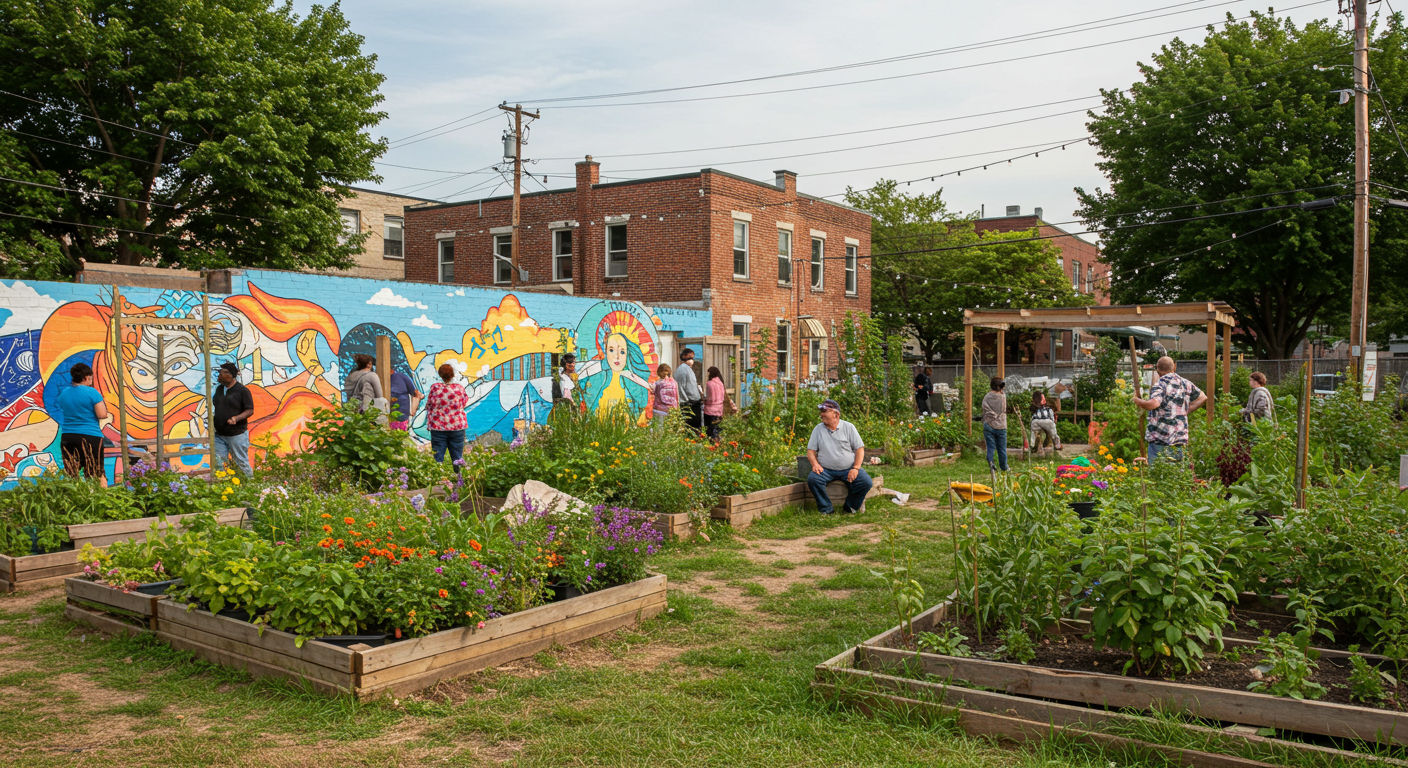
A few hundred dollars and a willing block turn a dumping ground into a place people are proud of.
Why St. Louis is unusually good ground for this
Some cities would have to build the civic muscle a program like this needs. St. Louis already has it — arguably more of it than almost any city its size. The metro is famously organized at the neighborhood level: dozens upon dozens of active neighborhood associations, block units, and community development corporations, many with decades of history and their own monthly cleanups. That’s the exact delivery network Love Your Block runs on. In most cities the hard part is finding organized residents to hand grants to. In St. Louis, they’re already meeting on Tuesday nights.
The city also has the two other ingredients, for better and worse. It has the need: thousands of vacant lots and buildings, many held by the Land Reutilization Authority, that are exactly the blight a micro-grant turns into a garden or pocket park. And it has the volunteer culture: Brightside St. Louis has been fielding thousands of residents a year since 1982, so the habit of showing up for your block is already deeply set here. A grant program wouldn’t be planting a new idea in hostile soil — it’d be watering something that’s been growing for forty years.
And the timing is rare. The tornado-recovery moment has focused attention and money on North St. Louis precisely where the need is greatest, and the neighborhoods rebuilding are the ones where resident-led investment matters most. A program that puts small grants and real trust in the hands of those blocks — letting people shape their own recovery rather than have it done to them — fits the moment almost perfectly. The pieces are on the table. What’s missing is the small fund and the decision to trust neighbors with it.
Random, but: Roxana’s restaurant scene is bigger than you’d guess.
How St. Louis could actually run it
This doesn’t require inventing anything — it requires assembling pieces the city already has. Seed a fund (the Rams settlement’s $10 million for vacant-property reduction is the obvious source), set grants in the proven $500–$2,500 range, and route applications through the neighborhood associations and block clubs that already know their blocks. Lean on Brightside St. Louis for tools, supplies, and cleanup know-how so a first-time block isn’t starting from zero. Start with a handful of pilot neighborhoods — the ones with active associations and visible need — document the before-and-after, and expand toward what works.
The design details matter, and Columbia’s program is a ready template: keep the application simple enough that a busy resident can finish it, pay for the unglamorous stuff (dumpster rental, hauling, gloves, soil) that stops good intentions cold, and prioritize the neighborhoods that have been overlooked longest. The honest catch is that even a small grant program needs a coordinator — someone to run the applications, cut the checks, and keep the momentum — so it can’t be nobody’s job. But for a fraction of what a single contracted cleanup costs, St. Louis could activate dozens of blocks at once, and build the neighborhood ownership that keeps them clean long after. It’s one of the highest-return moves in our complete St. Louis cleanliness playbook.
There’s a multiplier worth naming, too. A block that turns one vacant lot into a garden rarely stops there — the neighbors who pulled it off tend to tackle the next lot, organize the next cleanup, and pull in more people each time. Cities that fund these micro-grants consistently report that the first project is really an on-ramp: it converts a few willing residents into an organized, durable group that keeps improving the neighborhood long after the grant is spent. For a dollar figure that barely registers in a city budget, that compounding civic energy may be the best return St. Louis could buy.
If Columbia can do it, St. Louis can — we already have the volunteers and the vacant lots. All that’s missing is a small fund that trusts neighbors to lead. The full plan is in our St. Louis cleanliness playbook.
Own a business in the metro? When a block takes pride in itself, the local businesses on it win. Listing it on St Louis Near Me Directory helps neighbors across Missouri and Illinois find and support you.
Frequently Asked Questions
What are the basic steps for a cleanup?
Five steps: (1) choose a target area and date; (2) recruit volunteers and confirm supplies; (3) coordinate disposal/hauling with your city’s refuse or 311 service ahead of time; (4) run the event with a safety briefing and assigned zones; (5) document before-and-after photos and schedule the next one. Small grants (like Love Your Block) can fund tools and dumpsters.
What are some tips for a successful cleanup?
Keep the area small enough to finish and see results, start early before the heat, provide water and gloves, and make it social — food or music brings people back. Partner with a neighborhood association for reach, line up disposal in advance so bags don’t sit, and celebrate the before-and-after. Recurring monthly cleanups beat one big annual push.
How to clean up the neighborhood?
Combine quick wins with lasting systems: organize regular volunteer cleanups, adopt chronic-problem blocks and alleys, report illegal dumping to the city, and pursue small grants (like Love Your Block) to fund tools and lot transformations. The most effective neighborhoods pair hands-on work with a bit of seed money and strong local ownership.
How to start a community clean up?
Rally a core group through your neighborhood association, pick a date and a specific area, and line up supplies and disposal in advance (Brightside St. Louis and the city’s Refuse Division can help). Publicize it widely, make it welcoming and social, and document the results. To go bigger and more lasting, pursue a small grant — the Love Your Block model — to fund tools, dumpsters, and lot improvements.
Are there grants to clean up your neighborhood?
Yes. Programs like Love Your Block give residents micro-grants (typically $500–$2,500) for neighborhood cleanup and beautification projects — Columbia, Missouri runs one now. Many cities also offer neighborhood or block-grant funds, and local foundations and business sponsors sometimes chip in. Start by asking your neighborhood association and city’s community-development office what’s available in your area.
How to start a neighborhood cleanup?
Pick one block and one date, not a whole district. Line up bags, gloves and a disposal plan before you invite anyone — the failure mode is twenty volunteers and nowhere to put the trash. Tell the city; many will supply materials or haul the pile if asked in advance.
What can you do to improve your neighborhood and keep it clean?
Small and repeated beats big and occasional. A standing monthly hour does more than one heroic Saturday, because the block starts to look maintained, and maintained blocks attract less dumping. Reporting problem properties and broken lights matters as much as picking up litter.
What are three things that make a good neighborhood?
People who know each other by name, somewhere to walk to, and visible upkeep. The third is the one residents can move fastest — it signals that somebody is paying attention, and that signal changes behavior more reliably than any ordinance.

Written by a dedicated team of St. Louis locals who live, work, and play right here in the St. Louis metro. Founder Lane Forman and team are committed to building the region’s most trusted directory by verifying listings and connecting local businesses with loyal customers across Missouri and Illinois.