How Philadelphia Cleaned Up the Whole City in 13 Weeks
Revised August 10, 2026
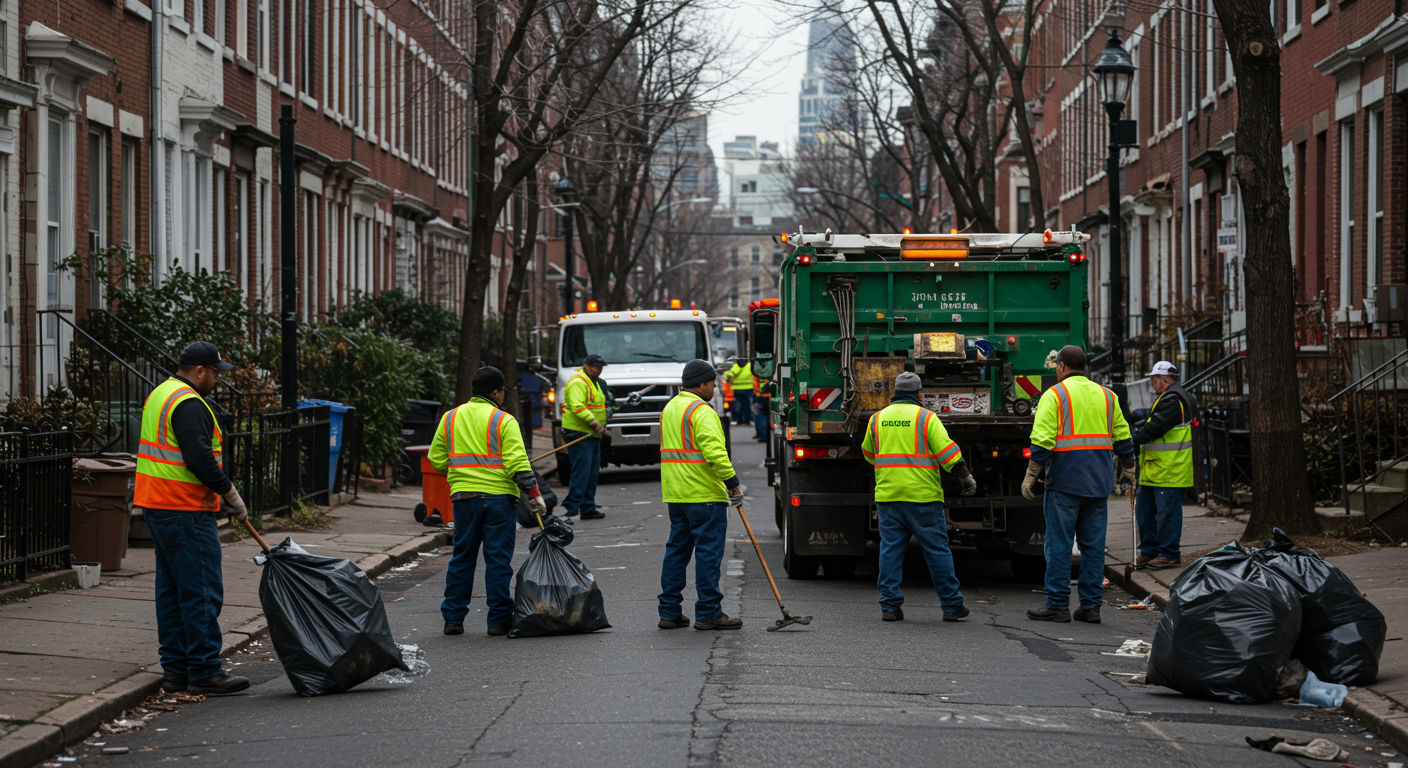
How do cities clean their streets?
The fastest-improving cities clean their streets by coordinating, not working department-by-department. Philadelphia’s One Philly, United City program delivered over 61,000 cleaning services across every neighborhood in 13 weeks by aligning a dozen city departments at once, then made it a permanent twice-yearly routine. The lesson for St. Louis: coordination is the multiplier.
Keep reading ↓Ask anyone who’s watched a city try to clean itself up why it never quite sticks, and you’ll hear the same thing: the left hand and the right hand don’t talk. Sanitation clears a lot; a week later someone dumps a couch on it. Forestry trims a park; the trash cans overflow beside it. Every department does its piece, and the pieces never add up. Then, in the summer of 2024, Philadelphia did something almost radical in its simplicity — it made them all work at once.
The program was called One Philly, United City, and it’s the clearest proof going that a city can visibly transform itself in weeks — if leadership forces every department to pull in the same direction at the same time. For St. Louis, digging out from disinvestment and a devastating 2025 tornado, it’s close to a blueprint.
61,000 services in 13 weeks
Launched by Mayor Cherelle L. Parker with the stated goal of making Philadelphia the “safest, cleanest, greenest big city in the nation,” One Philly ran for 13 weeks from June to August 2024 and pulled more than a dozen city departments under a single command structure. Sanitation led collections, Parks & Recreation handled green space, the Streets Department attacked illegal dumping, and on down the line — all coordinated, all measured.
The result: more than 61,000 quality-of-life services delivered across every neighborhood in a single summer — cleaned lots, cleared corridors, filled potholes, mowed medians. And crucially, the city didn’t treat it as a one-time stunt. Philadelphia made it standard operating procedure, running twice a year; by its fourth round in late 2025, the cumulative total had passed 200,000 services. It also funded 1,500 new solar-powered “Big Belly” smart litter bins — roughly doubling the city’s count of the high-capacity, self-compacting units.
Why coordination is the whole game
The reason One Philly worked isn’t exotic. Cities are full of capable departments that are individually busy and collectively uncoordinated. When you align them — same neighborhoods, same weeks, same scoreboard — you get results that look impossible because no single department could ever produce them alone. Residents suddenly see a government they can, in the mayor’s framing, “see, touch, and feel.” That visible competence rebuilds the civic trust that makes every future effort easier.
What One Philly actually did, department by department
The word “coordinated” does a lot of quiet work here, so it’s worth seeing what it meant on the ground. Sanitation ran deep-clean collections and cleared corridors. The Streets Department went after illegal dumping and potholes. Parks & Recreation mowed medians, cleaned lots, and tended green space. The Water Department handled drainage and infrastructure. And instead of each running its own schedule and its own map, they all worked the same neighborhoods in the same weeks under a single command structure, with a shared list of targets and a shared scoreboard.
That’s the difference between a city that’s busy and a city that’s effective. Any one of those departments, working alone, produces a result that fades — the mowed median beside the overflowing can, the cleared lot next to the dumping ground nobody touched. Aligned, they produce a whole block that’s visibly, completely done. The total isn’t the sum of the departments; it’s a multiple of them, because the pieces stop undoing each other.
Why most city cleanups fail — and this one didn’t
The graveyard of urban cleanups is full of one-time events: a big splashy weekend, a photo op, and six weeks later you can’t tell it happened. Philadelphia’s crucial decision was to refuse that trap. It made One Philly standard operating procedure, run twice a year, permanently — so the couch that reappears gets cleared again on a predictable schedule, and residents and businesses can plan around it. That steady, repeated cadence — not a single heroic push — is what turns cleanup into a system residents can count on.
It also paired the blitz with permanent infrastructure. The 1,500 new solar-powered smart bins aren’t a cleanup — they’re a change to the baseline, so the same corridor generates less mess between blitzes. That combination — a recurring coordinated push plus better everyday infrastructure — is what turns a good summer into a durable trend. And everything was measured, which is what let the city prove it worked and keep the funding.
The trust dividend
There’s a payoff here that doesn’t show up in the service count. When a city visibly does something big and competent, it rebuilds a currency most struggling cities are short on: faith that the government can actually deliver. Mayor Parker framed the goal as government residents can “see, touch, and feel,” and that’s not just a slogan — visible competence lowers the resistance to every future effort, from bond issues to volunteer drives. A city that proves it can clean up finds it easier to do everything else. For St. Louis, where decades of disinvestment have worn down exactly that trust, the trust dividend might matter as much as the clean streets.
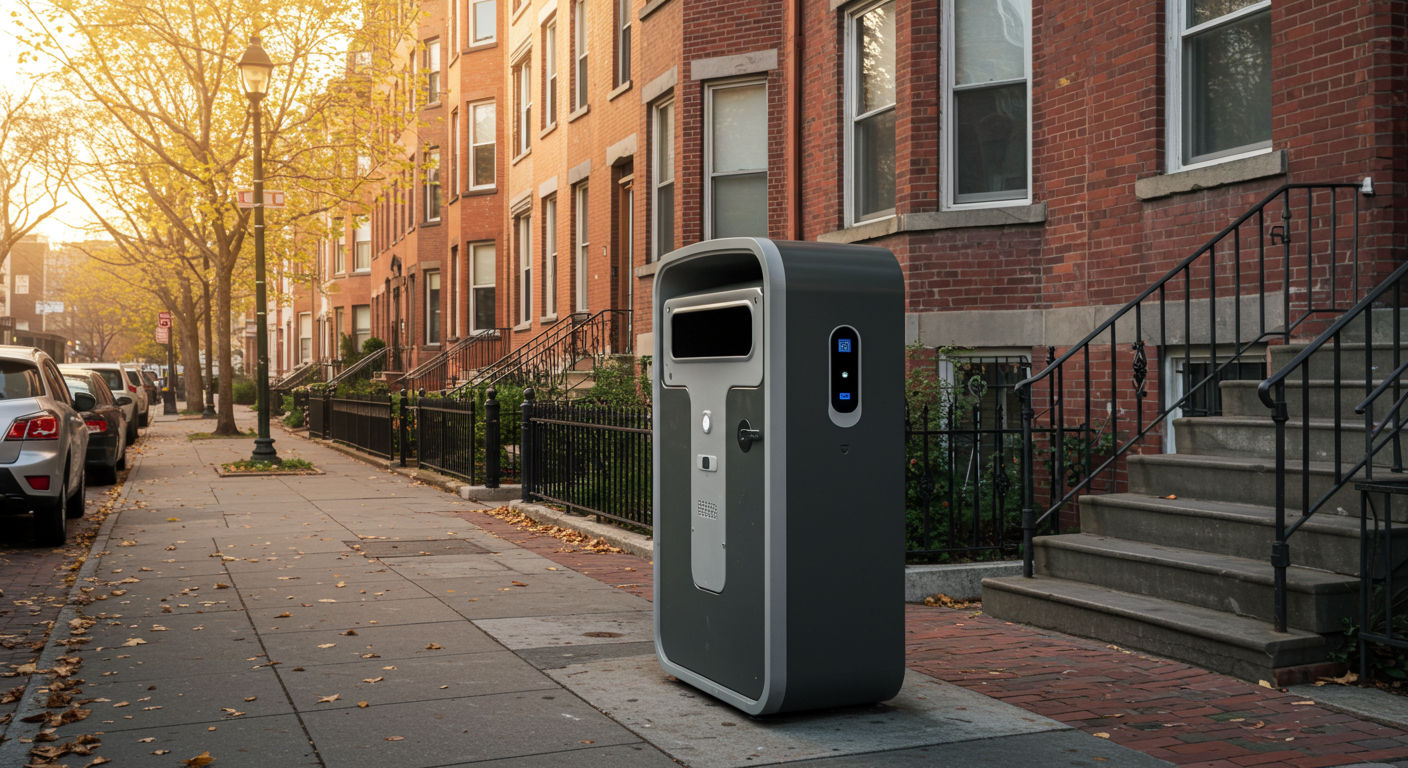
Philadelphia paired the blitz with permanent infrastructure — 1,500 new solar smart bins.
What St. Louis can steal from it
St. Louis is actually mid-experiment on exactly this idea. The city’s $255 million Rams settlement put its single largest share — $120 million — into North St. Louis recovery, much of it coordinating the rebuild after the May 2025 tornado that damaged more than 10,000 properties. That’s the raw material for a One Philly-style blitz: the money and the mandate to make Refuse, Forestry, the Street Department, and the Citizens’ Service Bureau move as one, neighborhood by neighborhood, with before-and-after photos and a public scoreboard.
The lesson from Philadelphia is that the blitz can’t be a one-off — it has to become the routine, twice a year, forever, or the couch comes back. Do that, pair it with permanent infrastructure like smart bins on the worst corridors, and St. Louis gets the same thing Philadelphia got: proof that the city works. See how it fits the bigger picture in our complete St. Louis cleanliness playbook.
Concretely, a St. Louis version would pick its hardest-hit areas — the North City tornado zone is the obvious place to start — and put Refuse, Forestry, the Street Department, and the Citizens’ Service Bureau on the same blocks in the same weeks, with a public before-and-after scoreboard so residents can watch the progress and hold the city to it. It would run on a fixed calendar, say spring and fall, not on whenever there’s an outcry, and it would drop permanent smart bins on the chronic dumping corridors the police cameras already flag. None of that is exotic — it’s what Philadelphia did, adapted to St. Louis’s map and funded, in part, with money the city already has. And a top-down blitz like this works best paired with bottom-up, resident-led effort — see how Love Your Block activates neighbors block by block.
Total tangent — but Festus is worth the drive for dinner.
The honest catch for St. Louis
It would be dishonest to pretend this is easy. One Philly worked because a mayor made it a top priority and forced more than a dozen departments to actually cooperate — and municipal departments, in any city, are territorial by nature. Coordination on that scale takes real political will and, just as important, the discipline to keep funding and running it after the ribbon-cutting glow fades. That’s the hard part St. Louis has historically struggled with: not launching things, but sustaining them past a single administration or news cycle.
The encouraging news is that the ingredients are lined up right now — the Rams money, the tornado-recovery mandate, and a public hungry for visible proof the city works. The lesson from Philadelphia isn’t just “coordinate”; it’s “coordinate, measure it, and make it permanent.” Miss that last step and even a great blitz becomes just another good summer nobody remembers by winter.
How St. Louis would know it’s working
One Philly didn’t just clean — it counted, and that’s a bigger deal than it sounds. “61,000 services” is a number a mayor can defend, a council can fund, and a resident can feel. Measurement is what separates a program that survives from a feel-good weekend that quietly disappears when budgets tighten. If St. Louis runs a coordinated blitz, the metrics are the difference between doing it once and doing it forever.
The right scoreboard mixes the hard and the human. On the hard side: 311 illegal-dumping reports over time (are they falling on the blocks you hit?), tons of trash and debris removed, alley-camera dumping incidents, potholes filled, lots cleared, and litter-index spot checks before and after. On the human side: resident satisfaction surveys, and — over a longer horizon — property values and new business activity in the targeted corridors, since a visibly cleaner neighborhood is one people invest in. Publishing that scoreboard does double duty: it keeps the city honest, and it rebuilds the very trust that makes the next round easier.
Crucially, the measurement has to be public and repeated. A one-time report is a press release; a running, block-by-block dashboard is accountability. It lets residents see the couch get cleared, watch the numbers move, and hold the city to its word — and it gives the program the evidence it needs to keep its funding when the initial enthusiasm fades. Philadelphia’s willingness to measure and publish is a big part of why One Philly became permanent instead of forgotten, and it’s the discipline St. Louis would need to make its own version stick.
St. Louis has the money and the moment — what One Philly proves is that coordination is the multiplier. Make every department move as one, make it routine, and the city becomes something residents can see and feel. The full local plan is in our St. Louis cleanliness playbook.
Own a business in the metro? A cleaner, better-run city brings more people to your door. Listing it on St Louis Near Me Directory helps neighbors across Missouri and Illinois find and support you.
Frequently Asked Questions
What are the top 10 cleanest cities in the US?
Rankings vary by source, but cities consistently cited among America’s cleanest include Honolulu, Portland, San Francisco, Seattle, Minneapolis, Denver, Boston, and Chicago, with newer efforts like Philadelphia’s One Philly aiming to join them. What they share isn’t luck — it’s coordinated municipal cleaning, good waste infrastructure, and sustained public investment.
How do cities keep public areas clean?
The cleanest cities combine four things: coordinated cleanup across all departments (not siloed), enough well-placed and well-serviced trash and recycling bins, real enforcement against illegal dumping, and ongoing community engagement so residents help maintain spaces. One-time cleanups fade; the cities that stay clean make it routine and measurable.
How to make a city more environmentally friendly?
Start with waste: better recycling and diversion, smart bins, and litter prevention reduce what reaches landfills and waterways. Add green infrastructure (trees, greenways, parks), coordinate departments for efficiency, and engage residents through cleanups and pride campaigns. Cleaner streets and greener space reinforce each other — and both lift property values and public health.
How long does it take to clean up a city?
Visible results can come fast — Philadelphia delivered 61,000+ services in a single 13-week blitz. But lasting change takes sustained commitment: the programs that work turn the blitz into a permanent, twice-yearly routine backed by infrastructure and enforcement. Expect quick wins in weeks, and a real culture shift over one to two years.
What are America’s two cleanest cities?
Honolulu and Portland, Oregon frequently top “cleanest U.S. city” rankings, though results vary by methodology (air quality, litter, sanitation, and green space are weighted differently by each list). The consistent thread among the leaders isn’t climate or luck — it’s sustained public investment, strong waste and recycling systems, and coordinated municipal upkeep, exactly the ingredients Philadelphia’s One Philly is trying to build.
What are the four basic sanitation practices?
At a municipal level they are: reliable waste collection and disposal, clean and maintained public spaces, safe drainage and stormwater management, and public education that shapes good habits. Cities that keep all four running consistently — rather than reacting only when things get bad — stay clean; those that let one slip (like drainage or education) tend to backslide no matter how many cleanups they run.

Written by a dedicated team of St. Louis locals who live, work, and play right here in the St. Louis metro. Founder Lane Forman and team are committed to building the region’s most trusted directory by verifying listings and connecting local businesses with loyal customers across Missouri and Illinois.