St. Louis Food Pantries: Most Want an ID. This Trailer Does Not
Revised October 20, 2026

Where can I get free food in St. Louis?
Dial 2-1-1, United Way’s line that answers 24/7, or type your ZIP code into the St. Louis Area Foodbank’s Pantry Locator. For a meal today, St. Patrick Center at 800 N. Tucker Blvd. serves lunch seven days a week, noon to 12:30 p.m., and Gateway 180 at 1000 North 19th St. hands out brown bag lunches all day. Most pantries want an appointment and a photo ID. You never need money.
Keep reading ↓Thursdays only, 10:30 to 12:30. That is the whole window at Estell Ministries Food Pantry on Page Boulevard, according to the city’s own list of food help. That’s it. Miss it because the bus sat at the light too long, and the cupboard with the one can of beans and the half bag of rice stays that way until next Thursday.
Or you make the trip on the right day and find the side door locked, a sheet of paper taped to the glass, the words by appointment only in marker. Your breath fogs the window while you read it twice. That is how most pantry doors in this city work, and the St. Louis Area Foodbank, which works with nearly 600 pantries, agencies and organizations in 26 counties in Eastern Missouri and Southwestern Illinois, says so on its own help page: for most food pantries, an appointment is required, and for most, a photo ID is required too. The people who walk out with a full bag are not luckier than you. They called first.
Now the two lines to screenshot and send to the friend who has been skipping lunch so the kids can eat. First: you never pay. The Foodbank’s exact words are that you do not need to bring any money to a food pantry or a food distribution event. Second, and almost nobody knows this one: there is a door with no paperwork at all. The Foodbank runs a program called Food on the Move, where neighbors walk through a custom-built trailer and choose the foods they need, and it says verification of personal information is not required to participate. No ID. No proof of address. You climb the step up into the trailer, an empty bag over your shoulder, and you reach for the cans and boxes your family will actually eat, not whatever someone packed for you.
Those trailers are not a once-a-year thing. Each month, the Foodbank and its partners hold over 80 food distribution events through Food on the Move and its Food Access and Resource Markets, and the stops are posted on the Foodbank’s distribution event calendar. And if the fridge is humming over nothing but ketchup and a jar of pickles tonight, there is hot food in this city today, too.
Where can I get free food in St. Louis?
Dial 2-1-1, United Way’s line that answers 24/7, or type your ZIP code into the St. Louis Area Foodbank’s Pantry Locator. For a meal today, St. Patrick Center at 800 N. Tucker Blvd. serves lunch seven days a week, noon to 12:30 p.m., and Gateway 180 at 1000 North 19th St. hands out brown bag lunches all day. Most pantries want an appointment and a photo ID. You never need money.
A hot lunch today, before any paperwork
A pantry fills the shelf for next week. Sometimes the problem is the next three hours: the growl that starts around eleven, the headache that comes with it, the paper bag you would trade almost anything for. The City of St. Louis keeps a list of food banks and free meals. Start with these three.
St. Patrick Center, 800 N. Tucker Blvd., lists lunch seven days a week from noon to 12:30 p.m. That is a thirty-minute window, so get in line a few minutes early. Gateway 180, at 1000 North 19th St., lists brown bag lunches seven days a week, all day, which makes it the closest thing to an open door you will find. And St. Peter and Paul Parish, in its Mid-Level Hall at 1919 S. 7th St., lists meals Monday through Friday from 5 to 5:45 p.m., with weekend meals from noon to 12:45 p.m. The city notes its list comes from Start Here STL and says to check there for the latest, so give the number a quick call before you go: St. Patrick Center is 314-802-0700, Gateway 180 is 314-231-1515 and St. Peter and Paul is 314-231-9923.
Eat first. A full stomach makes the next phone call a lot easier to make.
Can you just show up to a food pantry?
Usually not, which is why the taped sign on that locked door catches so many people. The Foodbank says that for most food pantries an appointment is required, and that you should check the website of the pantry you want before you go. Guardian Angel Settlement, at 3300 South Jefferson Ave., is listed by the city as by appointment only, at 314-773-9027. That is normal, not a brush-off.
The exception is the shortcut from the top of this page. Food distribution events run the other way. The Foodbank describes them as walk-through or drive-through events that are temporary, planned in advance and placed in areas with low access to food. An appointment is usually not required, it is first come, first served, and an ID is usually not required either. At the drive-through markets, it looks like this: hazard lights blinking down the lot, the trunk popping open, a volunteer in a reflective vest sliding a box in while you keep both hands on the wheel. Find the dates and places on the Foodbank’s distribution event calendar, look for a Food on the Move stop if you have no ID with you, and get there early.
The two-minute call that saves the trip
What is the difference between a food pantry and a food bank? The bank is the warehouse; the pantry is the door you walk through. The Foodbank itself puts it this way: supplied by a food bank, a food pantry is a distribution center for individuals and families in need to receive food free of charge. You will almost never shop at the warehouse. You will shop at a church basement, a school room or a storefront that the warehouse stocks.
That is why the call matters. Each pantry sets its own hours, its own service area and its own paperwork. Ask three things: are you open this week, do I need an appointment, and what do I bring. The Foodbank says to bring the documentation your pantry asks for, which may include a photo ID and proof of income, and it suggests a reusable bag, although bags are usually provided. Some doors are not where you would expect. The city lists Isaiah 58 Ministries at 2149 South Grand Blvd. with its entrance around the back, at 314-776-1410. Knowing that before you circle the building twice in the cold is worth the call by itself. To see which pantries open on which day, start with our day-by-day list of food pantries open today in St. Louis.
Find the pantry closest to your front door
The fastest search is the St. Louis Area Foodbank’s Pantry Locator. Its instructions are simple: enter your address or ZIP code, press Find Pantries, and see what food outlets are near you. Write down two, not one. If the first is closed or full, the second is already on your list, and you are not starting over with the kids asking what’s for dinner. If the map is not working for you, the Foodbank’s phone number is (314) 292-6262.
Can’t get across town? Mobile markets bring the food to the neighborhood. Check mobile pantry schedules and the Foodbank’s calendar, and if you would rather talk to a person, our guide to where to turn for help walks through another free search tool.
A few more pantries worth a look, each with its own hours and service area, so read their pages before you drive:
Your first visit, start to finish
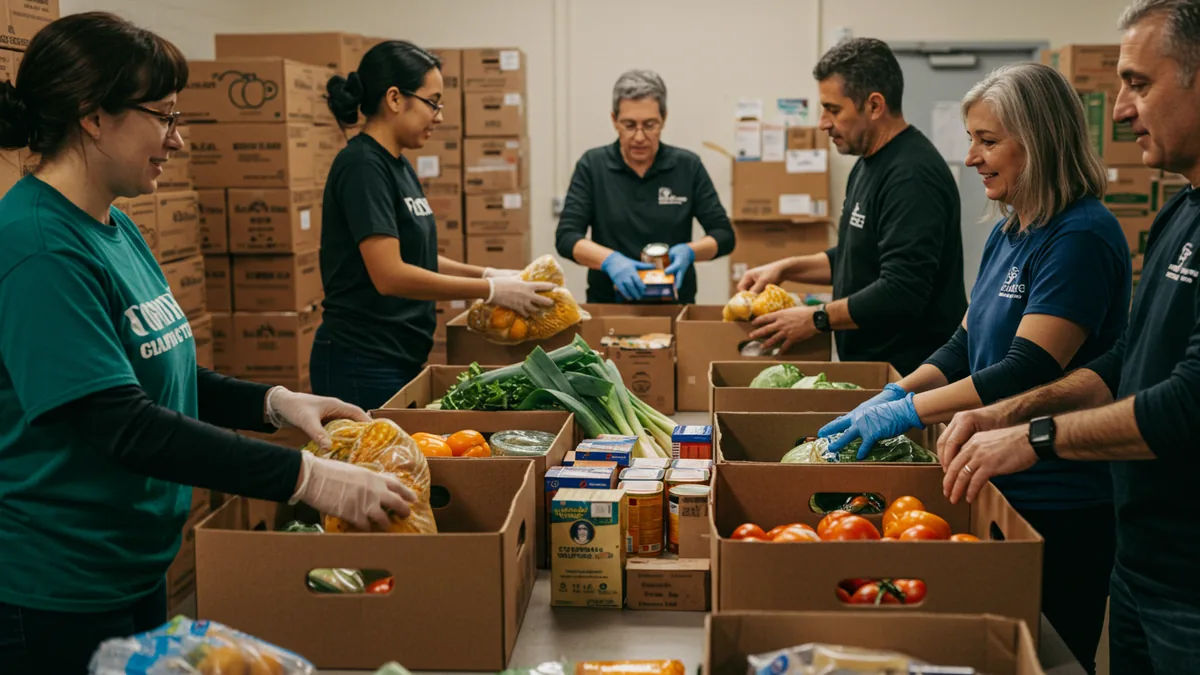
The first time is the hardest, mostly because you do not know what happens behind the door. Here is the usual shape of it. Someone at a folding table asks your name, maybe your address and how many people live with you. You show your ID if they asked for it on the phone. Then you wait, often in a hallway that smells like cardboard and floor cleaner, while other people from your own neighborhood wait beside you. Some pantries hand you a packed box. Others let you walk the shelves with a cart and choose, the way you would at a small store.
Nobody is grading you. The volunteers have seen every kind of week, the layoff, the medical bill, the car that died on Gravois. Ask the questions you came with: when can I come back, do you have diapers, is there fresh produce today. Say thank you if you want to. Then carry the bag to the car and let yourself breathe. You did the hard part.
Don’t throw out the can with yesterday’s date
You get home, unpack the bag on the counter, and a box of crackers says best by last week. Keep it. The Foodbank says “Best By,” “Sell By” and “Expiration” dates do not mean food is unsafe to eat after the date on the package. The one hard rule is infant formula, which the Foodbank says must be used before the date on the package. Check that can every time.
Groceries put away and five quiet minutes to yourself? Go read what Boulevard Heights is like.
Help that lasts longer than one bag
A pantry gets you through the week. SNAP gets you through the month. The Foodbank says it works with partner organizations and government agencies on everything from SNAP applications to Medicaid resources. When the paperwork feels like a wall, ask the pantry volunteer handing you the bag who helps with SNAP forms nearby. For more options, see the Franciscan Sisters of Our Lady of Perpetual Help and St. Louis Public Radio’s guide to SNAP alternatives.
Health coverage is often the next bill hiding behind the grocery bill. For help with applying for Medicaid and MO HealthNet renewals, ask the same person who helped with your SNAP form. And when it is 2 a.m. and nothing is open, United Way 211 of Missouri and Illinois says you can dial 211 to reach a trained resource specialist 24/7, including for food assistance programs.
For the neighbor who keeps asking how to help
Every reader of this page knows someone who has said, “Tell me what I can do.” Here is something specific to tell them. The Missouri Department of Revenue says any taxpayer, individual, corporation or trust, that donates cash or food supplies to a local food pantry, homeless shelter or soup kitchen may take a credit of 50 percent of the donation, up to $2,500 per taxpayer, per year. Give $200 to a pantry and the credit is worth $100 against Missouri income tax. The state says the credit is nonrefundable and scheduled to sunset, so donors should read the Department of Revenue’s food pantry credit page before counting on it. Volunteers can plug into the effort too. For who qualifies and how to claim the credit, see our guide to the Missouri food pantry tax credit.
Make one call before you close this page. Dial 2-1-1 or the pantry nearest you, ask if you need an appointment, and put your photo ID by the door tonight. For rent, utilities and family help in the same place, browse the St Louis Near Me public services directory.
If you run the corner grocery, the church kitchen or the catering van that drops off its extra trays, you already feed this city. Your business still needs to get more customers to keep doing it. A listing on St Louis Near Me Directory helps neighbors find you, for under a dollar a day. List your business.
More St. Louis help guides:
- How to cut your St. Louis grocery bill
- Better Family Life’s community resources
- St Louis Near Me public services directory
Frequently Asked Questions
Can you just show up to a food pantry?
At most pantries, no. The St. Louis Area Foodbank says an appointment is required at most food pantries, so check the pantry’s website or call first. Food distribution events are the exception: an appointment is usually not required, and food goes out first come, first served.
Do you pay for food at a food pantry?
No. The Foodbank says you do not need to bring any money to a food pantry or a food distribution event. A food pantry gives food free of charge to individuals and families in need.
What are the requirements to use a food pantry?
Each pantry sets its own. The Foodbank says most pantries require a photo ID, and some ask for proof of income. Many also serve only certain ZIP codes, so ask whether your address is in their area when you call.
What is the difference between a food pantry and a food bank?
A food bank is the supplier; a food pantry is where you pick up food. The St. Louis Area Foodbank works with nearly 600 pantries, agencies and organizations in 26 counties, and those pantries hand the food to families free of charge.
Is there any way I can get free food right now?
Yes. Gateway 180 at 1000 North 19th St. lists brown bag lunches seven days a week, all day, and St. Patrick Center at 800 N. Tucker Blvd. serves lunch daily from noon to 12:30 p.m. Any hour, dial 2-1-1 to reach a trained resource specialist.
Who is eligible to receive the food pantry tax credit in Missouri?
Any taxpayer, individual, corporation or trust, that donates cash or food supplies to a local food pantry, homeless shelter or soup kitchen. The Missouri Department of Revenue says the credit is 50 percent of the donation, up to $2,500 per taxpayer, per year, and it is nonrefundable.

Written by a dedicated team of St. Louis locals who live, work, and play right here in the St. Louis metro. Founder Lane Forman and team are committed to building the region’s most trusted directory by verifying listings and connecting local businesses with loyal customers across Missouri and Illinois.