How to Choose a Commercial Cleaning Service in St. Louis (Cost Guide)
Revised August 10, 2026
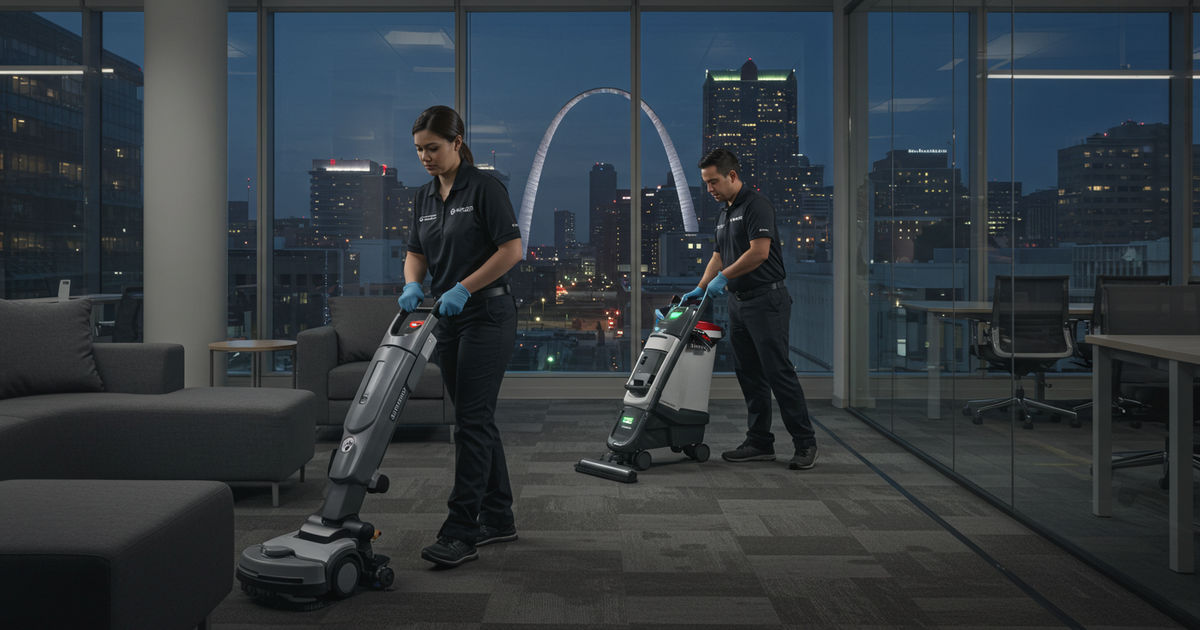
How much does commercial cleaning cost?
Standard recurring office cleaning runs roughly $0.10 to $0.18 per square foot in 2026 (the full market spans about $0.07 to $0.20), or $35 to $60 per hour for janitorial work. Your price depends most on frequency (weekly is cheaper per visit than nightly) and layout — open space cleans faster than the same footage split into offices and restrooms. Get an itemized written quote.
Keep reading ↓It’s 7:45 on a Monday morning. You unlock the office ahead of a 10 a.m. client meeting and it hits you before the lights are even on — the trash from Friday is still at every desk, the breakroom smells like it, and the glass door has a week of fingerprints. You’re paying a cleaning company for exactly this not to happen. Maybe you’ve lived it, whether you run a suite in Clayton, a storefront on The Hill, or a warehouse out in Earth City.
A clean, professional space isn’t vanity — it’s how clients judge you and how you keep employees healthy. But commercial cleaning is a crowded field where the quality gap between companies is enormous, and the wrong choice quietly costs you in bad impressions and constant babysitting. Here’s how a St. Louis business owner actually vets one — starting with what it should cost.
How Much Does Commercial Cleaning Cost in St. Louis?
Commercial cleaning is usually priced one of two ways: per square foot or per hour. For standard recurring office cleaning in 2026, expect roughly $0.10 to $0.18 per square foot, with the full market spanning about $0.07 to $0.20 depending on frequency, layout, and building type. Priced hourly, most janitorial work runs $35 to $60 per hour, though rates can reach $30 to $75 depending on scope and labor. Two things drive your number more than anything: frequency (weekly is cheaper per visit than nightly) and layout — ten thousand square feet of open office cleans far faster (and cheaper) than the same footage chopped into private offices, exam rooms, closets, and multiple restrooms. Because of that, a walk-through and a written, itemized quote for your space beat any per-foot average.
First, Define the Job
“Commercial cleaning” ranges from nightly janitorial (trash, restrooms, vacuuming, wipe-downs) to periodic deep cleaning, floor and carpet care, window work, and specialized disinfection. Before you call anyone, write a simple scope: what needs doing, how often, and on what schedule (after-hours is standard for offices). A clear scope is what makes quotes comparable instead of apples-to-oranges — and it becomes the checklist you hold them to later. It also stops you from overpaying for services you don’t need or, worse, discovering the restrooms weren’t in the deal after you’ve signed.
The Vetting That Actually Protects Your Business
This is where choosing a commercial cleaner differs from hiring for your home — these people are in your space, often after hours, with access to everything. Confirm liability insurance and bonding: liability insurance covers accidental damage, while bonding protects you against theft by cleaning staff — for a company handling your keys and alarm code after dark, both are non-negotiable, so ask for proof. Get a written scope and checklist, which is your recourse when standards slip. Ask for references from similar businesses — a medical office, a restaurant, and a law firm have very different needs, so ask for references that look like you. And make sure there’s a real point of contact: when there’s a problem, you want an account manager who answers, not a voicemail box.
Employees vs. Subcontractors: Why It Matters
One question separates consistent companies from chaotic ones: are your cleaners the company’s own W-2 employees, or are they subcontracted out? W-2 employees typically come with background checks, training, and direct accountability — the company owns the quality and answers for it. Subcontracted labor can be fine, but it introduces variability in who actually shows up, how they’re vetted, and who’s responsible when something goes wrong or goes missing. It also affects consistency of crew: the same team night after night learns your space, remembers that the conference room needs extra attention on Thursdays, and simply does better work than a rotating cast of strangers. Ask directly, and favor companies that staff with their own trained employees.
Green Cleaning, Supplies, and the Details That Separate Good From Great
A few details reveal a company’s real quality. Ask about green cleaning options if that matters to your brand or your employees’ health — low-VOC products and safer chemicals are widely available and worth requesting. Clarify supplies: do they provide their own equipment and restroom consumables (paper towels, soap, liners), or is that on you? Unclear supply terms are a common source of friction. And ask how they handle quality control — do they do periodic walk-throughs, supervisor checks, or a simple way for you to flag misses? A company that has a system for catching its own mistakes is one that takes the work seriously.
Contract Terms: Start on a Short Leash
On contracts, understand whether you’re signing month-to-month or into a longer commitment, and what the cancellation terms are if the service disappoints. A confident company will happily start you on a short leash — a trial period or month-to-month arrangement — because they expect to earn the renewal with good work. Be cautious of anyone who insists on a long, hard-to-exit contract before they’ve proven themselves. Read the terms for automatic renewals and price-escalation clauses too, so a fair starting rate doesn’t quietly climb. The goal is a relationship you stay in because the work is good, not because you’re locked in.
Random, but: West County’s whole dinner lineup is right here.
Types of Commercial Cleaning to Know
It helps to know the categories so your scope is precise. Janitorial is the routine recurring service — trash, restrooms, vacuuming, dusting, and surface wipe-downs, usually nightly or several times a week. Deep cleaning is a periodic, more intensive service that reaches the buildup routine cleaning doesn’t. Floor and carpet care (buffing, waxing, carpet extraction) is often scheduled separately on a rotation. Window cleaning and specialized disinfection (important for medical, dental, and food-service spaces) round out the menu. Many businesses combine a nightly janitorial contract with periodic deep cleans and floor care — spelling out which is which, and how often, keeps everyone honest and your quotes comparable.
Red Flags When Hiring a Cleaning Company
Watch for the warning signs. Be cautious of a company with no proof of insurance or bonding, no written scope, vague answers about who actually does the cleaning, a bid dramatically below the others (often a sign of undertrained, high-turnover labor), pressure to sign a long contract immediately, no references from businesses like yours, and no clear point of contact. A cleaning company is a quiet extension of your brand and a set of after-hours keys to your space — so professionalism, accountability, and transparency matter as much as the nightly checklist. The good ones welcome every one of these questions.
Why the Right Cleaner Is a Business Investment
It’s easy to treat cleaning as a line item to minimize, but a professional space quietly does real work for you. Clients form an impression the moment they walk in — a spotless lobby and fresh-smelling restroom signal competence and care before you say a word, while fingerprinted glass and an overflowing bin undercut everything else you’re trying to project. Inside, a consistently clean, sanitized workplace reduces the spread of illness, which means fewer sick days and steadier productivity, and it tells your employees you take their environment seriously. The wrong cleaner costs you twice: once in the bad impressions and health effects, and again in the hours you spend babysitting the service and re-explaining the same misses. Viewed that way, paying a little more for an accountable, consistent company is usually the cheaper choice.
How Often Should Your Office Be Cleaned?
The right frequency depends on your space, your traffic, and your industry — and it’s the biggest lever on your bill, so it’s worth thinking through. A busy office with heavy foot traffic, shared kitchens, and customer-facing areas usually warrants nightly or several-times-a-week janitorial service, especially the restrooms and breakroom, where hygiene and smell are most noticeable. A smaller, lower-traffic office might do fine with cleaning two or three times a week, or even weekly, with restrooms and trash handled more often. Medical, dental, and food-service spaces have higher hygiene and disinfection needs and often stricter requirements. The common pattern is a nightly or few-times-weekly janitorial base plus periodic deep cleans and floor care on a rotation. A good company will right-size this with you rather than upselling a nightly contract you don’t need — and being able to scale up or down as your needs change is a fair thing to ask for.
Questions to Ask Before You Hire
Before you sign, ask: Are you insured and bonded, and can I see proof? Are your cleaners W-2 employees or subcontractors, and are they background-checked? Can you provide a written scope and checklist? Do you have references from businesses like mine? Who’s my point of contact if there’s a problem? Do you provide supplies and restroom consumables? Do you offer green cleaning? Is this month-to-month, and what are the cancellation terms? How do you handle quality control and missed items? A professional company answers all of these clearly and welcomes them — the questions themselves are a filter, because the accountable, well-run companies expect them, while the ones to avoid get vague exactly where it matters most.
The fastest way to a shortlist you can trust is to compare a few local companies side by side. Browse commercial and janitorial cleaning companies across the metro on the St. Louis Commercial Cleaning Map — compare service areas and reviews, and reach out to several at once for quotes on your scope.
Run a cleaning company? Being on that map is how the manager standing in that Monday-morning mess finds you at the moment they’re ready to switch. Listing your business takes only a few minutes — and a listing with real reviews is exactly the proof a cautious buyer looks for.
Want the same scrutiny applied to the products themselves? How to tell which cleaners are genuinely eco-friendly — the two certifications that actually mean something.
More St. Louis Business Guides
- How to choose a carpet cleaner in St. Louis
- How to find a plumber in St. Louis you can trust
- How to choose an electrician in St. Louis
Frequently Asked Questions
How much does commercial cleaning cost in St. Louis?
Standard recurring office cleaning runs roughly $0.10 to $0.18 per square foot in 2026 (the full market spans about $0.07 to $0.20), or $35 to $60 per hour for janitorial work. Your price depends most on frequency (weekly is cheaper per visit than nightly) and layout — open space cleans faster and cheaper than the same footage split into offices, exam rooms, and restrooms. Get a walk-through and an itemized written quote.
What’s the difference between insurance and bonding for a cleaning company?
Liability insurance covers accidental damage the cleaners cause to your property; bonding protects you financially against theft by their staff. For a company handling your keys and alarm code after hours, both are non-negotiable — ask for written proof of each. A reputable commercial cleaner carries both and provides documentation without hesitation.
Should cleaners be employees or subcontractors?
Favor companies that use their own W-2 employees, who typically come with background checks, training, and direct accountability — the company owns the quality. Subcontracted labor can work but adds variability in who shows up and who’s responsible if something goes wrong. Employees also mean a more consistent crew, and the same team night after night learns your space and does better work.
Should I sign a long-term cleaning contract?
Start on a short leash. A confident company will offer a trial period or month-to-month arrangement because they expect to earn the renewal with good work. Be cautious of anyone insisting on a long, hard-to-exit contract before proving themselves, and read for automatic renewals and price-escalation clauses. The goal is a relationship you stay in because the work is good, not because you’re locked in.
How do I compare commercial cleaning quotes fairly?
Write a clear scope first — what needs cleaning, how often, and on what schedule — then have each company quote against that same scope. This turns apples-to-oranges bids into a real comparison and becomes your checklist to hold them to. Confirm insurance and bonding, ask who does the work, get supplies and consumables spelled out, and favor an itemized written quote over a vague flat number.

Written by a dedicated team of St. Louis locals who live, work, and play right here in the St. Louis metro. Founder Lane Forman and team are committed to building the region’s most trusted directory by verifying listings and connecting local businesses with loyal customers across Missouri and Illinois.