Past the Bat Gate: Things to Do in Oakville, MO, From Cliff Cave to Bee Tree Park
Revised November 10, 2026

Is there a cave at Cliff Cave Park?
Yes. Cliff Cave is a real limestone cave in the bluffs of Cliff Cave County Park in Oakville. St. Louis County gated it in October 2009 to protect the endangered Indiana bat and because it can flash flood. It stays closed to casual visitors, but the county parks department has opened it for rare ranger-led events.
Keep reading ↓An Oakville bluff breathes on you. Cold air rolls out of a black, gated opening in the limestone at Cliff Cave Park on a sticky July afternoon, and for a second it feels like somebody left a refrigerator door open in the woods. The historical marker by the trail says almost exactly that: walk into a cave in summer and you may feel like you just stepped into an air-conditioned room. Then you see the bars. A steel gate covers the mouth, and the stone walls framing it were laid by a wine company that kept its barrels in here back in the mid-1800s.
Most people stop at that gate, take a picture, and drive home thinking that’s all there is. It isn’t. Oakville, the corner of south St. Louis County where the Meramec runs into the Mississippi, keeps most of its good stuff below the bluffs and off Telegraph Road, where nobody stuck at a red light would guess it’s there. A cave that rangers sometimes open. A paved trail that climbs from the river bottoms to an overlook. A small fishing lake beside a stone mansion that has stood empty for decades. A library where, on the right day, the floor shakes.
This guide is for a Saturday with no plan, a kid who needs to run, or a visiting cousin who thinks Oakville is all strip malls. Here’s the short version before the details. Turn off Telegraph Road for Cliff Cave Park, where Great Rivers Greenway lists parking, restrooms, shelters and tables. Walk to the cave mouth first while it’s cool, then take the 6.7-mile paved loop or the shaded 2.04-mile climb to the overlook. Finish at Bee Tree Lake, open until a half-hour after sunset. And this week, not next summer, call St. Louis County Parks to ask when the next ranger-led cave program opens sign-ups. Bring shoes you can get muddy. You’ll want them by noon.
Is there a cave at Cliff Cave Park?
Yes. Cliff Cave is a real limestone cave in the bluffs of Cliff Cave County Park in Oakville. St. Louis County put a gate on it in October 2009 to protect the endangered Indiana bat, and also because the cave can flash flood. It stays closed to casual visitors, but the county parks department has opened it for rare ranger-led events.
The gate is not there to spoil your day. The marker at the entrance spells out both reasons: the federally endangered gray bat and Indiana bat hibernate in the cave over winter, hanging upside down in the dark, and the cave is connected to sinkholes that can send a flash flood through it. That second reason is not theoretical. On July 23, 1993, six people exploring the cave were killed when a flash flood filled it. Stand at the bars for a minute and feel how fast the damp chill finds your arms.
How people actually get inside. The county doesn’t just hand out keys. It opens the gate for its own ranger-led programs. In 2022, Terrain Magazine wrote about one of them, a county event called Stories in the Cave, which gave people what the magazine called a rare opportunity to enter Cliff Cave. A park ranger led the group in, the lights went down, and the stories came out in the dark. If you want in, call St. Louis County Parks and ask what ranger-led cave program is next and when sign-ups open. Ask early. Small groups and a gate that stays locked the rest of the year add up to spots that go fast.
What you can see without a reservation. Plenty. Your hand on the cold bars, damp stone under your sneakers, a faint smell like a basement after rain. Walk up to the mouth any day the park is open and you’re standing in front of three chapters of St. Louis history in one stone face. The cave was long called Indian Cave, because, as the marker puts it, Native Americans once used it for shelter and for storing food and goods. In the mid-1800s the Cliff Cave Wine Company used it as a wine cellar and built the rock walls you still see at the entrance. Great Rivers Greenway, the regional trails agency, adds the local stories: a riverside tavern in the days of early Missouri exploration, and a hideout for horse thieves.
Why there’s a cave here at all. Look at the ground on the way up. Great Rivers Greenway describes the park as karst, a region where the bedrock has been dissolved or collapsed. Rain soaks through cracks in the limestone, eats it from the inside, and leaves behind sinkholes on top and passages underneath. The dips in the woods beside the trail are the same story the cave tells, just told from above.
Can’t get on a ranger trip this year? Our guide to things to do in Waterloo, IL looks across the river at the caves on the Illinois side.
The trail that climbs out of the river bottoms
Stand on the floodplain at Cliff Cave in August and the heat comes off the asphalt in waves. That’s the first half of this ride. The second half is shade, a long climb and a view.
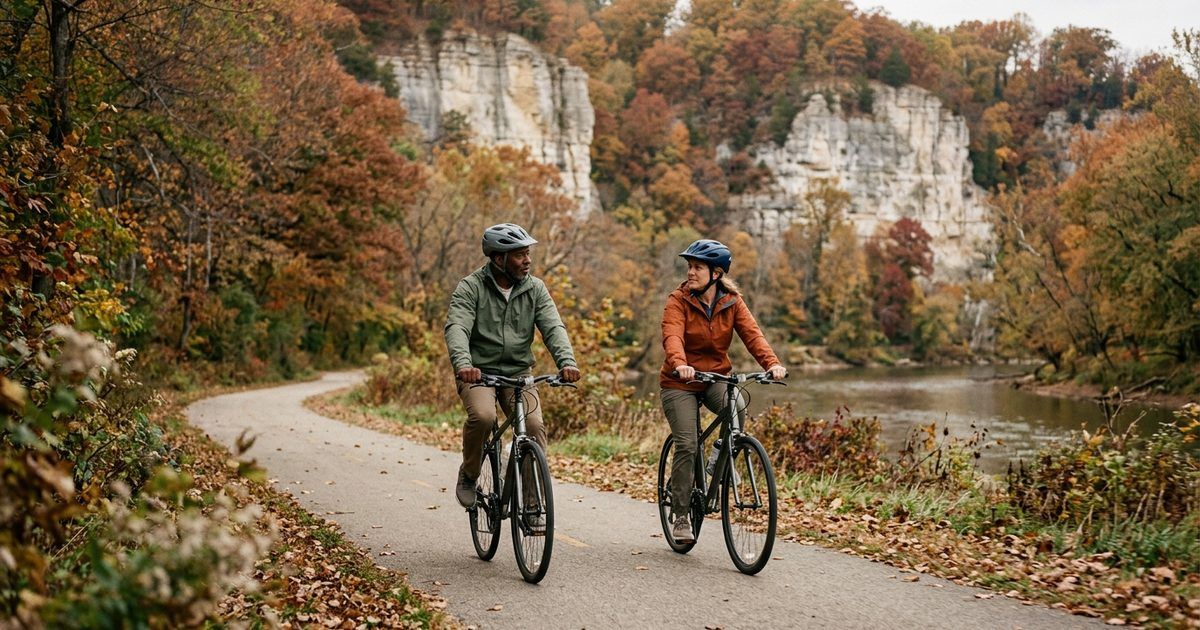
The loop. Great Rivers Greenway lists the Mississippi Trail inside the park as a 6.7-mile paved loop through the floodplain bottomland, with views of the river. It also says plainly that there is very little shade, so bring water in summer. Flat, wide and easy for kids on bikes, it’s the stretch our guide to easy family-friendly hiking trails around St. Louis has in mind.
The climb. This is the better half. A 2.04-mile extension, completed in May 2018, leaves the bottoms and climbs the bluff under tree cover to a scenic overlook, then connects to Telegraph Road. On a hot day that canopy feels like a different park. Ride down it first and you’ll earn the climb back.
The dirt. River Bluff Trail is about a mile of flat, unpaved path along the top of the bluff, with the river and valley spread out below. Spring Valley Trail runs about 3 miles of moderate hills. Mountain bikers and horseback riders use the park too.
What changes by season. Hundreds of migratory birds stop here in spring and fall, according to Great Rivers Greenway, and great blue herons and egrets stand in the shallows all summer. After a good snow, the same agency says, the trails work for cross-country skiing. One caution from us: the lower park sits on the floodplain, so after heavy rain upstream, check with the county before you go.
Came off the bluff hungry? Where to eat in Oakville, MO
Who built the empty stone house at Bee Tree?
Somewhere a woodpecker is knocking. Drive south from Cliff Cave and the road drops through the trees toward Bee Tree Park, and then a stone house appears on the bluff like it wandered over from the English countryside. That’s the Nims Mansion, along the bluffs of the Mississippi in Oakville. It was designed in 1929 by the St. Louis firm Maritz & Young in the Tudor Revival style, with local stone from a nearby quarry, for Bee Tree Farm, the country place of Mr. and Mrs. Eugene Nims.
The park’s name comes from a swarm. A 1936 St. Louis Post-Dispatch article said their nephew, Thomas Ratcliffe, named the place when it was first built, because of the bees he saw swarming about a grove of white oaks. Stand under the oaks in May and it’s easy to believe him.
In 1968 the St. Louis County Parks Department acquired the property and turned it into Bee Tree Park. The house itself has been vacant for more than 30 years, and preservation efforts are underway to keep it from falling apart. Stand outside and look at the stonework, the windows of rooms nobody has lived in for a long time, then turn around to the river view the Nims family built the place for.

Does Bee Tree Park have a lake or river?
Both, but you fish only one of them there. The Mississippi runs below the bluff, and at Bee Tree it’s the view. The lake is where the rods go.
The lake. Bee Tree Lake is 9 acres, owned and run by St. Louis County Parks and managed for fishing under a cooperative agreement with the Missouri Department of Conservation. MDC lists white bass, sunfish, catfish, crappie and black bass. Boats aren’t allowed, so it’s a quiet bank lake: the slap of a bobber, a kid yelling about a bluegill, not much else. MDC points anglers to Chapter 12 of the Wildlife Code for the fishing rules here. For more lakes, see our picks for the best fishing spots in St. Louis.
The river. For the Mississippi itself, go back to Cliff Cave. Great Rivers Greenway lists fishing on the Mississippi River among that park’s activities. If it’s the Meramec you’re after, cross it: our guide to fishing in Arnold covers that side.
Mud on your shoes and fish smell on your hands is the right way to end an Oakville morning. Our guide to where to eat in Oakville, MO maps the family-owned kitchens up on Telegraph Road, so you know where you’re headed before you peel off the wet socks.
If you’re the bait shop, the bike shop or the Telegraph Road kitchen that cavers and anglers drive past on the way home, those are customers already in your neighborhood with an appetite. Put your spot where they’re looking and get more customers from every Saturday at the park.
A whole Saturday in Oakville, start to finish
The car smells like sunscreen and worms by 9 a.m. That’s how you know it’s going right. Before you leave, pack water (there’s very little shade on the loop), closed shoes that can get muddy, a dry pair of socks, binoculars for the herons, and your fishing gear. Great Rivers Greenway lists parking, restrooms, shelters, tables and grills at Cliff Cave, so lunch can be a cooler instead of a restaurant.
Morning, at the gate. Start at Cliff Cave and walk up to the cave mouth while the air is still cool. Feel that cold breath come out of the rock, and read the marker.
Late morning, the climb. Ride or walk the bluff extension up to the overlook. It’s the shaded half, which matters in July.
Lunch, Telegraph Road. Up the bluff, where Oakville’s family-owned restaurants are.
Afternoon, Bee Tree. Head south to Bee Tree. MDC’s directions: south on Telegraph Road off I-270, left on Becker, then down Finestown Avenue. MDC lists the lake’s hours as 8 a.m. until a half-hour after sunset, so you’ve got until dusk. Fish the lake for an hour, then walk up to the Nims Mansion and stand at the bluff looking across the Mississippi to Illinois while the light goes gold.
What can you do in Oakville on a rainy day?
Visit a library that shakes. The Cliff Cave Branch of St. Louis County Library, at 5430 Telegraph Rd., puts a fun fact right on its own page: it’s built near two active quarries, and on blasting days you can both hear the blast and feel the vibrations. Kids love this. Check the library’s event calendar for what’s on.
Look for more indoor ideas. Our list of indoor activities in St. Louis covers the rest of the metro, and if the rain lets up, our guide to historic sites in St. Louis has more old stone to look at.
Over the Meramec and beyond
Oakville ends at the Meramec. Cross it and you’re in Arnold, and a little farther down the river is Kimmswick. For the rest of the region, start with our small towns outside St. Louis guide.
Next time somebody tells you Oakville is just Telegraph Road traffic, you’ll know about the cold air at the gate, the wine company’s walls, and the house named for a swarm of bees.
Frequently asked questions
What happened at Cliff Cave Park?
On July 23, 1993, six people exploring Cliff Cave were killed when a flash flood filled the cave. The cave connects to sinkholes that make it prone to flash flooding, which is one reason public access stays limited today.
What time does Bee Tree Park open?
MDC’s listing for Bee Tree Lake gives the hours as 8 a.m. until a half-hour after sunset. St. Louis County Parks runs the park, so check with the county if you’re planning an early start.
Where is Bee Tree Park located?
Bee Tree Park sits on the bluff overlooking the Mississippi just above its confluence with the Meramec, where the Nims family built Bee Tree Farm. MDC’s directions: go south on Telegraph Road off I-270, turn left on Becker, then go down Finestown Avenue.
What is the best cave to visit near St. Louis?
For Oakville, it’s Cliff Cave, if you can get in on a county event like the one Terrain Magazine called a rare opportunity to enter the cave. Even from outside the gate you get the wine company’s stone walls and that refrigerator-cold breath on a summer day.
What are the popular attractions near Bee Tree Park?
Cliff Cave Park, with its gated cave, the 6.7-mile paved loop and the 2.04-mile climb to a scenic overlook. On Telegraph Road there’s the Cliff Cave Branch library, the one where you can feel the quarry blasts.
Can you go inside the Nims Mansion?
The 1929 Tudor Revival house has been vacant for more than 30 years, and efforts are underway to preserve it, so check with St. Louis County Parks before you plan on seeing the inside.

Written by a dedicated team of St. Louis locals who live, work, and play right here in the St. Louis metro. Founder Lane Forman and team are committed to building the region’s most trusted directory by verifying listings and connecting local businesses with loyal customers across Missouri and Illinois.