What Chinese Herbal Medicine Involves in St. Louis
Revised September 24, 2026
What to avoid when taking Chinese herbs?
Avoid starting herbs without telling your physician and your practitioner every drug, supplement and vitamin you take, because interactions are real. Skip any herbal product with no ingredient list, no lot number and no testing behind it. And never stop or adjust a prescription on your own.
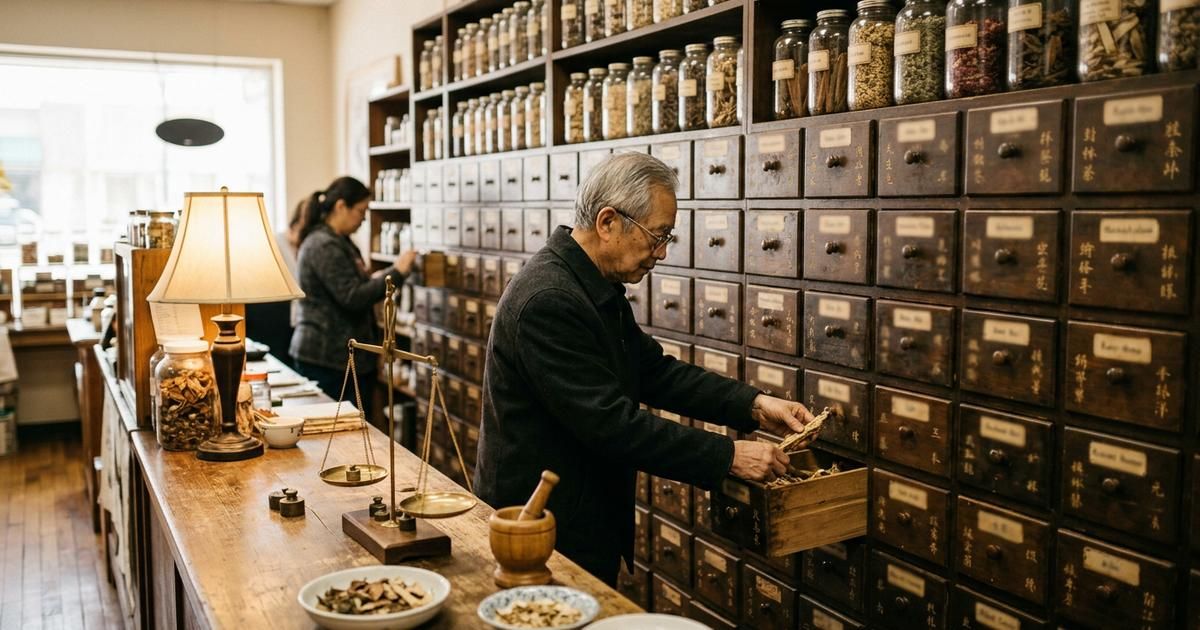
Keep reading ↓A stapled paper bag on the counter with your name written across it in marker, and a photocopied sheet folded inside. Bark. Twigs. Something curled and tan that could be a root or could be a dried mushroom. Simmer in four cups of water for forty minutes, strain, drink half in the morning and half before bed.
That bag is the half of Chinese medicine almost nobody around St. Louis has actually seen. Needles get the attention, the news segments, the insurance questions. Herbs are the older side of the tradition and, for plenty of practitioners here, the larger share of what they actually do all week.
They’re also the side that raises the real questions. What’s in the bag. Where it came from. Whether it interacts with the three prescriptions already in your cabinet. Whether any of it does anything at all. This is the plain version: what a consultation involves, how a formula differs from a single bottle off a shelf, what forms exist, how long before anyone can honestly judge it, and where cupping and gua sha fit.
What to avoid when taking Chinese herbs?
Avoid starting herbs without telling your physician and your practitioner every drug, supplement and vitamin you take, because interactions are real. Skip any herbal product with no ingredient list, no lot number and no testing behind it. And never stop or adjust a prescription on your own.
The interaction problem is the one that deserves your attention first. Herbs are chemically active. That’s the entire point of them. Which means they can plausibly push in the same direction as a blood thinner, a blood pressure medication, a diabetes drug, a sedative, an immunosuppressant or a course of chemotherapy. Nobody has mapped every herb against every drug, and any practitioner who tells you otherwise is overselling.
So the rule is boring and it works. Carry one list. Prescriptions, over-the-counter pills, vitamins, protein powders, the gummies, the thing your sister-in-law swears by. Hand that same list to the doctor and to the herbalist. Let two people who know different things look at it. The list is doing more for your safety than any single decision you’ll make in that room.
Some situations call for a harder pause. Pregnancy, nursing, actively trying to conceive. Children. Known liver or kidney disease, since both organs handle whatever you swallow. Active cancer treatment, where oncology teams have specific and well-reasoned opinions about supplements. And surgery: surgical teams routinely ask patients to stop supplements ahead of an operation, so tell them what you’re on well before the date.
Then there’s what to avoid buying. Anything with no full ingredient list in English. Anything with no lot number. Anything sold by a company you can’t reach. Be especially wary of herbal products marketed for weight loss, energy or sexual performance, a category the FDA has issued repeated public warnings about for containing undeclared pharmaceutical ingredients. Those warnings are a matter of public record, and they’re worth ten minutes of reading.
Last one. Don’t self-prescribe a formula name you found online because the description matched how you feel. Formulas were built to be matched to a person and adjusted over time, not ordered from a screenshot. And don’t stack: a practitioner’s formula plus four store-bought bottles is a combination nobody in the equation is actually tracking. Even a common ingredient like licorice root, taken at high doses for long stretches, is documented to raise blood pressure and drop potassium.
What actually happens at a first herbal consultation?
It runs long, and most of it is talking. Expect a lot of questions about sleep, appetite, digestion, energy through the day, whether you run hot or cold, thirst, headaches, stress, and menstrual cycle if that applies. Some of it will feel unrelated to the reason you came. That’s deliberate.
Then two things that surprise first-timers. You’ll be asked to stick out your tongue, and the practitioner will study its color, coating, shape and the underside. And they’ll take your pulse at both wrists, at three positions each, with more fingers and more time than any nurse has ever spent on your radial artery. These are the traditional diagnostic tools. They inform the formula.
You’ll probably hear language that lands oddly on a Midwestern ear. Dampness. Deficiency. Stagnation. Heat. Fair framing for an adult: that’s a descriptive system built over centuries to sort patterns of symptoms, and it isn’t a claim about your bloodwork. A good practitioner can say that out loud without flinching, and can translate the pattern back into plain English about what they observed in you.
You leave with a formula, dosing instructions, and ideally a follow-up already on the calendar. Many practitioners around the metro combine herbs with needling in the same visit, since the two developed alongside each other. If that side of it is new to you, we cover the appointment itself in our guide to acupuncture in St. Louis, including how a course of treatment tends to be structured.
How is a formula different from a single supplement?
A formula is a combination, usually somewhere between six and twenty ingredients, assembled with an internal logic. The traditional structure names roles: a chief herb doing the main work, deputies supporting it, assistants moderating harshness or side effects, and an envoy directing the whole thing. It’s closer to a recipe than a single active ingredient.
That’s the real gap between this and the bottle of a single herb you can buy at any grocery store on a Saturday. The bottle is one plant at one dose for everybody who picks it up. A formula gets modified. Two people walk in with the same complaint and leave with different combinations, and the same person’s formula may get tweaked three visits running as things shift.
Worth holding both halves of this honestly. The combination approach is the actual tradition, and it’s why practitioners spend years in training on materia medica rather than memorizing a chart. It also makes safety harder to trace than a single ingredient does. Twelve things at once means twelve possible interactions, and if you react badly, nobody immediately knows which one did it.
Which is why the written record matters more here than people expect. Ask for the formula in writing, with the ingredient names, so you have something to hand to a physician or a pharmacist. A practitioner who hands that over without hesitation has told you something useful about how they operate.
What forms do Chinese herbs come in?
Four main ones, and which you get depends on the practitioner, the formula and how much cooking you’re realistically going to do. The form changes the taste, the daily effort and the cost, and it changes whether you actually stick with it for six weeks. Practitioners know that last part very well.
Raw herbs, cooked as a decoction
The paper bag version. You get the actual dried plant material and simmer it into a strong tea, usually once a day or once every two days, then drink it in divided doses. It’s the most traditional and the most adjustable form. It’s also bitter, it takes real time at the stove, and your kitchen will smell like it for a while. Some people don’t mind. Some people quit in week two.
Granules and powders
Herbs already extracted and dried into a concentrated granule you stir into hot water. This is what a lot of clinics default to now, because it keeps most of the flexibility of raw herbs without the forty minutes of simmering. Still bitter. Much faster. Easier to carry to work.
Pills and capsules
Classical formulas pressed into small pills or packed into capsules. Convenient, tasteless, portable, and the least adjustable of the bunch, since the ratios are fixed by whoever manufactured them. Fine for a standard formula. Less useful when your practitioner wants to move one ingredient up and another down.
Tinctures and topicals
Alcohol extracts taken by drops, plus a whole category of external preparations: liniments, plasters, soaks and washes applied to skin rather than swallowed. External use shows up often alongside bodywork for a sore shoulder or a stiff ankle.

How long before anyone can judge whether it’s working?
Most practitioners ask for a couple of weeks before the first real check-in, and longer for something you’ve had for years. Acute complaints are supposed to move faster than chronic ones. The number matters less than the agreement: you and the practitioner should decide, out loud, what you’re watching and when you’ll look.
Here’s the part people skip. Define what better means before you start. Not “I feel a bit more like myself,” which is unfalsifiable and which everybody reports after spending an hour being listened to. Something you can count. Nights you slept through. Days you skipped the afternoon pain reliever. Mornings the stiffness lasted under ten minutes. Write it down on day one, because memory quietly rewrites itself over six weeks.
Ask for a stopping rule too. What happens if nothing changes by the second follow-up? A practitioner worth your time has an answer ready: adjust the formula, reconsider the pattern, or tell you this isn’t the right tool and point you somewhere else. Open-ended is the warning sign. If the plan is just to keep going indefinitely and keep buying, that’s a plan for their calendar, not your health.
Herbs aside, Caribbean cooking leans on its own spice tradition.
Where do the herbs come from, and how do you ask about quality?
Here’s the regulatory fact you need, stated plainly. In the United States, Chinese herbal products are regulated as dietary supplements, not as drugs. They don’t go through FDA approval for safety and effectiveness before sale. Manufacturing rules exist, but oversight is largely after the fact. Quality genuinely varies by supplier.
That isn’t an accusation against the tradition or against anyone practicing it. It’s a description of the shelf. The documented problems in the broader supplement category are heavy metal contamination, pesticide residue, substitution of one plant for a cheaper lookalike, and in some imported products, undeclared pharmaceutical ingredients. Good suppliers test for these things. The question is whether yours does.
So ask. Where do your herbs come from? Do your suppliers third-party test, and for what specifically? Heavy metals and pesticides, or just identity? Can I see a certificate of analysis for a batch? Do the products carry lot numbers? What happens if I want to look one of these ingredients up myself?
The answers separate people fast. A practitioner who sources carefully has thought about all of this and will happily walk you through it, because it’s a point of pride and they’ve had the conversation a hundred times. A practitioner who gets vague, or who treats the question as an insult, has answered you anyway.
What are cupping, gua sha and tui na?
The manual side of the same tradition. None of these involve needles and none involve swallowing anything, which is exactly why they’re often the first thing a curious person tries. All three are usually offered in the same clinics that do herbs, frequently in the same appointment.
Cupping
Glass, silicone or plastic cups placed on the skin with suction, either by a pump or by briefly heating the air inside a glass cup with a flame. The suction pulls skin and superficial tissue up into the cup. Cups may sit still for several minutes or slide along oiled skin. It’s used most often for muscular tightness and stiffness, particularly across the back and shoulders.
The circular marks are the famous part. They’re not bruises in the injury sense — no impact caused them — but they are blood drawn toward the surface, and they can be dark. They fade over days, usually within a week or so. Plan your neckline accordingly if you have a wedding on Saturday.
Gua sha
A smooth-edged tool, often ceramic or horn or stone, stroked firmly along oiled skin in short repeated passes. It raises a temporary red speckling. Same general territory as cupping: tight, achy muscle, usually neck, shoulders and upper back. The facial version sold in beauty aisles is a much gentler descendant of the clinical technique, and the two shouldn’t be confused.
Tui na
Clinical bodywork with its own vocabulary of pressing, rolling, kneading, stretching and joint mobilization, applied along the same channel map the rest of the tradition uses. It’s more targeted and often more vigorous than a relaxation massage, and it’s typically shorter. If you’re weighing it against a standard table session, the pricing landscape for therapeutic massage in St. Louis is a useful comparison point, since the two often compete for the same appointment slot.
Safety on all three is mostly common sense that somebody has to say out loud. Cups and scraping don’t belong on broken skin, open wounds, sunburn, active rashes, moles, varicose veins, or over the front of the throat. People on blood thinners, people with bleeding disorders, and people with fragile skin should say so before anyone touches them. Pregnancy changes where practitioners will work. Soreness for a day or two is normal; blistering, broken skin or pain that keeps climbing is not, and that’s a call to make.
The evidence picture, told straight
Uneven, and you deserve to hear it that way. The strongest research signals in this whole area sit with acupuncture for nausea and for certain chronic pain conditions. For herbal formulas specifically, systematic reviews tend to land on the same conclusion again and again: small studies, inconsistent methods, low-quality evidence, more research needed.
Some of that is a genuine research problem rather than a verdict. Blinding a bitter decoction is hard. Studying a formula that’s supposed to change every three weeks doesn’t fit neatly into a trial design built around one fixed pill. And much of the published literature comes from places with known publication bias toward positive results, which reviewers flag constantly.
None of which means nothing is happening. It means that for most uses, the honest answer is that we don’t know yet, and that anyone selling certainty in either direction is ahead of the data. A lot of people arrive at a clinic in New Melle or Clifton Heights after conventional care ran out of ideas for a stubborn problem, which is a completely understandable reason to try something. Just go in as an experiment with a defined endpoint, not as an act of faith.
How should you shortlist a practitioner around the metro?
Pick two or three worth interviewing and actually interview them. Most clinics will do a short phone consultation or answer a detailed email. Say plainly what you want and what you expect, then compare that against what they’re prepared to provide. The gap between the two is the signal. Not the price.
Credentials first. Missouri licenses acupuncturists, and that license is a checkable public fact you can verify through the state rather than taking a wall certificate on trust. Herbal training is a separate specialty with its own national board certification, and not everyone who does one does the other. So ask directly: what license do you hold in Missouri, and what specific training and certification do you have in herbal medicine?
Then the five questions that do the real work. Where do your herbs come from and are they third-party tested? What will you do if I feel worse? How will we decide together whether this is working? What would make you refer me out to a physician? And how do you handle the fact that I take other medications?
Geography deserves a thought too, since this only works if you keep showing up. Clinics cluster where the wellness market already is, alongside the massage studios and the physical therapy offices. Somebody in Crystal City or Hanley Hills may be looking at a real drive for follow-ups, and a formula you have to re-collect every few weeks makes that drive recurring. A closer practitioner you’ll actually return to beats a distant one you’ll ghost by October. Readers out toward Winchester tend to figure that out by visit three.
Ready to talk to somebody about a formula? Browse Chinese medicine practitioners around St. Louis on St Louis Near Me Directory, then call two or three and ask the sourcing and credential questions before you book anything.
If you’re the practice, list your practice.
Frequently asked questions
How long does it take for Chinese herbs to start working?
It depends on whether the complaint is recent or long-standing. Practitioners commonly ask for a couple of weeks before the first honest check-in, and considerably longer for something chronic. The useful move is agreeing in advance on what you’re measuring and when you’ll look at it, then writing down a countable marker on day one. Nights slept through, doses of pain reliever skipped, minutes of morning stiffness. Ask for a stopping rule as well, so there’s a plan if nothing shifts.
What are the side effects of Chinese herbs?
Digestive upset is the most commonly reported: nausea, loose stools, cramping, or simply not tolerating the taste. Allergic reactions happen. Some individual herbs carry documented effects at higher doses or longer durations, licorice root and blood pressure being a well-known example. The larger concern is interaction with medications you already take, which is why the full list goes to both your physician and your practitioner. Anything that feels wrong, stop and call somebody rather than pushing through it.
How much does Chinese herbal medicine cost?
It’s normally billed in two pieces: a consultation fee, which is front-loaded and highest at the first long visit, plus the formula itself, which is an ongoing cost that repeats as long as you keep taking it. Herbal products generally aren’t covered the way a medical visit might be, since they’re supplements. Before you commit, ask what the initial consult and follow-ups run, what a typical month of the formula costs, how often it gets refilled, and whether the form can change to something cheaper.
Does Chinese herbal medicine actually work?
The honest answer is that it varies by use and the evidence is mixed. Research signals are strongest for acupuncture in nausea and some chronic pain conditions. For herbal formulas specifically, systematic reviews repeatedly describe small studies, inconsistent methods and low-quality evidence. Part of that reflects genuine difficulty studying an individualized, bitter, frequently adjusted preparation in a trial built for fixed pills. Treat it as an experiment with a defined endpoint rather than a settled answer in either direction.
What should I tell my doctor before I start a formula?
Everything, and in writing. Bring the formula ingredient list your practitioner gave you, along with the product name, the form, the dose and how often you take it. Mention any planned surgery, pregnancy or fertility treatment, and any liver or kidney condition. Your physician may want bloodwork, may flag an interaction with something you’re already prescribed, or may have no concerns at all. The point is that both people see the same complete list rather than half of it each.
What is cupping treatment good for?
It’s used most often for muscular tightness, stiffness and soreness, especially across the back, shoulders and neck. Athletes and desk workers are the two groups you’ll see most in a waiting room. Many people describe short-term relief and looser movement afterward. As with the rest of this tradition, the research base is thin and the studies are hard to blind, so the fair framing is that it’s widely used and generally low-risk rather than proven for any specific condition.
What are the side effects of cupping?
Circular marks are expected, not a complication, and they typically fade within a week. Soreness, tenderness and mild lightheadedness right afterward are common. Less common but real: blistering, broken skin, and burns if fire cupping is done carelessly. Skin infection is possible where the skin breaks. People on blood thinners, people with bleeding disorders, fragile skin or active skin conditions should say so beforehand, and cups shouldn’t go on wounds, rashes, moles, varicose veins or the front of the throat.
What is the difference between tui na and a regular massage?
Tui na works from the same channel map as the rest of Chinese medicine and aims at a specific complaint rather than general relaxation. Expect pressing, rolling, kneading, stretching and joint mobilization, often more vigorous and often shorter than a full table session. It’s frequently paired with cupping or herbs in one visit. A standard therapeutic massage is its own trained profession with its own state licensing, so which one fits depends on whether you want targeted work or an hour of genuine rest.

Written by a dedicated team of St. Louis locals who live, work, and play right here in the St. Louis metro. Founder Lane Forman and team are committed to building the region’s most trusted directory by verifying listings and connecting local businesses with loyal customers across Missouri and Illinois.