Candle Making Classes in St. Louis
Revised September 30, 2026
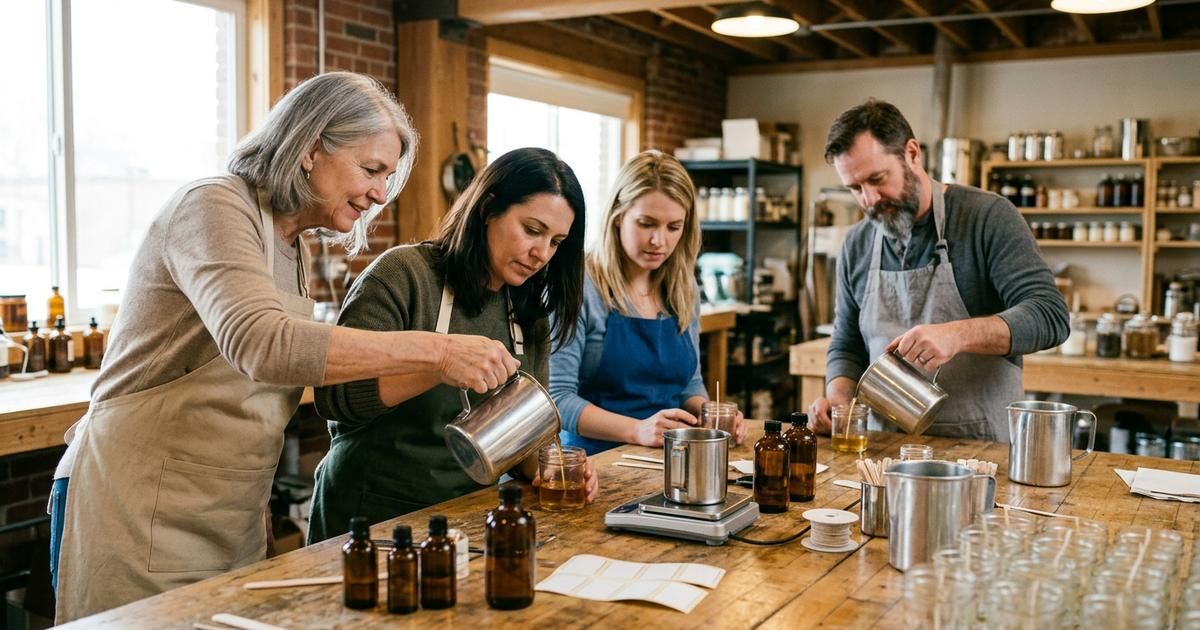
Is a candle making class worth it in St. Louis?
It is worth it when you want the session as much as the candle. The studio has already chosen the wax, sized the wick and picked the vessel, so you leave with a jar that burns properly on the first try, plus an evening out that is not another dinner.
Keep reading ↓Rachel had run out of date nights. She and Dev had eaten at everything within ten minutes of their place in Maplewood, and a Friday that starts with “where do you want to go” had stopped being fun sometime last winter. Someone at work mentioned pouring candles. Sit at a bench, smell a hundred little bottles, pick two, make something. She booked it mostly to break the pattern. What she could not find anywhere on the studio’s page was the one thing she actually wanted to know: does the candle come home with you that night, or do you drive back across town later to collect a jar you already paid for? She booked anyway and hoped.
A few weeks earlier, out in St. Charles, Nadia was trying to fill an afternoon. Her sister’s bridal shower needed something between brunch and dinner. Twelve women, two of them in their seventies, one very pregnant, and a mother-in-law who gets a headache from strong perfume. Nadia called two places. The first talked about availability and a deposit. The second asked how many people, what ages, how long she had, and whether anyone was sensitive to scent, then said the room seats fourteen, the fragrance table can sit on the far wall, and they open the back door between pours. Nadia booked the second one before she hung up. Same activity, roughly the same money. One of them had obviously done this for a group before.
Here is what this covers. What a pour-your-own session actually looks like from the minute you sit down, and how much of the hard work the studio has already finished before you walk in. What you personally do: choose a fragrance, weigh it, stir, pour, wait. Why the waiting matters, and the difference between a candle being cool enough to carry out and cured enough to burn well. Why wick sizing is the genuinely difficult part of candle making, and why that is the strongest argument for a class over a first kit. How sessions are priced and what is usually included. How to pick one for a date night, a birthday, a group of twelve, or a serious first run at the hobby. The safety rules worth knowing before you light anything. And at the end, a note to studios and shops around the metro about the handful of details people search for and almost never find.
Is a candle making class worth it in St. Louis?
It is worth it when you want the session as much as the candle. The studio has already chosen the wax, sized the wick and picked the vessel, so you leave with a jar that burns properly on the first try, plus an evening out that is not another dinner.
The honest comparison is not class versus store candle. If a candle is all you want, buying one is faster and cheaper per jar, because a studio is charging you for a seat, a teacher, a clean bench and a room, not for wax. The comparison that makes sense is class versus a restaurant table, class versus a paint night, class versus a birthday party you have to run yourself in your own kitchen. Judged that way it holds up. You sit with people, you do something with your hands, nobody is on a phone, and at the end there is an object with your name on the bottom of it.
The second kind of value is instructional, and it is easy to underrate. A first candle kit at home usually fails in a specific, predictable way, and the person holding the jar has no way to tell whether the wax, the wick, the fragrance or the pour temperature caused it. In a class every one of those variables is locked down by somebody who has poured a few hundred jars. You get to watch a correct pour before you develop any bad habits, and you find out what melted wax at the right temperature actually looks like, which is surprisingly hard to learn from a photo.
What actually happens in a candle making class?
Most of the technical work is done before you arrive. The studio has selected the wax, matched a wick to the vessel, and set the melt and pour temperatures. Your part is the enjoyable part: smell your way through a fragrance library, build a blend you like, weigh it, stir it into hot wax, pour, and wait for the jar to set.
What the studio has already decided for you
Four decisions are made before the door opens. The wax, which might be soy, a coconut blend, a soy and paraffin blend or straight paraffin, each behaving differently in the jar. The vessel, chosen for its diameter as much as its looks, because diameter drives everything downstream. The wick, sized and centered for that wax in that vessel. And the temperatures, meaning how hot the wax gets, at what point the fragrance goes in, and how cool it should be when it hits the jar. None of that is glamorous and all of it is why the candle works.
What you actually do at the bench
You start at the fragrance table with scent strips, which is where most of the session’s pleasure lives. Sniff broadly, narrow to a few, then usually blend two or three into something that is yours. From there it is measurement, not guesswork. Fragrance is dosed as a percentage of the wax weight, and every wax has a maximum load its manufacturer publishes, so the staff will weigh your oils on a digital scale against the wax going into your jar. Then you stir, and you stir longer than feels necessary, because that is how the fragrance binds into the wax instead of sitting on top of it. Then you pour, straighten the wick, and label the bottom.

The wait, and then the longer wait
This is the part nobody explains and everybody wants to know. A freshly poured candle is too hot and too liquid to move, so it has to sit before you can carry it out. Some studios build that into the session with a drink, a snack or a label-making break. Others have you come back for it. Ask which, because it changes your evening. Then there is the second wait. A poured candle needs days to cure before it burns and smells its best, and if you light it on the drive home it will underperform and you will blame yourself. Set it somewhere with the lid off, be patient, and let the scent settle in.
Why is wick sizing the hardest part of candle making?
Because the wick has to match the wax, the jar diameter and the fragrance all at once, and the only way to know you got it right is to burn a test candle and watch. That is the single job a class does for you, and it is the reason a first kit at home so often disappoints.
A wick that runs too small tunnels. It burns a narrow well straight down the middle and leaves a thick ring of unmelted wax stuck to the glass, and once that happens you rarely recover it. A wick that runs too large burns hot, mushrooms a carbon ball on the tip, soots the jar, and can make the glass uncomfortably warm. In between there is a narrow band where the melt pool reaches the edge in a reasonable time and stays there. Change the fragrance and that band moves. Change the jar and it moves again. Serious makers keep test logs for exactly this reason.
So a class hands you a solved problem. If you later want to pour at home, the transferable lesson is not the recipe, it is the method: change one variable at a time, write down what you did, and burn the result before you make twenty of them. In our experience that is the difference between people who keep the hobby and people who put the kit in a closet.
What does a candle making class cost and what is included?
Sessions are almost always priced per person, and that price usually covers the vessel, the wax, your fragrance selection and the instruction. Bigger vessels and add-ons cost more. Private group bookings are typically quoted per head with a minimum number of guests. Prices move, so confirm the current one when you book rather than trusting a number in an article.
What pushes the number around is worth knowing, because it lets you read two quotes as either a discount or a different experience. Vessel size and style is the biggest lever, followed by how many candles you are making. A walk-in pour bar priced by jar size works differently from a scheduled class with a set start time. Private rooms, weekend evenings, holiday dates and anything involving food or drink all add. So do extras like wax melts, room sprays or a second small jar. None of that is a markup trick, it is just a longer list of things you are taking home.
When you call, ask what is included at the base price, whether there is a minimum for a private booking, and what happens if two people cancel the day before. Those three answers make quotes comparable in a way that the headline number never does.
How do you pick a session for a date night, a birthday or a first try?
Match the format to the occasion, not the other way round. A walk-in pour bar suits two people with a loose evening. A scheduled class with a teacher suits a birthday or a shower where somebody has to be in charge. A small hands-on workshop suits the person who wants to keep doing this at home afterward.
For a date night
Flexibility beats structure here. A pour bar or open studio night lets you arrive, take your time at the fragrance table, and talk while you work, which is most of the point. Check two things: whether the studio is next to somewhere you would happily eat afterward, and whether the candle can leave with you. Couples in Webster Groves and Maplewood are often within a short drive of both. Nobody wants a romantic evening that ends with a scheduled return trip.
For a group, a birthday or a shower
Now you want structure and a person running it. Ask about the minimum and maximum group size, the age policy if kids are coming, whether the room is private, and how long the whole thing takes from arrival to leaving. Say out loud if anyone in the party is pregnant, asthmatic or scent-sensitive, because a room full of open fragrance oils is a lot, and a studio that has thought about it will tell you where to sit and how they ventilate. Groups traveling in from Belleville, Granite City or Cottleville should also ask about parking, which sounds trivial until twelve cars arrive at once.
For a genuine first try at the hobby
Look for a smaller class where you can actually ask questions. The things you want explained are the wax type and why they chose it, how they matched the wick to that jar, the fragrance percentage and where they found the maximum, and the pour temperature. If the answers come easily, you have found a teacher. If the format is more party than instruction, that is fine, just book it knowing what it is.
Shortlist two or three, then call them
Pick two or three studios worth an actual phone call and give each one the same short summary. Here is the group size, here is the occasion, here are the ages, here is how long we have, and here is who is sensitive to scent. Then listen. One will ask you three questions back and describe the room. One will send you to a booking page. One will tell you they can do it and get vague when you press. You are not asking anyone to itemize a quote or produce estimates in writing. You are comparing the gap between what you plainly said you wanted and what each place is set up to deliver, and that gap shows up in about four minutes.
Booking a kid’s birthday next? Swim lessons have their own right age.
What is the 3-hour rule for candles?
Burn a candle no more than about three to four hours at a time, then put it out and let it cool before you relight it. Trim the wick each time, back to a short stub. Long burns overheat the container, let the wick mushroom and soot, and shorten the life of the candle you just made.
The companion rule matters just as much, and it applies the very first time you light it. Let that first burn run until the melted wax reaches the edges of the jar all the way around. Wax has a memory. If you blow it out early, the candle will keep tunneling down that same narrow channel for the rest of its life. So plan the first burn for an evening when you will be home and sitting down.
The rest is ordinary fire sense. Never leave a burning candle unattended. Keep it away from drafts, vents and open windows, since moving air makes the flame flicker, smoke and burn unevenly. Keep it well clear of curtains, paper, bookshelves, kids and pets, and on a stable, heat-safe surface. Stop burning when a small amount of wax is left in the bottom, rather than running it dry against the glass.
Is candle making a profitable hobby?
It can be, but a class is not a business course, and the gap between the two is wide. Selling candles means buying wax, vessels, wicks, fragrance, labels and packaging at volume, testing every combination until it burns safely, and pricing your own labor into a product that customers compare against mass-produced jars.
Want another hands-on hobby? Here’s how to learn cake decorating.
The part people underestimate is testing. Every new vessel, every new fragrance, every new wax lot potentially changes how a wick performs, and a candle sold to the public needs to burn safely in someone else’s house. That is burn logs, discarded batches and time before a single sale. There are also labeling and safety expectations for anything sold, which are worth researching properly for your state and your sales channel before you list anything. Take the class because it is fun. Treat the business question as a separate project with its own homework.
Ready to book something? You can browse candle shops and studios on St Louis Near Me Directory, shortlist two or three worth a phone call, and ask each one the same four questions: how long is the session, what is included, do we take the candle home the same day, and how do you handle a guest who is sensitive to scent. How readily those come back tells you most of what you need.
If you’re the one people should be calling, don’t stay invisible - list your business.
For St. Louis candle studios and shops
Think about Rachel scrolling a booking page at eleven at night, trying to work out whether she drives home with a candle or drives back for it. She was not being difficult. She was trying to plan an evening, and the answer was not written anywhere. Nadia had the same problem and solved it by calling, which most people will not do.
So write it down. Session length, start to finish, including the setting time. Exactly what the price includes and what counts as an add-on. Minimum and maximum group size for a private booking. Your age policy, stated plainly, including whether a younger child can pour or only pick the scent. Whether the candle goes home the same day. What the cure time is and what you tell people to do with the jar in the meantime. And a clear note on fragrance allergies and scent sensitivity, because in every group of a dozen there is someone quietly worried about it.
Then publish it where people look, which is a phone, before anyone drives anywhere. A short page covering those seven things answers the questions your staff repeat all week and wins the bookings from families in Ferguson, Granite City and Cottleville who are choosing between you and a restaurant. If private groups need lead time, post the honest current lead time and keep it current. Someone planning a shower around a date will forgive a long wait far more readily than a missed one.
Frequently asked questions
How long do candle making classes take?
It varies a lot by format, so confirm it when you book. A drop-in pour bar can be quick, while a taught class with a set start time runs longer. The question that trips people up is whether the posted length includes the time your jar needs to set before you can carry it out, or whether that is extra.
Is candle making difficult?
Pouring one is easy. Designing one is not. In a class the hard decisions, wax, wick size, vessel and pour temperature, are already made, so the skill you use is choosing a scent and following instructions. Doing it from scratch at home is harder, because you have to test wicks and pour temperatures yourself and burn the results to find out what worked.
Where can I make my own candle in St. Louis, Mo?
Look at a few venue types rather than one. Dedicated candle studios and pour bars run open sessions and private bookings. Craft and paint studios often add candle nights to their calendar. Some gift and home goods shops host workshops in a back room, and independent makers take private group bookings. Community centers and event spaces sometimes bring a maker in for a one-off.
Is it cheaper to make your own candles or buy them?
Buying is cheaper for one candle, every time. Making becomes competitive only at volume, once you have bought wax, wicks, vessels, fragrance and equipment and spread that across many jars, and only if you do not count your own time. A class is priced as an experience, not as a cheaper way to get a candle, and it is fair to judge it that way.
How many candles does a 10 lb bag of soy wax make?
It depends entirely on your vessel, not on the wax brand. The arithmetic is simple: divide the usable wax weight by the fill weight of one jar. A small tin takes a fraction of what a wide three-wick vessel takes, so the same bag might fill a lot of little containers or far fewer big ones. Weigh one filled jar and do the division.
What not to do when making candles?
Do not eyeball the fragrance. It is a percentage of wax weight, and every wax has a published maximum you should stay under. Do not pour at a guessed temperature, do not skip stirring after the fragrance goes in, and do not move or chill a jar to speed setting. Never leave melting wax unattended, and never assume an untested wick is safe.
Where can I find a candlemaking course?
Beyond one-off studio sessions, check community college continuing education catalogs, city and county parks and recreation class listings, and library maker spaces, which run seasonal craft classes. Online, wax and fragrance suppliers publish detailed technical guides and structured courses, and independent makers sell recorded curricula. For safety and testing method, supplier documentation is usually the most reliable reading.
Can kids do a candle making class?
Often yes, but age policies differ and you must ask first. Some studios set a minimum age for anyone handling hot wax, some let younger children choose the fragrance and decorate while an adult pours, and some run family sessions built around that split. Confirm the policy and the adult-to-child ratio before you promise a birthday party.
More St. Louis guides
- Where to Buy Craft Supplies in St. Louis
- St. Louis Gift Baskets: What to Put Inside
- St. Louis Gifts That Are Actually From Here

Written by a dedicated team of St. Louis locals who live, work, and play right here in the St. Louis metro. Founder Lane Forman and team are committed to building the region’s most trusted directory by verifying listings and connecting local businesses with loyal customers across Missouri and Illinois.