Coyotes and Pets in St. Louis: Why One Hangs Around and What Missouri Law Allows
Revised October 9, 2026
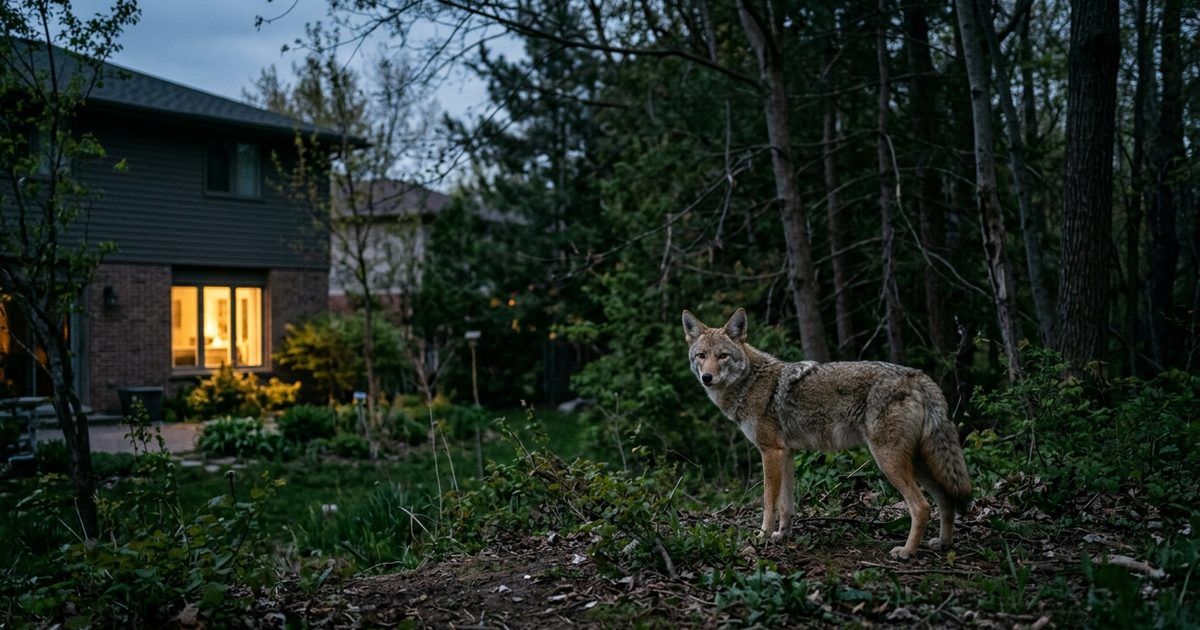
What does it mean when a coyote hangs around your house?
Usually that something in or near your yard is feeding it. Pet food, open trash, fallen fruit and bird feeders that draw squirrels and mice give a coyote a reason to come back, and in April and May a den may be close by. A daytime sighting alone doesn’t mean it’s sick. Make its visits unpleasant.
Keep reading ↓Every neighborhood Facebook group in St. Louis gets the same post a few times a year. A doorbell clip, a lean gray-brown dog trotting past the recycling bins at 5 a.m., and a comment thread that splits into two camps: “somebody needs to come get rid of it” and “it’s out in daylight, so it must be rabid.” Both camps mean well. Both are wrong. And the first one can leave your street with a bigger coyote problem than it started with.
Here’s why. Tom Meister, then the Missouri Department of Conservation’s wildlife damage biologist for the St. Louis region, told the Missouri Conservationist in 2019 that when a coyote is removed from a place with food, water and shelter, another one moves in, and the population can even grow. Kill a dominant parent and the young ones lose the adult that kept them in line. The territory doesn’t stay empty. It gets a new tenant who hasn’t learned anything about your yard yet.
So the job in front of you is teaching. Coyotes live in every part of Missouri, the city included, and they learn fast: which street sets trash out the night before pickup, which patio leaves the cat bowl out, which house sends somebody out the back door with an air horn. Missouri law allows less than most comment threads assume, and it helps less than you’d hope. Rules and dates here are current as of October 2026 from MDC, MU Extension, state law and local agencies; confirm them before you act. And if you’re mapping where your dog is welcome, start with our guide to dog-friendly places in St. Louis.
What does it mean when a coyote hangs around your house?
Usually that something in or near your yard is feeding it. Pet food, open trash, fallen fruit and bird feeders that draw squirrels and mice give a coyote a reason to come back, and in April and May a den may be close by. A daytime sighting alone doesn’t mean it’s sick. Make its visits unpleasant.
Start with food, because MDC does. Meister’s list of things that pull coyotes into a yard reads like a suburban chore list: garbage cans, pet food, apples and pears dropped from trees, pumpkins, even bird feeders. Birdseed itself doesn’t interest a coyote much. The squirrels and mice it brings in do. City coyotes learn schedules, too. Meister described parents teaching pups that garbage goes out on one street Wednesday morning, so Tuesday night is dinner.
Then check the calendar. MDC’s coyote booklet says Missouri coyotes feeding pups usually hunt no more than a mile from the den, and that a pair’s home range shrinks in spring while it raises pups. If the same coyote crosses your yard every evening in late April or May, a den may well sit within walking distance: under a brush pile, a big tree’s root wad, a culvert, a deck or an unused shed.
Daylight isn’t a red flag on its own. MDC’s field guide calls coyotes nocturnal but notes they’re also seen by day, and Oregon’s wildlife agency says plainly that a coyote out in daylight isn’t necessarily sick. Mange can make one look alarming; MDC biologists get “chupacabra” calls that turn out to be coyotes stripped bare by mites. What deserves your attention is behavior. A coyote that walks toward people, won’t leave when hazed, or raises its hackles, bares its teeth and growls should be reported to MDC.
What it almost never means is that people are on the menu. MDC’s coyote booklet says there have been no documented cases of coyotes attacking people in Missouri, and a 2009 study MDC cites counted fewer than 150 attacks on people across the U.S. and Canada from 1960 to 2006, most of them minor and about a third involving someone who’d been feeding coyotes. Pets are the real exposure.

Where do coyotes live in St. Louis?
Anywhere with a strip of green and a place to hide, which in St. Louis covers a lot of ground. By the end of the 1970s, MDC says, coyotes had spread to every part of Missouri, and the department now calls them common throughout the state, urban and suburban areas included. Its St. Louis staff describe routine sightings in Forest Park and Wilmore Park and in Queeny and Jefferson Barracks county parks. In early 2010 a coyote made an extended appearance in Tower Grove Park, got nicknamed “Gal,” and ended up with its own Facebook page and more than 1,300 followers.
The sharpest local picture comes from the Forest Park Living Lab, a research partnership that includes WashU and Saint Louis University. In spring 2024 its scientists put GPS collars on two of the park’s coyotes, and the St. Louis Post-Dispatch mapped every move. Silver, a young male with mange collared March 20, used a home range of 37.8 square miles, zigzagging across the metro as far as the McKinley Bridge and returning again and again to a strip along the River des Peres. Solar, a pregnant female caught hours after the April 8 eclipse, raised five pups around a residential subdivision near the park inside 6.4 square miles. She traveled at night, rarely much past the park, and was usually back at her den by morning. Researchers told the paper both ranges looked about average for urban coyotes. Neither collar lasted the year: Silver was found dead in late June, and Solar died of blunt-force trauma in August.
Read those maps the way a pet owner would. A mother with pups kept her world small, a few square miles of backyards and park edges. A young male passed through a huge slice of the region. The coyote you see every evening in May is most likely a local parent. The one you see once in October may be a youngster on the move, since MDC says pups are on their own by fall.
MDC’s biologists name the in-town habitat: municipal parks, golf courses, cemeteries, storm-water creeks, drainage ditches, wooded common ground in subdivisions, and the yards themselves. Meister has seen dens in tunnels under roads and in holes dug beneath root wads. Joe DeBold, an MDC urban wildlife biologist, said in the same 2019 article that coyotes treat a block of houses like any other structure to weave through in the dark.
Out on the rural edge of the metro, the picture flips. Around Catawissa, Lonedell and Richwoods, coyotes work timber edges, hay fields and brushy draws, the semi-open country MDC’s field guide describes as classic coyote range. MDC’s booklet adds the point that explains city coyotes: where they’re hunted and trapped, they stay very wary of people, and in urban areas where nobody does either, they have less fear. Same animal, different education. In town, the education is up to you.
Which months put St. Louis pets most at risk?
In Missouri, April and May. That surprises people, because some national pet guides flag January through March, and that calendar doesn’t match what MDC sees here. Missouri coyotes breed from mid-February into the first days of March, according to MDC’s coyote booklet. Gestation runs about 63 days, so most pups arrive between mid-April and the first week of May. Then the grocery bill explodes. Meister’s explanation was simple: food needs rise so sharply during pup rearing that April through May is when conflicts between people and urban coyotes are most common.
That’s the season of the classic dog-walk scare. A coyote trails you and your dog along a path, stops when you stop, maybe huffs or barks, then peels off. Wildlife agencies call it escorting, and Oregon’s describes it as protective rather than predatory: a parent pushing a perceived threat away from the den. MDC’s booklet says coyotes with pups sometimes turn aggressive toward dogs that come near their dens in April and May. The fix is dull and it works. Take a different route for a few weeks. You can change a walk a lot faster than she can move five pups.
Late winter matters for a different reason. During breeding season coyotes roam larger home ranges and howl more, MDC says, so sightings climb and the doorbell clips start circulating. MDC’s St. Louis office has issued February reminders asking pet owners to stay alert, noting that coyotes may go after pets as territorial competition rather than as food.
Coyotes sleep outside all winter. People shouldn’t have to: warming centers in St. Louis
Time of day beats month, though. MDC’s rule is dusk, nighttime and dawn. Those are the hours coyotes are most active, and those are the hours a cat or small dog shouldn’t be outside alone. In any month.
How do you protect cats and small dogs from coyotes?
Be there. That’s most of it. DeBold told the Missouri Conservationist that when coyotes go after a cat or dog, it usually isn’t right at a person’s feet, and that the days of opening the back door and letting a pet wander for an hour are over where coyotes live. Go out with your pet, stand beside it, bring it back in.
Cats are the likeliest loss, so start there. MDC notes that urban coyotes do prey on housecats. The only setup that fully protects a cat is indoors, or outdoors inside a screened catio. A cat that roams at dusk on a block with a resident coyote is taking a real chance, and no spray, collar bell or porch light changes that. If a cat doesn’t come home, though, check the shelters before the comment threads. Our guide to lost pets in St. Louis walks through which shelter holds strays from your part of town.
Small dogs come next, and attitude is part of the risk. MDC’s booklet says full-size collies, German shepherds and Labrador retrievers typically aren’t in danger from coyotes, except as puppies. Meister said coyotes more often treat dogs as competition than as food, and a small dog that charges or barks at one reads as a challenge. Toy breeds can look like prey. Either way, the answer is the same set of habits.
Walk on a short, fixed leash. One national emergency-vet group recommends a standard 6-foot leash over a retractable one, because a dog at the far end of a retractable is a dog you can’t scoop up. MDC’s booklet adds the plain version: obey leash laws. If a coyote shows up, pick up a small dog first and haze second, the order Colorado’s wildlife agency recommends.
Fence it properly. MDC’s yard spec is at least six feet high and dug six inches into the ground, so a coyote can’t jump it or dig under it. Its livestock guide calls for woven wire at least seven feet tall when a fence has to be truly predator-proof, and some owners add rollers along the top rail. Walk the line every few months for gaps. An invisible electric fence keeps your dog in and does nothing to keep a coyote out, and that same vet group says a dog door doesn’t protect against predators either.
Light the yard and look before you open the door. MDC’s booklet says to keep outside pet areas well lit. A motion light over the back step won’t scare off a determined coyote for long, but it buys you a look before the dog bolts.
Pull the food. Feed pets indoors, lid the trash, and set cans out as close to pickup time as you can, which is advice MDC’s St. Louis office put in writing. Pick up fallen fruit, and clear brush piles that shelter the rabbits and rodents coyotes hunt.
Keep shots and parasite control current. Colorado’s agency tells owners to keep pets up to date on vaccines, and if your dog is behind on rabies, our guide to puppy shots in St. Louis covers the schedule and cost. Meister’s advice on mange, which coyotes and foxes carry, was a good flea and tick preventive, the same product you want anyway for ticks in Missouri.
Say you keep a barn cat and a couple of terriers on a few acres outside Lonedell. Everything above applies, plus a coop or kennel that shuts at dusk. MDC’s livestock advice is to bring animals into a night lot behind a predator-proof fence, because putting them up at night is one of the best ways to cut losses. Farm pets deserve the same courtesy.

How do you haze a coyote so it stays away?
Make every visit unpleasant, every single time, and make sure the coyote knows the unpleasantness comes from people. That’s MDC’s hazing doctrine in one line, and the department says research has established that coyotes can be conditioned to stay away through consistent harassment. Consistency is the hard part. A coyote that gets yelled at on Monday and ignored on Tuesday learns that Tuesday is fine.
The toolkit is low-tech. Yell. Wave your arms. Blow an air horn. Bang a pot. Throw sticks or rocks toward it. Hit it with a high-pressure garden hose. Rattle a shaker can full of pennies. MDC also lists paintball guns and fireworks where local ordinances allow them, so check your city’s rules before you reach for either.
It works at city scale. Denver made hazing its main response to coyote problems, and its parks department reported that direct encounters between people and coyotes fell more than 75 percent from 2009 to 2010, as MDC’s magazine recounted.
Three habits keep hazing safe and effective. Stay big, loud and visible until the coyote actually leaves, because a half-hearted shout it ignores teaches the wrong lesson. Never corner it; you want a coyote that chooses to leave, not one pinned against a fence. And skip hazing a parent near an active den in spring. Change your route instead.
If one stands its ground, don’t run. Colorado Parks and Wildlife’s guidance is to face the coyote, get as big and loud as you can, and back away slowly if it still won’t leave. The warning signs of real aggression are raised hackles, bared teeth and growling. A coyote showing those, or one that keeps approaching people after repeated hazing, is the one to report.
Then recruit the neighbors. Hazing works best as a block-wide habit. If one house yells and the next leaves kibble on the porch, the coyote learns the second lesson. Which brings us back to that Facebook thread. One post asking everybody to bring in pet food, hold the trash until pickup morning and blow an air horn on sight will do more than two hundred comments about calling someone.
What does Missouri law allow you to do about a coyote?
More than you’d expect on a farm, and much less than you’d expect in town. Missouri treats the coyote as a furbearer and game mammal, and for 2026 the hunting season runs all year with no daily limit for small game permit holders, with catches: no daylight hunting from April 1 until spring turkey season opens, turkey methods and an unfilled turkey permit during turkey season, and an unfilled deer permit for daylight hunting in the November firearms deer portion. New this year, artificial light, night vision and thermal gear are legal for coyotes January 1 through September 30, except during spring turkey season. Trapping runs November 15, 2026 through February 28, 2027, plus a private-land extension from March 1 to April 14 for foot-hold, foot-enclosing and cage traps only. The dates move every year, so check MDC’s current regulations first.
Out of season, there’s the landowner rule. Under 3 CSR 10-4.130 of the Wildlife Code, wildlife that is, beyond reasonable doubt, damaging property may be shot or trapped by the property owner or a representative at any time without a permit, on the owner’s property only. Two strings come attached. Anything captured or killed has to be reported to an MDC agent within 24 hours, and it’s disposed of only as the agent instructs. Trapping a coyote and quietly letting it go in a park isn’t your call to make.
Picture a small hobby farm outside Richwoods where a coyote has started taking chickens. That’s the case the rule was written for: damage beyond reasonable doubt, on the owner’s land, in unincorporated country. The same coyote in a city backyard is a different legal animal.
In town, gunfire is the problem. Missouri’s Blair’s Law, in effect since August 28, 2024, makes it a crime to recklessly fire a gun within or into the limits of any municipality, a class A misdemeanor the first time. Its exceptions include hunting during an open season, nuisance-wildlife control as permitted by MDC, defending a pet from an attack that’s actually underway, and shooting more than a mile from any occupied building, and even the hunting exception lets a city restrict gunfire within a quarter mile of an occupied structure. Cities stack their own rules on top. St. Louis updated its illegal-discharge ordinance in November 2024, city police have reminded residents that firing a gun inside city limits is illegal, and MU Extension notes that most cities have ordinances against shooting. A coyote trotting down a south city alley isn’t a hunting opportunity.
Trapping in town has its own fences. In Missouri communities of 10,000 people or more, only cage-type or foot-enclosing traps may be set within 150 feet of a home or occupied building. Snares on dry land are illegal without MDC authorization, and no trap may go in a path used by people or pets. MDC’s biologists add that coyote traps can catch cats, dogs or even children, which makes them unsafe in populated areas, and that most coyotes are too wary to walk into a cage trap anyway. MDC’s hunting and trapping rules also say furbearer dens aren’t to be molested or destroyed, so if you find one under your deck, call MDC before you touch it.
And the biggest legal hammer may not fix anything. Remove the coyote and another takes the spot. That’s why MDC and MU Extension put food removal, fencing and hazing first, and save lethal control for specific animals doing specific damage. This is a plain-language summary rather than legal advice; for your address, ask MDC and your local police department.
Who do you call about a coyote in St. Louis?
It depends on what the coyote is doing. One passing through, or showing up now and then, needs no call at all. Haze it and fix the food.
A coyote that keeps hanging around, acts bold or is causing real trouble is MDC’s department. The St. Louis Regional Office answers at 636-441-4554. MDC’s coyote control page says your county conservation agent can usually name a local trapper, and the regional wildlife damage biologist can sometimes help with instruction or equipment. MU Extension notes that MDC’s wildlife damage program has served Missourians since 1945 and often makes traps and scare devices available at cost.
A sick, injured or threatening coyote depends on where you live. In the City, file a report through the Citizens’ Service Bureau; City Animal Care and Control says it doesn’t respond to nuisance wildlife but will respond to injured wildlife or wildlife that poses a safety or health issue. In the County, animal control points residents with outdoor wildlife to the Bi-State Wildlife Hotline at 636-492-1610 and to MDC. Our breakdown of animal control in St. Louis City vs. County sorts out which agency covers your address. If a person is hurt, call 911.
If your pet is hurt, go to a vet now, even if the wound looks small. That same emergency-vet group warns that small puncture wounds can hide deeper injury and infection, and a wild-animal bite can mean a rabies booster. Press a clean cloth firmly on any bleeding, add layers rather than lifting the soaked one, and drive. Never reach in with bare hands to break up a fight; use a hose, a stick or a trash can lid. After hours, here’s how to find an emergency vet in St. Louis.
For hands-on work, like coyote-proofing a fence line or a trapper for a rural property, City Animal Care and Control itself suggests a pest control company. Ask whether they handle coyotes, which traps they use near homes, and whether they report to MDC as the Wildlife Code requires.
Coyotes aren’t leaving St. Louis. The ones that last here are the ones that learned where the easy meals are. Be the house on the block that taught them yours isn’t one.
Need hands-on help with a den under the deck or a yard that needs coyote-proofing? Start with wildlife and pest control companies around St. Louis and ask whether they take coyote calls before you book.
And if you run a wildlife removal or exclusion company, the pet owners reading this want to know whether you work through April and May and which Missouri trap rules you follow, so list your wildlife control business with us with your service area and coyote work spelled out.
Frequently asked questions
What month are coyotes most aggressive?
In Missouri, April and May. MDC says conflicts between people and urban coyotes peak then because parents are feeding pups, and coyotes with pups sometimes turn aggressive toward dogs that come near a den. Breeding season in February and early March brings more sightings and howling, but less trouble.
Can you shoot coyotes anytime in Missouri?
Not quite. The 2026 season is open all year with no limit for permit holders, but daylight hunting closes from April 1 until spring turkey season opens, and turkey and deer seasons add method rules. A coyote damaging your property can be taken on your own land without a permit if you report it to MDC within 24 hours. Inside city limits, state law and local ordinances usually make firing a gun illegal.
What smell do coyotes hate the most?
None has proven reliable. MDC lists repellents for coyotes as not recommended because none are known to be effective, and MU Extension says home remedies like ammonia and urine haven’t been scientifically proven. Taking away food, cover and easy access works better than any smell.
Will motion lights scare coyotes?
For a while. MU Extension calls frightening devices a short-term fix, and a light that flicks on with nothing else happening stops meaning much. Use motion lights to check the yard before your pet goes out, which fits MDC’s advice to keep pet areas well lit, and back the light up with a person making noise.
Will a coyote chase you if you run?
Don’t give it the chance. Colorado Parks and Wildlife says not to run or turn your back on a coyote. Face it, be big and loud, and back away slowly if it doesn’t leave. Most coyotes retreat from a confident person. With a small dog along, pick the dog up first.
What is a coyote’s weakness?
Its caution. MDC’s coyote booklet says coyotes that are hunted and trapped stay very wary of people, and city coyotes lose that wariness when nobody pushes back. Hazing rebuilds it. They’re also smaller than people expect: MDC puts Missouri coyotes at 18 to 30 pounds.
Can a coyote jump a 6-foot fence?
Some can. MDC’s yard advice is a fence at least six feet high and dug six inches into the ground, and its livestock guide calls for woven wire at least seven feet tall when a fence has to be truly predator-proof. Rollers on the top rail help. Supervise small pets anyway, because a fence slows a coyote down more than it guarantees anything.
Are coyotes dangerous to people in St. Louis?
Rarely. MDC’s coyote booklet says there have been no documented cases of coyotes attacking people in Missouri. Never feed one, keep small children supervised where coyotes are active, and report any coyote that approaches people or won’t leave when hazed to MDC’s St. Louis office at 636-441-4554.

Written by a dedicated team of St. Louis locals who live, work, and play right here in the St. Louis metro. Founder Lane Forman and team are committed to building the region’s most trusted directory by verifying listings and connecting local businesses with loyal customers across Missouri and Illinois.