Mill Creek Valley Held 20,000 St. Louisans. Only Five Buildings Remain.
Revised November 10, 2026
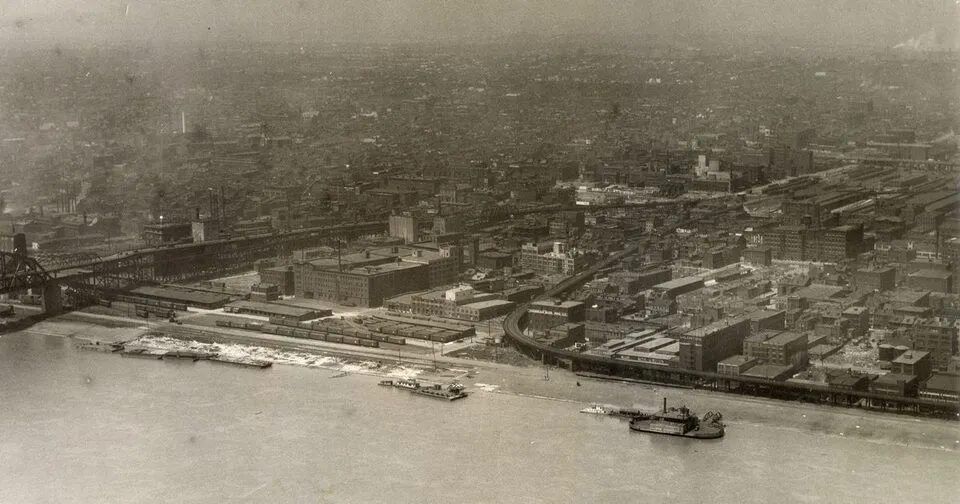
What happened to Mill Creek, St. Louis?
The city tore it down. Starting in 1959, St. Louis cleared Mill Creek Valley, a neighborhood of about 20,000 people, 95 percent of them Black, in the name of urban renewal, after city voters approved a $10 million bond issue to raze it. Of its 5,700 homes and more than 800 businesses, only five remain. Today the ground holds Harris-Stowe State University, ballfields, highway ramps and a soccer stadium.
Keep reading ↓Lean in close to the black stone. The words are set inside the pillar, so you have to bend toward it, almost press your face to the granite, before a voice from the old neighborhood comes up out of the dark. Behind you, on match days, the roar spills out of Energizer Park. Under your shoes, set into the walkway, are house numbers. Addresses. Somebody’s front door used to be right there.
This is Market Street, and you are standing in Mill Creek Valley. Great Rivers Greenway says the benches and bushes outside Energizer Park outline the parcels where homes and businesses once stood, with each address number embedded in the walkway. The granite plinths go further. They carry the name, age and occupation of everyone who lived in that block.
Everyone. Read a few. A porter. A cook. A child.
And beneath that stretch of greenway, according to the same agency, a buried creek is still flowing into the Mississippi River. The creek gave the valley its name. The city took the rest.
What happened to Mill Creek, St. Louis?
The city tore it down. Starting in 1959, St. Louis cleared Mill Creek Valley, a neighborhood of about 20,000 people, 95 percent of them Black, in the name of urban renewal, after city voters approved a $10 million bond issue to raze it. Of its 5,700 homes and more than 800 businesses, only five remain. Today the ground holds Harris-Stowe State University, ballfields, highway ramps and a soccer stadium.
That number is the one people don’t believe when they hear it. Five. Not five blocks. Five buildings, out of a neighborhood Great Rivers Greenway says once held 5,700 homes and more than 800 businesses. Gwen Moore, who lived there with her parents as one of its last residents and later became a curator at the Missouri Historical Society, put the scale in plain words on St. Louis Public Radio: “You cannot wipe out 5,000 buildings. Well, they left a couple standing. There were 43 historical churches, and they wiped those all out.”
If you’ve watched a CITY SC match, taken a class at Harris-Stowe or sat in traffic on the highway ramps through Midtown, you’ve already been inside the old valley. Most people who have been there have no idea.
The old valley has a marker at its other end, too, and almost nobody turns it around. At the fountain on the southeast corner of Grand and Lindell Boulevards, which Saint Louis University calls a historic entrance to the former neighborhood, artist Cbabi Bayoc’s The Legacy of Mill Creek stands in four panels: faith, business, music and sports. Walk to the back of each one. Bayoc left a handwritten message there explaining his inspiration. “With this art, I wanted to hit on the pillars of the community,” he told SLU.
So make it a two-ended visit. Start at the pillars outside Energizer Park at 20th and Market, read the names on the granite, then go west to Grand and Lindell and finish at the fountain, reading the backs of the panels. One end shows you who lived here. The other shows you what they built.
What is Mill Creek known for?
For being a whole Black city inside St. Louis. Great Rivers Greenway’s history of the neighborhood says that during the first half of the twentieth century it was a predominantly Black neighborhood where many residents owned their own businesses, and that by the 1950s its 20,000 people had built an abundance of businesses, houses of worship, and doctor and lawyer offices. Washington University’s history of St. Louis’ eminent domain describes who lived there: Black teachers, janitors, cooks, laundresses, railroad porters and musicians, with shops, grocery stores, churches, saloons and a bank owned by African-American investors.
And it had a sound. Great Rivers Greenway says ragtime music, the music that influenced the jazz, blues, soul and hip hop that define American music today, was born in the restaurants and bars that once stood where the Brickline Greenway is built today. Stand on that path with a phone playing a Scott Joplin rag and you are hearing it, more or less, where it started.
Hear the rest of it the way the record allows: the porters coming home off the trains, the church doors open, the musicians. The St. Louis Stars, Great Rivers Greenway notes, won 3 Negro National League pennants with the neighborhood behind them. A mural along the greenway just east of Compton Avenue honors the team and the Mill Creek Valley community who supported them.
It was also a hard place to live, and the record says so plainly. Racial segregation crippled the community, pushing up rents and leading to deteriorated housing, the Washington University history says. A residential survey in 1958 found that more than half of the dwellings lacked indoor plumbing. Rats were a regular menace. Families paid too much for too little because they weren’t allowed to live most other places.
Why was Mill Creek Valley destroyed?
Because the people running the region wanted the land in the middle of the city. On August 7, 1954, Mayor Raymond R. Tucker announced plans to demolish the commercial buildings and 5,600 residential units in Mill Creek Valley, according to Washington University. Newspapers praised his bold vision. The local NAACP supported the plan. City voters approved a $10 million bond issue to raze the neighborhood, and it became one of the nation’s largest urban renewal projects.
Terry Jones, a SLU student at the time who covered the Mill Creek story as editor of SLU’s newspaper, laid out the logic on that St. Louis Public Radio program: “At the heart of their plans was the central corridor. And in order to make the central corridor work better, many things had to happen, one of which - they had to get rid of this neighborhood that was right in the middle of things.” The city’s 1958 redevelopment plan labeled the neighborhood a “slum clearance,” PBS NewsHour reported, and the children who lived there heard what that meant. “They were calling you a slum dweller, calling your parents slum dwellers and your friends and your neighbors,” Moore told PBS.
Then the first wrecking ball smashed into the neighborhood in 1959. Moore was one of the kids who had to go. “My memories are very pleasant, and I remember being traumatized when we were told that we had to move,” she said.
Her family was one of thousands. Great Rivers Greenway puts it at 20,000 Black residents displaced in the name of urban renewal in the late 1950s and early 1960s. Every one of them had a street address. Those are the numbers now set into the walkway on Market Street, the ones people step over on the way to their seats.

The ground sat empty, and the city had a name for it
The plan assumed St. Louis would keep growing. It didn’t. The city’s population peaked in 1950 at 856,796 people, Washington University notes, and that assumption proved a mistake. Reinvestment was slow or not at all. The clearing left a vast wasteland that St. Louisans called “Hiroshima Flats.”
Think about walking past that. Block after block of broken ground where your church stood, where your doctor’s office was, where your grandmother’s porch looked out on the street. Moore’s verdict, decades later, was blunt: “Mill Creek became sort of the poster child of how not to do urban renewal.”
What eventually filled it was not a neighborhood. According to Washington University, Mill Creek Valley today is ballfields, a college sports stadium, Harris-Stowe State University, highway entrance ramps and an office park owned by an investment bank. It calls Mill Creek St. Louis’ most famous forgotten neighborhood.
Our Midtown neighborhood guide covers what sits on much of that ground now and where to eat while you’re there.
Mill Creek ran on Black-owned business. Find Black-owned restaurants in St. Louis today.
Where is Mill Creek Valley located?
Follow the water. Great Rivers Greenway says the waterway called Mill Creek created the east-west valley through the center of St. Louis that generations of people have traveled through and lived in. The creekbank gave a flat surface for travel, and many modern roads are built on routes created by Native American peoples. That segment of Market Street, the agency notes, is built on the Osage Trail.
So the valley runs where the land runs: low and flat, east to west, between downtown and Midtown. Walk Market Street from 20th Street west to Compton Avenue and you are walking its spine. The creek is still down there, buried, moving toward the river the whole time you’re walking.
Where can you see Mill Creek Valley’s history today?
Start on Market Street. Pillars of the Valley, by artist Damon Davis, is a mile-long permanent public art installation along the Brickline Greenway, from Compton Avenue at Harris-Stowe State University to 20th Street at Energizer Park. It’s outdoors, and you can walk it end to end in an afternoon.
Begin at the stadium end, where the hourglass-shaped pillars stand. Great Rivers Greenway says they’re meant to be holding up the residents’ stories, excavated from the earth. Inside each pillar, and along the greenway path, are quotes from the people who lived there. Bend down and read them. Then look at the granite plinths: an artist statement, a map showing how dense the neighborhood was, the name, age and occupation of everyone who lived on that block, and a relief of Mill Creek itself, a waterway now buried underground, flowing to the Mississippi.
Look down, too. The benches and bushes outside the stadium trace the old lot lines, and the address numbers sit in the walkway under your feet. For visitors with low or no vision, a braille and tactile model is available in three locations.
Walk west toward Compton. Just east of Compton Avenue, the Stars Park mural, made by Great Rivers Greenway, Harris-Stowe State University and St. Louis ArtWorks teen apprentices with local artists, honors the St. Louis Stars and the neighborhood that filled the stands. Harris-Stowe’s campus is right there, on the ground the valley used to hold.
Next time someone calls Mill Creek a slum that had to go, you’ll know about the porters and laundresses on the granite, the bank owned by Black investors, the three pennants, and the creek still running in the dark under Market Street. Pick a dry afternoon. Start at the pillars by the stadium, walk west to Compton, and read every name you can.
For more of the city’s surviving past, keep going:
- our guide to the oldest buildings in St. Louis
- our list of underrated places to visit in St. Louis
- our guide to things to do in Brentwood, MO

Make a day of it. After the walk, our Midtown neighborhood guide covers where to eat and what’s open around Harris-Stowe, SLU and Grand Center.
If you run a shop, a kitchen or an office in Midtown or Downtown West, on ground that was once Mill Creek Valley, the people walking the Brickline Greenway are looking for somewhere to sit down afterward. List your business with us and turn that foot traffic into customers.
Frequently asked questions
What is the history of Mill Creek Valley?
Great Rivers Greenway says the valley’s first homes were built by families who emigrated from Europe in the late 1800s and moved out in the early 1900s, as many Black families moved from Southern states to Mill Creek Valley. By the 1950s, 20,000 people lived there, 95 percent Black. Demolition began in 1959.
Where is Mill Creek Valley located?
In the city’s central corridor, west of downtown. The Pillars of the Valley memorial runs along Market Street from 20th Street at Energizer Park to Compton Avenue at Harris-Stowe State University, through the heart of the old neighborhood.
Why was Mill Creek Valley destroyed?
City leaders wanted the central corridor cleared. Mayor Raymond R. Tucker announced the plan on August 7, 1954, city voters approved a $10 million bond issue to raze the neighborhood, and the 1958 redevelopment plan labeled it a “slum clearance.” Demolition began in 1959.
What is Mill Creek Valley in St. Louis like today?
According to Washington University, Mill Creek Valley today is ballfields, a college sports stadium, Harris-Stowe State University, highway entrance ramps and an office park owned by an investment bank. The Pillars of the Valley memorial now runs along Market Street. Of its 5,700 homes and more than 800 businesses, only five remain.
Which neighborhood in St. Louis is historically Black?
Mill Creek Valley was one of the biggest: by the 1950s, 20,000 people lived there, 95 percent Black. For the north side story, see our guide to The Ville.
Why did urban renewal fail?
In Mill Creek, the plan assumed continued growth, but the city’s population peaked in 1950 at 856,796 people. Reinvestment was slow or not at all, and the clearing left a vast wasteland that St. Louisans called “Hiroshima Flats.”

Written by a dedicated team of St. Louis locals who live, work, and play right here in the St. Louis metro. Founder Lane Forman and team are committed to building the region’s most trusted directory by verifying listings and connecting local businesses with loyal customers across Missouri and Illinois.