Pink and Orange Under the Grime: St. Louis City Hall, Walk In Weekdays 8 to 5
Revised November 22, 2026
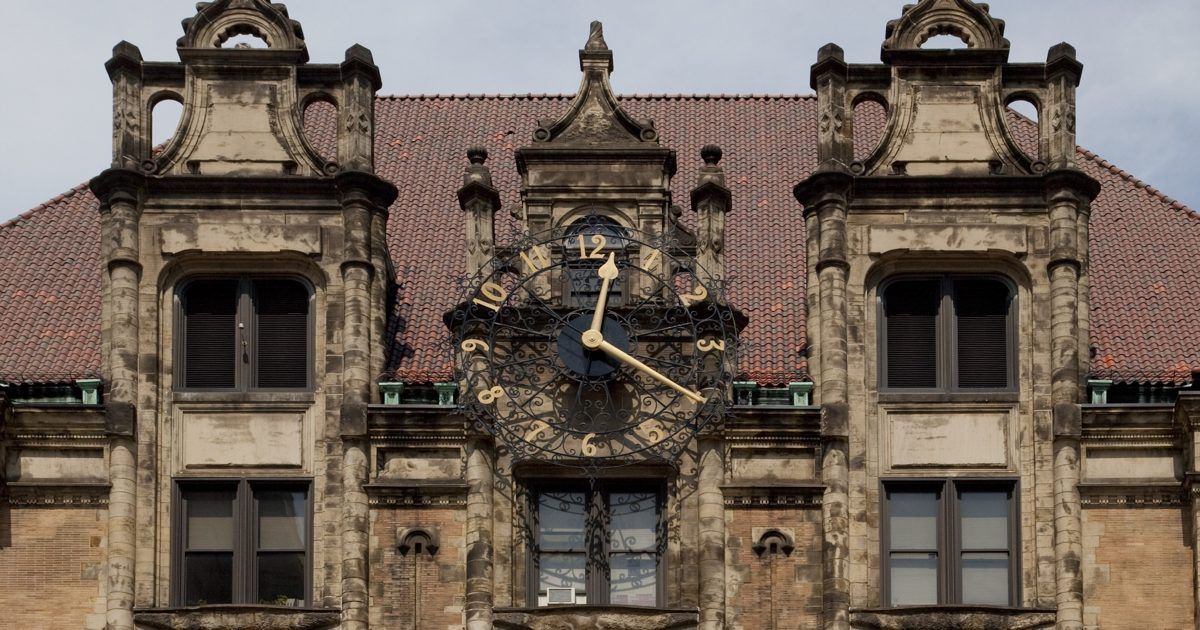
Is St. Louis City Hall still in use?
Yes. St. Louis City Hall, at 1200 Market St., has housed city government since 1898. The Board of Aldermen, the Recorder of Deeds and the Collector of Revenue all work there, and the building is open to the public Monday through Friday, 8 a.m. to 5 p.m., with its main doors on Tucker Boulevard and Clark Avenue.
Keep reading ↓A boy was selling newspapers with a paper sack over his head, eyeholes cut out. The photographer who shot the Federal Building at Twelfth and Market on Nov. 28, 1939, wrote that down. St. Louis still calls that day Black Tuesday, when coal smoke, in the words of the Missouri Department of Natural Resources, “turned day into darkest night.” In another picture from that day, the state notes, the statue of Gen. Ulysses S. Grant is barely visible and St. Louis City Hall “cannot be seen at all.”
Under the smoke, the building was pink. It still is. The city’s own history page puts it in one sentence: “A poorly executed acid cleaning and years of exposure to coal smoke has left the original pink and orange exterior tarnished.” The ground story is dressed pink granite, the city’s preservation plan says, with yellow brick and sandstone above. So if it reads as a dull brown block through your windshield at the light on Market Street, that’s the smoke and the acid talking, not the stone.
The city went after that smoke. In February 1937 St. Louis passed a Smoke Ordinance and appointed Raymond R. Tucker, who had taught mechanical engineering, as its first smoke commissioner, with a staff of 13 inspectors; Tucker later served three terms as mayor. The color comes back best after dark. In March 2021 the city switched on about 120 LED fixtures, donated by the Gateway Foundation and valued at $400,000, that light all four sides. The facade has three kinds of stone, says Randy Burkett, whose firm designed the lighting: yellow brick, sandstone and pink granite at the base. Drive down Market some night and look at the base for yourself.
Is St. Louis City Hall still in use?
Yes. St. Louis City Hall, at 1200 Market St., has housed city government since 1898. The Board of Aldermen, the Recorder of Deeds and the Collector of Revenue all work there, and the building is open to the public Monday through Friday, 8 a.m. to 5 p.m., with its main doors on Tucker Boulevard and Clark Avenue.
Getting in is simple. The front of City Hall faces Tucker Boulevard, which the city still labels 12th Street on its own visitor page, even though the official address is on Market. The main pedestrian doors are on Tucker and on Clark Avenue. The accessible entrance is at the tunnel on the west side of the building, near Market. For parking, the City Hall Lot is reached from Clark, Tucker and Market, there’s more at the Kiel Center Garage, and metered spots line Tucker and Market. The main number is 314-622-4800. City Hall keeps the city’s holiday schedule, so check the city’s Visiting City Hall page before you make a special trip.
It has never been anything but a working building. Any weekday, people come through its doors with a tax bill to pay or a marriage license to pick up, and it still runs on the room numbers. The Board of Aldermen is in Room 230, the Recorder of Deeds in Room 128 and the Collector of Revenue in Room 110, according to the city’s department pages. Most cashier windows open at 8:30 a.m. and close at 4 p.m., so if you’re paying something, get there before the windows close, not before the doors do.
One office breaks the weekday rule. The Recorder’s birth, death and marriage counter keeps longer hours, 8 a.m. to 6 p.m. on weekdays and 9 a.m. to 1 p.m. on Saturday, the Recorder’s page says. If weekdays don’t work for a marriage license or a birth certificate, Saturday morning does.
The rooms changed hands once, in a way you can still read in the floor plan. When the building was designed, St. Louis had a two-house government, a House of Delegates and a City Council, set up a lot like the Missouri Legislature. The City Charter adopted in 1914 eliminated the Council and turned the House of Delegates into the Board of Aldermen. The aldermen took over the old House of Delegates chamber and committee rooms, and the Council’s old room became the Board of Public Service chamber.
Why did St. Louis City Hall take 14 years to build?
Because nobody borrowed a dime for it. “No bond issue was passed to finance construction of the new City Hall,” the city’s history page says, and that explains the 14 years. The money came from general revenue and the sale of city property. Every year or two the council authorized an average of $110,000 to keep the crews going, and work crept forward a slice at a time.
The city had owned the ground for half a century by then. It bought the site from Thomas Smith on Dec. 1, 1840, for $25,000, part of a six-acre site, and it sat for 50 years before construction began. An ordinance passed on April 4, 1889, let a City Hall Commission advertise for bids, with the cost not to exceed $1 million. The commission picked George Richard Mann, of the firm Eckel & Mann in St. Joseph, out of 37 national entries. Mann titled his design “St. Louis 1892,” the year he obviously expected it to be done.
It took until 1904. Ground was broken on July 19, 1890, by Mayor Edward Noonan’s daughter Zoe, and the cornerstone went down on June 6, 1891. A Sept. 10, 1893, ordinance capped the total at $2 million. City officials couldn’t wait for a finished building: on April 11, 1898, Mayor Henry Ziegenhein led a ceremonial parade of city officials from the old building to their new offices, in a City Hall that still had no finished rotunda or grand staircase. Those came last, in 1904, designed by the St. Louis firm of Weber & Groves. On Nov. 5, 1904, Mayor Rolla Wells threw an open house for the people of St. Louis and declared the building complete. Final cost: $1,787,159.16. Our guide to the St. Louis World’s Fair covers what else from those years is still standing.

The city halls that came before, and the Barn
St. Louis had reasons to be careful. In the early years the town fathers met in private homes, banks and saloons, anywhere they could find a room. In 1827 the council spent $13,000 on a combination City Hall and market on the riverfront, on the Place D’Armes. It survived the 1849 fire that destroyed much of downtown and was razed the following year anyway.
The next one, built in 1851, was paid for with a bond issue. Fire took it in 1856. With no building of their own, city officials rented one of the wings of the Old Courthouse in St. Louis for about $1,000 a year. In 1872 the city put up a “temporary” three-story building on the block bounded by 11th, 12th, Market and Chestnut. It cost $70,000, everyone called it the Barn, and city government stayed in it until 1898. It wasn’t torn down until 1921.
So the one City Hall built on borrowed money burned. The one built a slice at a time out of general revenue is the one you can still walk into.
Who designed St. Louis City Hall to look like Paris?
Mann’s plan was French on purpose. The city describes it as “inspired by the Hotel de Ville or City Hall of Paris,” with ornamental dormer windows and former towers, and says it also recalled the Chateau de Chambord on the Loire. The city’s preservation plan calls it Renaissance Revival: an open rectangle around an interior light court, three finished street facades, and on Tucker a projecting central bay with paired entrances set back under arches, flanked by an arcade of granite columns. Stand across Tucker and you can trace it: the deep doorways, the columns, the steep tile roof broken up by dormers.
Then look closer at those dormers. The city calls them belvederes, and every side of the building has them. Each one has bare panels of limestone that were meant to be carved. They never were, “probably due to lack of funds,” the city says. A building paid for as it went simply ran out of pay before the carvers got to it, and the blank stone is still up there, waiting.
Critics forgave it. Even in its incomplete state, the city notes, City Hall was praised for its “splendid architectural composition” and called “an impressive period piece of craftsmanship.”
Pink granite seen, belvederes counted, stomach growling? Where to eat in downtown St. Louis
Where did City Hall’s towers go?
They came down, and the city can’t agree with itself on the year. Its preservation plan says several towers, “including a two-story clock tower,” were removed in 1934. Its city landmark page says several towers were removed “around 1938.” Either way, they never went back up. If the roofline over the Tucker doors looks like it’s missing something, it is.
The clock didn’t leave with them. The city’s lighting announcement says the new fixtures accent key features, including the entry portals and the clock on the Tucker Boulevard side, so look for it lit up at night.

Walk in the Tucker doors and look up
We couldn’t find a scheduled public tour. You don’t need one. It’s a public building, open weekdays from 8 a.m. to 5 p.m., and the best parts are right inside the main doors. Keep in mind it’s a working office: people are in line to pay bills and pick up records, so keep your voice down and stay out of their way.
Start with the rotunda, the piece finished last, in 1904. The preservation plan describes it as four stories tall, with a marble double staircase and open balconies at every floor. Stand at the bottom, listen to shoes on the marble stairs, and follow the balconies up with your eyes.
Then find the mural. Inside the main Tucker Boulevard entrance hangs “Front Street in 1840,” and the city’s history page points to it for a reason: it shows the 1827 City Hall and market on the riverfront, the one that dodged the 1849 fire and got torn down anyway.
Outside, walk the block. Count the blank belvedere panels. Find the spot over the Tucker doors where the towers stood. Then come back after dark, when every side is lit and the base shows its color.
Done craning your neck in the rotunda? Walk back out onto Tucker and pick a lunch spot from our guide to where to eat in downtown St. Louis before you head back to the lot.
If you’re the lunch counter, the coffee bar or the walking-tour guide a few blocks from Market and Tucker, the people leaving City Hall with a marriage license in hand are hungry customers standing on your sidewalk. Put your spot where they’re looking.
Next time you’re stopped at Market and Tucker, you’re the one who knows the brown building is pink and orange underneath, that it was paid for in cash a slice at a time, and that the carvers never came back for the dormers. Go on a weekday. Walk in through the Tucker doors. Look up. Then find more underrated places to visit in St. Louis for the rest of the afternoon, or, when you’re ready to leave downtown behind, try the small towns outside St. Louis.
Frequently asked questions
Who is the architect of St. Louis City Hall?
George Richard Mann, of the firm Eckel & Mann in St. Joseph, Missouri. The city’s City Hall Commission picked his design out of 37 national entries; he titled it “St. Louis 1892.” The rotunda, the Tucker Boulevard vestibule and the grand staircase, finished in 1904, were designed by the St. Louis firm of Weber & Groves.
Is City Hall open today in St. Louis?
On weekdays, yes. The city lists general hours of Monday through Friday, 8 a.m. to 5 p.m., and most cashiers open at 8:30 a.m. and close at 4 p.m. The city posts a holiday schedule of the days it observes. The Recorder of Deeds’ birth, death and marriage counter also opens Saturdays from 9 a.m. to 1 p.m. Call 314-622-4800 or check the city’s Visiting City Hall page before you go.
What is the history of St. Louis City Hall?
The city bought the site in 1840 for $25,000 and left it open for 50 years. Construction started on July 19, 1890, city officials moved in on April 11, 1898, before it was finished, and the building was declared complete on Nov. 5, 1904, at a final cost of $1,787,159.16. No bond issue paid for it, which is why it took 14 years. It became City Landmark No. 29 in 1971.
What are some of the most famous architecture in St. Louis?
Start with the city’s own landmark list. It opens with Eads Bridge at No. 1, the Old Courthouse at No. 2 and the Old Cathedral at No. 3, and the Wainwright Building is No. 7. City Hall is No. 29, a landmark since 1971. Our guide to historic sites in St. Louis covers more of them.
What is the oldest building in St. Louis, MO?
Not City Hall, which went up between 1890 and 1904. For something much older, walk to the Old Cathedral. Its parish history says the church was designed by Morton and Laveill and completed in 1834, and it sits at No. 3 on the city’s landmark list.

Written by a dedicated team of St. Louis locals who live, work, and play right here in the St. Louis metro. Founder Lane Forman and team are committed to building the region’s most trusted directory by verifying listings and connecting local businesses with loyal customers across Missouri and Illinois.