The Scotts Won Here First: Old Courthouse St. Louis, Free Ranger Tours and the Courtroom That Vanished
Revised November 14, 2026
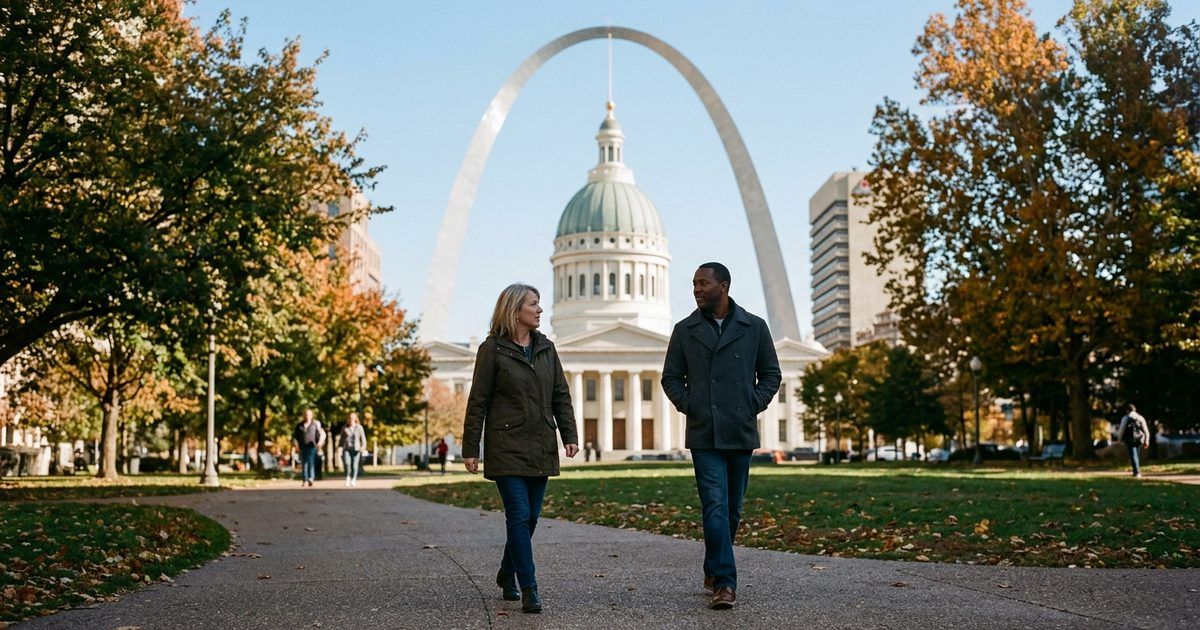
What is the significance of the Old Courthouse in St. Louis?
The Old Courthouse is where Dred and Harriet Scott sued for their freedom in 1846, and where a jury declared them free in 1850. Higher courts took that away, ending in the 1857 Supreme Court ruling that pushed the country toward civil war. Hundreds more freedom suits were filed here, and Virginia Minor’s fight for women’s votes began here.
Keep reading ↓Climb the east wing steps at Fourth and Market and you are standing where enslaved people were sold. The Park Service says it happened right there, to settle estates and property suits. Push through the door, cross the polished limestone of the rotunda, every slab at least 3.5 inches thick, and turn toward the west wing. On that first floor, on Jan. 12, 1850, a St. Louis jury decided that Dred Scott and his family should be free.
They won here. Two years later the Missouri Supreme Court took that away, and in 1857 the U.S. Supreme Court made the loss famous. Travel lists tend to file this building as the place where the case “was heard.” Snap the dome, move on. The verdict gets left on the steps.
You can’t stand in that courtroom, either. It’s gone. A construction flaw threatened its ceiling, so in 1855, while the Scotts’ case was still in the courts, a new east-west hallway was cut through the room, leaving two smaller courtrooms that could hold up the floor above, according to the National Park Service. The building kept the story. It lost the room.
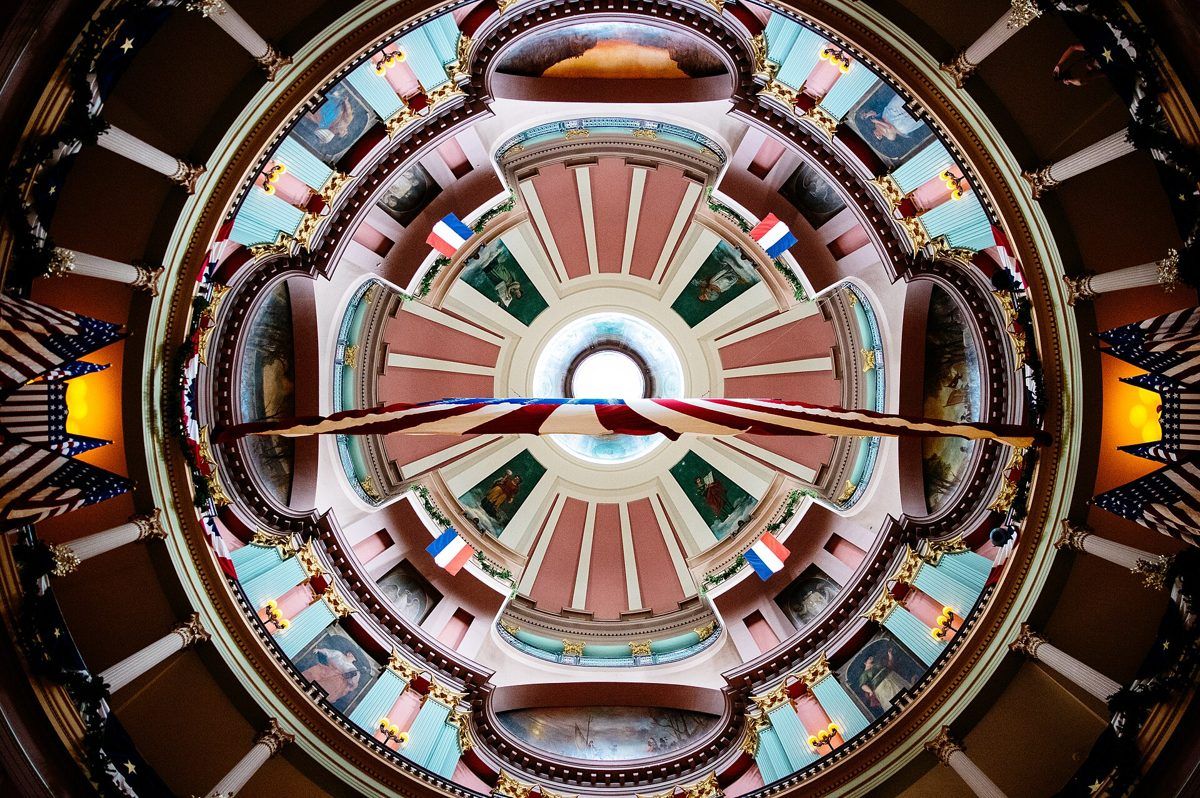
So stand in the rotunda instead and look up. Three tiers of balconies climb toward a dome 192 feet overhead, and the murals up there were painted by Carl Wimar while tuberculosis was killing him. He died soon after he finished. The building is downtown, it’s run by the National Park Service, and you can still walk in for free.
What is the significance of the Old Courthouse in St. Louis?
The Old Courthouse is where Dred and Harriet Scott sued for their freedom in 1846, and where a jury declared them free in 1850. Higher courts took that away, ending in the 1857 Supreme Court ruling that pushed the country toward civil war. Hundreds more freedom suits were filed here, and Virginia Minor’s fight for women’s votes began here.
The freedom suits. The Scotts were far from alone. Hundreds of enslaved people sued for their freedom in the Old Courthouse, which is why the Park Service lists it in its National Underground Railroad Network to Freedom as a place tied to legal challenges to slavery.
The city. Long before the Arch, this rotunda was where emigrants heading west on the Oregon and California trails met. Virginia Minor’s 1873 suit for women’s right to vote was argued here too, and like the Scotts’ case it reached the U.S. Supreme Court. The Missouri Historical Society counts four precedent-setting Supreme Court civil rights cases that began in St. Louis, possibly the most to reach the high court from any one place. When the courthouse opened in 1845, it was one of the largest public spaces in town. At 192 feet to the top of the dome, it was Missouri’s tallest habitable building from 1864 to 1894. The city gave it to the federal government in 1940, and today it belongs to Gateway Arch National Park.
Can you tour the Old Courthouse in St. Louis?
Yes, and it costs nothing. The National Park Service’s Old Courthouse page says the building is open daily from 9 a.m. to 5 p.m. and closed only on Thanksgiving, Christmas and New Year’s Day, with no admission fee and no tickets. Check that page before you go.
The 2:15 ranger tour. Be standing on that limestone, under the dome, a few minutes before 2:15. The free guided tour runs every day at 2:15 p.m. and covers the architecture, the building’s history and the court cases tied to it. No reservations. The Park Service says a tour can be canceled now and then when staff aren’t available, and it asks groups of more than 10 to call ahead at 314-655-1731 or 314-655-1636. Its Old Courthouse page now lists 877-982-1410 for group reservations, so try that number first. A school or club that wants a formal ranger program has to book at least 30 days out through the park’s group sales specialist at 314-923-3048.
On your own. Most visitors need about an hour, the Park Service says. The building reopened on May 3, 2025, after a $24.5 million renovation that ran from 2020 to 2025 and added an elevator, new heating and cooling, a new fire suppression system and four new galleries.
See You in Court sits in a recreated 1850s courtroom, and visitors can take part in mock trials there. Designed for Justice is about the architects, artists and craftsmen, with hands-on pieces that kids tend to love. Pathways to Freedom traces Black life in St. Louis from slavery onward, including the wealthy Black families of the 1800s known as the Colored Aristocracy. And Dred and Harriet Scott tells the family’s story. The park’s superintendent, Jeremy Sweat, told St. Louis Public Radio the old exhibit centered on the court case, and this one centers on the Scotts as people.
Upstairs, two historic courtrooms are restored and open to wander. Kids can work through the Junior Ranger challenges for a badge.
Getting in and parking. The address is 11 N. Fourth St. You can enter through the east or west wing, and both entrances have ramps. The park doesn’t run its own parking. Its preferred garage is Stadium East, at $10 for five hours if you prepay through the park’s parking program. Skip the prepay on a ballgame or big event day and you’ll pay event rates. It’s also one of the better free rainy-day stops downtown, and our list of indoor things to do in St. Louis has more for when the weather turns.

When was the Old Courthouse in St. Louis built?
Construction began in 1839 and wrapped up in 1862, 23 years in all. The cornerstone went down on Oct. 21, 1839, with newspapers from several cities, a handful of coins and the names of government officers sealed inside. The doors opened to the public in February 1845, long before the building was done. That unfinished courthouse is the one the Scotts walked into on April 6, 1846, to file their petitions.
The land came with a string attached. In 1816, Auguste Chouteau, one of the city’s founders, and Judge John B.C. Lucas donated the block to St. Louis County on the condition that it be “used forever” as the site of the county courthouse. Before that, official business bounced between a church, a tavern and a fort. The first courthouse on the block was a plain brick building in the Federal style, and the county outgrew it ten years after it opened. Architect Henry Singleton’s cross-shaped design, chosen in an 1838 competition, wrapped a new building around it, with the old courthouse serving as the east wing until it was torn down and replaced starting in 1851.
The dome almost didn’t happen. The first dome was a smaller classical one. In the rebuilding that began in the 1850s, architect William Rumbold designed a far bigger one in wrought and cast iron with a copper skin, modeled on St. Peter’s Basilica in Rome. At the same moment, the federal government was raising a dome modeled on the same church over the U.S. Capitol. Critics in St. Louis were sure Rumbold’s would be too heavy for the building to carry. He built a test model to prove it would stand. He also patented the lightweight iron skeleton he used, and the Park Service calls his dome one of the first of its type, a design that later showed up on the Capitol and other statehouses. It was finished in 1862 and rises 192 feet.
The paintings under it. Carl Wimar painted the oval murals inside the dome, called lunettes, in 1862, showing four turning points in St. Louis history. He was very sick with tuberculosis while he worked and died soon after he finished. Italian artist Ettore Miragoli painted the other murals in 1880. All of it cost about $1.2 million, which the Park Service puts at around $44 million in today’s money.
What was the most famous court case in St. Louis?
Dred Scott v. Sandford, and it began in this building. Dred and Harriet Scott sued for their freedom here in 1846. Eleven years later, on March 6, 1857, the U.S. Supreme Court ruled that Black Americans, enslaved or free, were not citizens and had no right to sue in federal court, and that the Missouri Compromise’s ban on slavery in the territories was void. The Park Service says the ruling hastened the Civil War.
Who they were. Dred Scott was born into slavery in Virginia around 1800, by the Park Service’s estimate, and came to St. Louis in 1830 with the Blow family, who soon sold him. His buyer, Dr. John Emerson, an Army surgeon at Jefferson Barracks, took him to posts in Illinois and at Fort Snelling, in what is now Minnesota, where slavery was barred. Harriet Robinson, also enslaved, married Dred at Fort Snelling. Their first daughter, Eliza, was born on a steamboat on the Mississippi, and a second, Lizzie, came later. After Emerson died in 1843, his widow, Irene, hired the family out to other households and kept most of their wages. Harriet probably did laundry, cleaned houses and cared for children.
Why they had a case. Missouri courts had long followed a rule known as “once free, always free.” If an enslaver kept a person for a long stretch on free soil, that person could claim freedom back in Missouri. The Scotts had lived on free soil for years. On April 6, 1846, they filed separate petitions, one for Dred and one for Harriet. Under the law of the day, the Park Service notes, the court wasn’t deciding whether people have a right to be free. It was deciding a property question.
The trials here. The first trial, on June 30, 1847, went against them on a technicality. The one witness who could show that Irene Emerson held them in slavery was ruled to be offering hearsay. Judge Alexander Hamilton granted a new trial. Then a citywide fire in May 1849 and a cholera outbreak that summer pushed the retrial to Jan. 12, 1850. With new testimony and Hamilton presiding again, the jury found for the Scotts. They were free.
How it was taken back. Irene Emerson appealed. In 1852 the Missouri Supreme Court reversed the verdict and broke with its own past decisions, declaring that “times now are not as they were” when the earlier cases were decided. In 1854 the Scotts tried federal court, suing Irene Emerson’s brother, John F.A. Sanford. That trial wasn’t held here. It was heard a few blocks away in the Papin Building, and the family lost again. The appeal went to Washington as Dred Scott v. Sandford.
The ending most lists leave out. Chief Justice Roger B. Taney wrote that the framers of the Constitution had believed Black people had “no rights which the white man was bound to respect.” Less than three months later, on May 26, 1857, Dred and Harriet Scott went back before the St. Louis Circuit Court and were freed. By then Irene Emerson had married Calvin Chaffee, an abolitionist who had won a seat in Congress. Ownership of the family passed to Taylor Blow, from the family that had first brought Dred to St. Louis, because Missouri law let only a citizen of the state free someone there. The judge who approved the papers was Alexander Hamilton, the same judge who had first heard their case.
Freedom came late. Dred Scott took a job as a porter at Barnum’s Hotel at Second and Walnut streets, where he became something of a celebrity, and he died of tuberculosis on Sept. 17, 1858. Harriet lived free in St. Louis for 19 more years, working as a laundress, until her death on June 17, 1876.
The other case that went to Washington. On Oct. 15, 1872, Virginia Minor, who had launched the woman suffrage movement in Missouri, tried to register to vote and was refused by registrar Reese Happersett because she was a woman. Married women couldn’t sue on their own in Missouri until 1889, so her husband, lawyer Francis Minor, brought the suit with her. There was no jury and no trial. Both sides argued on paper at a hearing on Feb. 3, 1873, in Circuit Court No. 5, which is now the park’s library, Room 212. The Missouri Supreme Court heard her appeal in its chambers in the courthouse’s south wing. In 1875 a unanimous U.S. Supreme Court ruled against her, holding that the Constitution “does not confer the right of suffrage upon anyone.”
Out of the rotunda and hungry? Where to eat in downtown St. Louis
Were enslaved people sold at the Old Courthouse?
Yes, sometimes. Those are the east wing steps from the top of this page: the Park Service says enslaved people were sold there to settle estates and property suits, though it was not a regular business there. The same building heard hundreds of freedom suits. People were sold on its steps and sued for their freedom in its courtrooms, and you can’t understand the place without holding both.
How a freedom suit worked. A Missouri law from 1824, built on an 1807 territorial statute, let anyone held in bondage petition the local court for permission to sue. The petition needed a legal basis, and most fell into three kinds. The person had been taken to live where slavery was illegal. Or they’d been freed by a will or a purchase and were being held anyway. Or they could show their mother had not been legally enslaved. The burden of proof sat on the person suing: papers, witnesses, all of it.
The odds got worse. More than 300 enslaved people in St. Louis sued for their freedom between 1812 and 1865, the Park Service says, and fewer than half won. By the time the Scotts filed, the courts had turned colder. The Missouri State Archives counts 25 freedom suits filed in the St. Louis Circuit Court from 1844 to 1846, and only one ended in freedom. Lucy Delaney was 17 when she sued for her freedom at the Old Courthouse in 1844. Every one of those suits has been scanned and can be searched through the St. Louis Circuit Court Historical Records Project.
Free, but licensed. Winning didn’t end it. Under an 1835 Missouri law, a free Black person had to carry a license proving it at all times or risk jail. Free Black Missourians weren’t considered citizens, and after 1847 their children couldn’t attend school. Original freedom bonds tied to many of those licenses are preserved today at the Missouri Historical Society.
When did St. Louis stop using the Old Courthouse?
In 1930. That year the courts moved a few blocks west into a new building, and the Old Courthouse’s run as a working courthouse ended after about 85 years. A bond for the new courthouse passed in 1923 and ground was broken in 1926. Since everyone knew the old building was on its way out, maintenance stopped and it began to decay.
The odd decade. For ten years after that, the building held an art school, a workshop where a religious group fixed up toys for children in need, and offices for two justices of the peace and their constables.
The heirs who wanted it back. Remember the 1816 condition, “used forever” as the courthouse site? Descendants of the Chouteau and Lucas families did. Once the courts left, they sued in the Missouri Supreme Court, arguing that the property should revert to them. They lost. In 1940 the City of St. Louis gave the building to the federal government, and it became part of Jefferson National Expansion Memorial, which President Franklin D. Roosevelt had designated in 1935. The Park Service put on a new roof in 1941. The memorial was renamed Gateway Arch National Park in 2018.
The long closure. The building closed in 2020, first for the pandemic and then for the renovation, the final piece of the $380 million CityArchRiver project around the riverfront park. It reopened on May 3, 2025, with a ribbon cutting and a Journey to Justice festival in nearby Kiener Plaza, where Lynne Jackson, the Scotts’ great-great-granddaughter, was among the speakers. If an old listing or forum post tells you the courthouse is closed for renovation, it’s out of date.
What should you look for at the Old Courthouse?
The floor under your feet. The rotunda floor is original polished limestone, every slab at least 3.5 inches thick. Stand in the middle and look up through three tiers of balconies. Stone pillars hold up the first. The two above it rest on white oak columns.
The two old courtrooms. Both are on the second floor. Circuit Courtroom No. 4 in the west wing is the older of the pair, set to look the way it did in the mid-1800s. No. 13, in the east wing, is restored to about 1910. Neither is the room where the Scotts won, since that one no longer exists, but No. 4 sits in the same wing, one floor up.
The turtles on the fence. Look closely at the iron fence around the lawn. The wrought iron turtles worked into it are a nod to James Quigley, a 19th-century caretaker who put turtles in the courthouse fountain every summer. The fence and the three-tiered green fountain are both reconstructions. The bronze sundial in the southeast courtyard is the only original landscape feature still standing.
The statue. The life-size bronze of Dred and Harriet Scott on the east side of the courthouse was dedicated on June 8, 2012, by the Dred Scott Heritage Foundation, the Park Service and St. Louis sculptor Harry Weber. The Regional Arts Commission says it was the first statue of the couple anywhere in the world.
The small stuff outside. A plaque on the east sidewalk, placed in 1947, marks where Joseph Pulitzer bought the St. Louis Dispatch in 1878. The Corinthian and Ionic capitals in the northeast and northwest courtyards were salvaged from a building torn down to make way for the national park.
The view from Illinois. The courthouse and the park were laid out on a single east-west line. Cross the river to Malcolm W. Martin Memorial Park and you’ll find the Old Courthouse framed between the Arch’s legs, the shot photographers cross the river for.
Where else in St. Louis can you follow Dred and Harriet Scott?
The Freedom Suits Memorial. On the east plaza of the Civil Courts Building, at Market and Tucker a few blocks west, sculptor Preston Jackson’s memorial was unveiled on June 20, 2022, for the hundreds of people who went to court in St. Louis to sue for their freedom. Pair it with the courthouse and you’ve seen both ends of the story in one morning.
Calvary Cemetery. Dred Scott was buried in St. Louis in 1858. His grave was moved to Calvary Cemetery in north St. Louis in the 1860s, and it got a marker in 1957, a century after the decision, thanks to the Rev. Edward Dowling.
Greenwood Cemetery. Harriet Scott is buried at Greenwood, one of the first Black burial grounds in the St. Louis area. Our guide to historic sites in St. Louis has the addresses for both cemeteries and the rest of the region’s Underground Railroad stops.
Next time somebody calls it the place where Dred Scott lost, you’re the one who knows the Scotts won here first, that their courtroom was cut in two before the case was over, and that the judge who heard them in 1847 approved their freedom ten years later. Get there by 2. Catch the 2:15 tour. Then walk west to the memorial. When you’ve done downtown, our guide to small towns outside St. Louis has day trips farther out, and our list of underrated places to visit in St. Louis has more afternoons like this one.
Done with the galleries and ready to eat? Our guide to where to eat in downtown St. Louis groups downtown spots by walkable pocket, so you can eat within a few blocks of the dome.
If you’re the kitchen, the coffee bar or the walking-tour guide within a few blocks of Fourth and Market, the people spilling out of the 2:15 ranger tour are hungry customers checking their phones on the courthouse steps. List your spot with us so they find you before they walk back to the garage.
Up Market Street, St. Louis City Hall hides its own surprise: years of coal smoke and a poorly executed acid cleaning tarnished its original pink and orange exterior.
Frequently asked questions
Is the Old Courthouse in St. Louis free?
Yes. There’s no entrance fee and no ticket, and the daily 2:15 ranger tour is free too. Your only cost is parking, about $10 for five hours at the park’s preferred garage if you prepay. The Old Courthouse Shop even sells the annual national parks pass.
Can you go inside the Old Courthouse in St. Louis?
Yes. It reopened on May 3, 2025, after a renovation that kept it closed from 2020, and it’s open daily from 9 a.m. to 5 p.m. except Thanksgiving, Christmas and New Year’s Day. Inside are four galleries, two restored courtrooms and the rotunda, with a new elevator.
What is the Old Courthouse in St. Louis?
It’s the city’s former courthouse at 11 N. Fourth St., built from 1839 to 1862 and used by the courts until 1930. Today it’s a free museum run by the National Park Service as part of Gateway Arch National Park, best known as the place where Dred and Harriet Scott sued for their freedom.
Was Dred Scott ever freed?
Yes. On May 26, 1857, less than three months after the Supreme Court ruled against him, Dred Scott, Harriet and their daughters were freed in the St. Louis Circuit Court, with Taylor Blow signing the papers and Judge Alexander Hamilton approving them. Dred died of tuberculosis on Sept. 17, 1858. Harriet lived free until 1876.
Are there any descendants of Dred Scott?
Yes. Lynne M. Jackson, the great-great-granddaughter of Dred and Harriet Scott, founded the Dred Scott Heritage Foundation, which helped dedicate the couple’s statue at the Old Courthouse in 2012. She spoke at the courthouse’s reopening in May 2025 and told St. Louis Public Radio that a permanent gallery for the Scotts was a huge honor.
What did Dred Scott v. Sandford do to the Missouri Compromise?
It declared it void. Chief Justice Roger B. Taney ruled that Congress had no power to ban slavery in the territories, so the 1820 Missouri Compromise’s ban was unconstitutional, and Dred Scott’s years at Fort Snelling had never made him free. The ruling deepened the national split over slavery in the years before the Civil War.
What is the oldest building in St. Louis?
Not the Old Courthouse, which wasn’t started until 1839. Inside the city limits, the building usually named is the Old Cathedral, the Basilica of St. Louis, King of France, built from 1831 to 1834 a short walk southeast of the courthouse. Our roundup of the oldest buildings in St. Louis covers older survivors in Florissant and St. Louis County too.
Is the Old Courthouse the same as the Civil Courts Building?
No. The Civil Courts Building, at 10 N. Tucker Blvd., is the courthouse that replaced it in 1930, the tall one with the stepped pyramid top modeled on the ancient Mausoleum at Halicarnassus. It’s still a working courthouse for the 22nd Judicial Circuit, and in December 2024 the city renamed it the Clyde S. Cahill Courts Building, after one of St. Louis’s first Black judges.

Written by a dedicated team of St. Louis locals who live, work, and play right here in the St. Louis metro. Founder Lane Forman and team are committed to building the region’s most trusted directory by verifying listings and connecting local businesses with loyal customers across Missouri and Illinois.