St. Louis Downtown Development Incentives Explained
Revised August 10, 2026
What development incentives does St. Louis offer downtown?
St. Louis stacks deep redevelopment incentives: the $55M downtown share of its $255M Rams settlement, a 25% Missouri plus 20% federal historic tax credit (together covering close to 45% of a rehab), Opportunity Zones, tax-increment financing, and abatement. Paired with buildings selling for a fraction of replacement cost, it’s one of the deepest incentive stacks of any U.S. downtown.
Keep reading ↓Imagine buying a grand old building for a fraction of its value, and then having the government hand you back nearly half the cost of fixing it up. In downtown St. Louis in 2026, that isn’t a fantasy — it’s roughly how the math works. Between long-standing tax credits and a fresh wave of city money, St. Louis has assembled one of the most aggressive redevelopment-incentive stacks of any major American downtown.
This is the companion money-and-mechanics guide to our broader case that downtown St. Louis is ripe for development. Here we get specific: exactly what the widely-reported $55 million is, the tax-credit engine that makes rehabs pencil out, the other tools stacked on top, and the honest caveats every developer should keep in mind. If you build, invest, or just want to understand why the smart money is starting to look here, this is the nuts and bolts.
Bookmark this — incentive programs change, and we keep it current. Confirm the latest details with the city before you commit capital.
What is the $55 million for downtown St. Louis?
Let’s be precise, because the number gets thrown around loosely. The $55 million is not a new tax or a mystery fund. It’s the downtown share of a $255 million spending plan the Board of Aldermen passed on July 2, 2026 — the city’s cut of the legal settlement it won when the Rams NFL franchise left for Los Angeles (STLPR). Unveiled by Mayor Cara Spencer and Board President Megan Green, the full plan spreads across the whole city; the downtown slice breaks down like this:
| Downtown allocation | Amount |
|---|---|
| Capital projects & acquiring vacant buildings | $15 million |
| Riverfront economic development | $15 million |
| Downtown infrastructure | $15 million |
| Retail & restaurant incentives | $7.5 million |
| Public-private partnership / large-event fund | $2.5 million |
That $15 million for acquiring vacant buildings is aimed at exactly the kind of stuck, high-profile properties that have dragged downtown down — the long-empty Railway Exchange Building has been named as a target. The idea is for the city to take control of dead assets and hand them to developers who will actually revive them. One important honest note: like every public commitment, this $55 million is current as of 2026 and subject to the usual political process. City and state incentives can be reshaped, delayed, or trimmed under budget or political pressure — so treat it as a strong signal of intent backed by a passed bill, not an ironclad guarantee.
It’s worth seeing the $55 million in context, too: it’s one slice of a citywide plan. The larger $255 million package directs its biggest share — roughly $120 million — toward North St. Louis, including recovery from a 2025 tornado, plus about $70 million for infrastructure across the city. Downtown’s $55 million is meaningful, but it’s a targeted bet inside a broader effort to stabilize a shrinking city, not a downtown-only windfall. That’s another reason private capital, not just public dollars, will ultimately decide how far downtown’s comeback goes — the city money is a spark, not the whole fire.
The real engine: historic tax credits
The city money grabs headlines, but the workhorse that actually makes downtown rehabs viable is older and bigger: historic tax credits. Two of them stack:
- The Missouri Historic Tax Credit returns 25% of the qualified cost of rehabbing a certified historic building (Missouri State Parks / SHPO).
- The federal Historic Tax Credit returns another 20% (via the National Park Service).
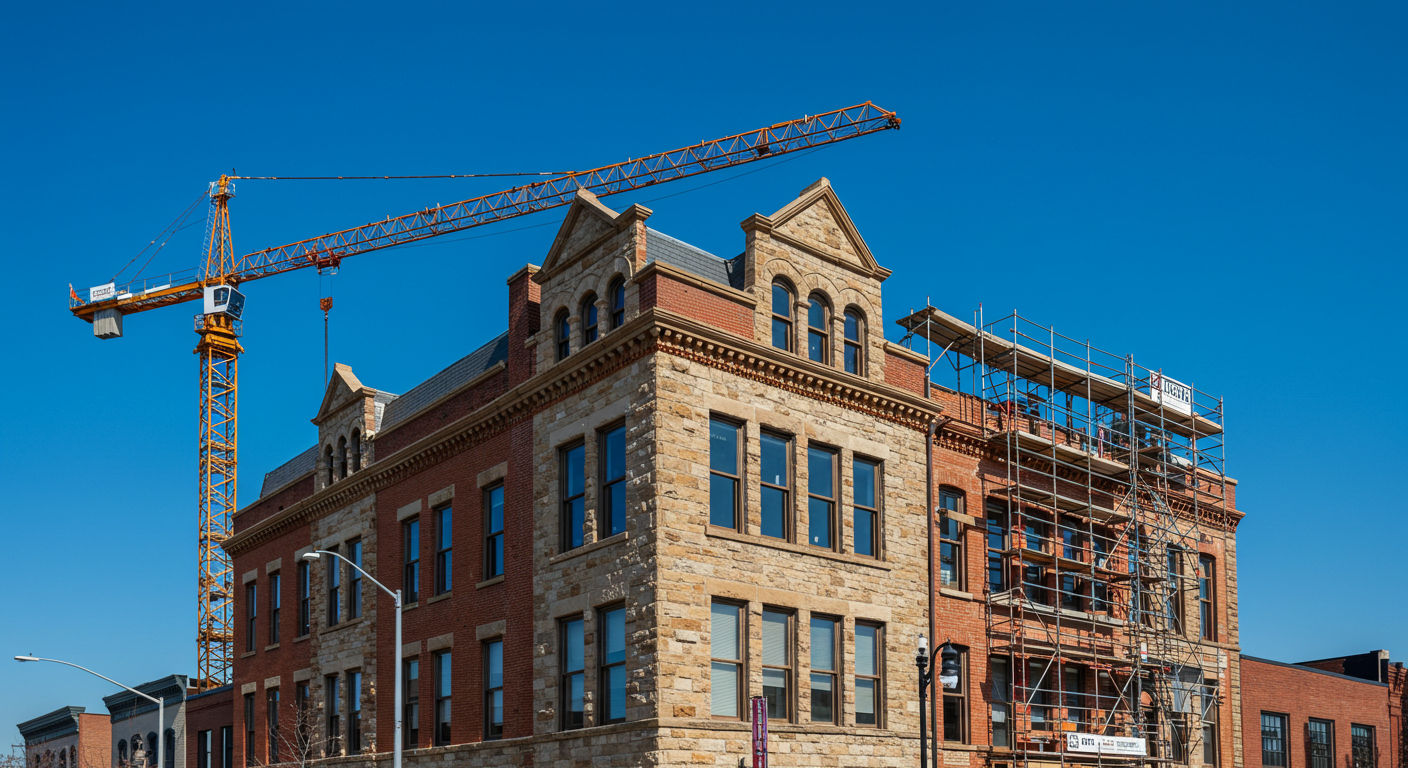
Stacked, they can offset close to 45% of a rehabilitation’s cost. Here’s why that matters: a tax credit — a dollar-for-dollar reduction of taxes owed, and often sellable to investors for cash — is far more powerful than a deduction. When nearly half your renovation budget comes back, a project that would lose money at full cost suddenly turns a profit. That single mechanism is what turned dozens of derelict downtown warehouses into the occupied Washington Avenue loft district between 1998 and 2008 — and it’s still on the books, ready to do it again for today’s empty office towers.
Here’s the math on a real scale. Say a developer buys a vacant historic office building and budgets $20 million to rehab it into apartments. The 25% state and 20% federal historic credits together can return close to $9 million of that — credits the developer can sell to investors for upfront cash to fund the work. Layer in an Opportunity Zone for the equity and tax abatement on the finished building, and a deal that looked impossible at $20 million out-of-pocket becomes one that actually clears. That gap — between the sticker cost and the after-incentive cost — is the entire reason a 100-year-old building gets a second life instead of a wrecking ball.
The new frontier: office-to-residential conversion
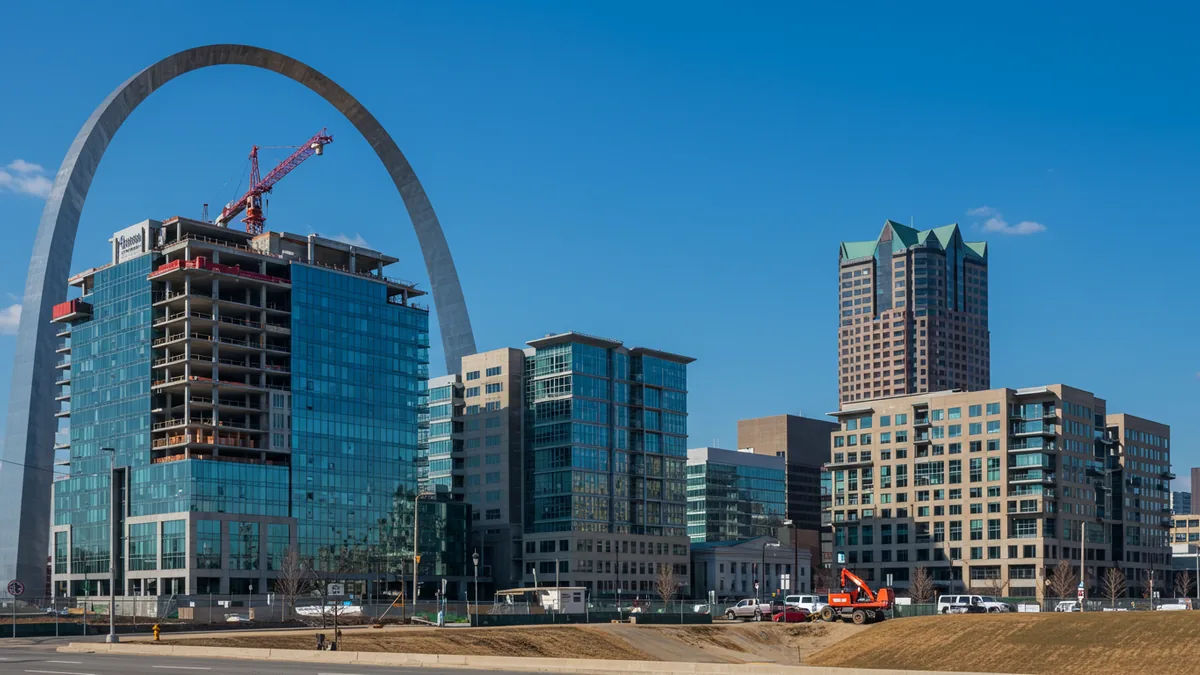
The specific challenge in 2026 is downtown’s glut of empty office space — vacancy hit 31.7%, the highest since 1999. The national fix is office-to-residential conversion: gutting an obsolete office tower and rebuilding it as apartments, which downtowns desperately need. Missouri moved in 2026 to sweeten this specifically, advancing new downtown “innovation zone” incentives aimed at conversions (STLPR). The exact terms and timing of the state’s conversion incentives have been in flux — some pieces are phasing in, and at least one project (the AT&T Tower) paused waiting on the details — so confirm the current program before you underwrite a deal. But the direction is unmistakable: both the city and the state are steering money toward turning empty desks into front doors.
The rest of the stack: OZs, TIF, and abatement
Beyond historic credits, downtown developers can layer several more tools. They’re alphabet soup, so here’s each in plain English:
- Opportunity Zones (OZs) — a federal program where investors who put capital gains into projects in designated lower-income areas (much of downtown qualifies) can defer and reduce the taxes on those gains. It rewards patient money that stays invested.
- Tax Increment Financing (TIF) — the city lets a project use the future increase in tax revenue it generates to help pay for its own upfront costs. The bet is that a rebuilt building throws off far more tax than the empty one it replaced.
- Property-tax abatement (Chapter 353 and similar) — a temporary freeze or reduction on property taxes for a redeveloped building, so an owner isn’t punished with a huge tax jump the moment they improve it.
Used together — historic credits plus an OZ plus abatement, say — these programs can dramatically change a project’s return. That’s the whole point: downtown’s buildings are cheap and the public sector is willing to co-invest in fixing them, a combination that’s rare in a major U.S. city.
What the money is actually targeting
The incentives aren’t abstract — they’re pointed at specific problems downtown:
- Stuck landmark buildings: the vacant Railway Exchange and the enormous, empty AT&T Tower — Missouri’s largest building, which sold for about $3.6 million after being worth $205 million in 2006 — are exactly the assets the acquisition money and conversion incentives aim to unstick.
- The riverfront: $15 million backs riverfront economic development, alongside the privately-led $670 million redevelopment replacing the demolished Millennium Hotel near the Arch.
- Street life: the $7.5 million in retail and restaurant incentives targets the chicken-and-egg problem directly — you need shops and dining to attract residents, and the money is meant to help the first movers open.
How a developer actually taps this
The high-level path looks like this: identify a building (ideally one already on, or eligible for, the National Register of Historic Places, which unlocks the historic credits), work with the city’s development arm (the St. Louis Development Corporation) and the State Historic Preservation Office on the applications, and stack the programs that fit — historic credits for the rehab, an OZ for the equity, abatement or TIF for the ongoing costs. It’s paperwork-heavy and slow, and most developers use consultants who specialize in the credits. But the payoff is a project that simply wouldn’t exist at market math — which is the entire reason St. Louis’s historic core is even convertible.
On timing, set realistic expectations: a historic-tax-credit deal isn’t a weekend flip. Getting a building certified, lining up the credit financing, and completing a full rehab commonly runs a year or more from purchase to occupancy, and the credit cash flows as the project hits milestones rather than on day one. That’s exactly why the low purchase prices matter so much — they give a project the cushion to absorb a long, complex timeline and still pencil out. Patience is part of the price of admission, and it’s priced in.
Nothing to do with tax credits — Clifton Heights dinner options, right this way.
For small businesses, not just developers
It’s easy to read all this as a game for people who buy skyscrapers. It isn’t. The $7.5 million in retail and restaurant incentives in the city’s downtown plan is aimed squarely at small operators — the coffee shop, the boutique, the neighborhood restaurant — because a downtown revives on street life, and street life comes from independent businesses, not office leases. Pair those incentives with downtown’s unusually cheap commercial rents, and the barrier to opening a storefront here is lower than in almost any comparable big-city core.
There’s a real first-mover advantage in it, too. The businesses that open before a district fills in are the ones that become its anchors — the spot everyone already knows by the time the new residents arrive. In a downtown with thousands of apartments in the conversion pipeline and a city actively subsidizing the first wave of retail, an entrepreneur with a good concept and some nerve has a genuine shot at planting a flag early and cheaply. That’s a very different proposition than fighting for overpriced space in a market that’s already peaked.
The bottom line for anyone building, investing, or opening a business: St. Louis has stacked cheap real estate, deep public incentives, and active political will into one of the more compelling redevelopment setups in the country — and it’s still early enough that being first actually pays.
This isn’t theoretical: the buildings already coming back
The incentive stack isn’t a promise on paper — it’s already producing occupied buildings, and it has a track record.
- The Washington Avenue loft boom of 1998–2008 ran on these exact credits. Along the lower stretch of Washington Avenue alone, developers claimed roughly $82.9 million in historic tax credits against about $332 million in total rehab costs — more than $100 million of private investment poured into buildings everyone had written off, creating a living neighborhood where there had been empty warehouses.
- Today, the Butler Brothers building has reopened as “The Victor,” a 384-unit apartment conversion in the Downtown West neighborhood.
- The Jefferson Arms — vacant for 19 years — is finishing a roughly $104 million conversion into apartments, a hotel, and retail.
These are leased buildings with residents and businesses inside them, all made possible by the same tools now aimed at downtown’s empty office towers. The model is proven; the open question is only how fast it scales.
How St. Louis stacks up against other cities
What makes St. Louis unusual isn’t any single program — it’s the depth of the whole stack. Plenty of cities offer the 20% federal historic credit, because it’s national. Far fewer add a 25% state credit on top; Missouri’s is among the most generous historic-preservation credits in the country. Combine that with Opportunity Zones covering much of downtown, tax abatement, TIF, and now fresh city money and state conversion incentives, and the total subsidy available on a St. Louis rehab runs deeper than in most major markets. Meanwhile the buildings themselves cost a fraction of comparable historic stock in Chicago, Denver, or Nashville. Cheap real estate paired with a deep incentive stack is a genuinely uncommon combination — and it’s the core of the St. Louis pitch.
Who should be paying attention
This isn’t only a game for billion-dollar developers. Several different players stand to gain:
- Developers and investors who can navigate the credits and take on a full building — the obvious audience.
- Out-of-state and coastal investors priced out of their own markets, who can buy far more building per dollar here and let the incentive stack carry much of the cost.
- Local entrepreneurs and small businesses — the retail and restaurant incentives, plus cheap downtown space, lower the bar to opening a storefront in a district that badly needs first movers.
- Owner-occupants and small landlords who can rehab a single historic building and still tap the credits, not just the big syndicated deals.
If any of that describes you, the combination of low prices and deep incentives is worth a serious look before the wider market catches on. The best deals in a turnaround happen before the turnaround is obvious.
The honest caveats
None of this is free money, and we’re not going to pretend otherwise:
- Incentives can change. The $55 million and the state conversion credits are subject to political and budget pressure. Programs get capped, delayed, or altered. Build your model with a margin.
- Projects stall. The AT&T Tower’s conversion paused waiting on incentives — proof that even a marquee deal can hang on a single program’s timing.
- Credits are complex and take time. Historic-tax-credit deals involve certification, syndication, and long timelines; the cash doesn’t arrive on day one.
- Demand is still early. Incentives lower your cost, but downtown’s residential and retail demand is still building. This rewards conviction, not a quick flip — you may be buying into a district a year or two ahead of the crowd.
- Not every building is savable. Some vacant structures are too far gone, contaminated, or structurally compromised to rehab economically. The incentives help, but they can’t rescue a building past the point of no return — due diligence on the physical asset matters as much as the incentive math.
Weigh all that, and the picture is still unusually favorable: cheap buildings, a deep incentive stack, and a city actively trying to say yes. For the fuller opportunity, see our guide to why downtown St. Louis is ripe for development, and for the numbers behind it, why St. Louis real estate is so affordable.
Exploring a St. Louis project or investment? Find local contractors, architects, and services on the St Louis Near Me Directory.
Already building in St. Louis? List your business so partners and clients can find you.
Frequently Asked Questions
What is the $55 million for downtown St. Louis?
It’s the downtown share of a $255 million spending plan the Board of Aldermen passed in July 2026 — the city’s cut of the Rams relocation settlement. The downtown $55 million funds vacant-building acquisition ($15M), the riverfront ($15M), infrastructure ($15M), retail and restaurant incentives ($7.5M), and a public-private events fund ($2.5M).
Where is the St. Louis Rams settlement money going?
The full $255 million plan spreads across the city: roughly $120 million toward North St. Louis recovery, about $70 million for infrastructure, $55 million for downtown, and around $10 million for vacant-property reduction. It stems from the legal settlement St. Louis won after the Rams left for Los Angeles.
What tax credits are available for rehabbing historic buildings in Missouri?
Two stack together: Missouri’s state Historic Tax Credit covers 25% of qualified rehabilitation costs on a certified historic building, and the federal Historic Tax Credit covers another 20%. Combined, they can offset close to 45% of a rehab — the financial engine behind most downtown St. Louis conversions.
What is an Opportunity Zone?
An Opportunity Zone is a federally designated lower-income area where investors who reinvest capital gains into local projects can defer and reduce the taxes owed on those gains. Much of downtown St. Louis qualifies, so it’s a common layer developers stack on top of historic tax credits to improve a project’s returns.
What is Tax Increment Financing (TIF) in St. Louis?
TIF lets a redevelopment project use the future increase in tax revenue it generates to help pay its upfront costs. The reasoning: a rebuilt, occupied building produces far more tax revenue than the vacant one it replaced, so the city captures that growth to help finance the improvement.
Is St. Louis offering incentives to developers?
Yes, and aggressively. Beyond the $55 million in Rams-settlement downtown money, developers can stack the 25% state and 20% federal historic tax credits, Opportunity Zone benefits, tax abatement, and emerging office-to-residential conversion incentives. It’s one of the deeper redevelopment-incentive stacks of any major U.S. downtown.
What is happening with the Railway Exchange Building?
The long-vacant Railway Exchange, a massive historic downtown building, has been named a target of the city’s $15 million vacant-building acquisition money. The city has moved to take control of it so a developer can revive it, though as of 2026 no developer had been finalized. It’s a test case for the whole strategy.
Can I convert a St. Louis office building into apartments?
That’s exactly the play the city and state are encouraging. Office-to-residential conversion turns empty office towers — downtown vacancy is 31.7% — into needed housing, supported by historic tax credits and emerging state conversion incentives. Terms and timing have been evolving, so confirm the current programs before underwriting a conversion.
Will St. Louis’s development incentives last?
The historic tax credits are long-standing and stable, but the newer money — the $55 million and state conversion incentives — is subject to political and budget pressure, and can be capped, delayed, or altered. Treat the passed programs as strong signals of intent, build a margin into your model, and confirm current terms with the city.
Why is downtown St. Louis a good place to invest?
The combination is rare: historic buildings selling for a fraction of replacement cost, an incentive stack that can cover close to half a rehab, fresh public money, and a city actively trying to attract developers — all in a metro with below-average costs and rising job growth. The catch is that demand is still early-stage, so it rewards patient, conviction-driven capital.

Written by a dedicated team of St. Louis locals who live, work, and play right here in the St. Louis metro. Founder Lane Forman and team are committed to building the region’s most trusted directory by verifying listings and connecting local businesses with loyal customers across Missouri and Illinois.