Why Downtown St. Louis Is Ripe for Development
Revised August 10, 2026
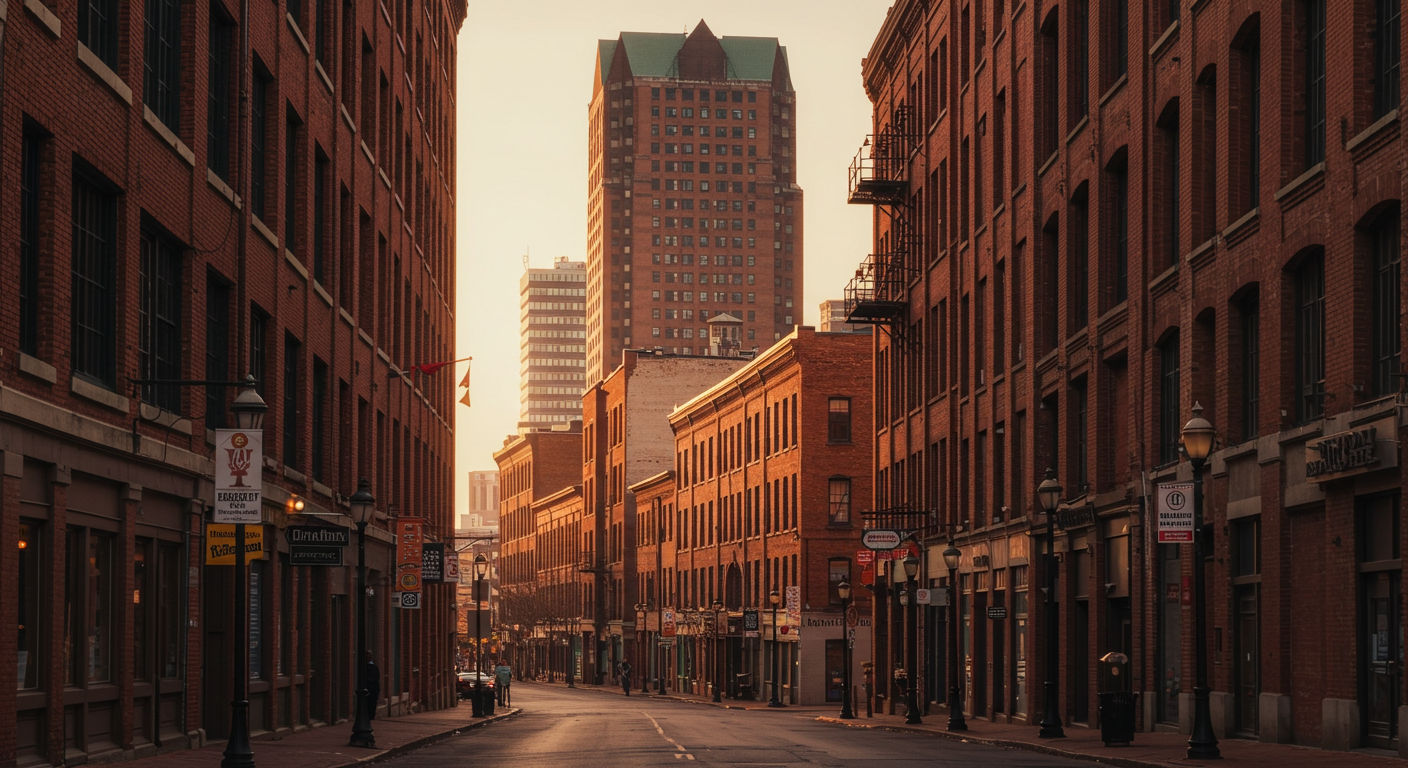
Why is downtown St. Louis ripe for development?
Downtown St. Louis is ripe for development because it pairs remarkably low real-estate costs with historic building stock, major public and private investment, and improving safety trends. Vacant offices and landmark buildings are selling far below replacement cost, generous historic tax credits and incentives lower the risk, and new residential conversions are drawing people back — a rare mix of cheap entry and real upside.
Keep reading ↓Here is downtown St. Louis in a single building. In 2006, the 44-story tower at 909 Chestnut — the former AT&T Center, the tallest office building in Missouri — was worth about $205 million. In 2025 it sold for roughly $3.6 million. That’s under two cents on the dollar for the biggest building in the state.
You can read that number two ways. One: proof of collapse. Two: the buy of the decade. This guide makes the honest case for the second reading — that downtown St. Louis, after decades of disinvestment and a rough reputation, is genuinely ripe for development in 2026: unusually cheap, newly incentivized, historically rich, and finally sitting on the pieces of a comeback. It’s not a boom yet. But the setup for one is more real than it has been in twenty years.
We’re not going to cheerlead. Downtown’s problems are real and we’ll name every one of them. But the opportunity is real too, and most people haven’t noticed — so let’s walk through it with clear eyes and sourced facts.
Bookmark this — we keep it current as the downtown story develops. If you build things for a living, read to the end.
First, the honest part: the reputation
Ask the internet about St. Louis and you get a wall of doubt: Is St. Louis still in decline? Why is it so run down? Will it ever come back? Those questions are fair, and pretending otherwise would insult you. The City of St. Louis has lost population year over year — it slipped to roughly 278,000 residents in 2025, continuing a decline that’s run for decades — and that shrinking tax base is exactly why the mayor and aldermen are working so hard to reverse it. Downtown’s office towers emptied out, storefronts went dark, and the “everyone left for the suburbs” story became the whole story.
All of that is true. But three big pieces of the reputation deserve a much closer look — the “run-down” label, the crime numbers, and the city’s industrial bones — because each one is more hopeful, and more interesting, than the headline.
“Run-down” vs. old: they’re not the same thing
Start with the word people use most: run-down. Here’s some context that changes the picture. St. Louis was founded in 1764 — it’s 262 years old, one of the oldest cities west of the Mississippi. Its housing and building stock is routinely 100-plus years old: brick rowhouses, terra-cotta storefronts, and grand stone warehouses built when the city was one of the largest in America.
That age gets misread. A lot of what a visitor calls “run-down” is really just old — historic architecture that a newer Sun Belt city simply doesn’t have. Century-old brick and carved stone read as “worn” to an eye trained on beige subdivisions, but that same building stock is exactly what makes St. Louis beautiful, walkable, and cheap to own. Old is not a synonym for decayed. Much of it is character that money can restore.
Now the honest flip side: some parts of the city genuinely are run-down — disinvested blocks, vacant lots, buildings past saving. The city is working to clear those obstacles, from demolition of the truly dangerous to incentives for the salvageable. But reversing real disinvestment takes the one thing a shrinking tax base can’t manufacture on its own: good-paying jobs and outside money. Which is the whole point of this article. Job creators, developers, employers — the door is open, the price is right, and the city is holding it for you. St. Louis is, frankly, waiting.
A blue-collar town that made things
To understand why downtown looks the way it does — grand old buildings, cheap prices — you have to know what St. Louis was. This is a former Rust Belt city, and it made things the whole country used. St. Louis was one of America’s great manufacturing hubs: it was a shoe-making capital (the Brown Shoe Company, maker of Buster Brown shoes, was founded here in 1878 and still runs from suburban Clayton as Caleres), a brewing giant, an aircraft builder, and a car town — the Chevrolet Corvette was assembled at a St. Louis plant for its first three decades, from 1954 to 1981, before production moved to Kentucky.
That industrial wealth is why the city has such spectacular building stock — the warehouses, factories, and headquarters of an economy that employed hundreds of thousands. And the collapse of that manufacturing base, from the 1960s on, is why so much of it sits empty and cheap today. St. Louis isn’t rust-belt anymore — its growth sectors now are agtech, biotech, and geospatial technology — but it still carries a blue-collar, make-things-with-your-hands DNA. That heritage is a feature: it’s a city that knows how to build, sitting on the physical infrastructure of a much larger economy, waiting for the next thing to fill it.
The crime reputation vs. the crime numbers
St. Louis’s heaviest reputational weight is crime, so let’s deal with it directly, with sourced facts instead of spin. Violent crime in St. Louis has fallen for four straight years. Homicides dropped to 141 in 2025 — a 12-year low — down from a peak of about 260 in 2020, and overall crime fell 16% in that single year, with shootings down 28% (SLMPD 2025 statistics). Since Police Chief Robert Tracy took over in 2023, the department reports homicides down roughly 31% and violent crime down about 42%. Mayor Cara Spencer re-signed Tracy through 2029 and made a downtown public-safety task force one of her stated priorities.
Now the part almost every “most dangerous city” ranking gets wrong. Those rankings measure the City of St. Louis’s tiny boundary — a 62-square-mile city of about 290,000 people that split from its county in 1876 and never annexed its suburbs — while the actual metro holds around 2.8 million. Only about one in ten metro residents lives inside the lines those rankings use.
Do the math and the distortion is stark. Roughly 141 homicides against the city’s ~290,000 residents produces a rate near 50 per 100,000 — the scary number that fuels the lists. But spread those same deaths across the full 2.8-million metro — the way a city like Indianapolis, Jacksonville, or Nashville, which swallowed their suburbs, effectively counts — and the rate falls to roughly 5 per 100,000, right around the national average. It’s an illustration, not a perfect measurement (the suburbs have their own, lower crime counted separately) — but it shows how much a frozen 1876 border, not present-day danger, drives St. Louis’s ranking.
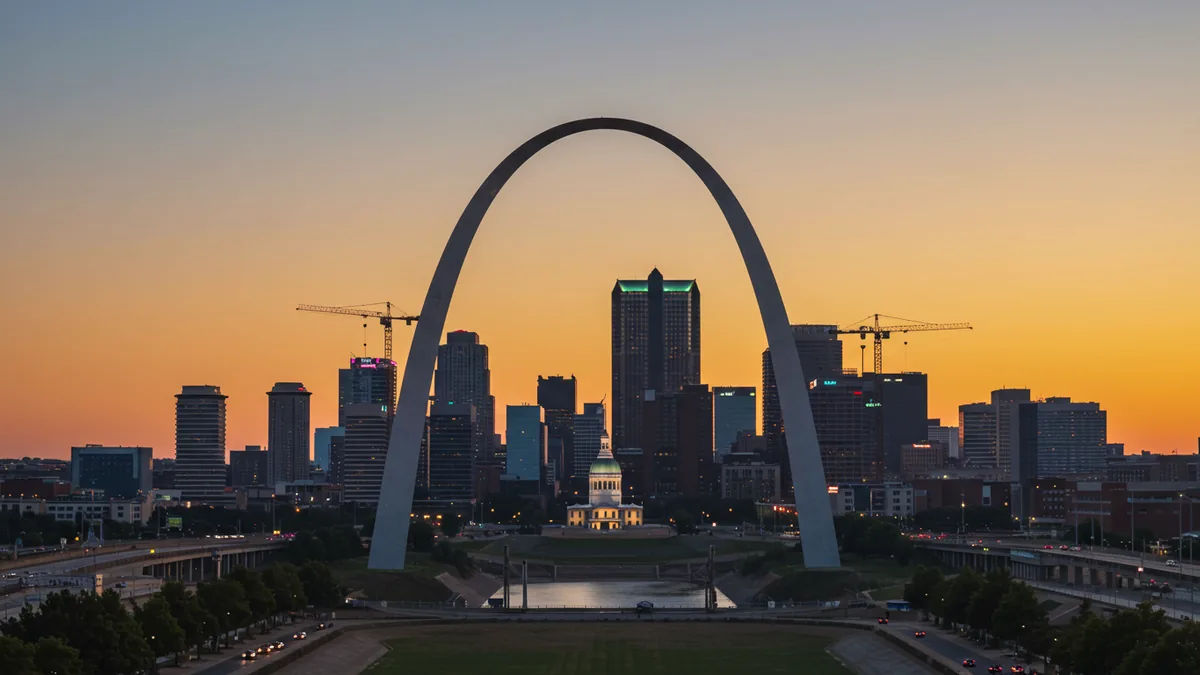
The honest bottom line: crime is falling, meaningfully and by the city’s own numbers — but a 12-year low is still not a low rate, a few categories like carjacking have seen upticks, and the improvement isn’t uniform across every neighborhood. It’s a real trend in the right direction, not a finished job. For anyone weighing downtown, “getting safer, fast” is a very different bet than “dangerous and getting worse” — and the data says it’s the former.
We’ve done this before — and it worked
Here’s the part St. Louis forgets: downtown has already staged one comeback, and the playbook still exists. In 1998, Missouri created a state Historic Tax Credit — a tax break covering 25% of the cost of rehabbing a historic building — that stacks on top of the federal 20% credit. Together they can cover close to half the rehab cost of an old building, which is what turns a money-losing renovation into a deal that pencils out.
The result was the Washington Avenue loft district running through Downtown West: from about 1998 to 2008, dozens of empty garment-district warehouses became loft apartments and condos, pulling thousands of new residents into a downtown everyone had written off. STLPR later called it a “wildfire” of development. That same tax-credit toolkit is still on the books — the exact lever that makes converting today’s empty office towers financially possible. St. Louis isn’t guessing whether this can work. It has the receipts.
What’s different now: money, will, and a $670 million signal
Three things shifted in 2025–2026 that weren’t true a few years ago.
1. Real public money is on the table. In July 2026, the Board of Aldermen passed a $255 million spending plan — the city’s share of the settlement from the Rams’ departure to Los Angeles — and carved out $55 million specifically for downtown (STLPR). That downtown slice includes $15 million to acquire vacant buildings, $15 million for the riverfront, $15 million for infrastructure, and $7.5 million in retail and restaurant incentives. Like every public commitment, the figure is current as of 2026 and subject to the usual political process — but it’s passed, and it’s real today. (For the full breakdown of the money and the tax-credit stack behind it, see our guide to St. Louis’s downtown development incentives.)
2. City leadership made downtown the priority. Mayor Cara Spencer, who took office in 2025, has named downtown revitalization a formal strategic priority, pushing office-to-residential conversion and downtown safety at the same time. When City Hall’s attention and its checkbook point the same direction, developers notice.
3. A $670 million vote of confidence at the riverfront. The old twin-tower Millennium Hotel by the Arch — vacant and decaying for years — is being demolished now and replaced with a roughly $670 million mixed-use campus of housing, offices, retail, and public space, a short walk from the America’s Center convention complex, and backed by the Gateway Arch Park Foundation and Cordish Companies. You don’t spend $670 million on a district you think is dying.
And it’s already working in places. The Butler Brothers building reopened as “The Victor,” a 384-unit apartment conversion. The long-vacant Jefferson Arms — empty for 19 years — is finishing a roughly $104 million conversion into apartments, a hotel, and retail. These aren’t renderings; they’re leased buildings with residents in them, proof the conversion model works in downtown St. Louis right now.
Total tangent — here’s how Florissant businesses get found online.
The empty-building math: why cheap is the opportunity
Downtown’s office vacancy hit 31.7% at the end of 2025 — the highest since 1999 (CBRE), and that figure doesn’t even count the two fully-empty giants, the AT&T Tower and the Railway Exchange. On the surface, that’s a crisis. Underneath, it’s the entire investment thesis: a glut of grand old buildings selling for a fraction of what they’d cost to build, in a city that will help pay to rehab them.
Nationally, the smart-money move of this decade is office-to-residential conversion — turning obsolete office space into apartments people actually want. The Brookings Institution literally used St. Louis as its case study for reversing an “urban doom loop” this way. St. Louis has the raw material (beautiful, cheap, empty buildings), the tool (the tax-credit stack), and now the public money to prime it. That combination is genuinely rare.
The catalyst that hasn’t fired yet: NGA
The wild card is the Next NGA West campus — the $1.7 billion National Geospatial-Intelligence Agency headquarters that opened in north St. Louis in 2025, the largest single federal investment in the region’s history. On paper it should be a gold mine: thousands of high-paying jobs and a magnet for the contractors and geospatial startups that cluster around a facility like this. It may well be the leash that eventually leads the dog — the anchor that pulls a whole new economy into the city.
But here’s the honest part: that spillover hasn’t fully happened yet. The campus is open; the surrounding boom is still mostly potential. And that’s the pattern across downtown right now — the ingredients are assembled, but the reaction is waiting on a spark.
The chicken-and-egg problem — and who breaks it
If it’s all so cheap and incentivized, why isn’t everyone already here? Because downtown is stuck in a classic chicken-and-egg standoff. Residents wait for more shops, restaurants, and street life before they’ll move in. Retailers and restaurants wait for more residents before they’ll open. Developers wait for proof of demand before they’ll commit. Everyone is watching the door, and nobody wants to be first through it.

That standoff is the opportunity. The public money, the tax credits, the falling crime, the $670 million riverfront project — those are the tools designed to break the logjam and make being first pay off. Whoever moves while it’s cheap — the developer, the small business, the resident who wants a real loft for a third of what one costs in Denver or Nashville — is the one who gets in before the curve, not after. First movers in an undervalued market are the ones who look like geniuses in ten years.
The bigger picture: cheap, and quietly on the rise
Zoom out from downtown and the case gets stronger. The St. Louis metro’s median home price is around $285,000 — against roughly $404,000 nationally and $1.5 million in San Jose — and the overall cost of living runs about 16% below the U.S. average. That’s why Redfin flagged St. Louis as a market poised to heat up, and why U.S. News lists it among the country’s most undervalued housing markets. (For the full affordability case, see our guide to why St. Louis real estate is so affordable.)
The economy underneath is stronger than the reputation suggests: metro GDP grew 7.1% over two years, the region ranked #3 in the nation for job growth, and St. Louis is quietly a national hub for agtech, biotech, and geospatial technology. (For the companies proving it, see our guide to the top St. Louis businesses to watch.) None of that erases the challenges — workforce is a real concern here, as it is across the entire country right now — but “cheap and declining” and “cheap and undervalued” are very different things, and the data increasingly points to the second.
Put it all together — a 262-year-old city with irreplaceable architecture, buildings selling for pennies on the dollar, a tax-credit stack that covers half a rehab, $55 million in fresh public money, a $670 million riverfront project, crime falling four years running, and a $1.7 billion federal anchor already in the ground — and you have a downtown that isn’t dying. It’s waiting. The only missing ingredient is the people and the capital willing to move before everyone else figures it out.
Watching St. Louis’s comeback? Explore the businesses, neighborhoods, and resources across the metro on the St Louis Near Me Directory.
Building or investing in St. Louis? Listing your business is how customers and partners find you as downtown turns the corner.
Frequently Asked Questions
Is St. Louis making a comeback?
The pieces of one are in place. Violent crime has fallen for four straight years to a 12-year low, the city committed $55 million to downtown from its Rams settlement, a $670 million redevelopment is replacing the Millennium Hotel, and old office towers are converting to apartments. It’s not a finished comeback — the city is still losing population overall — but downtown is a genuine bright spot with real momentum and unusually low prices.
Why is St. Louis so run down?
Much of what looks “run-down” is simply old: St. Louis is a 262-year-old city with grand, century-plus architecture that a newer city can’t match, and historic character often gets mistaken for decay. That said, decades of manufacturing decline and population loss did leave real disinvestment in some areas. The city is clearing obstacles to fix it, but the lasting cure is jobs and investment — which is exactly why downtown is priced to attract them.
How old is St. Louis?
St. Louis was founded in 1764 by French fur traders Pierre Laclède and Auguste Chouteau, making it 262 years old and one of the oldest cities west of the Mississippi River. That long history is why its building stock is largely 100-plus years old — brick rowhouses, terra-cotta storefronts, and stone warehouses from the city’s industrial heyday.
Is downtown St. Louis getting safer?
Yes, by the numbers. St. Louis homicides fell to 141 in 2025, a 12-year low, down from about 260 in 2020, with overall crime off 16% in a single year (SLMPD). The city also runs a downtown public-safety task force. Crime remains above the national average, so it’s “improving fast,” not “solved” — but the four-year trend is clearly downward.
Why does St. Louis rank as a dangerous city if crime is falling?
Because those rankings use the City of St. Louis’s unusually small 62-square-mile boundary — about 290,000 people — while the metro holds 2.8 million. Only about 10% of metro residents live inside the lines the rankings measure, which concentrates crime into a tiny denominator. Spread the same numbers across the full metro, the way annexed cities count, and the rate drops near the national average.
Why are downtown St. Louis buildings so cheap?
Decades of population loss and a post-pandemic office exodus pushed downtown office vacancy to 31.7%, the highest since 1999, so grand historic towers sell for a fraction of replacement cost — the AT&T Tower sold for about $3.6 million, down from $205 million in 2006. Paired with historic tax credits covering up to 45% of a rehab, that’s why value investors are starting to circle.
What is happening to the Millennium Hotel in St. Louis?
The vacant two-tower Millennium Hotel by the Gateway Arch is being demolished, a process that began in late 2025. It’s being replaced by a roughly $670 million mixed-use redevelopment — housing, offices, retail, and public space — led by the Gateway Arch Park Foundation and Cordish Companies, one of the largest downtown projects in decades.
What tax credits are available for rehabbing historic buildings in Missouri?
Two stack together: Missouri’s state Historic Tax Credit covers 25% of qualified rehabilitation costs on a historic building, and the federal Historic Tax Credit covers another 20%. Combined, they can offset close to 45% of a rehab — the financial engine behind St. Louis’s loft conversions and today’s office-to-residential projects.
Is St. Louis a good place to invest in real estate?
For value investors, it’s among the most interesting markets in the country: a metro median home price around $285,000 (versus $404,000 nationally), cost of living 16% below average, deep historic-tax-credit incentives, and new downtown money. The catch is that downtown’s turnaround is still early-stage, so it rewards patience and conviction over a quick flip.
Is St. Louis a good place to move to?
If affordability and space matter to you, strongly consider it — your housing dollar goes about twice as far as on the coasts, and the metro ranks among the nation’s most undervalued and fastest job-growing. Like any city it has trade-offs, including a crime rate that’s falling but still above average, so research specific neighborhoods. For many people, the value is hard to beat.

Written by a dedicated team of St. Louis locals who live, work, and play right here in the St. Louis metro. Founder Lane Forman and team are committed to building the region’s most trusted directory by verifying listings and connecting local businesses with loyal customers across Missouri and Illinois.