Storm-Proofing Your Trees: A St. Louis Homeowner’s Guide
Revised August 13, 2026
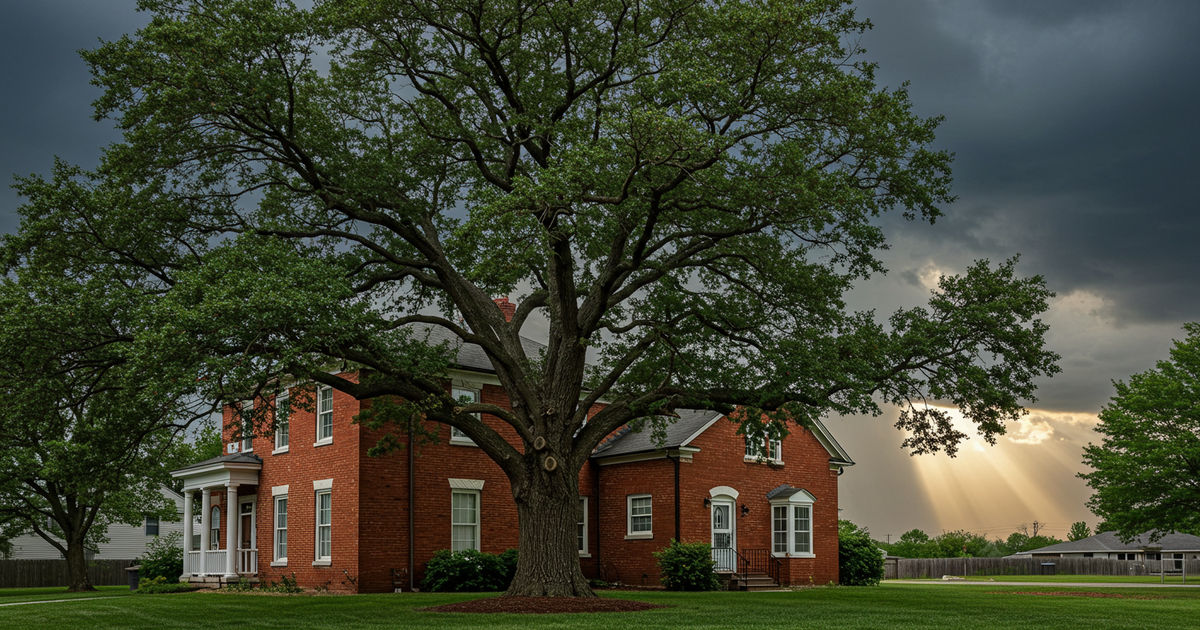
How do you protect trees from strong winds?
Protect trees from storm and wind damage by keeping them healthy and structurally pruned: during the dormant season, thin and reduce weak, dead, and over-extended branches to lower wind load — and never top a tree, which makes failure worse. Remove hazardous trees, favor strong-wooded species over brittle ones like Bradford pear, and have a certified arborist inspect large or leaning trees.
Keep reading ↓Picture a July evening in St. Louis. The sky goes that eerie green, the wind picks up, and you find yourself staring at the big old silver maple in the backyard — the beautiful one that shades half the house — wondering, for the first time, what happens if it comes down. Maybe you’re in Affton, maybe Florissant, maybe out in St. Charles. The storm passes this time. But the question lingers.
Two questions decide most of this: which trees are most vulnerable to storm damage, and how you protect the ones you have from high winds before the next line of storms comes through. Both have practical answers, and neither requires removing a healthy tree.
It should. St. Louis gets real weather — straight-line winds, ice storms, and the occasional tornado — and a failing tree is one of the most expensive, dangerous things on your property. The good news: a lot of storm damage is preventable, and most of the prevention is cheap or free. A well-cared-for tree is one of the best things about a St. Louis property — shade in July, character year-round, real value at resale — and keeping it safe is mostly about a few smart habits, not constant expense. Here’s a local’s guide to storm-proofing your trees before the next big one, how to read the warning signs yourself, and what to do (and what to avoid) after the wind hits.
At a Glance: How to Storm-Proof a Tree
| Do this | Why it matters |
|---|---|
| Prune in the dormant season | Thins wind load, heals fastest |
| Never “top” a tree | Topping makes storm failure worse |
| Learn the weak-wooded species | Bradford pear & silver maple break first |
| Spot hazard signs early | Cracks, lean, and root heave warn you |
| Get big trees inspected | A certified arborist catches what you can’t |
A Healthy, Well-Pruned Tree Is a Safer Tree
The single best thing you can do for a tree’s storm resistance is keep it well-pruned. Structural pruning — thinning and shortening weak, over-extended, dead, or poorly attached branches — reduces the “sail” a canopy presents to the wind and removes the limbs most likely to snap. A dense, unbalanced, never-touched canopy catches wind like a sheet; a well-structured one lets it pass through.
Timing matters in Missouri. The best window to prune most trees is the dormant season — from leaf-fall through early spring before the buds break — when wounds close fastest and the tree’s structure is easy to read. University of Missouri Extension recommends February and March for bigger cuts. A little routine pruning every few years beats one drastic overhaul.
One thing to never do: top your tree. Topping — hacking the canopy back to stubs — is, in the Missouri Department of Conservation’s words, “one of the worst things you can do to a tree.” It triggers a flush of weakly attached new branches that are more likely to break in the next storm, not less. If a tree service suggests topping, that’s your signal to call someone else.
Know St. Louis’s Weak-Wooded Trees
Some trees are simply built to fail in storms, and several of them are extremely common in St. Louis yards. University of Missouri and the Missouri Botanical Garden flag these as weak-wooded and prone to storm and ice injury:
- Bradford (Callery) pear — the poster child; its tight, upright branch angles split under wind and ice (and it’s invasive, so no loss).
- Silver maple — fast-growing, brittle, often multi-trunked; a frequent storm casualty.
- Siberian elm — MDC notes its “weak wood breaks easily in storms or under the weight of ice.”
- Eastern cottonwood and river birch — fast growers that shed limbs.
The general rule holds: fast-growing trees tend to be weak-wooded; slow-growing ones tend to be stronger. If you’re planting new, favor sturdier natives (oaks, for instance) over a quick-growing Bradford pear you’ll regret in a decade. What you plant today is the storm risk — or the safety — of twenty years from now.
Placement matters as much as species. A big, brittle tree planted right over the roof, the driveway, or the power line is a standing liability no matter how healthy it looks; the same tree in an open corner of the yard is just a nice tree. When you plant, think about where the tree will land if it ever fails, and give large species room away from the house. It’s the cheapest storm-proofing there is — a decision made with a shovel, years before the wind ever tests it.
Learn to Spot a Risky Tree
You don’t need to be an expert to catch the warning signs. Walk your trees a couple of times a year and look for the red flags the Arbor Day Foundation says signal a hazardous tree:
- Cracks, cavities, or soft, decayed wood in the trunk — and especially two vertical cracks on opposite sides, which is extremely dangerous.
- A sudden lean, or soil at the base that’s buckling, cracking, or heaving (a sign the root plate is lifting).
- Mushrooms or fungi at the base — often a sign of root or trunk decay you can’t see.
- Lots of dead or hanging limbs, or a thin, unbalanced canopy.
- Included bark — a tight V-shaped union where bark is pinched between two stems, a classic split point.
Any one of these, especially on a big tree near the house, driveway, or a power line, is worth a professional look before storm season — not after.
Trees and Power Lines: Whose Job Is It?
This one surprises a lot of St. Louisans. The wire running from the main power line to your house — the service drop — and any tree touching it are generally the property owner’s responsibility, not Ameren’s. Ameren maintains vegetation along its main lines and rights-of-way, but the branch growing into the line feeding your meter is yours to deal with. Never trim near a live line yourself: contact Ameren Missouri (they can temporarily disconnect the drop) and use a qualified line-clearance professional for anything within 10 feet of a higher-voltage line. It’s a safety issue, not a DIY project.
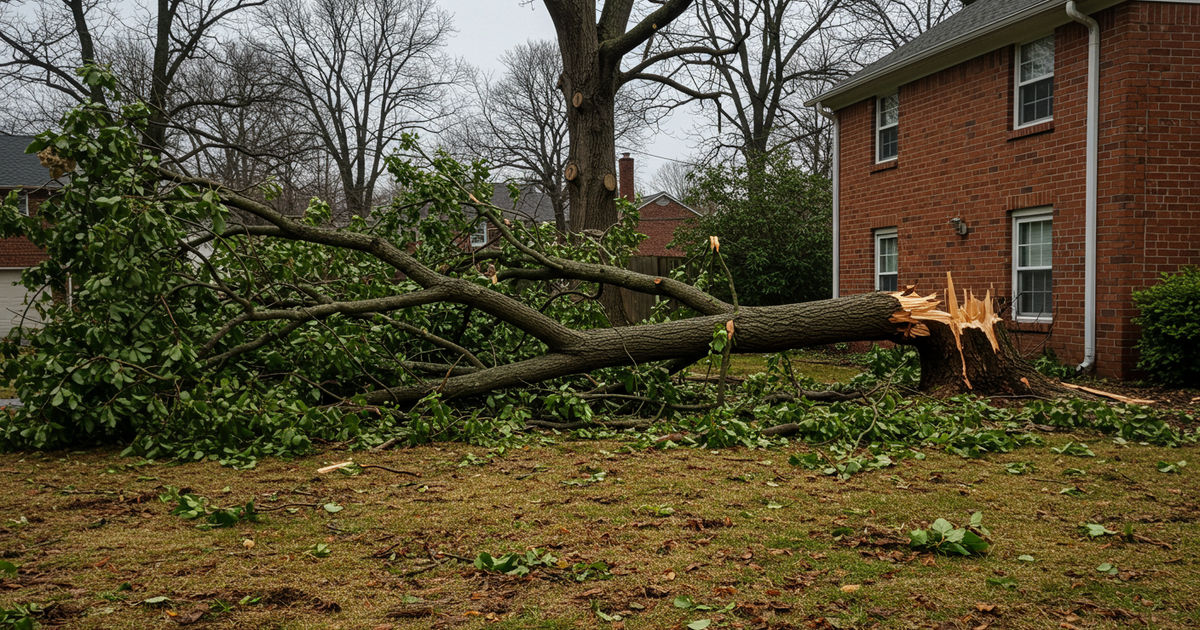
After a Storm: Get Help — but Watch for the Scam
When a big storm rolls through and limbs are down, the “stormchasers” come out. These are out-of-town crews who knock on doors, claim they’re “working in the neighborhood,” pressure you to sign on the spot, and often take a big deposit and vanish. University of Missouri Extension is blunt about it: legitimate tree-care professionals don’t solicit door-to-door.
Protect yourself. Before you hire anyone after a storm: get the full company name, address, and references and actually call them; require current liability and workers’ compensation insurance certificates; look for ISA Certified Arborist credentials; get two or three detailed written estimates; and never pay a large deposit up front or sign under pressure. Reputable local companies give free estimates and don’t rush you.
Right After a Storm: Safety First
When the wind dies down and you head outside to survey the damage, slow down — the hours after a storm are when people get hurt. Assume every downed wire is live and stay far away from it (and from any tree or fence touching it); report it to Ameren, don’t approach it. Look up before you walk under a damaged tree: “hangers” — broken limbs caught in the canopy — can drop without warning. And resist the urge to grab the chainsaw for anything big or overhead. Cutting a limb that’s under tension can whip back violently, and ladder-plus-chainsaw is how serious injuries happen. Small stuff on the ground, fine; anything large, leaning, tangled in lines, or over your head is a job for insured professionals.
Once it’s safe, photograph the damage before you clean up — your homeowners insurance may cover removal of a tree that hit a structure, and documentation helps the claim.
Off-topic and unapologetic — your honey-do list has been waiting for the handyman map.
Why This Matters Here in St. Louis
This isn’t hypothetical. On May 16, 2025, an EF3 tornado carved a miles-long path across the city — through the Greater Ville, Fountain Park, Forest Park, and Skinker-DeBaliviere — snapping numerous large trees, killing five people, and causing an estimated $1.6 billion in damage. Add the June 2023 derecho that knocked out power to around 200,000 customers, and the pattern is clear: St. Louis trees take a beating. The homeowners who’d kept their trees pruned and their hazards removed fared a lot better than the ones who hadn’t. Storm-proofing isn’t paranoia here — it’s maintenance, and it’s a lot cheaper than an emergency removal or a claim on your roof. A few hundred dollars of pruning every few years is the best storm insurance a tree owner can buy.
Find a Tree Pro (and a note for the owners)
Need a tree pro before the next storm? A big removal, a limb over the roof, or anything near a power line is a job for a certified professional — and lining one up now beats scrambling after the wind hits. Search St Louis Near Me Directory for local tree services and arborists across the metro, with the details in one place.
Run a tree-care or landscaping business in the metro? The homeowners planning ahead are looking for you right now. Listing your business is how St. Louis and Illinois neighbors find you — instead of a door-knocking stormchaser.
More St. Louis homeowner guides
- Why your trees need a regular arborist checkup
- A seasonal home-maintenance checklist for St. Louis
- Basement waterproofing in St. Louis
Storms rarely stop at the tree line. If the same night took shingles off, our breakdown of what a roof replacement costs in St. Louis covers what drives the number and what a complete estimate should itemize.
Frequently asked questions
Which type of trees are most vulnerable to storm damage?
Fast-growing softwoods with brittle wood take the worst of it — silver maple, Bradford pear, Siberian elm, willow and box elder are the usual casualties in St. Louis yards. Bradford pears in particular are structurally prone to splitting at the trunk once they reach maturity. Trees with tight V-shaped branch unions fail more often than those with wide U-shaped ones, regardless of species.
How can I protect my trees from high winds?
Structural pruning while the tree is young is the single most effective thing, because it establishes one dominant leader instead of competing stems. On mature trees, remove deadwood, thin crowded interior growth so wind passes through rather than pushing the canopy like a sail, and have weak unions cabled or braced by an arborist. Do not top a tree — it produces weak regrowth that fails harder in the next storm.
What should I do after a windstorm damages my trees?
Stay clear of anything touching a power line and call the utility, not a tree service. Photograph the damage before anything is moved, for insurance. Then get a certified arborist to assess whether the tree is salvageable — a clean limb break on a healthy tree is usually prunable, while a split trunk, a fresh lean with heaving soil, or more than about half the canopy gone generally is not.
Will insurance pay for tree removal after a storm?
Usually only when the fallen tree damaged a covered structure. Most homeowner policies pay to remove a tree that hit the house, garage or fence, often with a per-tree cap, but a tree that simply fell in the yard is commonly the homeowner’s expense. Coverage varies by carrier and policy, so read yours before assuming either way.
What trees are storm resistant?
Species with strong wood and good branch structure hold up best in this region — bur oak, white oak, hackberry, ginkgo, black gum and baldcypress among them. Native oaks in particular are well matched to St. Louis soils and weather. No tree is storm proof, but species choice at planting is a decision you only get to make once.
At what wind speed do trees fall down?
Healthy, well-structured trees generally tolerate gusts into the 50 to 60 mph range. Damage rises sharply above roughly 60 mph, and sustained winds near 80 mph will bring down even sound trees. Condition matters more than the number though: a decayed or poorly pruned tree can fail well below 50 mph, which is why maintenance beats guessing at wind speeds.

Written by a dedicated team of St. Louis locals who live, work, and play right here in the St. Louis metro. Founder Lane Forman and team are committed to building the region’s most trusted directory by verifying listings and connecting local businesses with loyal customers across Missouri and Illinois.