You Laugh a Beat Late? Free Language Classes in St. Louis
Revised October 20, 2026

How expensive is it to learn a language?
In St. Louis it can cost nothing. A St. Louis County Library card unlocks Transparent Language Online, more than 120 languages, free. St. Louis Public Schools and St. Louis Community College both run free adult ESL; for the SLPS classes, text your name to 314-252-8276. Missouri residents 65 and older can audit public-college classes tuition-free; at UMSL that’s a $25 registration fee. Among paid options, group classes cost the least per hour and private one-to-one the most.
Keep reading ↓You laugh a beat after everybody else. That’s the tell. Your son’s new in-laws are at the dinner table in Manchester, everyone is kind, everyone is trying, and you catch about one word in ten. On the drive home the car is so quiet you can hear the turn signal. That night you type “language classes near me” into your phone, and the prices that come back don’t agree with each other at all.
The same search is happening all over the metro: a nurse in Hazelwood who wants enough medical Spanish to take a history without waiting on an interpreter line, a commuter from Columbia, Illinois who wants their English to stop being the first thing people notice.
In St. Louis, the first few months can cost nothing. A St. Louis County Library card opens Transparent Language Online, more than 120 languages, on your own couch after the dishes are done. (The card is free to anyone who lives in, or pays property taxes to, St. Louis County, St. Louis City or St. Charles County; apply online or at a branch with a photo ID. Everyone else in the metro, Columbia included, pays $50 a year for the whole family.)
For English, text your name to 314-252-8276 and you’re on the way into St. Louis Public Schools’ free adult classes, mornings, afternoons or evenings, in person or online. St. Louis Community College runs free ESL for beginners through low-intermediate learners, and you don’t have to enroll in a degree to sit in. If someone you love keeps apologizing for their English, that phone number is the screenshot to send them tonight.
Sixty-five or older? Missouri law waives your tuition. Under Section 173.091, a Missouri resident who turns 65 by August 1 gets a tuition exemption at any public college, on a non-credit, space-available basis. At the University of Missouri-St. Louis, which teaches French, Japanese and Spanish, that means auditing an undergraduate course for a $25 registration fee plus any course fees; bring proof of age and Missouri residency. St. Louis Community College lets seniors audit at a $20 senior scholarship rate, with a catch almost nobody expects: that rate only opens the Friday before classes start. Register early, like a good student, and you pay the standard rate with no switching back. So the parent laughing a beat late at that dinner table could be sitting in a college Spanish class this term for less than the price of that dinner.
What a language class really costs here
A weeknight room of other grown-ups and the held-breath quiet before it is your turn to read aloud: here is what that costs. At the Alliance Française de St. Louis, group French meets two hours a week in eight-week terms for $304, which the Alliance itself works out to $19 an hour of instruction. Add the $60 annual membership and the $65 textbook that lasts about a year, and your first eight weeks come to $429. That’s the shape of a group class anywhere in town: a term, an hourly rate you can calculate, and a few costs that aren’t in the headline price.
You are not really buying a language. You are buying a chair and a number of hours: a seat in a group where you might speak a few times a night, or a seat across a small table from a teacher who hears every vowel you get wrong. Private one-to-one costs the most per hour; free routes cost nothing but your time. Divide every quote by its hours, the way the Alliance does, and the expensive quotes and the overpriced ones stop looking alike.
What actually drives the price of a language class?
Listen to the room before you look at the price: twenty voices conjugating at once, or one voice across a small table waiting for yours. The price comes down to four dials, and they multiply against each other: the format, the hours per week, the length of the term, and how much of the teacher’s attention is pointed at you specifically. Everything else is noise. Once you can see those four, an expensive quote and an overpriced quote stop looking like the same thing.
Format sets both the floor and the ceiling
A large group class spreads one teacher across a full room, so the cost per person per hour lands lower than any other paid option. A small group of four or five costs more per head and buys you far more talking time. Private one-to-one is the most expensive per hour by a wide margin, because undivided attention is the whole product. Intensive and immersion formats, where the entire session runs in the target language, sit at the top of the range.
Hours per week, and how long the term runs
A course priced by the term hides its hourly cost, so do the division yourself. Two programs can quote similar totals when one meets ninety minutes a week for eight weeks and the other meets three hours a week for twelve. Then ask how many students will be in the room, because contact hours mean much less when you personally get to use ten minutes of them.
Why two quotes for the same language look nothing alike
Because they are not the same product. Conversational Spanish for a trip, medical Spanish for a working nurse, and exam-focused instruction take different preparation and different teachers. Local rates are set locally and they move from year to year. Call two or three schools, tell each one the same thing about your goal and your schedule, and let them quote against that. An article cannot price your class, and you should not let one try.
People are asking
How long does it take to learn Spanish, French or Japanese?
The State Department’s language school expects 30 weeks for Spanish or French, two of the languages it files as close to English, and its typical week is 23 hours in a classroom chair plus 17 more of self-study, a 40-hour week of nothing but the language. Japanese, which UMSL also teaches, sits with Arabic, Korean, Mandarin and Cantonese on its “super-hard” list for native English speakers: 88 weeks, or 2,200 class hours. Those clocks run to a score of 3 in speaking and listening on the government’s proficiency scale, so a weeknight class is a far longer road, and every hour you spend talking out loud with a real person shortens it.
Where can you learn a language for free in St. Louis?
Free and nearly free routes do exist here, and they work better than most people expect. The catch is that almost none of them advertise. They live inside institutions you already know about, and you find them by picking up a phone and asking a direct question. Here is who to ask, and exactly what to ask them.
Your public library system
Library systems in this region commonly run adult literacy services, and conversation groups sometimes sit under that umbrella or under general community programming. Call the system’s main line and ask whether they host adult literacy tutoring, English conversation groups, or world language conversation circles, and which branches have them. Ask about free online learning platforms with your card too. St. Louis County Library, for one, gives cardholders Transparent Language Online, which covers more than 120 languages, and Mango Languages; its help line is (314) 994-3300. Offerings change from system to system and year to year, so ask yours.
Community and faith-based programs
A great deal of the English teaching in this metro happens in church basements and community center back rooms, taught by trained volunteers, at no cost or close to it. These programs almost never rank on Google. Ask at a community center near you, ask a neighborhood association, ask any immigrant or refugee services organization working in your area, and ask what they run and when it meets.
Community college non-credit courses
Continuing education catalogs are the most reliably overlooked option in the region. World language courses there are not free, but they are usually the cheapest structured classroom instruction you can find. English is the exception: St. Louis Community College runs its ESL classes free, and you do not need to be enrolled in a degree program to take them. Call the continuing education office rather than admissions, and ask for the current term catalog.
Cultural organizations tied to your language
If the language you want has a cultural community behind it here, go find that community. Heritage societies, cultural associations and language-specific clubs often run classes, film nights and conversation hours, sometimes for members only and sometimes wide open. Search the language plus “society” or “association” plus St. Louis, then call whoever answers.
Language exchange meetups
These are free by design. You give an hour of English, you get an hour of what you are learning. Meetup groups, university conversation partner programs and coffee shop exchange nights all run on that trade. Quality varies enormously and there is no curriculum. Paired with something structured, they are the cheapest speaking practice available anywhere.
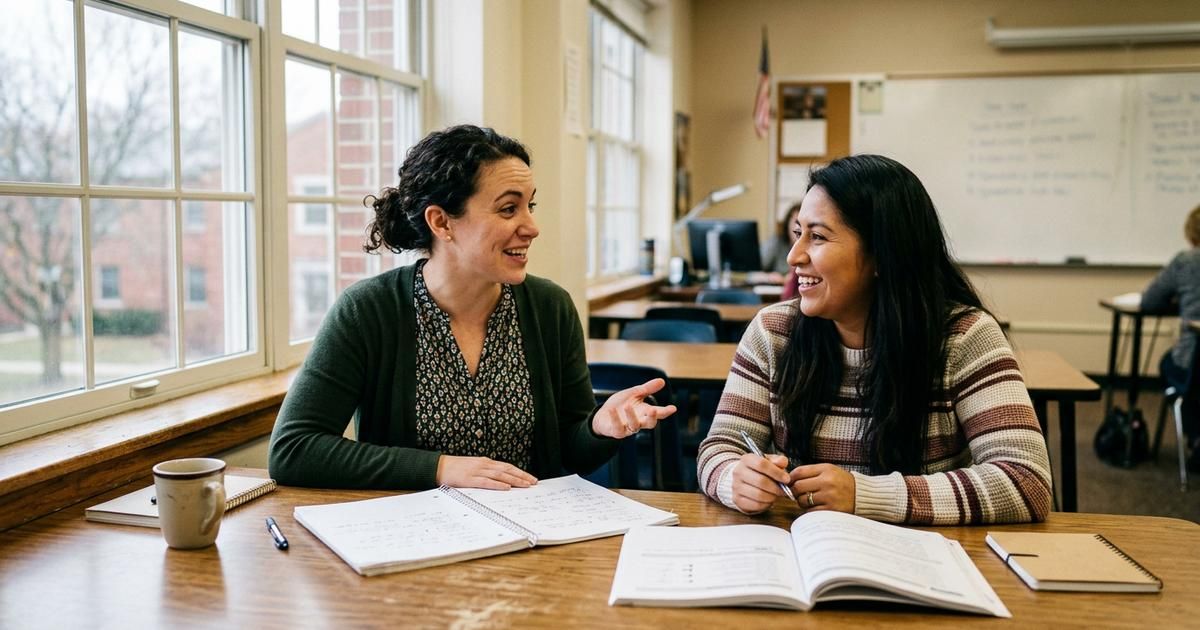
Where do adults learning English actually start?
Start with a free or low-cost class that meets on a schedule you can genuinely keep, then add speaking practice with a person. English instruction in the metro runs through community programs, faith-based volunteer programs, community college non-credit sequences, and adult literacy services attached to library systems. Getting in is rarely the hard part. Finding it is. If you or someone you are helping arrived here recently, our guide to immigrant and refugee services in St. Louis names the organizations that run those classes and answers a phone.
Ask directly, and in person if you can. Levels, schedules, childcare and cost differ program to program and change term to term, so what a friend told you two years ago may not be true now. Ask what levels they offer, when the next session starts, and whether there is a waiting list.
One thing is worth saying plainly. Reading and listening improve on their own with exposure. Speaking does not. If the goal is to be understood at work, on the phone, at your child’s school, then the hours that count are the ones where you are talking out loud to another person and being corrected. A cheap class with a lot of talking beats an expensive one where you mostly sit and listen.
Fluent enough to toast? Then start booking a banquet hall in St. Louis.
Where do apps help, and where do they stop?
Apps are good at the parts of a language you can practice alone: vocabulary, spelling, reading, and the plain habit of touching the language every day. Duolingo and the many tools like it are genuinely useful for that, and free tiers exist. What no app can hand you is a person sitting there waiting for you to finish your sentence.
That gap is where most self-taught learners stall out. You build a large passive vocabulary and still freeze the first time somebody answers you at normal speed. The fix is not a better app. It is a human on the other side of the table, whether that is a tutor you pay, a class you attend, or an exchange partner you found for free.
So the sensible stack for most adults looks like this. An app for daily maintenance, a class or group for structure and correction, and at least one recurring conversation with a real person. The app is the cheapest layer, and the one you should never mistake for the whole plan.
How fast can you really learn a language?
Slower than the marketing says, faster than you fear, and consistency beats intensity almost every time. “Fluent in three months” is a sales line rather than a timeline. What actually predicts progress is regular speaking practice with another person, week after week, at a level that stretches you slightly without drowning you.
Thirty focused minutes a day, six days a week, will carry you further across a year than a heroic four-hour Saturday you abandon in March. Nothing mystical about it. Language lives on retrieval, retrieval needs to happen often, and long gaps quietly undo the work you already paid for.
Be specific about what “fast” means to you, too. Ordering dinner, handling a shift at work, following a family conversation and reading a novel are four very different destinations. Pick the near one first and tell your teacher what it is. A class aimed at the wrong destination will feel slow no matter how good the teaching is.
Interview two or three schools before you pay anybody. You can browse language schools across the metro on St Louis Near Me Directory, then tell each one the same thing about your goal, your level and your schedule. The distance between what you asked for and what they offer is your answer.
If you’re the tutor, the language school or the one-teacher classroom, list your school with us and turn the nurse in Hazelwood and the parent in Olivette into customers before an app keeps them practicing alone.
How do you choose a language school worth paying for?
Shortlist two or three and interview them. Not about their pricing structure, about what actually happens in the room. Say plainly what you want, what level you are at now, how much speaking time you expect, and what schedule you can really keep. Then compare that against what each school is prepared to provide. The gap between those two things is the signal, not the price.
What to say when you call
Give them the whole picture in one go. “I want to hold a conversation with my in-laws by summer, I know maybe two hundred words, I can do two evenings a week, and I want to be talking for most of the class rather than listening.” A good school will tell you honestly whether their program fits that, and might point you somewhere else. Take that as a good sign.
Ask to sit in
Ask whether you can observe a class or take a trial session, then watch one thing while you are in there: how many minutes the students spend speaking. Rooms where the teacher talks the entire time feel productive and mostly are not. Count it if you have to.
Placement, and what happens if it is wrong
Ask how they place you, and what happens if the level turns out to be wrong. A program that can move you after week two is worth more than one that cannot, because nearly everybody misjudges their own level in one direction or the other. Adults especially tend to underrate what they already understand.
Compare the shapes, not the totals
Once you have two or three answers in hand, line them up by format and by speaking minutes per week instead of by the number at the bottom. A class that costs a little more and gives you twice the talking is not the expensive option. It is the one that works.
What do kids’ immersion and enrichment classes look like?
Two very different things get called the same thing here, and the difference matters for your budget. Full immersion means the school day, or a large part of it, runs in the target language. That is a placement decision, not a class you sign up for. Enrichment is a weekly after-school or Saturday class, and it is priced like any other kids’ activity.
For enrichment, the cost drivers are identical to the adult ones: group size, minutes per week, length of term. For immersion, ask what happens to a child entering mid-sequence, and ask what support exists at home when the adults in the house do not speak the language. Plenty of immersion parents end up holding a newsletter their second-grader has to translate for them.
Heritage schools and cultural organizations also run weekend language programs for children across the region, often for less than a commercial enrichment provider charges. Same rule as everything else on this page. Call and ask what is running this term.
If you teach a language in the metro
If you tutor or run a school here, you already know the demand does not arrive through advertising. It arrives when somebody types a language and a neighborhood into a search bar at nine at night. Being listed where those people are already looking does most of the work, because searchers look by area and by language long before they ever look by name.
Frequently asked questions
What is the cheapest way to learn a language?
Free routes plus a person to talk to. Library adult literacy services, community and faith-based volunteer programs, cultural organizations tied to the language, and language exchange meetups cost nothing but your time. Add a free app tier for daily vocabulary. When you are ready to pay, a community college non-credit course is usually the cheapest structured step up.
Where can I take an adult Spanish class in St. Louis?
Check three kinds of provider before you pay anyone. Community college continuing education offices run non-credit world language courses each term. Private language schools run group classes and one-to-one instruction. Cultural and heritage organizations often run classes and conversation hours. Call two or three, tell each the same thing about your goal and schedule, and compare what they say class time will look like.
Where can I find free ESL classes in St. Louis?
St. Louis Public Schools runs free adult ESL for every level, morning, afternoon and evening, in person or online; text your name to 314-252-8276 to register. St. Louis Community College’s ESL classes are free too. The International Institute of St. Louis teaches English classes (314-773-9090), and IHELP gives immigrants and refugees free one-on-one tutoring (314-771-1104). Ask when the next session starts and whether there is a waiting list.
Where can I learn languages for free?
Start with a library card. St. Louis County Library cardholders get Transparent Language Online, which covers more than 120 languages, including ESL for speakers of more than 26 of them, plus Mango Languages, all at no charge. Language exchange meetups trade an hour of your English for an hour of the language you want. University conversation partner programs, free app tiers and cultural organization events fill the rest. None of it replaces structure, but together it is a real program at no cost.
How do I learn languages quickly?
Speak from the first week and do something every day. Regular speaking practice with another person is what actually moves adults forward, and short daily sessions beat long weekend marathons because retrieval has to happen often. Narrow your goal to one near destination, tell your teacher what it is, and make sure most of your class minutes are you talking.
What is the best way for an adult to learn English?
A class you can genuinely attend, plus speaking practice with a person, plus daily exposure. Reading and listening improve with exposure on their own. Speaking only improves when you do it out loud and get corrected. Community programs, library adult literacy services and community college non-credit courses all offer that across the metro at low or no cost.
Is 2 hours a day enough to learn a language?
Two focused hours a day is far more than most adults sustain, and sustaining it is the entire point. Thirty minutes six days a week beats two hours that quietly stops in March. If you can genuinely hold two hours, split it: study and app work in one block, live speaking with another person in the other.
Can I learn Spanish in 3 months?
You can get genuinely useful in three months. You will not be fluent, and anyone selling that word on that timeline is selling. With daily practice and regular conversation, three months is enough to handle greetings, ordering, simple exchanges at work and short conversations on familiar topics. Aim there and progress stops feeling like failure.
More St. Louis guides
- Best tutoring and learning centers across the St. Louis metro
- How to choose a college or trade school in St. Louis
- How to find a trustworthy immigration lawyer in St. Louis

Written by a dedicated team of St. Louis locals who live, work, and play right here in the St. Louis metro. Founder Lane Forman and team are committed to building the region’s most trusted directory by verifying listings and connecting local businesses with loyal customers across Missouri and Illinois.