What to Expect From a CPR Class in St. Louis
Revised September 16, 2026
How long does a CPR training class take?
A basic adult, child, and infant CPR-and-AED class for laypeople typically runs a few hours in one sitting, usually a morning or an afternoon. Healthcare-provider classes, often called BLS, run longer because they cover more skills. Blended courses move the lecture online and cut the in-person part to a shorter skills session. Renewal classes are shorter than first-time classes.
Keep reading ↓Saturday, 8:55 a.m., a community room in Ballwin. Twelve folding chairs, a coffee urn that has seen things, and a row of plastic torsos lined up on blue mats like they’re waiting for a bus. A woman in scrubs is already kneeling by one of them, stretching her wrists. The dad next to her keeps checking his phone. Then the instructor walks in with a rolling case, pops it open, and pulls out a box with a speaker on it that says AED. Everybody gets a little quieter.
That’s the moment most people realize they have no idea what the next few hours look like. Is there a test? Do you have to put your mouth on the manikin? Will the card actually count at work? Half the room is here because a boss, a licensing board, or a coaching gig said so. The other half is here because someone they love has a heart condition and they don’t want to stand there useless. Both are good reasons.
This post walks you through the whole thing: how long the class runs, what happens in the room, which type of class fits your situation, why some online cards get bounced by employers, what drives the price, and how to pick a class that won’t waste your Saturday. No medical instruction here. That’s what the class is for.
How long does a CPR training class take?
A basic adult, child, and infant CPR-and-AED class for laypeople typically runs a few hours in one sitting, usually a morning or an afternoon. Healthcare-provider classes, often called BLS, run longer because they cover more skills. Blended courses move the lecture online and cut the in-person part to a shorter skills session. Renewal classes are shorter than first-time classes.
Why the range? Class size, mostly. An instructor with four students and four manikins moves fast. An instructor with sixteen students and six manikins has to rotate people through, and every rotation eats clock. Add a question-heavy group, a slow projector, or a skills check where two people need a second try, and a class that was scheduled for a morning slides into lunch.
Plan for the full block on the schedule, plus a little slack. Don’t book a 1 p.m. commitment in South County if the class is listed to end at noon in University City. Providers usually post the length on the sign-up page. If they don’t, ask. It’s a fair question and a good early read on how organized they are.
What actually happens in the room?
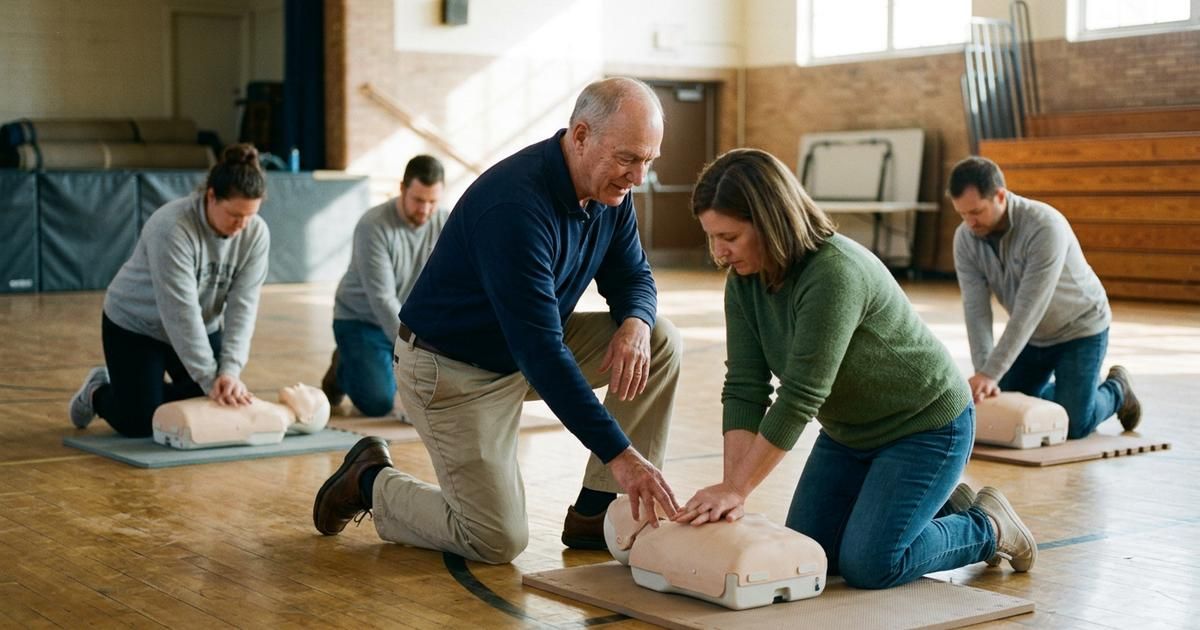
You’ll spend most of the class on your knees. That surprises people who expected a lecture. There’s some talking, usually with a video, but the bulk of the time is hands-on: pushing on a manikin’s chest, giving breaths, working the AED trainer, then doing it all again while the instructor watches and scores you.
Compressions on the manikin
The manikins are torsos, sometimes full bodies, usually adult-sized with a smaller infant model passed around later. Many of the newer ones click or light up when you press deep enough and fast enough. Your instructor shows the hand position, the depth, and the rhythm, then you do it. And do it. Your shoulders will feel it by the second round. That’s the point. Real compressions are physical work, and the class wants you to learn that here, not in a parking lot.
Breaths, the AED, and the skills check
Rescue breaths get practiced with a barrier, either a face shield or a pocket mask, so you’re not putting your mouth on a shared manikin. Then the AED trainer comes out. It talks. It tells you where to put the pads and when to stand clear, and you follow it. Most people find this the least scary part once they see the machine does the thinking.
The skills check is pass/fail. You run through the sequence on your own, compressions, breaths, and the AED, while the instructor checks boxes. If you miss something, most instructors coach you and let you go again. Nobody’s trying to fail you. They’re trying to make sure you can do it without them standing there.
The written test
The written test is short, multiple choice, and covers what was just taught. Some classes do it on paper, some on a tablet, and blended courses often do it online before you show up. Retakes are normally allowed. A nurse from Wentzville isn’t going to sweat it, and neither should a first-timer who paid attention. Read each question twice. That handles most of the misses.
Which kind of CPR class do you need?
It depends on who’s asking you to have it. A parent, coach, or office volunteer usually needs a layperson class covering adult, child, and infant CPR plus the AED. Nurses, EMTs, dental staff, and most clinical students need a healthcare-provider class. A blended format works for either group, as long as whoever wants your card accepts that provider’s in-person skills session.
Layperson: adult, child, and infant with AED
This is the class most people mean when they say CPR. It covers recognizing an emergency, calling for help, compressions, breaths, choking, and the AED, across the three age groups. Youth coaches, daycare staff, babysitters, and new parents fill these seats. If you’ve got a kid starting lessons at one of the St. Louis swim schools this year, this is the one you want. The pool staff will already have it.
Healthcare provider, usually called BLS
BLS adds two-rescuer technique, bag-mask ventilation, and more decision-making, and it runs longer. Clinical programs typically require it before you set foot in a facility. If you’re working through how to get into nursing school in St. Louis, check the program’s admissions page for exactly which card they want and how recent it has to be. Taking the wrong one costs you a second Saturday.
Blended: online lecture, in-person skills
Blended courses put the video and the written test online, then you show up for a shorter skills session with a manikin and an instructor. Good option for people who hate sitting in a room for the lecture part. Two catches. You must finish the online portion first and bring the completion certificate, and the skills session still has to happen in person. Skip that, and you don’t have a card most employers will take.

Why do employers reject some online-only cards?
Because nobody watched you push on a chest. An online-only certification, the kind with no in-person skills check, proves you clicked through slides and passed a quiz. It doesn’t prove you can do compressions at the right depth or work an AED with a little stress on you. Employers, schools, and childcare licensing usually want that hands-on proof, so they list those cards as not accepted.
The frustrating part is that these online-only sites look official. Nice seal, quick turnaround, a card in your inbox within the hour. Then the coach from University City who bought one for a league job finds out three weeks later that the league won’t take it, and now he’s paying twice. It happens more than you’d think.
The fix is boring and reliable: ask whoever requires the card what they accept, in writing, before you book anything. An email from HR or the licensing office that says “we accept a card with a hands-on skills component” is worth more than any promise on a sign-up page. Blended is fine for most. Online-only, almost never.
What does a CPR class cost, and why does it vary?
No dollar figures here, because they shift by provider and by month, and a stale number would just mislead you. What you’re paying for is instructor time, manikins and AED trainers that need cleaning and replacement, the card itself, and the overhead of a room. Change any one of those, and the price moves.
Class size matters most. A small class costs more per seat because the instructor’s time is split fewer ways. Big classes are cheaper per head but slower. Healthcare-provider classes cost more than layperson classes because they run longer and need more equipment. Renewals cost less than first-time classes. And a workplace class, where an instructor comes to your office in South County and trains twelve people at once, is usually priced per group rather than per person, which can work out well if you’re the one organizing it.
Free classes exist. Fire departments, hospitals, and community groups sometimes run them, often as hands-only sessions with no card, or with a card that’s fine for personal knowledge but not for an employer. Worth going to if you just want to know what to do. Not a substitute if a licensing board is waiting on paperwork. Ask before you attend.
How do you pick a CPR class worth your Saturday?
Shortlist two or three providers and interview them. Not a long call. Five questions, and you’ll know. Tell each one what you need the card for and by when, then listen to whether the answer matches. The gap between what you expect and what they’re set up to deliver is the signal.
- Which certifying body’s card do you issue, and does it include a hands-on skills session?
- How big is the class, and how many manikins do you have per student?
- Is the AED portion included, or is that a separate class?
- When does the card arrive, and is it digital, printed, or both?
- Will my employer, school, or licensing office accept this card? Then confirm that yourself.
Listen for hesitation. A provider who says “we’ll figure out the card later” or won’t say how many students they cap at is telling you something. A provider who answers all five without looking anything up has done this many times. That’s who you want on a Saturday morning in Wentzville with your kid’s league deadline on Monday.
One more thing. In our experience, the best instructors have real field time, nurses, medics, firefighters, and they tell short stories that make the sequence stick. If the provider mentions that their instructors work in the field, that’s a plus. If they say the instructor is “certified” and nothing else, fine, but it’s not the same.
Before you show up
Wear clothes you can kneel in. Pants and sneakers, hair tied back, nothing dangling. Bring a photo ID, and if it’s a blended class, the completion certificate from the online portion, printed or on your phone. Eat something first. Rooms run cold until you start compressions, then you’ll wish you’d worn layers. Get there ten minutes early so the instructor isn’t doing paperwork on your time.
Kids out at 3 and you’re not? See what after-school programs cost.
Ready to book a seat? Browse CPR classes across the St. Louis metro on St Louis Near Me Directory, then call two or three and ask which card they issue before you give up a Saturday.
If you’re the instructor or training center teaching CPR and first aid around St. Louis, this part is about your next customers - see the Gold plan and claim your spot.
Frequently asked questions
Are online CPR classes legitimate?
Some are, in the blended form. The online lecture and written test are legitimate when they’re paired with an in-person skills session where an instructor watches you do compressions, breaths, and the AED. A fully online certification with no hands-on check is the kind employers, schools, and childcare licensing usually reject. If nobody ever sees you touch a manikin, be careful.
How often does a CPR certificate expire?
Typically two years from the date of your class. The expiration date is printed on the card, so check it rather than guessing. Renewal classes are shorter than the first-time class, but many providers only let you take the renewal while your current card is still valid. Let it lapse, and you’re often back in the full class.
Is CPR certification hard to pass?
Not for most people. The skills check is pass/fail on compressions, breaths, and AED use, and instructors coach you and let you retry if you miss something. Written tests are short, and retakes are normally allowed. What trips people up is physical. Compressions tire your arms fast. Pay attention, practice on the manikin, and ask questions when you’re unsure.
Do you bring anything to a CPR class?
A photo ID, and for a blended class, the completion certificate from your online portion. If your employer or licensing office gave you a form to sign off, bring that too. Everything else, manikins, face shields, AED trainer, handouts, is provided. A water bottle and a pen are smart. Some classes email a workbook ahead of time, so check your inbox.
What should I wear to CPR training?
Clothes you can kneel and move in: pants, sneakers, and a shirt that stays put when you lean over a manikin. Skip skirts, dress shoes, and anything that dangles. Tie long hair back. Wear layers, because rooms tend to run cold until you’ve done a round of compressions, and then you’ll want to peel one off.
Are free CPR classes legit?
Usually, yes. Fire departments, hospitals, and community groups sometimes run free sessions, and the instruction is real. The catch is the card. Many free classes are hands-only or awareness sessions that issue no card, or a card an employer won’t accept. Ask before you attend if you get a card, which one, and if it’s the kind your job needs.
Can you perform CPR if your certification is expired?
Yes. Certification is something employers and licensing boards require. It isn’t legal permission to help someone. Good Samaritan protections exist for people who step in and help in good faith, though the details vary and this post isn’t legal advice. Renew anyway, because skills fade faster than you’d expect, and a refresher on the manikin brings them back.
How soon do you get your card after the class?
Often the same day or within a few days, usually as a digital card sent by email, sometimes printed too. Blended courses issue the card after the in-person skills session, not after the online part. If you have a deadline, ask about card timing before you book. Save a copy on your phone the moment it arrives.

Written by a dedicated team of St. Louis locals who live, work, and play right here in the St. Louis metro. Founder Lane Forman and team are committed to building the region’s most trusted directory by verifying listings and connecting local businesses with loyal customers across Missouri and Illinois.