DIY Lawn Care vs. Hiring a Pro in St. Louis: What the Science Says
Revised October 9, 2026

Should I do my own lawn care in St. Louis?
⭐ MU Extension on spring seeding, verbatim: “In some cases, complete failure should be expected.” The real window is Aug 25 – Oct 10, Labor Day best. Rates: 7 lb tall fescue per 1,000 sq ft in fall vs 10 lb in spring (40% more seed, worse result). September is the most important fertilization: 1–1½ lb N per 1,000 sq ft. Best grass = turf-type tall fescue (90/10 with Kentucky bluegrass); zoysia is the warm-season option but goes straw-colored mid-fall to mid-spring; bermuda is NOT recommended in our transition zone. ⚠️ Never add sand to clay — MU says it sets up “bricklike” below 75% sand by volume; use compost, and topdressing only works combined with core aeration. ⚖️ You need NO license to treat your OWN lawn with general-use products, but applying pesticide on someone else’s land for money legally requires a certified commercial applicator’s license ($65/yr, Category 3).
Keep reading ↓University of Missouri Extension has a sentence about seeding a lawn in spring that ought to be printed on every bag of grass seed sold in this state:
“In some cases, complete failure should be expected.”
That is a land-grant university telling you that the seed everyone buys in April is largely money in the trash. Timing, not effort and not equipment, is what separates a good St. Louis lawn from a bad one — and it’s also what decides whether you should be doing this yourself.
Should I do my own lawn care in St. Louis?
Mostly yes, with two exceptions. Missouri law lets you apply any general-use product to your own lawn with no license, and the highest-value task — seeding in the August 25 to October 10 window — requires timing rather than skill. Hire out core aeration, where renting the machine barely beats the roughly $107–$202 a service charges, and hire out anything on a neighbor’s property, because applying pesticide on someone else’s land for money legally requires a certified commercial applicator’s license.
Why nothing quite works here
St. Louis sits in what turf scientists call the Transition Zone — and MU Extension defines it exactly as bluntly as it deserves: an area “where neither warm- nor cool-season grass species are completely adapted.”
There is no perfect grass for this city. There are only trade-offs, and picking one means choosing which season you’re willing to lose.
Cool-season grasses grow best between 60 and 75 degrees — spring and fall — and struggle through a St. Louis August. Warm-season grasses want 80 to 95 degrees and go dormant in the cold.
MU’s recommendation for Missouri lawns has been the same for decades: turf-type tall fescue, ideally as a mix of 90% tall fescue and 10% Kentucky bluegrass. It has a deep root system and handles heat and drought better than other cool-season options. It is green in April and green in November and it suffers in high summer.
Zoysia is the other legitimate choice, adapted to the southern two-thirds of Missouri. It is genuinely tough — durable, weed-resistant, heat- and drought-tolerant, easy to mow. The price is that it goes straw-colored from mid-fall to mid-spring. Roughly half the year, your lawn is brown while your neighbor’s is green.
Neither is wrong. But bermudagrass is, at least here — MU says flatly that it is “not recommended for lawns in Transition Zone,” and is best adapted to the southern third of the state.
One number worth having if you pay a water bill: properly managed, tall fescue needs about 25% less water and zoysia about 50% less than Kentucky bluegrass to stay green and growing here.
The three weeks that decide your year
If you take one thing from this article, take this. For cool-season grass in Missouri, the seeding window is August 25 to October 10, and lawns seeded around Labor Day outperform ones seeded in October.
Spring seeding fails because spring moisture feeds weeds that outcompete your seedlings, and then summer heat kills whatever survived. Fall works because the soil is still warm enough for fast germination while the air is cooling, rain is more regular, and weed pressure has dropped.
The seeding rates make the point by themselves. MU specifies 7 pounds of tall fescue per 1,000 square feet in fall — and 10 pounds in spring. Forty percent more seed, for a result the same publication says may fail completely.
And here is what makes that window so efficient: the three highest-value jobs of the entire lawn year all land in it. Aeration is best in early fall. Seeding runs August 25 to October 10. And September is, in MU’s words, the most important time to fertilize — 1 to 1½ pounds of nitrogen per 1,000 square feet.
Done as one operation, the sequence is: mow low, aerate, seed, lightly rake in, fertilize, water. One weekend in early September does more for your lawn than everything you will do in April, May and June combined.
The rest of the calendar
For tall fescue: half a pound to a pound of slow-release nitrogen in early-to-mid April, the big feeding in September, and a moderate application in late October or November once temperatures drop below 50 degrees to push root growth.
Mowing height matters more than people think. MU gives 2 to 3½ inches in spring, 3 to 4 inches in summer, and 2½ to 3½ in fall. Cutting tall fescue short in a St. Louis July is a self-inflicted wound — taller grass shades its own roots and holds soil moisture.
If you have zoysia, throw all of that out, because the calendar is nearly the mirror image. Fertilize from late May through mid-August only — MU is explicit: do not fertilize into September, because the plant is heading for dormancy. Plant it in mid-May to early June, not fall. Mow it short, 1½ to 2 inches.
Applying the fescue program to a zoysia lawn is actively harmful, and a lot of people do it without realizing they have zoysia at all. If your lawn browns out every October while the neighborhood stays green, that’s your answer.
Clay, and what actually helps
Heavy clay compacts, restricts water and air movement, and produces shallow roots that stress fast in drought. Two things about it are worth knowing before you spend money.
Do not add sand. This is the single most common expensive mistake. MU is unambiguous: sand mixed into clay “can set up into a bricklike mixture,” and you need 75% or more sand by volume before you see any improvement in aeration, drainage or texture. Anything less makes it worse. A few bags of sand on a clay lawn is money spent making the problem harder.
What does work is organic matter — compost, peat or well-rotted manure, 1 to 3 inches worked into the top 6 inches, aiming for 2.5 to 3% organic matter. And note this carefully: MU says topdressing with topsoil “does not generally improve” heavy clay “unless it is done in combination with core aerification.” The aeration is what makes the amendment reach anything.
Test your drainage before you diagnose anything. Dig a hole and fill it with water. Gone within 18 to 24 hours is satisfactory. Two days or longer and you have a drainage problem that no fertilizer program will fix.
One thing in clay’s favor, since it gets a uniformly bad press: it holds water and nutrients well — ammonium, potassium, calcium, magnesium — which makes it naturally fertile. It’s a mixed blessing, not a curse.
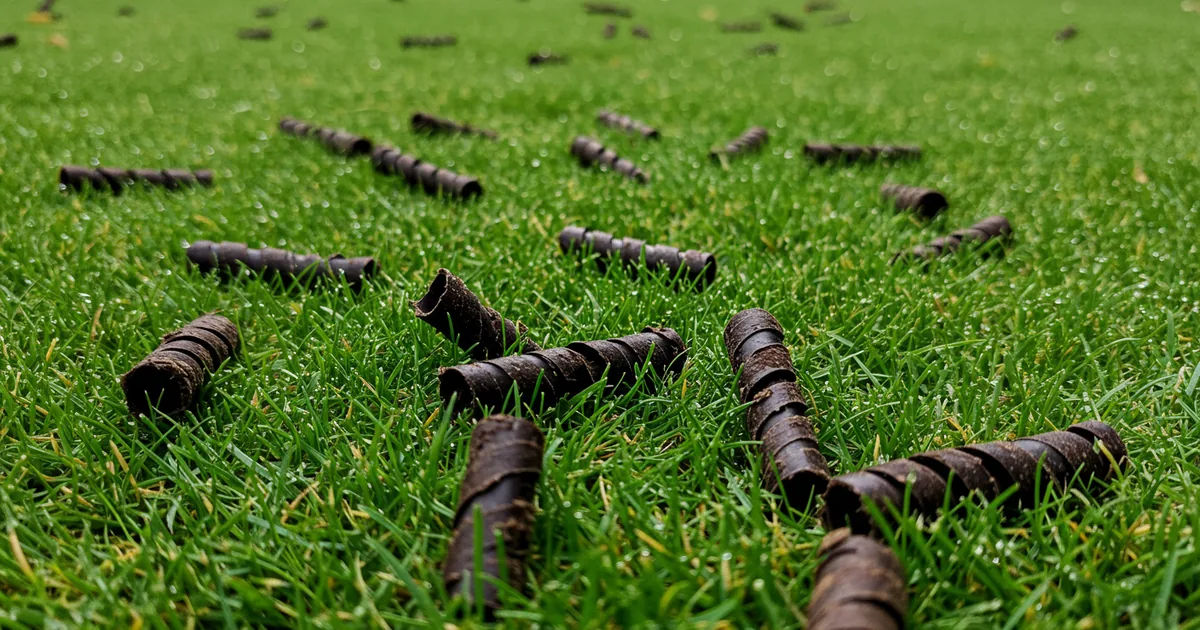
Aeration is the one to hire out
Core aeration — pulling plugs rather than poking holes — is the highest-value service on this list, and it’s the one where DIY math stops working.
Early fall is the best timing for cool-season lawns, which conveniently puts it in the same window as seeding. Coring also stresses the lawn less than dethatching with a power rake, and it reduces compaction at the same time.
A service runs roughly $107 to $202 nationally, with a second independent source putting it at $100 to $300 — those ranges corroborate each other, which is more than can be said for most home-services pricing. Against that: renting the machine, getting it home, running it, and returning it. The margin is thin and the machine is heavy. This is where hiring wins on the merits, and where it pays to compare the lawn and landscaping crews working your part of the metro before you book one.
Whoever does it, leave the plugs on the lawn to dry and crumble. Mowing them once dry redistributes the soil microbes that break down thatch. Raking them up throws away half the benefit.
Unrelated, and we know it — but Ellendale is worth a scroll.
What you can legally do yourself
There is a clean legal line here, and almost no local lawn content states it correctly.
On your own lawn: MU Extension puts it plainly — general-use pesticides “may be used by anyone, so long as the pesticide is used only on lands owned or rented by that person,” and “homeowners do not need a private applicator license.” Anything you can buy off the shelf at a hardware store is general-use. Read the label, follow it, and you’re fine.
On anyone else’s lawn, for money: Missouri law states that no individual shall use any pesticide “on the lands of another at any time without a certified commercial applicator’s license.” That’s $65 a year, under Category 3, Ornamental and Turf Pest Control, plus proof of financial responsibility through bond or insurance.
Which means the mowing side-hustle is fine, and the moment it becomes a spraying side-hustle it isn’t — not even once, not even as a favor with twenty dollars attached.
It also gives you a way to vet a lawn company in one sentence: “What’s your Missouri commercial applicator license number and category?” A legitimate operator has it ready. Certified applicators also recertify on a three-year cycle and must keep application records for three years, so a company that treats your yard should be able to tell you exactly what went down and when.
What hiring costs
There is no government or research source for lawn service pricing — not the Bureau of Labor Statistics, not the Department of Agriculture, not Extension. Every figure available comes from lawn-service marketplaces, which have an obvious interest in the framing. So treat these as national marketplace estimates, not St. Louis quotes:
Mowing: roughly $42 to $68 per visit.
Core aeration: $107 to $202.
Fertilization: $67 to $405 depending on program.
Full-service monthly: $100 to $410.
Mowing is the biggest line item in any full-service quote, because it’s the highest-frequency task. It’s also the lowest-skill one. If you want to cut a lawn bill in half without learning anything, mow it yourself and buy the rest.
The honest split
DIY genuinely wins on mowing, and on seeding and fertilizing your own lawn — where the law is entirely on your side and where timing beats technique. A homeowner who seeds on Labor Day weekend beats a professional who seeds in April, because MU says the April job risks complete failure regardless of who does it.
Hiring genuinely wins on core aeration, on anything touching a property you don’t own, on a lawn you suspect is zoysia and can’t confirm, and on a drainage failure — if water sits in that test hole past two days, you need grading and soil work, not a fertilizer program.
And if you do nothing else this year: put the seed and the fertilizer down in the first half of September. That single decision outweighs everything else on this page.
Frequently asked questions
When should I seed my lawn in St. Louis?
Between August 25 and October 10, with Labor Day weekend the sweet spot — MU Extension finds Labor Day seedings outperform October ones. Spring seeding is far riskier; MU states that with spring seeding “in some cases, complete failure should be expected,” because weeds outcompete seedlings and summer heat finishes them.
What is the best grass for St. Louis?
Turf-type tall fescue, ideally in a 90% fescue / 10% Kentucky bluegrass mix, is MU Extension’s long-standing recommendation for Missouri lawns. Zoysia is the warm-season alternative — tougher in summer but straw-colored from mid-fall to mid-spring. Bermudagrass is explicitly not recommended for our transition zone.
How much seed do I need per 1,000 square feet?
For tall fescue, MU specifies 7 pounds per 1,000 square feet when seeding in fall, and 10 pounds in spring. That 40% increase for spring seeding — for a worse expected result — is itself the strongest argument for waiting until late August.
When should I fertilize my lawn in Missouri?
For cool-season grass, September is the most important application at 1 to 1½ pounds of nitrogen per 1,000 square feet, with a half to one pound of slow-release in early-to-mid April and a moderate rate in late fall once temperatures fall below 50 degrees. Zoysia is the opposite — feed late May through mid-August and never into September.
Should I add sand to clay soil?
No. MU Extension warns that sand mixed with clay “can set up into a bricklike mixture,” and you would need 75% or more sand by volume before seeing any improvement. Use organic matter instead — 1 to 3 inches of compost worked into the top 6 inches — and note that topdressing generally does not help heavy clay unless combined with core aeration.
Do I need a license to spray my own lawn in Missouri?
No. General-use pesticides may be used by anyone on land they own or rent, and MU Extension states plainly that homeowners do not need a private applicator license. But applying pesticide on someone else’s property for compensation requires a certified commercial applicator’s license — $65 a year, Category 3 Ornamental and Turf.
How much does lawn care cost per month?
National marketplace estimates put full-service programs at roughly $100 to $410 a month, with mowing at $42 to $68 per visit and core aeration at $107 to $202. No government or research source publishes lawn service pricing, so treat all of these as national estimates rather than St. Louis quotes.
When should I aerate my lawn in St. Louis?
Once the mowing is handled, a bigger plan may be worth it — see what goes into hiring a landscape architect in St. Louis.
Early fall is best for cool-season lawns, which conveniently overlaps the seeding window — aerate, then seed, then fertilize in one operation. Zoysia and bermuda are different: mid-June is preferred, and only while actively growing. Leave the soil plugs on the lawn to dry and crumble rather than raking them up.
If your sign fell down tomorrow, would anyone online still know you exist? Need a pro instead? See our guides to landscaping services and sprinkler repair. Or browse local pros on St Louis Near Me Directory.
If you own a lawn care business, here is your part. You do good work. Why should getting more customers cost you a fortune and your trust? Six major AI engines are recommending local businesses today. Are you one of them? Find out →

Written by a dedicated team of St. Louis locals who live, work, and play right here in the St. Louis metro. Founder Lane Forman and team are committed to building the region’s most trusted directory by verifying listings and connecting local businesses with loyal customers across Missouri and Illinois.