What to Know Before Buying Plants in St. Louis
Revised August 21, 2026

What gardening zone is St. Louis, MO in?
St. Louis sits in USDA hardiness zone 7a — an average annual low of 0°F to 5°F — on the plant hardiness map the USDA released in November 2023. That was a half-zone warmer than the 2012 edition, which had the city in 6b. The 2023 map is built from 1991–2020 low temperatures at 13,412 weather stations, up from 7,983 last time.
Keep reading ↓Imagine it’s the second Saturday in May. You left the house in Kirkwood around nine, made one stop, and now there’s roughly $180 of plants riding home in the back — three hydrangeas, a flat of annuals, two tomatoes, and one small tree you absolutely did not plan on buying. Everything looked flawless under the shade cloth.
By the Fourth of July the hydrangeas are crisping at the edges, one tomato has stalled at knee height, and the tree has gone quietly yellow. Nothing dramatic happened. You watered it. You read the tag. The same slow disappointment plays out every summer from Florissant to Affton to Belleville, and it is almost never about how hard the gardener tried.
It usually comes down to three things settled before the car ever left the parking lot: which zone you actually garden in, which week you planted, and what your particular dirt does to a root ball. Sort those out and your shopping list gets shorter, cheaper, and a lot more forgiving. Here’s what to know before you spend the money.
What gardening zone is St. Louis, MO in?
St. Louis sits in USDA hardiness zone 7a — an average annual low of 0°F to 5°F — on the plant hardiness map the USDA released in November 2023. That was a half-zone warmer than the 2012 edition, which had the city in 6b. The 2023 map is built from 1991–2020 low temperatures at 13,412 weather stations, up from 7,983 last time.
The metro is not one single zone, though, and that matters when you are standing in front of a rack of shrubs reading tags. ZIP-code lookups against the 2023 map return 7a for downtown (63103), University City (63130), Kirkwood (63122) and Ballwin (63021). They also return 7a on the Illinois side for Belleville (62220), Edwardsville (62025) and Alton (62002). But St. Charles (63301) and St. Peters (63376) come back 6b — a full half-zone colder than the city.
So a marginal plant rated to zone 7 can be a reasonable gamble in Tower Grove and a bad one in O’Fallon, thirty-five minutes away. Look up your own ZIP at planthardiness.ars.usda.gov rather than trusting a generic “St. Louis” number. These lookups are keyed to the ZIP centroid, so if you live on a ridge or down in a bottom, treat the result as a starting point.
One more thing the zone number does not tell you: heat, humidity, and drainage. Zone 7a is a cold-hardiness rating and nothing else. Plenty of plants that survive a St. Louis January still fail in a St. Louis August, or drown in clay in a wet March. Hardiness gets a plant through winter. It does not get it through the rest of the year.
When should I start my garden in Missouri?
Cool-season crops go in early to mid-March; warm-season crops wait until frost danger has passed, which for most of this metro means late April into early May. The Missouri Botanical Garden puts the average last frost for east-central Missouri at April 15 and the first killing frost at October 15 — roughly 185 frost-free days, long enough for almost anything you want to grow.
Tomatoes are the one everybody rushes. The Garden’s own tomato factsheet is blunt about it: they should not go outdoors until frost danger is past and the soil has begun to warm, and in St. Louis that happens safely around May 15. Below 50°F they need protection, and fruit only sets when night temperatures land between 55°F and 75°F. A tomato planted April 20 does not beat one planted May 15. It just sits there, sulking, while the May plant catches up and passes it.
The official weather numbers are more generous, and the gap is worth understanding. At St. Louis Lambert International Airport, with records back to 1874, the National Weather Service puts the average last freeze of 32°F at April 5 and the average first freeze at October 31 — an average freeze-free stretch of 208 days. The latest spring freeze ever recorded there was May 10, 1966.
Why the two-week difference between the weather station and the garden? The airport measures 32°F in a sheltered instrument several feet off the ground. Frost forms on leaves at the surface, often when the official air temperature is still in the mid-30s, and cold air pools overnight in low spots along the Missouri and Mississippi bottoms. A raised yard in Webster Groves and a river-bottom lot in Chesterfield are not running the same calendar. The gardening date is the conservative one on purpose.
Practical version: cool-season vegetables — broccoli, cabbage, lettuce, spinach, onions, peas, potatoes, radishes — go in early to mid-March, then again in July and August for a fall crop. Warm-season vegetables and tender annuals go in from late April through mid-May. Cool-season crops tolerate a light frost but are usually killed outright below 25°F.
Is it cheaper to buy plants at a nursery or Home Depot?
On the sticker, usually yes — the big box is often cheaper for the same nominal pot size. But the comparison is rarely apples to apples, and the price gap is smaller than most people assume, because a lot of the plants in both places came off the same growing benches.
The USDA’s 2024 Census of Horticultural Specialties, released February 26, 2026, tracks where U.S. growers actually sell. Wholesalers were the largest channel at $6.33 billion. Home improvement stores were next at $2.19 billion, just ahead of retail florists at $2.17 billion and landscape contractors at $2.09 billion. Sales made on-site at the grower’s own place totaled $1.81 billion. So the divide is not “real plants here, fake plants there.” It is a distribution difference.
What actually differs is everything after the truck unloads. Pot sizes are not standardized, so a $12 “one gallon” and an $18 “one gallon” can hold noticeably different amounts of root. A plant that has been on a hot asphalt lot for three weeks with intermittent watering is not the same purchase as one that arrived Thursday. And the second half of the price — whether anyone on the floor can tell you what happens to that shrub in clay, in full afternoon sun, in year three — is not on the tag at all.
Fair way to shop it: buy commodity items on price, and buy anything that has to live more than one season on condition and advice. Bagged mulch, soil, annual flats and basic vegetable starts are commodities. A $200 tree that will be in your yard for forty years is not.
What is the difference between a nursery and garden center?
A nursery grows plants. A garden center sells them, along with soil, pots, tools and everything else. In practice the words get used interchangeably around here, and plenty of local businesses are honestly both — growing some of their own stock and buying in the rest.
Purdue Extension’s guide to the nursery business splits the trade into three formats, which is a useful lens when you are trying to figure out what kind of place you just walked into. Landscape nurseries grow plants for retail sale and for their own installation crews. Retail nurseries and garden centers grow on limited acreage and sell to homeowners and contractors. Wholesale nurseries propagate and grow at volume and sell to other nurseries, landscapers and retail outlets rather than to the public. That last distinction matters if you are weighing doing the planting yourself against hiring it out — here is how to choose a landscaping company in St. Louis.
Why you should care: a place with its own growing ground has usually kept plants through a St. Louis winter and an August heat dome, and the staff has watched what died. A pure retail operation may still be excellent, but its knowledge comes from selling rather than growing. Both are legitimate. Ask which one you are in, and ask where a given plant was grown.
Wildly off-topic — here’s where to get your car detailed.
Why do healthy plants die in St. Louis clay soil?
Because the root ball never leaves the hole. In heavy clay, a hole dug with a shovel and backfilled with fluffy potting mix acts like a bucket: water runs in, cannot move out through the surrounding clay, and the roots sit in it. The plant leafs out on stored energy in spring, then declines through summer. It looks like a watering mistake. It is a drainage problem.
Our dirt is specific. Menfro silt loam is Missouri’s state soil, formed in deep loess along the Missouri and Mississippi river bluffs, and the USDA’s official series description places it in central and eastern Missouri and in west-central and southwestern Illinois — both sides of the river. The surface is a silt loam, but the subsoil grades into silty clay loam. Strip the topsoil during construction and that subsoil is what you are handed.
The Missouri Botanical Garden’s Rainscaping Guide states it plainly: much of the soil in the St. Louis region is compacted silt topsoil or exposed clay subsoil that needs amending and aeration, and if your place was built less than five years ago, expect the soil to have little ability to absorb rainwater. That is a subdivision problem as much as a soil problem, and it explains why a house in a new Wentzville or Shiloh development can be harder to garden than a hundred-year-old lot in Maplewood.
There is a free test that settles it before you buy anything. MU Extension’s guide to improving lawn and landscape soils says to dig your planting holes in advance and fill them with water. If the water is gone in 18 to 24 hours, drainage is satisfactory. If it stands for two days or more, the soil is poorly drained — pick water-tolerant plants, or build a raised bed or a mound. Do that on a Saturday and you will shop very differently on Sunday.
What actually works in clay:
- Dig the hole at least twice as wide as the root ball and no deeper than the root ball. Loosened soil under the ball settles, and the plant sinks into a depression that collects water.
- In heavy clay, set trees and shrubs a few inches above the grade of the surrounding soil, or mound-plant outright.
- Do not build a rich pocket in the hole. The Garden’s tree-planting factsheet says it is no longer recommended to add large amounts of peat or compost to the planting hole. Work organic matter into the soil around the plant instead — about 3 feet across for a small plant, 6 to 10 feet for a large tree.
- Plant at the depth it grew in the pot. Deep planting can kill a tree slowly, over years, in a way that never looks like a planting error.
- Aim for organic matter in the 4 to 6 percent range for beds and landscapes; MU Extension notes Missouri soils typically run about 2.5 to 3 percent. The Garden’s rainscaping guidance is a little higher, calling 5 to 10 percent ideal and 10 to 15 percent for vegetables. Either way, most local yards start below the target.
What should you inspect before you buy a plant?
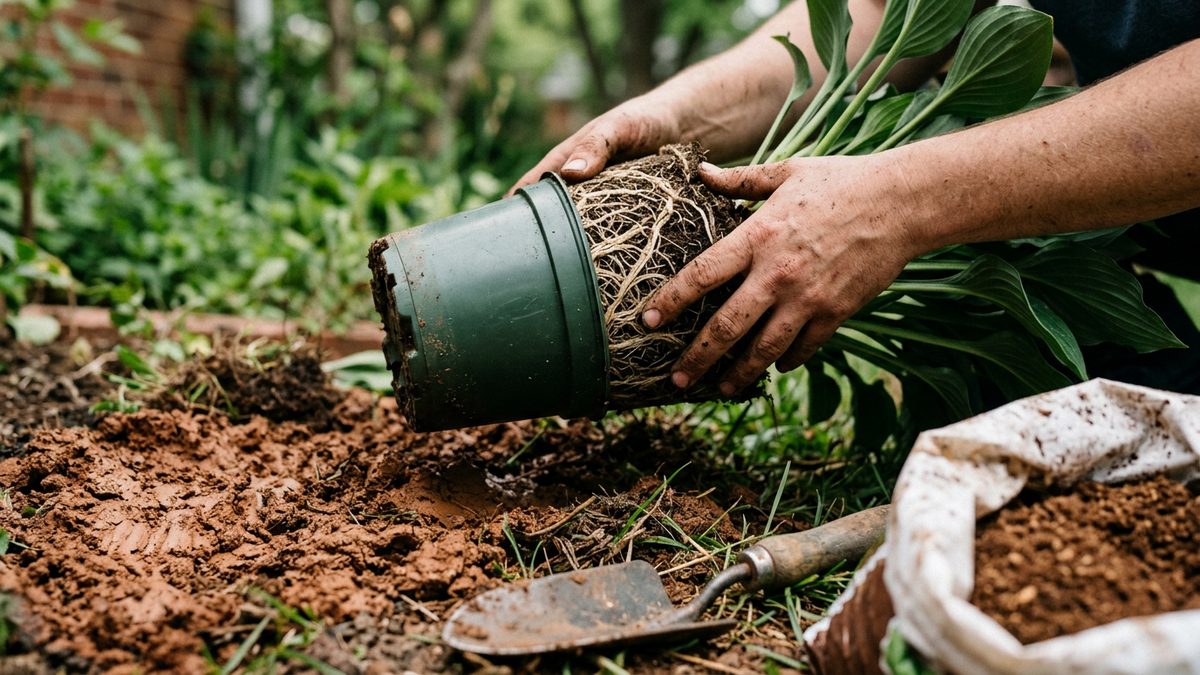
Turn it over and look at the roots. That is the single most useful thing you can do in a garden center, and almost nobody does it. Slide a container plant partway out of its pot. Roots circling tightly around the outside mean the plant has been in that pot too long, and it will keep circling in the ground unless you cut them.
The fix is more aggressive than most people expect. The Missouri Botanical Garden’s planting guidance says to cut and fray the root ball, and that removing one-fourth to one-half of the roots in the outer inch of a root-bound plant should not hurt establishment — it should actually stimulate growth. Bring that up at the register. A good salesperson will agree with you.
- Read the tag for sun hours and water needs, not for the flower photo. Know how many hours of direct sun your spot really gets before you leave the house.
- Check the hardiness number on the tag against your own ZIP, not against “St. Louis.” A zone 7 rating means something different in Ballwin than in St. Peters.
- On balled-and-burlapped stock, plan to remove all twine from the trunk at planting — twine left tied can strangle a tree after a few years — and remove plastic burlap entirely.
- Bare-root plants are cheaper and generally available only in early spring. They are also more perishable, so plant fast and soak the roots up to 12 hours first.
- Look under the leaves for insects and check for mushy stems or a sour smell at the soil line. Ask when the shipment came in.
- Buy fewer, better plants. Three well-chosen shrubs that fit the site beat nine impulse buys that do not.
When is the best time to buy trees and shrubs in St. Louis?
Fall, for most woody plants. University of Missouri horticulturist David Trinklein, writing in September 2021, recommends planting trees and shrubs from September until the end of October, which leaves enough time for good root development before the soil gets too cold. Warm soil plus cool air means less stress on the top of the plant and more energy going into new feeder roots.
The Missouri Botanical Garden gives a similar window for balled-and-burlapped stock: early spring from April through June, or fall from late August into October. The exception is marginally hardy species, which are better saved for spring so they are not asked to survive a hard first winter on a three-month-old root system.
There is a money angle too. Living inventory is the only retail category that dies if it does not sell, and holding it through winter costs real money, so late-season clearance on trees, shrubs and perennials is genuinely common. How deep the discount runs varies by store and by what is left, so treat it as worth checking rather than guaranteed. Water anything you buy in fall thoroughly, and keep it moist without drowning it, right up until the ground freezes.
How do plant guarantees actually work?
A plant guarantee is a replacement promise with conditions, not a refund. The common shape across published nursery policies: trees, shrubs, evergreens and perennials are covered for one year from the date of purchase; annuals and houseplants usually are not covered at all. That one-year term is the single biggest reason to keep the receipt.
What claims typically require, and what they typically exclude:
- The original receipt. Nearly every policy requires it, and many want the dead plant back or a clear photo of it.
- A one-time replacement or store credit for the purchase price. Replacements are usually not themselves guaranteed, and labor and delivery are usually excluded.
- Weather damage — frost, freeze, wind, storm — is commonly excluded, along with animal damage, vandalism and neglect.
- Some policies only apply if the store did the planting, or are prorated after a certain number of months.
Terms differ genuinely from store to store, including between independents and national chains, so the only reliable move is to ask before you pay and get the answer written on the receipt. A guarantee is also a quiet signal about sourcing: a business that stands behind a plant for a year has an incentive to sell you something that survives here.
What does the plant business look like from behind the counter?
It is the one retail category where the inventory dies if nobody buys it, and it has to be watered every single day either way. The USDA’s 2024 Census of Horticultural Specialties shows labor as the largest production expense in the trade nationally — $5.57 billion of $14.9 billion, up 14 percent since 2019 — while the pots, growing media and seed line rose 39 percent and fertilizer and chemicals rose 54 percent. Meanwhile 61 percent of U.S. horticultural operations sell under $100,000 a year. This is a small-business trade with perishable stock and a compressed selling window: spring is the year, and a cold, wet April cannot be made up in July.
The money is also not where shoppers think. Nursery stock is 30 percent of all horticultural sales nationally, and broadleaf evergreens alone are 18 percent. The unglamorous green shrub pays the bills; the flowering thing on the front table gets the photograph. The complaint you will hear from operators is people shopping by bloom instead of by site — arriving without knowing how many hours of sun the spot gets. Owners in this category live and die on being found in the six weeks that matter, which is why a complete, accurate listing on St Louis Near Me Directory is worth the twenty minutes it takes.
Where can you get free plant advice in St. Louis?
The Missouri Botanical Garden’s Plant Finder is free, public, and probably the most underused gardening tool in the metro. It is a searchable database you can filter by zone, sun, water, height and bloom time — and, critically for this region, by tolerances including clay soil, heavy shade, drought, deer and urban conditions. You can also filter to Missouri natives and to the Garden’s Plant of Merit list.
The Garden also runs a Horticulture Answer Service by phone and email, Monday through Friday, 9 a.m. to noon, at (314) 577-5143 or plantinformation@mobot.org. No visit or ticket needed to ask a question. On the grounds, the Plant Doctor Desk at the William T. Kemper Center for Home Gardening is staffed by Garden experts and Master Gardener volunteers, and the Garden asks that you bring photos rather than plant samples so its own collections are not exposed to pests.
If you do want to walk the demonstration gardens, admission checked on August 21, 2026 was $16 for general admission ages 13 and up, $6 for the St. Louis resident rate, and $4 for residents 65 and over with proof of residency. Members are free. Hours are 9 a.m. to 5 p.m. with last entry at 4:30 p.m. The Garden has offered free or discounted resident windows at various times, so confirm the current terms on its hours and admission page before you plan around one.
Ready to buy plants that will actually live here? Browse nurseries and garden centers across the St. Louis metro on St Louis Near Me Directory, then call ahead and ask two questions: what did you grow yourself, and what is your guarantee?
Frequently asked questions
Are plants more expensive at a nursery?
Often yes on the sticker, and the gap narrows fast once you compare what you are actually getting. Pot sizes are not standardized, so two “one gallon” plants can hold different root volumes. Nurseries also tend to carry larger, older stock and to hold plants under better conditions. Compare root mass, condition and how long it has been on the lot, not the label.
What month should you start planting a garden?
March for cool-season crops in the St. Louis area, May for warm-season crops. The Missouri Botanical Garden recommends planting cool-season vegetables like broccoli, lettuce, spinach, peas and potatoes in early to mid-March, then again in July and August for fall. Warm-season crops go in from late April into early May, with tomatoes safest around May 15.
How late is too late to start a vegetable garden?
Count backward from the first fall freeze. The National Weather Service puts the St. Louis average first freeze at October 31, so mid-August still leaves roughly 70 frost-free days — enough for lettuce, spinach, radishes, kale and bush beans. September plantings work under row cover. Long-season crops like tomatoes and peppers need to be in the ground by early June.
Where is the cheapest place to get garden plants?
Cheapest per plant is usually seed, then bare-root stock in early spring, then end-of-season clearance in late summer and fall. Divisions from a neighbor cost nothing at all. Big-box stores typically beat independents on sticker price for common annuals and small containers. For anything meant to live for years, condition and correct selection save more money than the discount does.
What is the 3-year rule for plants?
It is the gardening rule of thumb usually stated as sleep, creep, leap: a perennial spends its first year building roots with little visible growth, its second year spreading modestly and blooming lightly, and its third year reaching full size and flowering. It is folk wisdom rather than a measured standard, but it is a fair warning against pulling something out too soon.
What is the 70/30 rule in gardening?
It is a design guideline, and it has more than one version. The best known, associated with designer Piet Oudolf, puts about 70 percent of a planting into long-lived structural plants that carry the space year-round and 30 percent into seasonal fillers for color. A separate native-plants version, associated with entomologist Doug Tallamy, uses 70 percent natives to 30 percent non-invasive non-natives.
How much does it cost to get into the Botanical Gardens in St. Louis?
Checked August 21, 2026, the Missouri Botanical Garden lists $16 general admission for ages 13 and up, a $6 St. Louis resident rate, and $4 for residents 65 and over with proof of residency. Members enter free. Hours are 9 a.m. to 5 p.m., last entry 4:30 p.m. Resident and free-admission offers change, so confirm on the Garden’s hours and admission page.
What is the most common plant sold at nurseries?
By dollar value it is woody nursery stock, and within that, broadleaf evergreens. The USDA’s 2024 Census of Horticultural Specialties, released February 2026, put nursery stock at $5.34 billion — 30 percent of all U.S. horticultural sales — with broadleaf evergreens alone at 18 percent of the total. Annual bedding and garden plants came second at $2.67 billion.

Written by a dedicated team of St. Louis locals who live, work, and play right here in the St. Louis metro. Founder Lane Forman and team are committed to building the region’s most trusted directory by verifying listings and connecting local businesses with loyal customers across Missouri and Illinois.