What You Can Actually Recycle in St. Louis (and Where the Hard Stuff Goes)
Revised August 16, 2026

Are Ziploc bags really recyclable?
No. Zip-top bags are film, and bags and film are rejected across the metro because they wrap around the spinning screens at a sorting facility and have to be cut out by hand. Clean, dry bags and wrap belong in a grocery store’s front-of-store film bin. And never bag your recyclables: a sealed bag of good material gets pulled off the line as trash.
Keep reading ↓Imagine it’s a Saturday morning in Affton and you’re standing over the bin holding a dead drill battery in one hand and a greasy pizza box in the other. Neither one feels obvious. The battery seems like something that ought to be recycled. The box is cardboard, and cardboard is supposed to be the easy one.
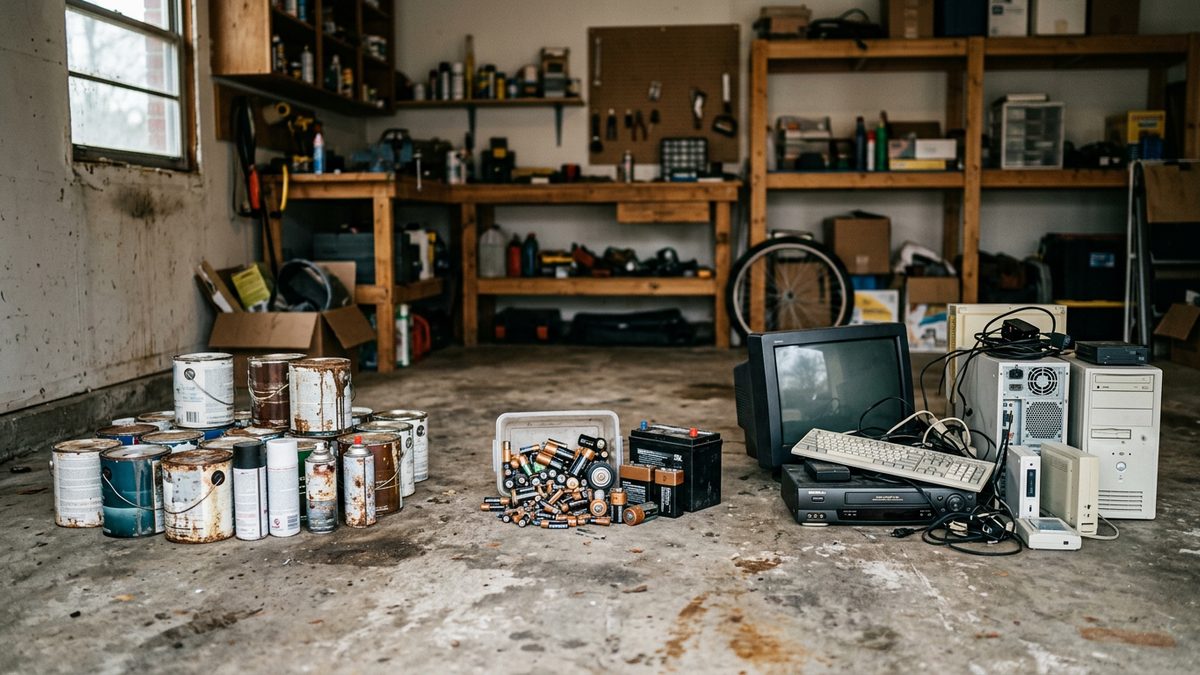
Or it’s a garage in Florissant: half a can of deck stain from 2019, four bald tires behind the mower, a tube television nobody has switched on in a decade. Or a condo in Belleville, where the recycling can has to be marked RECYCLE and you’re holding a bag stuffed with other bags.
Here’s the honest version. The answer depends on which side of a city line you’re standing on. Not roughly — literally. Kirkwood, unincorporated St. Louis County and the City of St. Louis run three different systems, and the Illinois side is a fourth.
What can you actually put in the recycling bin?
Five things, in nearly every program around here: paper and flattened cardboard, plastic bottles and containers, glass bottles and jars, metal food and beverage cans, and food and beverage cartons. The City of St. Louis compresses the rest of the rule into four words — loose, clean and dry. Nothing in a bag.
Clean means rinsed, not scrubbed. Dry means the paper riding next to it still has value at the sorting line. Flatten the cardboard every time.
What are 5 things that cannot be recycled? Plastic bags and film, Styrofoam, food waste, needles and sharps, and one-time-use disposables. Styrofoam is technically recyclable somewhere in the world. There is no local processor for it, so here it is trash.
Why do the rules change when you cross a city line?
Because curbside recycling here is set by whoever holds the contract, and that is rarely the same body twice. St. Louis County writes a minimum level of service into its waste ordinance — weekly trash, weekly recycling, twice-yearly bulky pickup for one monthly fee — but that floor covers only one- and two-family homes, and the county runs trash districts only in unincorporated areas.
Every municipality inside the county signs its own hauler contract, so Ballwin’s rules belong to Ballwin’s hauler. The City of St. Louis operates its own refuse division. Across the river, Belleville collects weekly in that marked 32-gallon can and takes glass bottles and jars, newspaper, office paper, unwaxed flattened cardboard, aluminum and tin — and no electronics of any kind.
So pull up your own city’s waste page, not a generic one. Two neighbors across a boundary street can both be right and still disagree about a yogurt cup.
What gets a whole truckload of recycling rejected?
Bagged recyclables, tanglers and food-soaked cardboard, mostly. The local numbers are brutal. From January through May 2025, more than half of everything the City of St. Louis collected from alley recycling dumpsters was rejected at the recycling center for contamination. When the city tested collecting from roll carts and drop-off sites only in July 2025, contamination fell to 25% or less.
That is why alley recycling ended in August 2025 and those blue alley bins became trash dumpsters. Since the change, the city reports contamination down 83% and the tonnage actually recycled up 8%.
What is surprisingly not recyclable? Tanglers, the ones nobody guesses. Garden hose, extension cords, string lights, rope and plastic bags wind around the spinning screens at a sorting facility, and somebody has to climb in with a knife and cut them free. Grease and cheese wreck paper fiber: tear off the clean pizza box lid, trash the soaked bottom. Wishcycling is how a load that would have paid becomes a load somebody pays to bury.
Is glass still worth recycling in St. Louis?
Yes. The City of St. Louis and Belleville both take glass bottles and jars at the curb. But glass has been the troubled material here for years, and the reason is mechanical rather than moral. In a single-stream truck glass breaks, the shards migrate into paper and plastic, and a bale of paper with glass in it is worth less to a mill.
So a separate channel exists. Ripple Glass — started in Kansas City in 2009 by the owners of Boulevard Brewing, bought by Strategic Materials in 2022 — expanded into St. Louis and runs free purple drop-off bins around the metro, open to anyone. Glass left there is crushed into cullet for manufacturers instead of screened out as residue.
Nothing to do with bins — lawn and garden season arrives sooner than expected.
Where do old electronics and TVs actually go?
It depends which state you’re in, and the difference is legal rather than cultural. Illinois has banned electronics from landfill disposal since January 1, 2012 under the Electronic Products Recycling and Reuse Act, tightened by the Consumer Electronics Recycling Act in 2017. Televisions, monitors, computers, tablets and printers cannot go in an Illinois trash can at all.
Missouri has no residential landfill ban. The Missouri Department of Natural Resources says plainly that most electronics from a home can legally be thrown away, while recommending you don’t. What Missouri has instead is manufacturer takeback: under the state’s Electronics Scrap Management Rule, computer equipment bought in Missouri after July 1, 2010 carries a recovery plan, and the manufacturer has to collect and recycle it at no cost to a household.
One trap before you drive anywhere: the region’s two permanent household hazardous waste facilities list electronics, televisions and monitors among the things they will not take. E-waste is a separate errand.
Where does household hazardous waste go in St. Louis?
Two permanent facilities, appointment only, open to residents of St. Louis City, St. Louis County and Jefferson County. The South facility sits at 291 E. Hoffmeister and runs Thursdays and Fridays plus alternating Saturdays. The North facility is at 4100 Seven Hills Drive in Florissant, Wednesdays plus alternating Saturdays. Weekday slots are 8:30 to 11:45 a.m. and 1:00 to 5:20 p.m.
Bring proof of address — a utility bill or your driver’s license. The first 50 pounds are subsidized; past that it runs $1.70 per pound, and latex paint is 50 cents per pound. Saturday dates alternate between the two sites, so book before you load the car. The scheduling line is 314-615-8958.
They accept paints, stains and varnishes, pesticides and herbicides, gasoline, motor oil and filters, antifreeze, transmission fluid, and alkaline and car batteries. They refuse explosives, ammunition, radioactive material, appliances, electronics and medical waste. Waste from a business, church, school or government office isn’t accepted here at all.
What about paint, tires, mattresses and old appliances?
Latex paint doesn’t have to be an errand. Missouri’s DNR says to open the can, stir in kitty litter, sand, shredded newspaper or a paint hardener, leave the lid off until it dries into a hard crumble, then put it in the household trash. Oil-based paint is flammable in any state and belongs at a hazardous waste facility.
Tires have been banned whole from Missouri landfills since the 1990 law that also banned major appliances, waste oil and lead-acid batteries. The 50-cent fee on every new tire sold in Missouri funds the state cleanup program. A tire shop will take your old ones for roughly $3 to $5 each. Missouri does allow a homeowner to trash a tire cut through the tread or with the sidewalls removed.
Mattresses have no statewide recycling program in Missouri or Illinois, unlike the handful of states that fund one through a purchase fee. A recycling center that takes them charges by the piece, a hauler charges more and comes to you, and a retailer delivering a new set will usually take the old one if you arrange it at purchase.
Refrigerators, freezers and air conditioners have been banned from Missouri landfills since January 1, 1991, and the refrigerant has to be recovered by a certified technician rather than vented. If the unit still runs, Ameren Missouri pays $50 and hauls it away free through its fridge and freezer recycling program.
Which batteries start fires in garbage trucks?
Lithium-ion. The rechargeable cell inside a laptop, a cordless drill, a phone, a hoverboard, a disposable vape. Crushed in the back of a packer truck or inside a baler, it enters thermal runaway, and that fire feeds itself and shrugs off water. Industry tracking counted 448 publicly reported fires at North American waste and recycling operations in 2025, with roughly $2.5 billion in estimated damage.
So none in the recycling cart, and none in the trash either. Tape the terminals with clear packing tape, bag it on its own, and take it to a hazardous waste facility or a retail battery drop-off. A swollen or damaged cell should go promptly rather than sit in a kitchen drawer.
Car batteries are the older, easier problem. Lead-acid has been banned from Missouri landfills since 1991, and nearly anywhere that sells one takes one back — the core charge on your receipt is the deposit that makes that happen.
Where do motor oil, propane tanks and old pills go?
Used motor oil is banned from Missouri landfills and is simple to hand off. Most auto parts stores and quick-lube shops accept do-it-yourself oil free, commonly up to five gallons at a time, so long as it hasn’t been mixed with antifreeze, solvent or water. Once it’s mixed it stops being recyclable oil and becomes hazardous waste. Filters can be recycled too, but call ahead.
Propane tanks never go in a cart, a dumpster or a drop-off bin, because nobody downstream can be certain they’re empty. For a standard 20-pound grill tank, the exchange cage at a gas station or hardware store is the industry’s take-back loop: swap it, and the old shell becomes their problem. To be rid of one for good, ask an exchange or refill dealer to retire it. The one-pound camping cylinders are the awkward case.
Leftover medication should not be flushed. Many area police departments run permanent drop boxes, the St. Louis County Police Department keeps collection bins at several sites, and thousands of pharmacies take medication back year round. On the DEA’s April 25, 2026 take-back day, more than 30,000 pounds came in across the 323 collection sites in its St. Louis Field Division.
What a small business owner learns the first time they price a dumpster
Commercial waste is a contract, not a service the city owes you. A shop signs for a front-load dumpster — nationally, a four-yard container on weekly pickup runs around $110 to $200 a month — and the fine print bites: a one- to three-year term, an annual escalator, and fuel and environmental surcharges outside the quoted rate. A compactor costs real money up front and pays back only above roughly one pickup a week.
Cardboard is the one stream that can pay instead of cost. Baled old corrugated has traded near $100 to $130 a short ton through 2026, under the five-year average around $140 — real money at volume, on a clean bale, with a baler you own. And a Missouri business cannot do what a household can with retired computers: businesses, schools, churches and nonprofits are barred from landfilling certain electronics, and a serialized certificate of destruction settles the customer-data question two years later. Operators who are easy to find locally get the call, and being listed and complete is the cheap half of that.
Related reading: reporting what was dumped and what to do with the old sofa.
Still holding the thing you don’t know what to do with? Browse recycling centers across the St. Louis metro on St Louis Near Me Directory, then call the closest one and read your item out loud before you load the car.
Frequently asked questions
Are Ziploc bags really recyclable?
No. Zip-top bags are film, and bags and film are rejected across the metro because they wrap around the spinning screens at a sorting facility and have to be cut out by hand. Clean, dry bags and wrap belong in a grocery store’s front-of-store film bin. And never bag your recyclables: a sealed bag of good material gets pulled off the line as trash.
Does the City of St. Louis still pick up recycling in the alley?
No. The city ended alley recycling in August 2025, after more than half the material collected from alley dumpsters between January and May 2025 was rejected for contamination. Those blue bins are trash dumpsters now. Residents without a roll cart use the city’s single-stream drop-off sites, most open around the clock.
Where can I take an old TV in the St. Louis area?
Not to a household hazardous waste facility — both permanent sites list televisions and monitors among the items they refuse. In Illinois, televisions have been banned from the trash since 2012, so a certified electronics collector or a county collection event is the route. Missouri has no residential ban, but recyclers and collection events take them, often for a fee on tube sets.
How much does it cost to drop off hazardous waste in St. Louis?
The first 50 pounds are subsidized for residents of St. Louis County, St. Louis City and Jefferson County. Above that it’s $1.70 per pound, and latex paint runs 50 cents per pound regardless. Appointments are required at both the South facility on E. Hoffmeister and the North facility on Seven Hills Drive, and you’ll need proof of address.
What do I do with a dead lithium-ion battery?
Tape the terminals with clear packing tape, bag it on its own, and take it to a hazardous waste facility or a retail battery drop-off. Never the recycling cart, never the household trash. Crushed inside a truck or a baler, a lithium cell can go into thermal runaway; there were 448 publicly reported fires at North American waste and recycling operations during 2025.
Is glass recyclable in St. Louis?
Glass bottles and jars are taken at the curb by the City of St. Louis and by Belleville, though not by every metro program, because broken glass contaminates paper and wears down sorting equipment. Free purple Ripple Glass drop-off bins sit around the region for that reason, and glass left there is crushed into cullet. Window glass, mirrors, ovenware and light bulbs are never accepted.
What are 5 things that cannot be recycled?
Plastic bags and film, food-soaked cardboard, tanglers like hoses and cords and holiday lights, anything with a lithium-ion battery in it, and household hazardous waste such as paint or motor oil. None of those belong in a curbside cart anywhere in the metro. The last two are not just rejected — they start fires in trucks and at sorting facilities.
Which items cannot be recycled?
Beyond the obvious five, the routine offenders here are bagged recyclables, greasy pizza boxes, polystyrene foam, disposable cups with a plastic lining, and ceramics or window glass mixed in with bottles. Bagging is the big one locally — more than half of what the City collected from alley dumpsters in early 2025 was rejected for contamination, which is why alley recycling ended that August.
Do I have to rinse containers before I recycle them?
Rinse, don’t scrub. The standard across metro programs is loose, clean and dry: empty the liquid, get the food residue out, let it dry. A container with real food still in it contaminates the paper riding beside it and can get a whole load downgraded. Pizza boxes are fine if you recycle only the clean top.

Written by a dedicated team of St. Louis locals who live, work, and play right here in the St. Louis metro. Founder Lane Forman and team are committed to building the region’s most trusted directory by verifying listings and connecting local businesses with loyal customers across Missouri and Illinois.