Transforming St. Louis: A Comprehensive City Cleanliness Program
Revised August 10, 2026

How can illegal dumping be prevented?
Illegal dumping is prevented best by pairing deterrence with easy alternatives: camera surveillance (St. Louis runs about 275 anti-dumping cameras), cleaning up existing messes fast (people dump where it’s already dirty), convenient free bulk-disposal so the legal option beats the alley, and community and corporate cleanup partnerships — like the $1 million Boeing grant that cleared Kinloch. Enforcement alone rarely holds; deterrence plus easy disposal and local pride does.
Keep reading ↓Drive down the wrong alley in parts of St. Louis on a Tuesday morning and you’ll see it before you smell it: a mattress slumped against a fence, a busted TV, bags that split open in the last rain. Ride down a main drag — Gravois, Kingshighway, West Florissant — and you’ll watch a fast-food bag sail out of a car window at 40 miles an hour. Chicken bones. A diaper. We wish we were exaggerating. We’re not.
Those of us who have lived in the city 20-plus years know the reputation, because St. Louis earned it honestly. “Trashy” is a word this town has worn for a long time. But here is the part we hesitate to say out loud, because it sounds too much like a sales pitch: over the last few years, it has gotten noticeably better. Not fixed — certain pockets are still magnets for illegal dumping, and litter still blows across every ZIP code — but better. Cleaner blocks. Fewer tires in the creeks. More people who seem to actually care.
This is the honest story of how St. Louis got dirty, who is quietly cleaning it up right now — from a $1 million Boeing grant in Kinloch to the volunteers who have shown up for Brightside since 1982 — what has actually worked in other cities that turned the corner, and how you can be part of it, whether you own a business here or just love the place.
Why does St. Louis have a reputation for being dirty?
The short answer: St. Louis is a big city that lost most of its people. The population peaked around 856,000 in 1950 and sits closer to 280,000 today — inside a metro of roughly 2.8 million. When more than half a city moves away over a few decades, it leaves behind something specific: vacant lots, empty buildings, and long stretches where nobody is watching. The city’s land bank, the Land Reutilization Authority, holds thousands of those vacant parcels. An empty lot with no owner around is exactly where a contractor with a truck full of demolition debris dumps it at 2 a.m. rather than pay the landfill fee.
So the trash breaks into two different problems, and it matters that we don’t blur them. Illegal dumping — the mattresses, the tires, the truckloads of construction waste — concentrates heavily in North City’s alleys and vacant lots, where the dumper counts on nobody looking. Litter — the bottles, the bags, the car-window stuff — is genuinely citywide, South City to North, Dogtown to Baden. Most neighborhoods deal mostly with litter and the occasional dumped couch; the heavy, organized dumping is a North City burden the rest of the city rarely sees.
Here is the part most people never think about, and it’s the reason litter is more than an eyesore. That plastic bottle in the gutter doesn’t just sit there. The next hard rain washes it into a storm drain, and St. Louis storm drains run to the River Des Peres, then the Mississippi. The bag that blew out of a car in Affton can end up wrapped around a turtle downstream, or broken into microplastics in the water a city pulls its drinking supply from. Litter is a water-pollution problem wearing a disguise.
And it costs money — real money, your money. Every hour a city crew spends hauling an illegally dumped pile of shingles is an hour not spent fixing a park, and every dollar spent chasing dumpers is a dollar not spent on a rec center or a streetlight. A dirty city taxes itself twice: once in what the mess does to property values and business, and again in what it costs to clean up.
Is St. Louis actually getting cleaner?
Honestly? Yes — slowly, unevenly, and mostly in effort rather than in a tidy statistic you can frame. We want to be straight with you here, because the whole point of this piece is trust: the same police unit that runs the cameras will tell you the problem is far from solved. What has changed is that the city stopped treating dumping as background noise and started treating it as a crime with a badge behind it.
The St. Louis Metropolitan Police Department’s Environmental Investigations Unit now monitors roughly 275 surveillance cameras trained on the alleys and vacant lots that dumpers favor, funded in part with federal American Rescue Plan money, and it has issued a record number of citations for illegal dumping. The Citizens’ Service Bureau — the city’s 311 line, at 314-622-4800 — takes dumping reports, and the city offers a reward of up to $100 for a tip that leads to a conviction. Is it enough? No. But a dumper who used to face zero odds of getting caught now faces a camera and a fine, and that changes the math.
Who is cleaning up St. Louis right now
This is the part that surprised even us when we started digging. St. Louis isn’t waiting to be rescued — a whole patchwork of people, nonprofits, neighborhoods, and even Fortune-100 corporations are already at it. Some of these efforts are 40 years old. Some are brand new. Together they’re the real reason the city looks a little better than it did.
Brightside St. Louis has been at this the longest. It started in 1982 as Operation Brightside, after a 1981 city survey asked residents to name their biggest problem and the answer came back: a dirty city. More than four decades later it’s still the city’s flagship beautification nonprofit, fielding about 6,000 volunteers a year for litter cleanups, tree and flower plantings, and neighborhood blitzes. If you have ever wanted a place to start, that’s it. (See brightsidestl.org.)
Neighborhood associations do the quiet, unglamorous work between the big events — many organize one or two cleanups a month, block by block, with borrowed grabbers and their own trash bags. It’s worth sitting with what that means: a handful of neighbors, a couple hours, a visibly cleaner street. Now imagine ten more people on each of those blocks. Imagine what a whole city’s worth of that looks like. The ceiling on this is enormous, and it costs almost nothing but showing up.
Off on a tangent: every business in Ballwin, in one place.
Kinloch and Boeing is the story that should make national news. In May 2026, Boeing awarded the tiny north-county city of Kinloch a $1 million grant — what Boeing calls the largest cleanup effort in the city’s history — to clear roughly 300 tons of illegally dumped trash across about 100 acres. Kinloch is Missouri’s first incorporated Black city; it once had about 4,455 residents in 1980 and was hollowed out to just 263 by 2020 after an airport-noise buyout bought up and demolished more than a thousand homes, leaving vacant land that became a decades-long dumping ground. Boeing’s Berkeley offices sit less than 500 yards away, and the company has put 300-plus volunteers on the ground alongside the check. When a global aerospace company decides a 263-person town’s trash is its problem too, something is shifting. (Details via the St. Louis Economic Development Partnership.)
The Rams settlement is rebuilding North City. On July 2, 2026, the Board of Aldermen passed the plan for the city’s $255 million NFL relocation settlement, and the single largest slice — $120 million — goes to North St. Louis recovery and neighborhood plans, much of it aimed at the May 16, 2025 tornado that tore through North City and damaged more than 10,000 properties. “What we’re doing here is making a sizeable investment in north St. Louis, both in the tornado zone and recognizing we have to make investment around other parts of north St. Louis as well,” Mayor Cara Spencer said of the plan. (The remaining funds: $70 million for infrastructure, $55 million for downtown, and $10 million specifically for reducing vacant property — the very lots where dumping thrives.)
RECA is cleaning up an older, deeper mess. Some of the region’s worst contamination isn’t litter at all — it’s the Manhattan Project nuclear waste that has sat in Coldwater Creek and the West Lake Landfill in North County for generations. In July 2025, an expansion of the federal Radiation Exposure Compensation Act, championed by Senator Josh Hawley, was signed into law and for the first time covered St. Louis-area victims. One year in, nearly 15,000 Missouri claims have been filed and about $150 million has been paid to families. It doesn’t haul away a single tire, but it’s the same story: a region finally forcing a long-ignored mess into the light.

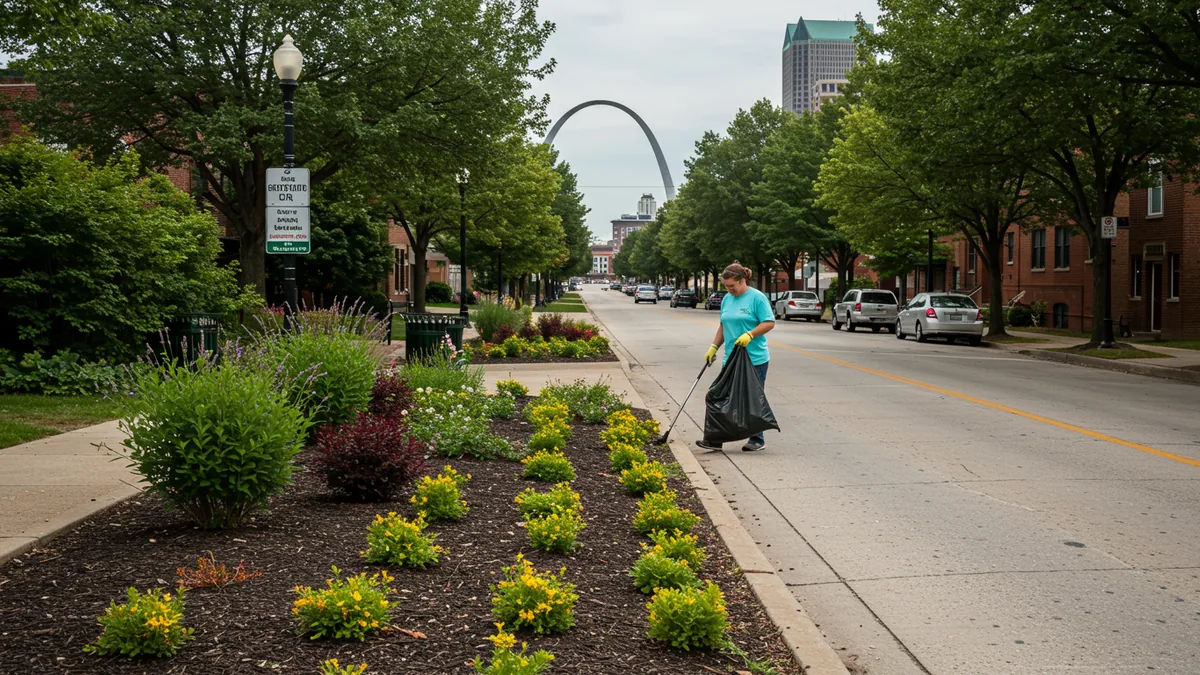
Volunteers clearing litter block by block — the quiet engine behind a cleaner St. Louis.
Forest Park Forever is the proof that this works here. The public-private partnership between the nonprofit and the city has now poured investment into Forest Park in three distinct waves — roughly $100 million from 1995 to 2003 to restore the Grand Basin, Boathouse, and Jewel Box; the Forever campaign launched in 2012 that raised about $117 million toward restoration and a maintenance endowment; and a fresh nine-figure effort underway in the 2020s. Forest Park is cleaner, safer, and more beloved than it was a generation ago, and it got that way through exactly the kind of city-plus-donors stewardship this whole article is about. It’s a national model, and it’s in our backyard. (See forestparkforever.org.)
And the momentum is spreading: Great Rivers Greenway broke ground in 2025 on the Brickline Greenway’s North Grand segment, a 1.3-mile ribbon of new, accessible public space through the heart of the city, while Greater St. Louis, Inc. reports more than $2.2 billion in announced downtown investment and a downtown residential population up roughly 40% over the decade. People and money are, in fact, noticing. If you’re weighing whether St. Louis is worth a bet, that’s the same case we make in our look at why downtown St. Louis is ripe for development.
What actually works: 6 models from cities that turned it around
St. Louis doesn’t have to guess. Cities and even whole countries have run large, measurable campaigns to clean themselves up, and the results point to a clear lesson: the winning programs treat cleanliness as a matter of pride and behavior, not just a matter of trucks and fines. Here are six of the best, each of which we break down in its own deep-dive guide.
| Where | The program | What worked | Result |
|---|---|---|---|
| Tanzania | Nyumba ni Choo | Pride & status messaging, not health lectures | Sanitation 43% → 72% |
| Philadelphia | One Philly, United City | Every city department, one coordinated blitz | 61,000+ services in 13 weeks |
| Texas | Don’t Mess with Texas | A civic-pride ad campaign with teeth | 34% less roadside litter; 98% recognition |
| United Kingdom | Ballot Bins & Love Essex | Gamification plus business partnerships | Up to 41% less targeted litter |
| U.S. cities (incl. Columbia, MO) | Love Your Block | Small micro-grants to resident groups | 300,000+ lbs of trash; 1,000+ acres |
| New England | Pay-As-You-Throw | Charge by the bag — a price signal | ~28% less waste (studies vary 25–50%) |
The thread running through all six: behavior beats equipment. Tanzania nearly doubled its sanitation coverage not by subsidizing toilets but by making a clean home a status symbol. Texas cut roadside litter by a third with a slogan that became an identity. The cheapest, most durable wins came from making people want a clean city, then giving them an easy way to act on it — a lesson St. Louis, a town with fierce neighborhood pride, is unusually well positioned to use. Each model in the table above links to its own in-depth St. Louis guide.
A realistic playbook for St. Louis
Pulling those lessons together, a workable St. Louis program wouldn’t copy any single city — it would blend a top-down blitz with bottom-up ownership, in three phases.
Phase one: a visible blitz. Following Philadelphia’s model, coordinate every relevant department — Refuse, Forestry, the Street Department, Citizens’ Service Bureau — for an intensive, well-documented cleanup across every neighborhood, with before-and-after photos. The point is momentum and proof that the city means it.
Phase two: put money in residents’ hands. Following the Love Your Block model, a modest fund of small grants — a few hundred to a few thousand dollars — lets neighborhood associations and block clubs run their own projects: clearing a lot, planting a corner, starting a monthly cleanup. Cities that do this get enormous return on tiny investments, because volunteer labor and local knowledge do the heavy lifting.
Phase three: make it permanent. The programs that fail are the one-time events; the ones that work get institutionalized — recurring schedules, ongoing funding, and infrastructure like the smart, sealed litter bins other cities have deployed. Then you measure what matters: not just tons collected, but 311 dumping reports over time, resident satisfaction, and property values in the blocks you touched.
What you can do — whether you live here or run a business here
None of this works without ordinary people, so here is the honest, specific list.
- Report dumping. Call the Citizens’ Service Bureau at 314-622-4800 or use the city’s 311 tools. A tip that leads to a conviction can earn you up to $100 — but the real payoff is a camera pointed at the next dumper.
- Join a cleanup. Brightside St. Louis and your neighborhood association almost certainly have one coming up. Two hours, a pair of gloves, a visibly better block.
- Adopt your patch. A block, an alley, the frontage in front of your shop. The single most powerful anti-litter force is a neighbor who has decided a spot is theirs.
- And — we have to say it — keep it in the car. The chicken bones, the bag, the bottle. Hold it until you get home. It sounds small. Multiplied by a city, it’s everything.
A cleaner St. Louis is a stronger St. Louis — for its people and its businesses. Clean blocks lift property values, bring foot traffic, and tell every visitor and would-be investor that this is a city that takes care of itself. The payoff is economic, plain and simple — the case cities from Philadelphia to Texas have already proved.
Own a business in the metro? When neighbors take pride in a place, they want to support the businesses there — and they can only support what they can find. Listing it on St Louis Near Me Directory is how customers across Missouri and Illinois discover you. It’s a small move that rides the same rising tide as everything above.
Frequently Asked Questions
Why is St. Louis a dying city?
St. Louis isn’t so much dying as shrinking and stabilizing. The city fell from about 856,000 residents in 1950 to roughly 280,000 today, which left the vacant lots, empty buildings, and disinvestment behind its rough reputation. But the direction has turned: billions in new downtown investment, corporate cleanup grants, and a falling crime rate point to a city clawing back, not one in free fall.
Will St. Louis ever recover?
Recovery is already visible. Downtown has drawn more than $2.2 billion in announced investment and grown its residential population about 40% over the decade; Boeing put $1 million into cleaning up Kinloch; and $120 million of the city’s Rams settlement is rebuilding North St. Louis. It’s slow and uneven, but the trajectory is upward — the same story as the city’s cleanliness.
Is crime in St. Louis getting better?
Yes. St. Louis homicides fell to a 12-year low in 2025 — down about 7% — and the city dropped out of a national top-10 “most dangerous cities” ranking. Crime is still a real problem in disinvested neighborhoods, but — like the litter and dumping — the measurable direction is improvement, not decline.
How do I report illegal dumping in St. Louis?
Call the Citizens’ Service Bureau at 314-622-4800 or use the City of St. Louis 311 tools. The city offers a reward of up to $100 for information that leads to a conviction, and the police Environmental Investigations Unit reviews footage from roughly 275 alley and vacant-lot cameras.
What items are considered illegal dumping?
Illegal dumping is leaving waste anywhere other than a permitted facility — mattresses, tires, appliances, furniture, construction and demolition debris, yard waste, and household trash dropped on streets, alleys, vacant lots, or someone’s property without permission. In St. Louis it concentrates in North City’s alleys and empty lots, and it’s a citable offense with cameras watching many hotspots.
Why is Kinloch, Missouri abandoned?
Kinloch — Missouri’s first incorporated Black city — was largely emptied by a 1980s–90s airport-noise buyout near Lambert that bought and demolished more than a thousand homes, dropping its population from about 4,455 in 1980 to just 263 by 2020. The vacant land became a dumping ground — which a $1 million Boeing grant is now helping clear.
Where to volunteer in St. Louis?
For cleanups and greening, start with Brightside St. Louis, the city’s beautification nonprofit, which fields about 6,000 volunteers a year. Most neighborhood associations also run one or two cleanups a month. Both are the easiest, lowest-cost way to make a visible difference — often right on your own block.
What are the pros and cons of living in St. Louis?
The pros: St. Louis is remarkably affordable (a metro-area median home near $285,000 versus roughly $404,000 nationally), loaded with free attractions and strong neighborhoods, and visibly improving. The cons: it’s still recovering from decades of population loss, and cleanliness and safety — while better — aren’t uniform across the city. See our guide to why St. Louis real estate is so affordable.
Helpful links and resources
St. Louis cleanup & civic resources
- Brightside St. Louis — the city’s beautification nonprofit; volunteer events and adopt-a-street programs.
- City of St. Louis Citizens’ Service Bureau (311) — report illegal dumping, litter, and vacant-lot problems.
- Great Rivers Greenway — the regional greenway network, including the Brickline Greenway.
- Forest Park Forever — the public-private partnership stewarding Forest Park.
- Metropolitan St. Louis Sewer District — storm-water and water-quality programs for the region.
State & national resources
- Missouri Department of Natural Resources — state environmental and cleanup programs.
- U.S. Environmental Protection Agency — federal environmental programs and community grants.
- Keep America Beautiful — national anti-litter nonprofit and the Great American Cleanup.

Written by a dedicated team of St. Louis locals who live, work, and play right here in the St. Louis metro. Founder Lane Forman and team are committed to building the region’s most trusted directory by verifying listings and connecting local businesses with loyal customers across Missouri and Illinois.