15-Year-Old Furnace, $400 Quote: St. Louis Repair or Replace
Revised October 20, 2026

Should I repair or replace my HVAC system in St. Louis?
In St. Louis, start with the $5,000 rule: multiply the furnace’s age by the repair quote, and if the result tops 5,000, start pricing a replacement. ENERGY STAR says to consider replacing a furnace that is more than 15 years old, or an air conditioner or heat pump that is more than 10. Inside the city, a new furnace needs a mechanical permit, $40 plus a $25 application fee, pulled by a City-certified licensed contractor.
Keep reading ↓The furnace is 15. The fix is $400. Your socks are already cold on the basement concrete of a South City brick flat, and the tech’s flashlight is still resting on top of the cabinet. Upstairs, the floor registers have stopped breathing, and the kids are asking why their room is cold. No click, no whoosh, just the fridge humming in the kitchen. You flip the repair quote over and do the math in pen: 15 times 400 is 6,000.
That 6,000 is over a line. Trane, the furnace and air conditioner maker, calls it the $5,000 rule: multiply the age of your equipment by the estimated repair cost, and if the number is more than $5,000, consider replacing the unit. Screenshot that. It turns a panicked basement decision into kitchen-table arithmetic.
Then hold on to a second number, a St. Louis one: $65, which is the city’s $40 residential furnace permit plus its $25 application fee. The city issues those permits to licensed mechanical contractors who are certified by the City of Saint Louis. Here’s the turn: the city’s fee schedule lists a combination furnace and condensing unit at $40 too. Swap the furnace and the outdoor AC unit together and the permit costs no more than the furnace alone. So when a replacement quote comes in low and never says the word permit, you’re not looking at a bargain. You’re looking at a permit nobody has mentioned yet. Ask about it.
Should I repair or replace my HVAC system in St. Louis?
In St. Louis, start with the $5,000 rule: multiply the furnace’s age by the repair quote, and if the result tops 5,000, start pricing a replacement. ENERGY STAR says to consider replacing a furnace that is more than 15 years old, or an air conditioner or heat pump that is more than 10. Inside the city, a new furnace needs a mechanical permit, $40 plus a $25 application fee, pulled by a City-certified licensed contractor.
The permit only a city-licensed contractor can pull
Here’s the St. Louis piece of this decision, and it protects your wallet and your family. Mechanical permits in the city are required to install things like boilers and furnaces, and to apply, a contractor needs a Mechanical Contractor’s license issued by the City of St. Louis Building Division. The rules behind it are the 2018 International Mechanical Code as the city adopted it, through Ordinance #70800.
It isn’t an excuse for a slow job, either. The city says most applications are approved within 1 to 3 business days, and once a permit is approved, the contractor prints it from the STL City Permits dashboard and schedules the inspection. So ask every bidder the same blunt question, out loud, at the basement stairs: are you licensed with the city, and are you pulling the permit?
Want to check for yourself? The city’s Permit Section is at 1200 Market, Room 425, at (314) 622-3313, Monday through Friday from 8 a.m. to 4:30 p.m. The city even posts residential mechanical permits by neighborhood on its open data dashboard, so you can see how busy furnace work has been on your side of town. Write the Permit Section number in marker on the furnace cabinet, right next to the filter size, so the next time a stranger with a clipboard is standing in your basement, the question is already waiting for you.
When the furnace goes, look at the whole system
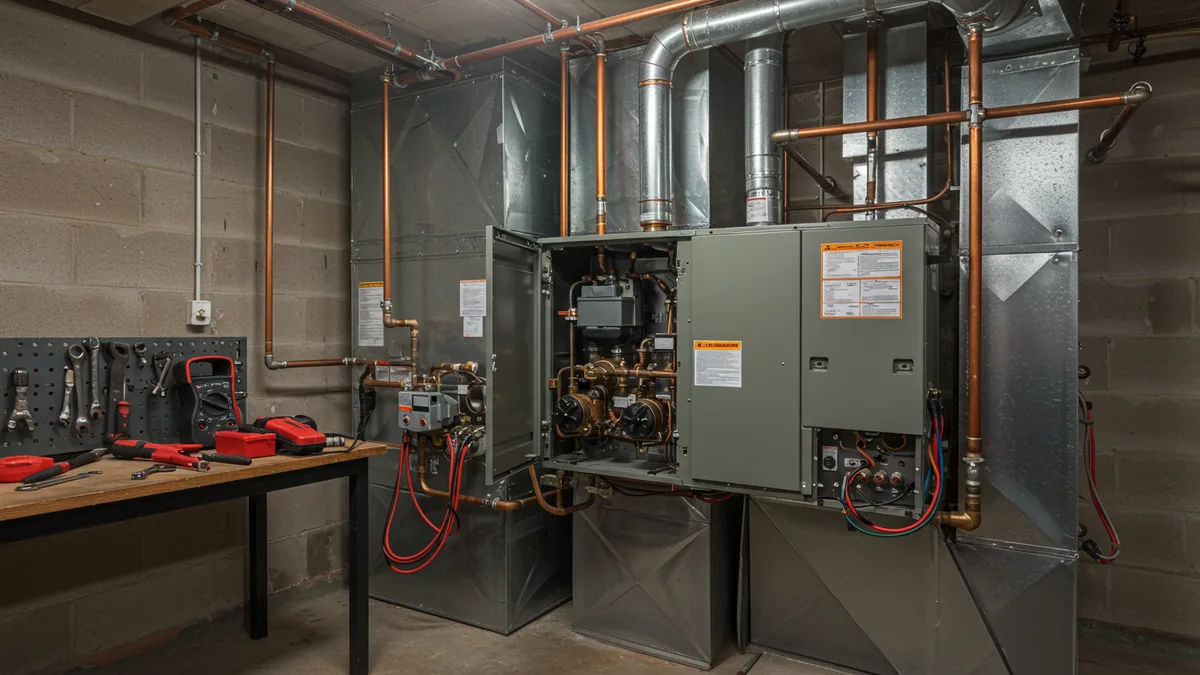
Stand at the furnace and look up. If you have central air, that sheet-metal box riding on top, sweating in August and silent in January, is part of the air conditioning, and out back the condenser sits on its slab by the alley. The furnace doesn’t live alone down there. It shares ductwork, a blower and usually a thermostat with the air conditioner outside, so a furnace decision is really a whole-house decision. That’s why the honest quote asks about the AC’s age before it prices a furnace. In the city, the permit math even leans that way: the fee schedule charges $40 for a combination furnace and condensing unit, the same as a furnace by itself.
Pay attention to the air itself. ENERGY STAR notes that poor equipment operation, inadequate equipment and leaky ductwork can make the air too dry in the winter or too humid in the summer. In this town you feel both: the static shock off the doorknob in February, the clammy sheets in August. If your house does both, ask the contractor to look at the ducts and the sizing, not just the box.
And ask how they sized it. “Same size as the old one” is a guess, not a measurement, and a house that has had new windows or insulation since the last furnace went in may not need the same equipment at all.
One more thing to picture before you sign. A brand-new furnace paired with a tired old air conditioner is a mismatched couple, and you’ll be back in the basement with a flashlight sooner than you’d like. If the AC is already past its own line, ENERGY STAR’s threshold for an air conditioner or heat pump is more than 10 years, then price both and decide with the whole picture on the kitchen table, not one box at a time. You may still fix only the furnace. You just won’t be surprised next July.
What is the $5000 HVAC rule?
It’s a multiplication problem you can do on a napkin while the tech packs up. Age times repair cost. A 15-year-old furnace with a $400 repair scores 6,000, over the line, so you price a replacement before you sign anything. Run the same $400 repair on a 6-year-old furnace and you get 2,400, well under it, so you fix it and go back to bed.
Trane pairs it with a second check. If repair costs are near or above 50% of the price of a new system, it says, consider HVAC replacement, particularly for older HVAC equipment. That’s the rule that catches the one expensive repair on a younger unit, the quote that makes your stomach drop even when the age math looks fine.
Keep the size of these bills in perspective. Trane puts the cost to repair a furnace anywhere from $100 to $3,000 and up, depending on the problem, the age of the system and whether parts are still available. A small part on a young furnace is a Tuesday, the kind of thing you fix and forget before the Blues game starts. A four-figure repair on a 17-year-old furnace is the furnace telling you something.
The 15-year line, and the smell of the first cold night
Every fall it happens the same way. The first truly cold night, the thermostat clicks, the burner lights, and the house fills with that scorched-dust smell of a furnace waking up after a long summer. If that smell is coming from a furnace that went in before your oldest kid started school, you’re already in the zone where the math changes.
ENERGY STAR draws the line plainly: if your furnace or boiler is more than 15 years old, consider replacing it with an ENERGY STAR qualified furnace, which it says is 15% more efficient than a conventional furnace. Picture that 15% on the Spire bill that lands in February, the one you open standing at the kitchen counter with your coat still on. Trane lands in the same place. Well-maintained central AC units and furnaces can last up to 20 years, it says, while heat pumps can last up to 15 years. Fifteen isn’t a death sentence. It’s the point where a repair stops being routine and starts being a bet.
The other tells are ones you can feel without a gauge. ENERGY STAR lists equipment that needs frequent repairs while your energy bills keep going up, rooms that are too hot or too cold, and a system that’s noisy. You know the room. It’s the back bedroom where the kids sleep under two blankets in January while the living room feels like July.
The furnace can wait an hour. Dinner can’t: where to eat in Wildwood.
How often should you get HVAC replaced?
Less often than the guy with the clipboard would like. Trane says that, in general, an HVAC system will last 10-20 years, and that for any system more than 15 years old, replacement may be recommended. The gap between 10 and 20 is mostly maintenance, and most of that maintenance is boring.
Trane’s list starts with changing the HVAC air filter every 30-90 days and keeping indoor supply registers and return air vents clear. Pull the filter and hold it up to the basement light. If you can’t see the bulb through it, your blower is breathing through a pillow.
Then walk outside to the condenser, the big metal box humming next to the patio. Trane’s same list says to keep the area around the outdoor unit clear on all sides. Pull the leaves out of the fins, cut back the hostas, move the recycling bin. It takes ten minutes on a Saturday, and it’s the cheapest repair you’ll ever make.
People are asking
What’s the best HVAC service category for finding local contractors for furnace repair?
Search under HVAC or heating contractors, then ask each one whether they hold a city license, because in the City of St. Louis mechanical permits for furnaces are issued to licensed mechanical contractors certified by the city. For a repair, Trane puts the cost to fix a furnace anywhere from $100 to $3,000 and up. For more costly repairs, Trane suggests getting multiple quotes, just like you would for a replacement. You can browse St. Louis HVAC contractors on our map to start.
What to do this week, before anything breaks again
Get the failing part diagnosed and priced in writing. Run the $5,000 rule and the 50% rule on it at the kitchen table, not in the basement with the tech waiting. If it fails either one, or the furnace is past 15, get replacement quotes from more than one contractor. Trane suggests getting multiple quotes and comparing them, and thinking about who answered your questions and was most responsive, not just who was cheapest.
Ask every one of them the same three things: who pulls the permit, how they sized the new equipment, and whether the price covers the inspection. The one who answers all three without flinching is usually the one worth hiring. For a deeper walk through comparing bids, see our guide to getting and comparing HVAC estimates in St. Louis.
People are asking
What is the average lifespan of a furnace?
Lennox, the furnace maker, says the average lifespan of furnaces is 15-20 years. It adds that gas furnaces can last 15-20 years, boilers 15-30 years and electric furnaces 20-30 years. ENERGY STAR suggests you consider replacing a furnace or boiler once it is more than 15 years old.
Frequently Asked Questions
What is the $5,000 rule for HVAC systems?
Multiply the age of your equipment by the estimated repair cost. Trane says that if the number is more than $5,000, you should consider replacing the unit, and if it’s less, a repair may be the answer. A 15-year-old furnace with a $400 repair works out to 6,000, so it’s time to price a replacement.
What’s the average lifespan of an HVAC system?
Trane says that, in general, an HVAC system will last 10-20 years. Well-maintained central AC units and furnaces can last up to 20 years, while heat pumps can last up to 15 years.
Is it worth replacing a 30 year old furnace?
Usually, yes. ENERGY STAR suggests considering a replacement once a furnace is more than 15 years old, and that furnace is well past the line. ENERGY STAR says a qualified furnace is 15% more efficient than a conventional one, so the new unit starts paying you back on the gas bill.
What is the most reliable furnace brand?
I could not find an independent brand ranking I trust enough to print. What I can tell you is that the installer matters as much as the name on the cabinet: a well-sized, permitted, properly inspected furnace from any major maker beats a bargain install of a premium brand.
Do I need a permit to replace a furnace in St. Louis?
In the City of St. Louis, yes. Mechanical permits are required to install furnaces, and the city issues them to licensed mechanical contractors certified by the City of Saint Louis. The city’s fee schedule lists a residential furnace at $40, plus a $25 application fee, and most applications are approved within 1 to 3 business days.
The same fix-or-replace math runs on your gadgets, too. See how it plays out with electronics repair in St. Louis.
Cold house, quote in hand, not sure who to trust? Browse the home services listings in the St Louis Near Me Directory and line up two or three HVAC pros to price the same job.
If you’re the furnace tech whose van pulls up on these cold nights, a listing puts you in front of the St. Louis homeowners searching for help right now, so you get more customers from searches already happening: list your business or see who AI names instead of you.

Written by a dedicated team of St. Louis locals who live, work, and play right here in the St. Louis metro. Founder Lane Forman and team are committed to building the region’s most trusted directory by verifying listings and connecting local businesses with loyal customers across Missouri and Illinois.